Employees of the Fukushima nuclear plant demonstrated outside the headquarters of the operator Tepco Tokyo March 14, 2014 (Photo Toru Yamanaka. AFP)
Workers Fukushima accident have expressed their anger after the death on Friday of one of them, blaming the lack of rescue services to come to the aid of injured.
One of them, who calls himself TS-san, got angry on the internet as soon as he learned of the death of his colleague at the nuclear plant site.
“This is unbearable, how many times will this have to happen?” He has written.
“What is most tragic, it is not as expensive as decommissioning, the work hardly advances, there is contaminated water, no, what is the most tragic, ” is that we do not try harder to save the lives of those who work there””he added.
A worker died Friday afternoon at Fukushima Daiichi after the fall of earth and concrete into the hole to a depth of two meters in which he was to build the foundations of a building.
“He was taken unconscious to hospital where his death was confirmed,” said Tepco.
But for TS-san and others, rescue vehicles that are supplied are insufficient. And they need to have the use of a medical helicopter.
During the accident on Friday, the wounded, in his fifties, was transported by ambulance to a hospital more than 40 miles from the secluded nuclear disaster plant. It took over an hour to drive to the facility where his death was then confirmed. It had then been over three hours since the accident.
“When this kind of fatal accident happens, what to say? Sadness, anger, depression “, as evidenced by Happy, a veteran who worked in Fukushima since before the tsunami of March 11, 2011.
Other workers deaths had occurred before, but not necessarily on the site and not because of issues related to their activity during this time.
Some 3,000 people from hundreds of companies working every day at the Fukushima Daiichi ravaged March 11, 2011 by a massive tsunami.
Working conditions are often harsh, especially because of the compulsory wearing of masks and suits and because of the deplorable state of the destroyed site.
See also;
Japanese government covers up TEPCO workers deaths and intimidates journalists who speak out! – Mako Oshidori
The death of many Fukushima workers who die from radiation exposure is covered-up by Fukushima Daiichi power plant operator TEPCO and the Japanese government, said a Japanese journalist who investigated the unreported deaths, adding that she found a TEPCO memo instructing officials to “cut her questions short appropriately”, and that police is following her around in an intimidating manner.
TEPCO -Workers deaths are not reported 報道されない原発作業員の死亡について
…“She said that there have been so many workers dead without being reported. Some died during the 2 days break, some didn’t turn up the next morning and were found dead…. Those who died haven’t been measured for how much exposure they got. Tepco doesn’t count and report the dead unless they die during their work hours.” …
Thomas Pilkinton was a five-year old boy in Ely, NV, when the first nuclear test took place in the Nevada desert. Like many who lived in the small town nestled in the Nevada mountains, he gave little thought to the tests that would ultimately turn him, and the majority of his family, into what became known as Downwinders. While Pilkinton would not feel the effects of Downwinder Syndrome for many years, the devastating results of the testing on his relatives were almost immediate. Thomas Henry “Daddy Tom” O’Neil, Pilkinton’s great-grandfather and namesake, had always been known for his bad temper and robust health, but suddenly became ill in March 1952. On April 22 of that same year, Daddy Tom died of a rare, aggressive form of cancer. Pilkinton’s grandmother, Ethel Fields, died less than a month later, at 52, from an unknown blood infection. Prior to their deaths, Daddy Tom’s wife, Alice “Mumsey” O’Neil, lost her battle with “black lung,” now known as emphysema, in 1951.
While some may argue that the deaths of these three may not be related to the nuclear testing, the fact remains that none of the three was ever seriously ill until that testing took place.
Soon, more evidence of Downwinder Syndrome began to materialize in Pilkinton’s family and friends. His mother, Evelyn Pilkinton, became seriously ill with a thyroid disorder, another common manifestation of the syndrome, which required lifelong medication. His father, Ray Pilkinton, suffered from emphysema and Chronic Obstructive Pulmonary Disease (COPD). Ray died in 1991, and Evelyn died in 1996; neither lived to see 72. Pilkinton’s sister, Gail Pilkinton, died from lung cancer in 2005, at age 55.
Again, it could be debatable whether their deaths were directly related to Downwinders; both of the senior Pilkintons had been smokers, although neither had smoked for nearly 20 years prior to their deaths. They had both worked as welders in the shipyards during World War II. Pilkinton’s sister had fought a lifelong battle with drug and alcohol addiction, and she did not die from the lung cancer, but from a massive drug overdose.
However, in his early 60s, Pilkinton began to suffer from severe lethargy and unexplained weight gain, which began a downhill slide. This was a man who had never smoked, never done anything that would be considered a cancer risk. He was a Vietnam War veteran and successful businessman who enjoyed a wide range of friendships and travels. He lived his life and raised his niece, whom he had adopted, and then later became a surrogate grandfather to his grand nieces. Unlike his parents and sister, the reasons behind his health issues were not readily apparent, nor easily explained.
He began to suffer debilitating headaches, which led to the discovery of a brain aneurysm. But this did not explain the weight gain. His thyroid was tested, and found to be defective, which meant a regimen of medicine similar to that of his mother’s. However, no amount of maintenance or lifestyle changes could alter his ballooning weight or blood pressure, and his health steadily declined. In 2009, a bout of swine flu triggered an autoimmune disorder called Guillain Barre Syndrome. It took a CAT scan to determine the cause of the continuing weakness after the diagnosis of Guillain Barre that led to another disheartening discovery: thyroid cancer. Pilkinton had surgery to remove the right lobe of his thyroid in 2010, but almost died from that surgery due to a sudden upshot in his blood pressure. His health would not allow for further treatment beyond the surgery. When cancer was discovered in the left lobe, it was determined nothing more could be done. He died in July 2011, with his partner of 16 years, Frank Dominguez, by his side. His fight ended just 20 days after his 66th birthday.
Air Force scandal: More than 90 nuclear missile launch officers cheated on a proficiency test that required perfect scores for advancement. Now, nine Air Force officers have been demoted and one has resigned.
The Air Force will spend $19 million this fiscal year to refurbish the launch control center and repair infrastructure across the missile wing, James said. Another $3 million will go for “quality of life requirements” at the missile bases, which are in remote areas of the country where weather is often harsh.
By David Alexander and Phil Stewart, Reuters / March 29, 2014
Washington
The head of the nuclear missile wing at a base in Montana resigned on Thursday and nine officers were removed from their jobs over a test-cheating scandal that involved 91 missile launch officers, the Air Force said.
Lieutenant General Stephen Wilson, head of the Air Force’s Global Strike Command, said Colonel Robert Stanley, commander of the 341st Missile Wing at Malmstrom Air Force Base, had resigned on Thursday and would retire from the service.
The nine other officers, mainly colonels and lieutenant colonels, were removed from their positions of command at the Montana base that is home to a third of the nation’s nearly 450 intercontinental ballistic missiles. They will be reassigned to staff jobs and face administrative punishment, such as formal reprimands or letters of counseling.
Wilson said the root of the problem was the emphasis on perfection in the nuclear mission at the Montana base and throughout the missile force, which led to cheating on exams in an effort to achieve the sort of perfect scores perceived to be required for advancement and promotion.
The exams were classroom tests to check staff knowledge of how to carry out the nuclear mission and security procedures.
“Leadership’s focus on perfection led commanders to micro-manage their people. They sought to ensure that the zero defect standard was met by personally monitoring and directing daily operations, imposing unrelenting testing and inspections with the goal of eliminating all human error,” Wilson told a Pentagon news conference.
He and Air Force Secretary Deborah James said the evaluation and assessment of missile launch officers would be radically overhauled in an effort to change the culture and behavior that has developed in the missile wing.
The Ministry of Defence (MoD) has apologised for upsetting local residents by detonating 23 loud blasts at the UK nuclear bomb store at Coulport in Argyll last week.
People living in Ardentinny, a small village on the opposite shore of Loch Long a mile from Coulport, say they have been “traumatised” by the continual explosions, which made it feel like they were living in a “war zone”. They are furious that the MoD failed to forewarn them.
The MoD says the blasts were part of a staff training exercise, but has refused to elaborate. It told residents that they were “nothing to worry about”.
The Argyll and Bute MSP, Michael Russell, who is also the Scottish government’s education minister, yesterday wrote to the UK defence secretary, Philip Hammond, after being contacted by residents. “Coulport has been a bad neighbour and it needs to apologise and mend its ways,” he told the Sunday Herald.
“Many residents were very worried by the blasts which were at times intense enough to shake houses. The fact that no warning was given and that there has still been no adequate explanation makes the situation even worse – and there is a fear that explosions may start again at any time.”
The blasts started on Monday without any warning. On Wednesday, after being asked by residents, the MoD said they were finished for the week but then let off a further 11 explosions on Thursday and Friday.
“We have been told that further exercises may take place next Tuesday or Wednesday, however we have no way of knowing if this is correct,” said David McDowall from the community website ardentinny.org.
“Most people would be surprised to know that even a very small regional nuclear war on the other side of the planet could disrupt global climate for at least a decade and wipe out the ozone layer for a decade,”
Even a relatively small regional nuclear war could trigger global cooling, damage the ozone layer and cause droughts for more than a decade, researchers say.
These findings should further spur the elimination of the more than 17,000 nuclear weapons that exist today, scientists added.
During the Cold War, a nuclear exchange between superpowers was feared for years. One potential consequence of such a global nuclear war was “nuclear winter,” wherein nuclear explosions sparked huge fires whose smoke, dust and ash blotted out the sun, resulting in a “twilight at noon” for weeks. Much of humanity might eventually die from the resulting crop failures and starvation. [Doomsday: 9 Real Ways the Earth Could End]
Today, with the United States the only standing superpower, nuclear winter might seem a distant threat. Still, nuclear war remains a very real threat; for instance, between developing-world nuclear powers such as India and Pakistan.
To see what effects such a regional nuclear conflict might have on climate, scientists modeled a war between India and Pakistan involving 100 Hiroshima-level bombs, each packing the equivalent of 15,000 tons of TNT — just a small fraction of the world’s current nuclear arsenal. They simulated interactions within and between the atmosphere, ocean, land and sea ice components of the Earth’s climate system.
Scientists found the effects of such a war could be catastrophic.
The future of the world remains hostage not merely to one act of terrorism but to a larger degree, to one accident or one strategic miscalculation. In that sense, nuclear dangers abound on many fronts. All told, there are currently nuclear weapons materials in more than 40 countries, some “secured by nothing more than a chain-link fence”.
[…]
No wonder, the Seoul Summit communiqué could not go beyond reiterating a joint call to “secure all vulnerable nuclear material in four years” and backing the IAEA’s “essential role” in “facilitating international cooperation”. There was nothing binding other than “baskets” of voluntary commitments. Now the outcome at The Hague Summit 2014 seems to have further shrunk to just anodyne statements of participants’ “commitment” to nuclear disarmament, nuclear non-proliferation and the use of nuclear energy only for peaceful purposes. Again, there were no binding joint commitments, other than in a separate joint initiative of the US, the Netherlands and South Korea, signed only by 35 out of 53 participating states.
At the Third Nuclear Security Summit (NSS) in The Hague earlier this week, Prime Minister Nawaz Sharif made a strong case for Pakistan’s non-discriminatory access to nuclear technology for peaceful uses, including nuclear power generation, to meet our growing civilian programme – the lynchpin of its strategy to overcome chronic energy shortages. His predecessor Yousaf Raza Gilani, too, had made similar presentations at the last two summits held in Washington, DC (2010) and Seoul (2012).
In presenting Pakistan’s case at three consecutive summits, Pakistani leaders spared no effort in seeking to alleviate the unfounded fears about Pakistan’s nuclear security by citing its decades-long experience of safe and secure operations of nuclear power plants, a highly trained manpower and a well-established safety and security culture.
They also apprised the world leaders of the measures Pakistan had taken like any other nuclear weapons-state to strengthen the safety and security of its nuclear installations and materials.
Nawaz Sharif further reinforced the case by informing the conference of Pakistan’s five pillar-nuclear security regime encompassing a strong command and control system; an integrated intelligence system; a rigorous regulatory regime; a comprehensive export control regime; and active international cooperation. Pakistan’s nuclear security regime covers physical protection, material control and accounting, border controls and radiological emergencies. By all objective yardsticks, Pakistan meets every criteria-based benchmark to become a member of the Nuclear Suppliers Group (NSG) and other export control regimes on a non-discriminatory basis.
But this reality is not what the world’s nuclear arbiters holding the reins of the newly instituted NSS process are interested in.
Sunday, March 23, 2014 by: L.J. Devon, Staff Writer n order to appease the fears of the public and maintain order, leaders of government institutions often restrict valuable and alarming information from broadcast or publication. This censorship keeps the masses unaware but cooperative, as the truth is picked through and decimated. Such leaders are often timid and tend to uphold the status quo. They will typically refrain from riling people up so as not to disturb the powers of special interest that could shutter their career and livelihood.
While vital information is picked apart and wrought with censorship, people may suffer from the consequences of not knowing and not being able to take action.
Scientist finds alarming initial Fukushima cesium-137 measurements but is censored
When the Fukushima nuclear crisis began in March 2011, much censorship was placed on…
Three Mile Island – 35 years on http://www.theecologist.org/News/news_analysis/2334940/three_mile_island_35_years_on.htmlLinda Pentz Gunter 28th March 2014 Thirty-five years ago today the USA had its worst ever civilian nuclear accident with a reactor meltdown at Three Mile Island. Linda Pentz Gunter reports on the lies and cover ups about the true scale of the radiation release and its impacts on human health. Today marks 35 years since the meltdown at Unit 2 of the Three Mile Island (TMI) nuclear power plant near Harrisburg, Pennsylvania. Despite the long passage of time, myths and misinformation about the disaster still abound. Many questions may remain permanently unanswered.
The consequences of the TMI disaster were made more serious because, early on, emergency planning officials were repeatedly misinformed about the disaster’s progression and kept in the dark about the need for public protective actions.
Ironically, despite today’s popular ‘too much information’ shorthand, TMI is a story of ‘too little information’. What the public believes about TMI is far removed from what really happened. Continue reading →
Clamping down on tweetsMar 26th 2014, by Economist.comThorium the wonder fuel of Tomorrowland by Oliver MortonHOW the Doppler effect helped locate the likely remains of MH370, why thorium will not be the fuel of tomorrow and how Turkey (tried to) shut Twitter down
TRANSCRIPT by Noel Wauchope “……..Now we turn to thorium
Thorium can be used to fuel nuclear power plants of a normal design.
There has always been a group of thorium fans who have been campaigning for this.
And there is a little evidence that the idea of thorium nuclear power is making some progress.
There is a little bit of interest about thorium in China, and in India . The Indians have just unveiled a new thorium reactor design
It is an odd example of simultaneous nostalgia and neophilia . You find this in some technological areas where people want the new thing – that used to be the new thing but has never become the old thing – because it’s never the thing that anyone did.
Thorium is a great example of that – like airships
The purported advantages are that :
Thorium is more common than uranium, that you can use it in a form that doesn’t have to be enriched.You can design systems that don’t produce weapons grade uranium or plutonium
What are the benefits in a civilian sense ? The benefit basically that – it hasn’t been done
We know today a lot of stuff about a lot stuff about of reactors – about how things go wrong and how not to go wrong
Most work on thorium reactors has been done by enthusiasts – but all this tricky stuff in which you look at ways that things could actually go wrong and about how to engineer around them – hasn’t been done.
The idea that thorium can take off , whatever its intrinsic benefits that thorium from a standing start canovertake uranium based reactors that you have 60 years’ of operational experience with. that’s very unlikely
Disadvantages _ To even start building a thorium reactor you have to have a uranium fast breeder reactor, which is pretty tricky and pretty dangerous technology very few people have ever made to run very well
So this may end up being the fuel of the perpetual future It’s hard enough to make nuclear reactors that you know how they work – to work. Making these new nuclear reactors work, I’m not sure that anyone will really put in the effort. It is true that there are some things that are quite attractive about it.
A reactor which works with molten salt to thorium has some advantages in that it doesn’t have to be kept under high pressure. Some nice things technically – they’ve seduced some people, that doesn’t necessarily mean that they will conquer the world.
Withholding of radiation readings exposes gov’t push for evacuees’ return, Mainichi, 29 Mar 14, Recent revelations that a Cabinet Office team delayed the release of radiation measurements from three Fukushima Prefecture areas, planning to release them with lower, recalculated results, have exposed a government push to have residents’ return to nuclear disaster-hit areas.
Experts have raised questions about the government’s move, suggesting that officials intended to send residents back to those areas from the outset and that they manipulated data to achieve that purpose.
The three areas — the Miyakoji district of the city of Tamura, the village of Kawauchi and the village of Iitate — remain subject to evacuation orders imposed after the 2011 Fukushima No. 1 nuclear plant meltdowns. The government plans to lift these orders in the near future. According to one source familiar with the measurement process, the original radiation exposure readings from new, individual dosimeters were higher than expected, prompting the Cabinet Office team to withhold the results. Officials feared the higher readings would discourage residents from returning……… http://mainichi.jp/english/english/perspectives/news/20140327p2a00m0na009000c.html
Waves of uncertainty over wi-fiStuff.co.nz 29 March 14“……..CUT BACK ON YOUR EXPOSURE
MOBILES AND DEVICES
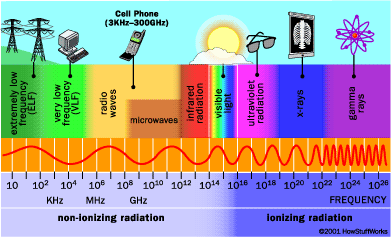
Before buying a cellphone or internet-capable device, check out its SAR (specific absorption rate) rating – though in New Zealand you’ll likely have to go online for this information. The SAR measures how much the device’s emissions are absorbed by the body. Lower ratings indicate lower absorption.
Ensure your mobile has flight mode and use this as often as you can, including overnight, and when carrying it close to your body.
For long computing tasks, select a wired desktop or plugged-in laptop, rather than a wireless tablet.
Avoid holding a laptop or device on your lap or stomach – use a table instead, unless it’s in flight mode.
When you can, choose a text over a call. Keep phone calls to a minimum or use a hands-free kit.
Keep calls to a minimum where reception is bad – when a mobile is far from a cell tower, it has to boost its signal to connect.
Choose a wired mouse and keyboard.
CORDLESS PHONES
If possible, choose corded devices, or purchase one with speaker-phone capabilities.
Keep the main transmitting base of the cordless phone away from bedrooms and desks.
Keep calls short.
WI-FI
When installing a transmitting unit, ask for it to be put up high, such as on the wall or a shelf, away from bedrooms or where people sit.
Only turn the system on when you’re using it. Make sure the router is turned off overnight, especially.
Explainer: how are IPCC reports written? , The Conversation, 29 March 14 David Karoly, Professor of Atmospheric Science at University of Melbourne This week in Yokohama, Japan, a group of scientists and representatives of more than 120 governments are meeting to approve the report Climate Change 2014: Impacts, Adaptation and Vulnerability. They will also agree on its Summary for Policymakers – an arduous process of negotiation and line-by-line approval. On Monday they will release it to the media and public.
The IPCC was established in 1988 to undertake comprehensive assessments of the scientific basis of climate change and the impacts and future risks to different sectors and regions. It also assesses the options for adapting to these impacts, and opportunities to mitigate climate change.
The IPCC is the accepted global authority on climate change. A recent explainer on The Conversation has described the structure of the IPCC and how it works.
It has three “Working Groups”: one on Climate Change Science; one on Impacts, Adaptation and Vulnerability; and one that deals with Mitigation of Climate Change. They work together to prepare comprehensive Assessment Reports roughly once every six years. The IPCC Third Assessment Report was released in 2001 and the Fourth Assessment Report in 2007.
Now we are in the middle of the release of the various parts of the Fifth Assessment Report, one from each Working Group and finally the Synthesis Report, to be released later this year.
How are the reports written?
The IPCC assessments are written by hundreds of leading scientists who volunteer their time. They undertake comprehensive assessments of the scientific literature across a very wide range of topics relevant to climate change. The reports are required to present policy-relevant information, but it must be presented in a policy-neutral manner, so there are no recommendations in any IPCC assessment.
Each part of the report goes through three stages of drafting and review by experts and governments. All review comments and the responses from the authors on how they addressed the comments are made public. This review process is more open and comprehensive than for any other scientific publication or assessment, including the peer-reviewed science publications on which the reports are based.
The final stage, the approval of the Summary for Policymakers, is often misunderstood. The government representatives go through the final draft line by line, seeking to ensure that the text is scientifically accurate, that any uncertainties are carefully explained, and that the language is as clear as possible. The authors of the chapters ensure their scientific accuracy and can veto any text that they consider to be inaccurate. Every line is approved by consensus by the representatives of all the governments present. It takes a long time.
Serbian Minister, UN representatives discuss depleted uraniumhttp://inserbia.info/today/2014/03/serbias-minister-un-representatives-discuss-depleted-uranium-sites/sites BELGRADE – Serbia’s Minister without portfolio for Kosovo-Metohija Aleksandar Vulin has discussed with UN representatives in Belgrade the progress made in research on locations in Serbia where higher levels of depleted uranium have been detected. Vulin on Thursday met with Peter Due, the Representative of the UN Secretary-General and Head of the UN Office in Belgrade, and UN Resident Coordinator Irena Vojackova-Solorano, the Serbian government’s Office for Kosovo-Metohija said in a statement.
Following field research in 1999 and 2002, the UN Environment Programme (UNEP) published reports on locations with higher levels of depleted uranium, the statement said.
During the 1999 bombing campaign, NATO forces used banned depleted uranium ammunition and Yugoslav Forces figures said that 30,000 to 50,000 rounds of depleted uranium ammunition were scattered on 112 locations across the country, but mostly in Kosovo-Metohija.
On the 15th anniversary of the bombing of the Federal Republic of Yugoslavia, Vulin discussed with the UN representatives the progress made in research on locations with higher depleted uranium levels in the territory of central Serbia, but also in Kosovo-Metohija.
Such research is helpful not only to Serbia, but also to other countries, Minister Vulin said.
Vojackova-Solorano said that the reports were the first of their kind and that the time has come to monitor the situation again, especially if the Serbian government has evidence of an impact of the bombing campaign on the health of the population in Serbia, the statement said.
She said that the UN agency will strive to provide support to Serbia’s health care system in the coming years.
Due also inquired about the progress in the technical negotiations on establishing the community of Serb municipalities and organising judicial authorities in northern Kosovo-Metohija.
Minister Vulin reiterated that any armed force in Kosovo-Metohija other than Kfor – the force envisioned by UN Security Council Resolution 1244 – is absolutely unacceptable to Serbia.
GERMANY: As the German government comes close to completing its draft for a new Renewable Energy Act, intended to be implemented as soon as August, demonstrations in support of wind and renewables continue. Around 30,000 people took to the streets in seven major German cities to show their support for renewable energies and opposition against coal, nuclear and gas fracking on 22 March, reported environment and nature protection organisation Bund on the same day……..http://www.windpowermonthly.com/article/1286689/german-wind-protests-continue









 nuclear-news