The Queen of England Deals Extensively in $17 Trillion Depleted Uranium Trade Nation of Change, : Friday 28 February The truth of the matter is that the Queen is sitting on enough money to end world hunger, fuel the world’s energy needs with non-nuclear, clean sources and definitely stop the poverty in her own country.
Uranium can be mined for some medical purposes and to make electricity, but its main purpose was and is to fuel nuclear warfare against the world. Just six mines provide 85 percent of the world’s uranium and guess who owns the mineral rights to that land?
Japan marks 3rd anniversary of tsunami Sky News, Tuesday March 11, 2014 Japan is marking the third anniversary of the quake-tsunami disaster which swept away 18,000 victims, destroyed coastal communities, and sparked a nuclear emergency that forced a re-think on atomic power.
Remembrance ceremonies will be held on Tuesday in towns and cities around the disaster zone and in the capital Tokyo, where Emperor Akihito and Empress Michiko are to lead tributes to those who lost their lives in Japan’s worst peace-time disaster………
The crippled plant remains volatile and experts say the complicated decommissioning process will take decades, as fears persist over the long-term health effects of leaked radiation. The accident forced tens of thousands to flee from areas around the shattered site……..
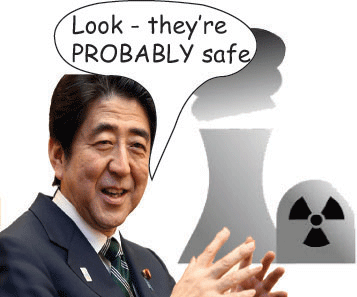
On Sunday, tens of thousands staged an anti-nuclear rally in Tokyo ahead of the anniversary, voicing anger at Prime Minister Shinzo Abe’s plan to switch on shuttered nuclear reactors, which once supplied more than a quarter of the resource-poor nation’s power.Abe repeated his view Monday that reactors which can be deemed safe would be turned back on. All of Japan’s reactors were switched off after the accident. http://www.skynews.com.au/world/article.aspx?id=957232
Fukushima disaster: Plan to send residents home three years after nuclear accident labelled ‘irresponsible’ ABC News By North Asia correspondent Matthew Carney 11 Mar 14″…….Turning reactors back on ‘a risk not worth taking’
The Abe government has said it is in the best interest of the economy to once again make nuclear power the core source of Japan’s energy.
It is worried that the reliance on imported coal and gas is threatening the country’s fragile economic recovery.
But a former prime minister, Morihiro Hosokawa, says it is a risk not worth taking.
“The causes of the accident haven’t been investigated properly. Contaminated water is still leaking, and compensation for victims hasn’t been sorted out,” he said. “I think in these circumstances it is very irresponsible to turn the reactors back on.”
He is backed by another former prime minister, Naoto Kan, who was in power at the time of the nuclear disaster in 2011.
Mr Kan says the current government does not understand the risk.
“They are trying to restart the nuclear reactors without learning the lessons of the March 11 accident,” he said. “If the accident had spread just a little further, then 50 million people around Tokyo would have been evacuated for a long time and that would have put Japan in chaos for 20 to 30 years.”
Mr Kan says no national evacuation plan has been developed, and in the rush to turn the reactors back on the government is ignoring the safety of the general public.”I submitted written questions to Prime Minister Abe and his response from the Nuclear Regulation Authority says it only decides on limited technical issues and won’t judge local disaster prevention plans; that is, whether residents can escape safely or whether the residents can ever return.
Nuclear energy costs still rising, three years on from Fukushima, SMH, 11 Mar 14 #……Atomic Abe The arrival of Abe as prime minister in December 2012, gave a boost to the pro-nuclear camp. Cutting energy costs is part of his plan to revitalize the economy.
Abe’s push on nuclear shows how polarizing the issue is in Japan.
At least three former prime ministers have publicly opposed the current premier on reactor restarts, including Junichiro Koizumi, Abe’s mentor and one of Japan’s most-popular postwar leaders. Naoto Kan, prime minister at the time of the 2011 quake, is another.
“The reason I’m against nuclear is that people cannot fully control it,” Kan told reporters in a briefing in December.
Industrial accidents can happen, but nothing on the scale of nuclear, he said. A worst-case scenario for Fukushima would have made a third of Japan’s land uninhabitable, Kan said. Opponents also point to the cost of nuclear accidents. The government has estimated it’ll take 11 trillion yen and 40 years to clean up the Fukushima site.
Massachusetts governor has nuclear plant concerns BOSTON (AP) 10 Mar 14— Gov. Deval Patrick pledged on Monday to write a letter to the Nuclear Regulatory Commission, expressing concerns about the safety of the Pilgrim nuclear power plant in Plymouth.
Africa Has Bright Renewable Energy Future – Ernst & Young Report VENTURES AFRICA- 10 Mar 14 Africa is poised to overtake Europe as one of the key areas of growth in the production and use of renewable energy technologies, as the use of clean tech becomes more imperative to stem the tide of climate change all over the world.
Already, South Africa has been recognised as a significant hub for clean tech, having been voted for by the IHS as the best country in the world to locate clean technologies. Market experts have watched international developers and funders invest copiously in the South Africa’s renewable energy market, making it a hub for laudable renewable energy projects.
While African countries like Ethiopia and Kenya were identified as markets to watch this year alongside other emerging markets like Malaysia and Uruguay; the Ernst & Young Renewable Energy Attractiveness Index (RECAI) report noted that emerging markets are attracting about half of new investment in the sector, and investors will increasingly focus on those markets ………
EU edges towards renewable energy targets http://au.news.yahoo.com/thewest/business/world/a/21909665/eu-edges-towards-renewable-energy-targets/Brussels (AFP) – The European Union is making steady progress towards its 2020 renewable energy target, a key effort in curbing the greenhouse gas emissions blamed for global warming, official data showed Monday. Renewables — predominantly wind but including tidal and biomass sources as well — accounted for 14.1 percent of the EU’s energy consumption in 2012, up from 13 percent in 2011, the Eurostat statistics bureau said.
The EU has set itself a 20-percent target for renewable energy use by the year 2020, part of its overall “Europe 2020″ strategy of sustainable economic growth.
Eurostat said of the 28 member states, Sweden continues to lead the field, with 51 percent of its energy coming from renewables, up from almost 39 percent 10 years ago when the EU average was 8.3 percent. Latvia on 35.8 percent was the next best performer, followed by Finland on 34.3 percent and Austria 32.1 percent.
Among the lowest ranked were Malta at just 1.4 percent, Luxembourg with 3.1 percent, Britain with 4.2 percent and the Netherlands with 4.5 percent.
Report: Inconsistent Nuclear Plant Safety Enforcement WLTX 19, Eric Connor, Greenville News, 10 Mar 14, Inconsistent enforcement by federal regulators stands in the way of protecting the public from the dangers of nuclear energy, across the country and at the Upstate’s Oconee Nuclear Station where concerns over fire and flood have hovered for decades, a nuclear watchdog group says in a new report………..The report — “The NRC and Nuclear Power Plant Safety in 2013: More Jekyll, Less Hyde” — lists 10 instances of what the group considers “near miss” events that required special inspections and posed higher-than-acceptable risks……..
The report’s author — Dave Lochbaum, a nuclear safety expert who once trained NRC inspectors — wrote that the NRC has been complicit in allowing utilities like Duke to ignore deadlines for years.
“What’s protecting the people around Oconee from fire risk? Luck,” Lochbaum wrote. “What’s protecting Oconee’s owner from the cost and bother of legally managing the fire risk? The NRC.”…….
Last year, The Greenville News reported on an NRC whistleblower’s analysis detailing dam concerns that spanned decades.
The NRC had held the analysis from public view on grounds that it contained security-related information, but the document has since been released in largely unedited form.
The News also reported on hundreds of internal emails that show NRC staffers expressing frustration over superiors they said were cowing to the industry instead of holding it accountable for the threat of a dam failure.
ust one month after the Fukushima meltdown, Lochbaum wrote, the NRC met with the public but didn’t mention the long-held concerns.
Nuclear energy costs still rising, three years on from Fukushima, SMH, 11 Mar 14“…..,.How Japan proceeds on nuclear will ripple beyond its own borders with nations in Europe and beyond wavering over whether to purse atomic power, Wade Allison, a physics professor at Oxford University, U.K., said during a recent Hamaoka visit.
“The world is looking at Japan and what you do with nuclear energy,” Allison said. “The faster Japan can turn the reactors on the better.”
That’s not the view of Japan’s citizens.
According to this month’s poll published by the Tokyo Shimbun newspaper, 69 percent of respondents said nuclear power should be phased out over time or immediately. The March 1 and 2 poll surveyed 3,000 people with a 58 percent response rate.
As the question of turning reactors back on continues to divide Japan, plant operators face other hurdles.
Southern Alliance seeks public review before St. Lucie nuclear plant returns to service, Tampa Bay Times, Ivan Penn,10 Mar 14, The Southern Alliance for Clean Energy filed a petition Monday to block a St. Lucie nuclear reactor from returning to service until the public vets unusual wear inside the plant’s steam generators.
In a complaint to the U.S. Nuclear Regulatory Commission, the Southern Alliance accused the NRC of allowing unit two of the St. Lucie nuclear complex to operate outside of its license.
The Southern Alliance argued that plant owner Florida Power & Light omitted components without formal NRC approval, contributing to premature steam generator tube wear……..
The Southern Alliance, based in Knoxville, Tenn., is one of the organizations, along with the state Office of Public Counsel, the Florida Industrial Powers Users Group and the Florida Retail Federation, that routinely argues cases against utilities before the Public Service Commission.
Ukraine may have to go nuclear, says Kiev lawmaker, USA Today, KIEV, Ukraine 10 Mar — Ukraine may have to arm itself with nuclear weapons if the United States and other world powers refuse to enforce a security pact that obligates them to reverse the Moscow-backed takeover of Crimea, a member of the Ukraine parliament told USA TODAY…….http://www.usatoday.com/story/news/world/2014/03/10/ukraine-nuclear/6250815/
When Social Democratic Party member Mizuho Fukushima asked lawmakers in the ruling party to explain the definition of “secret”, the reply she received alarmed her. “What is considered secret,” she was told, “is secret”.
“But information,” Fukushima insisted to the crowd of journalists attending the press conference, “is the currency of democracy.” [ Japans new secrecy bill was announced in October 2013 around the same time as this conference in the UK – Arclight2011 ]
As it is well known, the U.K. and Japan enjoy a relationship in which we continually exchange and enhance information on a mutual basis as the interpretation and operation of the Law of the Sea evolves and develops.
I believe we are able to do this because the U.K. and Japan have, over a great many years, shared such fundamentals sustaining the law of the sea as the respect for freedom of navigation and public goods, in a way that is both profound and unshakeable.
In light of this, then, it must be said that great things are expected of the Japan-U.K. partnership also in the Northern Sea Route that is about to newly open up.
Rejuvenating UK-Japan Relations for the 21st Century
09:00, 30 Sep – 1 Oct 2013
Hotel Okura Tokyo, South Wing 2F, 2-10-4 Toranomon, Minato-ku, Tokyo, 105-0001, Japan
The Japanese Prime Minister, Shinzo Abe, delivered the keynote speech on UK -Japan Relations in a conference organised in Tokyo by RUSI and the Sasakawa Peace Foundation.
Shinzo Abe delivering the speech with Professor Michael Clarke, RUSI, Director -General looking on.
I am very grateful to have been invited to this splendid gathering to consider the history of Japan-U.K. bilateral relations and its future path.
I would like to express my respect to Dr. Chiaki Akimoto, Director of RUSI Japan as well as the many others at both RUSI and the Sasakawa Peace Foundation for their great efforts in convening this meeting.
We are very honoured to welcome His Royal Highness Prince Andrews, Duke of York today. I find his attendance here exceptionally gratifying as we advance the development of Japan-U.K. bilateral relations.
This year, the First Sea Lord of the Royal Navy is scheduled to visit Japan soon. As if to coincide with it, visiting Japan also is HMS Daring, one of the most advanced ships of the Royal Navy. It is very regrettable that Prince Andrew will not be able to view the joint activities that might be taking place between Daring and the JMSDF.
He could see how masterfully members of the JMSDF use semaphore, for example. I suppose that Prince Andrew, as a naval officer himself, could easily gain insight into the proficiency of the MSDF by simply viewing that, or other signalling actions such as lamps and mast flags.
Japan learned the A to Z of modern navy entirely from the U.K., and so there is no question that the members of the MSDF themselves should feel very much honoured and accomplished to conduct the joint exercise with the Royal Navy. An anniversary year
This year marks the 400th year since the U.K. and Japan first encountered each other via the seas. It was the summer of 1613 when an East India Company ship arrived in Nagasaki and delivered to the retired shogun Tokugawa Ieyasu and the second-generation shogun Hidetada gifts and formal correspondence from King James the First. Ieyasu received a telescope at this time, as I know it.
Thousands stage anti-nuclear rally in Tokyo ahead of Fukushima anniversary ABC News 10 Mar 14Tens of thousands of Japanese citizens have turned out for an anti-nuclear rally in Tokyo, as the nation prepares to mark the third anniversary of the Fukushima disaster. Demonstrators congregated at Tokyo’s Hibiya Park on Sunday, close to central government buildings, before marching around the national parliament.
“I felt it’s important that we continue to raise our voice whenever possible,” Yasuro Kawai, a 66-year-old businessman from Chiba prefecture, said.
“Today, there is no electricity flowing in Japan that is made at nuclear plants.
“If we continue this zero nuclear status and if we make efforts to promote renewable energy and invest in energy saving technology, I think it’s possible to live without nuclear (power).”……..
Fukushima disaster ‘continues today’....he plant remains volatile and engineers say it will take four decades to dismantle the crippled reactors..Protesters in Tokyo stressed that Japan can live without nuclear power as it has done so for many months while all of the nation’s 50 commercial nuclear reactors have remained offline due to tense public opposition to restarting them……http://www.abc.net.au/news/2014-03-10/an-thousands-stage-anti-nuclear-rally-in-tokyo-ahead-of-fukushi/5309030
Wave of UK protests to mark anniversary of Fukuhima disaster http://www.indymedia.org.uk/en/2014/03/515841.html Camilla Berens | 09.03.2014 Opponents of nuclear power will be converging all over the UK to mark the third anniversary of the ongoing Fukushima disaster – and to highlight the precarious state of Britain’s own nuclear reactors. The recent spate of flooding has once again highlighted the vulnerability of the UK’s nuclear power stations. In particular, Hinkley Point nuclear power station is close to the centre of the recent floods and earthquake in Somerset.
A recent Defra report revealed that 12 of our 19 civil nuclear sites are at risk of flooding and costal erosion. Of these, 9 sites including Sizewell and Hartlepool nuclear power stations, are at immediate risk, the report concluded.
During the recent storms, residents in Morecambe Bay were alarmed to see waves breaching the flood defence wall of Heysham nuclear power station. On the third anniversary of the Fukushima tragedy (Tuesday 11th), they will be holding a vigil and presenting their fears about flooding and related radiation leaks to the plant’s operator, EDF Energy.
And while the stricken Fukushima Daiichi reactors continues to emit high levels of toxic radiation, there is growing concern about the increasing instability of the Europe’s ageing reactors. A new Greenpeace report warns that we are entering a ‘new era of risk’ as governments begin to extend the life of nuclear reactors beyond advised safety limits.
Camilla Berens, spokesperson for the Stop New Nuclear Alliance, says lessons must be learned from Fukushima. ‘Our hearts go out to the thousands of people affected by the ongoing disaster in Japan,’ she said. ‘If the Japanese nuclear industry can’t protect people from radiation poisoning, then no country can. The UK’s power stations are growing increasingly decrepit and our climate is getting more unpredictable. It’s a very worrying combination. We must take the lead from Germany and develop a new mindset for sustainable energy provision.’
During the Fukushima anniversary week, vigils, protests and marches will be taking place in central Bristol, Gloucestershire (opposite Berkeley and Oldbury nuclear power stations), Anglesey (opposite Wylfa nps), Cheshire (outside Capenhurst uranium enrichment plant) and Lancashire (University of Central Lancashire campus).
In London, a meeting will be held on Monday evening at the Houses of Parliament to discuss the effect of the Fukushima disaster three years on. A free concert for Japan will be held at St John’s church, Waterloo, on the 11th, followed by a vigil will outside the Japanese Embassy. A march will also take place through central London on Saturday 15th. Internationally, protests will be taking place in Japan, USA, Canada, Australia, Poland, Germany, France and Spain.
Last week, 56 people were arrested across six European countries after 240 Greenpeace activists took part in actions calling for ageing nuclear powers stations to be closed down.
Kikuji Enomoto wanted to live his retirement in peace while helping to beautify his neighborhood, but he is now stuck residing near more than 500 tons of radioactive waste.
The waste, consisting of incinerator ash, is being stored at the Teganuma disposal site, about 800 meters from Enomoto’s home in Abiko, Chiba Prefecture. It is part of the thousands of tons of radioactive waste that remain in temporary storage in the Tokyo area nearly three years after the triple meltdown at the Fukushima No. 1 nuclear power plant.
Enomoto, 73, has run out of patience waiting for the prefecture to decide on a final disposal site for the waste.
He heads a group of 32 residents who filed a lawsuit in January against the Chiba prefectural government, demanding that the radioactive waste temporarily stored in their neighborhood be removed immediately.
“A major problem would arise if the incinerator ash leaked out due to the effects of a natural disaster and contaminated the surrounding rice fields,” Enomoto said.
The temporarily stored waste contains more than 8,000 becquerels of radioactive cesium per kilogram and has been designated for special processing.
At the end of last year, 12 prefectures were storing a total of 140,843 tons of the waste. The basic rule is to have each prefectural government find a final disposal site for radioactive waste produced within its jurisdiction through garbage incineration or sewage treatment.
The central government plans to build final disposal sites in five prefectures–including Chiba–that have a dearth of storage sites, but no significant progress has been made. The other seven prefectures have still not decided how to handle radioactive waste within their boundaries.


 nuclear-news