No future for most of Japan’s nuclear reactors
 THREE YEARS AFTER: Majority of Japan’s nuclear reactors face bleak future THE ASAHI SHIMBUN 12 Mar 13 Due to stricter government safety regulations, 30 of Japan’s idled 48 nuclear reactors have no immediate prospects of restarting operations, at least in the near future, according to an Asahi Shimbun survey of utilities.Thirteen of those, mainly due to their age, are having particular difficulty in complying with the new standards, according to the survey, and are likely to be decommissioned……..
The new restrictions ban electric power companies from locating reactor facilities directly on top of active fault lines. The state also revised the Law on the Regulation of Nuclear Source Material, Nuclear Fuel Material and Reactors to limit, in principle, the operational life of reactors to 40 years.
“No matter how much money and time we spend, it would be impossible (for some reactors to clear certain hurdles),” said an official with an electric power company, referring to the two requirements.
The two restrictions are the main obstacles the utilities face in their efforts to restart idle reactors. The 13 likely to be decommissioned are the Tokai No. 2 plant in Ibaraki Prefecture; the three reactors at the Mihama plant in Fukui Prefecture; the two reactors each at the Oi, Takahama and Tsuruga plants, all in Fukui Prefecture; the No. 1 reactor at the Shimane plant; the No. 1 reactor at the Ikata plant in Ehime Prefecture; and the No. 1 reactor of the Genkai plant in Saga Prefecture.
Of these reactors, the Tsuruga plant’s No. 1 reactor and the Mihama plant’s No. 1 and No. 2 reactors have exceeded the 40-year limit.
The Shimane plant’s No. 1 reactor will mark its 40th anniversary of operation at the end of this month, while the Takahama plant’s No. 1 reactor will pass the four decade mark in November. Furthermore, an investigation by the Nuclear Regulation Authority has concluded that there is an active fault line beneath the Tsuruga plant’s No. 2 reactor building. A slip of an active fault directly under a reactor is highly likely to lead to its destruction.
The NRA is also studying the geological structure of the ground beneath the Shika nuclear plant in Ishikawa Prefecture, the Higashidori plant in Aomori Prefecture and the Mihama plant.
The new government standards also require nuclear plant operators to bolster fire prevention measures…….http://ajw.asahi.com/article/0311disaster/fukushima/AJ201403120057
Tokyo anti nuclear groups organise to promote renewable energy
Nuclear foes rally in U.S. cities on 3/11 anniversary Japan Times KYODO NEW YORK 12 Mar 14,“…..Green association forged KYODO A group of 38 local green power advocacy groups plan to set up a national association by June in an effort to break away from nuclear power generation.
The association will provide a forum for sharing information about members’ experiences in setting up community-based renewable power plants, the founders said Tuesday in Tokyo.
Members also plan to create a system for issuing certificates indicating the origin of electricity ahead of the 2016 liberalization of the retail electricity market, which will allow households to choose suppliers. Noting their wish not to have another nuclear disaster, the founders said they hope to assist companies and individuals to overcome challenges in developing locally driven power plants. http://www.japantimes.co.jp/news/2014/03/12/national/nuclear-foes-rally-in-u-s-cities-on-311-anniversary/#.UyII_j9dV9U
USA not happy about Japan’s plutonium plan
- Key findings: http://www.publicintegrity.org/2014/03/12/14406/key-findings
Japan’s nuclear industry has taken a beating in public opinion due to cost overruns, technical glitches and accidents like the Fukushima disaster two years ago next week. - Despite this, support for the Rokkasho plant among the country’s leaders remains high because of a tightly-woven network of regulators, utilities, labor leaders and local politicians who are dependent on a continuing stream of funding for nuclear power.

- Japan’s enthusiasm for nuclear power has been nurtured by the utilities, which spent $27 billion on advertising over the past four decades and lavished contributions on members of the leading Japanese political party.
- Although the government’s policy has long ruled out the production or possession of nuclear arms, some Japanese politicians have supported the production of additional plutonium on grounds that it sends a useful signal to potential aggressors about Japan’s capability to make such weapons.
- Eager to block that development, the U.S. has brought a stream of Japanese diplomats and military officers into highly restricted nuclear weapons centers to remind them of the robustness of the U.S. nuclear deterrent. They also have gently urged Japan not to take steps that would add to its existing plutonium stocks. But neither of these steps amounts to firm advice that Rokkasho should not be opened.

Revolutionary new system for solar power in remote parts of Africa
 Renewable energy: Samsung introduces digital village concept Ghana Web 12 Mar 14, Samsung Electronics is developing a concept that will make use of sunshine, which is an abundant natural resource in Africa, to change and improve the lives of inhabitants of rural communities in Africa.
The leading provider of digital solutions will use sunshine as a renewable source of energy in Africa to establish various facilities that can be operated through transportable solar-powered generators.
Officials of Samsung therefore seek to introduce what is called the digital village with solar integrated solutions, a unique concept that harnesses technology in a way that breaks through traditional, social and economic barriers and takes real support and opportunities to people where they live.
Mr Thierry Boulanger, Director of Information Technology (IT) and Business to Business (B2B) Solutions of Samsung Electronics in charge of Africa, said the solar-powered generators constituted the heart of the digital village that could be erected in 60 minutes of arrival.
He said the solar-powered generators could be used to power classrooms, small businesses, government offices, health facilities and remote -controlled gates…….
Virtually no cost for Michigan to triple its renewable energy use
Michigan Can Triple Its Use of Renewable Energy at Virtually No Additional Cost UCS , Sam Gomberg, March 12, 2014 With Governor Snyder’s recent announcement of clean energy goals for Michigan, the conversation is quickly developing around the future role of renewable energy in the state. To help inform that conversation, a newly released analysis by my UCS colleagues and me found that Michigan can triple its use of renewable energy — from 10 percent in 2015 to 33 percent in 2030 — at virtually no cost to consumers. Here’s how…….http://blog.ucsusa.org/michigan-can-triple-its-use-of-renewable-energy-at-virtually-no-additional-cost-446
Anti nuclear protests in American cities, on Fukushima anniversary
Nuclear foes rally in U.S. cities on 3/11 anniversary Japan Times KYODO NEW YORK 12 Mar 14,– Roughly 50 protesters rallied Tuesday in front of the Consulate General of Japan in New York to oppose the government’s embrace of nuclear power, as people around the world marked the third anniversary of the Fukushima nuclear disaster.
“We have a responsibility to speak up. This is not just about Japanese, this is a global issue,” said organizer Ritsuko Higashi. The demonstrators handed a letter to a consulate representative before marching to Times Square, chanting “no nukes, protect the children,” in Japanese.
The letter demanded the closure of Japanese nuclear plants, independent oversight of containment measures at the crippled Fukushima No. 1 plant, an end to Japan’s export of nuclear technology, transparency around decontamination, and compensation for the victims of the disaster. Similar protests were planned for several other U.S. cities, including Portland, Oregon, Seattle and San Francisco. Consulate general representatives in San Francisco told organizers ahead of the protest that they would not be able to receive any letter delivered in person, requesting that protesters send it by mail instead.
Similar protests were planned for several other U.S. cities, including Portland, Oregon, Seattle and San Francisco. Consulate general representatives in San Francisco told organizers ahead of the protest that they would not be able to receive any letter delivered in person, requesting that protesters send it by mail instead.http://www.japantimes.co.jp/news/2014/03/12/national/nuclear-foes-rally-in-u-s-cities-on-311-anniversary/#.UyII_j9dV9U
NATO to spend up big on nuclear weapons security
 Analyst: NATO Poised to Ramp Up Nuclear-Arms Security Spending National Journal By Diane Barnes 12 Mar 14, An issue expert says NATO is preparing a major increase in spending to protect U.S. nuclear arms fielded in allied European states.
The U.S. Defense Department’s fiscal 2015 budget proposal calls for $154 million to bolster defenses at military installations spread across Belgium, Germany, Italy, Turkey and the Netherlands. That amount would come in addition to $80 million the alliance has spent in the last 14 years to protect nuclear arms in the six European nations, says a Tuesday report by Hans Kristensen, who heads the Nuclear Information Project at the Federation of American Scientists.
Kristensen said more than three-fourths of the security spending to date took place in 2011 and 2012, after an Air Force panel determined that defenses at most U.S. nuclear-arms facilities in Europe did not meet Pentagon standards.
Unlikely that Ukraine will get nuclear weapons
Don’t Worry, Ukraine Won’t Go Nuclear Michael Crowley @Crowley TIME 12 Mar 14 Ukraine once had a massive nuclear arsenal. But despite calls in Kiev to develop a nuclear deterrent against Vladimir Putin’s Russia, the idea is far-fetched. Building a bomb would be incredibly difficult and contradicts the country’s long nonproliferation record…….http://time.com/22125/ukraine-crimea-cossacks-russia/
 Geo-engineering no Cure-all for Global Climate Change Sourceable 12 Mar 14 A new study by scientists in Germany has concluded that geo-engineering is unlikely to have anything more than a minor impact on global climate change. Research conducted by scientists from the Helmholtz Centre for Ocean Research in Kiel, Germany, has concluded that even the most ambitious and large-scale forms of geo-engineering are unlikely to have much of a diminishing impact on global warming.
The study was led by oceanographer Dr. David Keller and published in the scientific journal Nature Communications. It looked at five forms of geo-engineering which have the potential to reduce the effects of global climate change, modelling the outcome of their deployment.
According to Keller, the study is one of the most thorough and comprehensive ever undertaken with respect to the real world impact of climate engineering……..The methods examined included the mass forestation of arid desert areas in North Africa and Australia, and the reduction of solar radiation levels via measures such as the sowing of aerosols in the atmosphere to produce artificial cloud cover.
Three of the methods entail tinkering with the earth’s seas to raise their carbon dioxide uptake by means including the pumping of cold water rich in nutrients from the lower strata of the ocean; the sowing of iron to raise the fecundity of phytoplankton and thus foster the proliferation of plant life; and the dissemination of lime to increase CO2 absorption.
Despite the imaginative and ambitious nature of these geo-engineering methods, the study concluded that none of them are potent enough to significantly reduce levels of carbon dioxide in the atmosphere.
Even if they were deployed as early as the end of this decade, they would fail to make much of a difference given projected increases in the volume of greenhouse gases entering the atmosphere.
Modelling performed by the scientists concluded that the outcome for the earth’s atmosphere remains the same irrespective of whether or not geo-engineering measures are implemented…..
The methods would also have extreme ramifications for local ecosystems, given the radical nature and immense scale of any measures intended to influence the climate of the planet as a whole…….http://sourceable.net/geo-engineering-no-cure-all-for-global-climate-change/
Fukushima News 3/12/14:*Just In* “Radioactive Metal from Fukushima” Detected in Pacific Northwest
)
Published on 12 Mar 2014
*Just In* Scientists Raise Alarm: “Radioactive metal from Fukushima” detected in Pacific Northwest — Concern for impact on humans, west coast ecosystems — Continuing contamination crossing ocean, not going away soon — “A surprise… This is an international issue… Gov’t should be doing something”
http://enenews.com/scientists-raise-a…
Radiation surge detailed in 2011 accident
Data recorded by radiation monitoring posts near the Fukushima Daiichi nuclear power plant show the environmental radiation level rose sharply 1 hour before a hydrogen explosion took place at the plant.
14 monitoring posts around the plant recorded the radiation level every 20 seconds after the plant was damaged by the earthquake and tsunami on March 11th of 2011.
Data recorded by one of the monitoring posts, located 5.6 kilometers northwest of the plant, show that the radiation level began surging after 2:10 PM on March 12th.
At 2:40 and 40 seconds, the post measured 4.6 millisieverts per hour, the highest level of the day. That was about 1 hour before a hydrogen explosion occurred at the No.1 reactor of the plant.
The data suggest the accumulated doses of radiation would have reached 1 millisievert in about 20 minutes. 1 millisievert is the annual exposure limit for ordinary people.
Masamichi Chino, senior researcher at the Japan Atomic Energy Agency, says the rise in the environmental radiation level may have been caused by an emergency operation to protect the No.1 reactor by reducing pressure within the containment vessel. Tokyo Electric Power officials began the so-called vent work at around 2:00 PM.
The vented air was released after going through water to reduce the amount of radioactive cesium. The step is intended to reduce the substance to 1 thousandth of its original level. But the measure may not have been effective.
Chino says the data can help researchers investigate how radioactive substances were released into the atmosphere and study the effectiveness of the venting process.
US nuclear expert calls for strict safety measures
A US nuclear expert has stressed the need to prepare for accidents at nuclear power plants, saying there is no way to completely prevent them.
A former chairman of the US Nuclear Regulatory Commission, Gregory Jaczko, spoke to NHK in Tokyo on Tuesday, the 3rd anniversary of the accident at the Fukushima Daiichi nuclear plant.
Jaczko noted that the plant is still releasing radioactive materials through contaminated water.
He said someone who is considerate of people’s health and the environment should lead the workers at the plant. He also called for thorough explanations to be given to the people who had to leave their homes.
Jaczko said nuclear plants in Japan are less likely to have accidents thanks to the new safety measures that were introduced after the Fukushima disaster.
Official: Japan will be ruined if public doesn’t realize they’re being exposed to Fukushima radiation — “99.99% of the people are being sacrificed” — Rest of world will be taken down too (AUDIO)
http://enenews.com/lawmaker-if-japane…
THREE YEARS AFTER: Majority of Japan’s nuclear reactors face bleak future
http://ajw.asahi.com/article/0311disa…
‘Inadequate equipment, workforce for Fukushima decontamination’
http://rt.com/op-edge/fukushima-decon…
Japan’s Lower House speaker voices opposition against nuclear energy at 3/11 memorial
http://japandailypress.com/japans-low…
Sendai nuclear plant expected to be one of the first to go back online
http://japandailypress.com/sendai-nuc…
A nuclear reactor designed to burn up surplus Cold War plutonium has been closed by the US Department of Energy. Initially it was meant to cost $1bn. So far it has cost $4bn. To complete and operate would cost $25-34bn.
http://www.theecologist.org/News/news…
All WIPP employees will help in cleanup of nuclear site
Dept. of Energy approves recovery plan for site of nuclear waste repository
http://www.currentargus.com/carlsbad-…
Will we get an online bill of rights? – Truthloader comments on Sir Tim Berners-Lee statement – Breaking!
)
Published on 12 Mar 2014
Earlier today, Sir Tim Berners-Lee, the creator of the world wide web, made an unprecedented call. Speaking on the 25th anniversary of his creation, Sir Tim said there needed to be a “Magna Carta”-style bill of rights to protect web users — otherwise the online community could end up just continuing down a road towards more and more government surveillance. While all this sounds great however, we’re sceptical that governments would ever agree to such a bill. Here’s just a few reasons why.
Japan – Nuclear lobby still gagging independent coverage three years after disaster
The six-place fall of the past year is partly attributable to the Japanese Diet’s adoption of a special intelligence protection bill on 26 November that will allow the government to classify any sensitive information as a “state secret.”
March 12, 2014
Reporters Without Borders deplores the climate of censorship and self-censorship that continues to prevail in discussion of nuclear energy in Japan three years after the disaster at the Fukushima Daiichi nuclear power plant, 250 km north of Tokyo.
In particular, Reporters Without Borders condemns the treatment of independent journalists and bloggers who are critical of the government and the nuclear energy lobby, dubbed the “nuclear village” by its detractors.
The latest example is a “criminal contempt” complaint against freelance journalist and blogger Mari Takenouchi for a tweet about a project by an NGO called Ethos for encouraging the population to keep living in areas contaminated with radioactivity, which she described as “human experiments.”
“The complaint brought against Mari Takenouchi is yet another example of the way groups linked to the nuclear energy lobby are trying to gag opposing views,” said Benjamin Ismaïl, the head of the Reporters Without Borders Asia-Pacific desk.
“By criticizing the programme to encourage inhabitants to keep living in still radioactive areas, this journalist is just documenting a legitimate and well-substantiated concern about the health risks linked to radiation. We urge the head of Ethos, Ryoko Ando, to withdraw her complaint against Takenouchi, which acts as a deterrent to all independent news providers.
“As we feared in 2012, the freedom to inform and be informed continues to be restricted by the ‘nuclear village’ and government, which are trying to control coverage of their handling of the aftermath of this disaster. Its long-term consequences are only now beginning to emerge and coverage of the health risks and public health issues is more important than ever.”
Summary of Speakers comments at the Houses of Parliament Fukushima debate on the 10 March 2014
“there is a need for Japan to allow psychological therapeutic treatments available more widely and I hope that the UN and International community might help with this” said Geoff
“The next industrial revolution will be renewable”
“we cant evacuate children and we cant certify the safety for their return so we will not move children” Prefectoral official
Chantelle said that “Swiss energy policy hopes to see smaller decentralised methods of electricity production that would be safer and more efficient.”
Reported by Arclight2011
12 March 2014
posted to nuclear-news.net
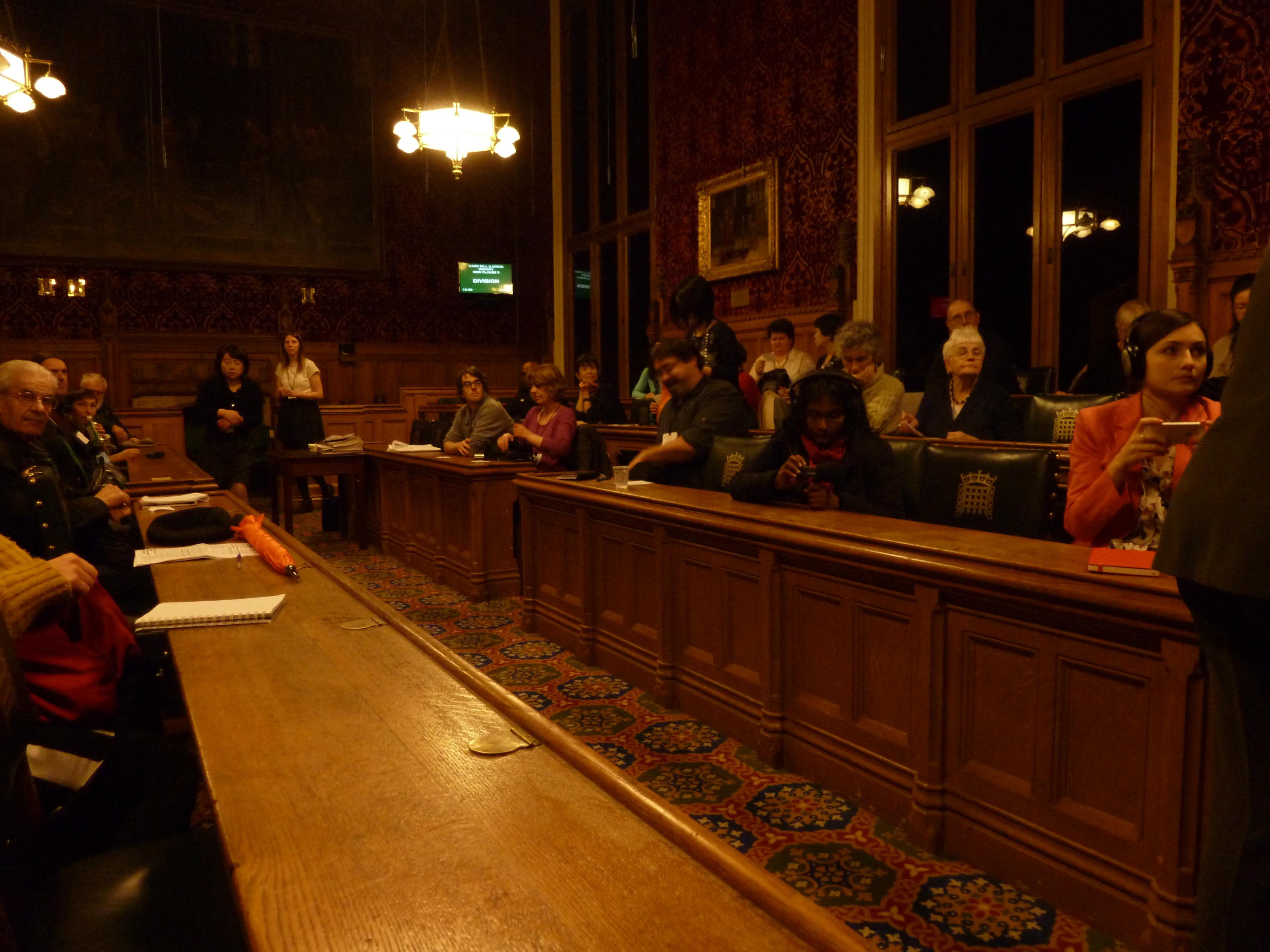
The Meeting was at the houses of Parliament in London on the 10 March 2014 and there were 6 speakers covering a range of topics as outlined below. An Audio file of the event has been uploaded by Fatima and can be accessed here; https://www.dropbox.com/sh/xgvnka0nj50hzof/QczME2MYJI A video should be available soon.
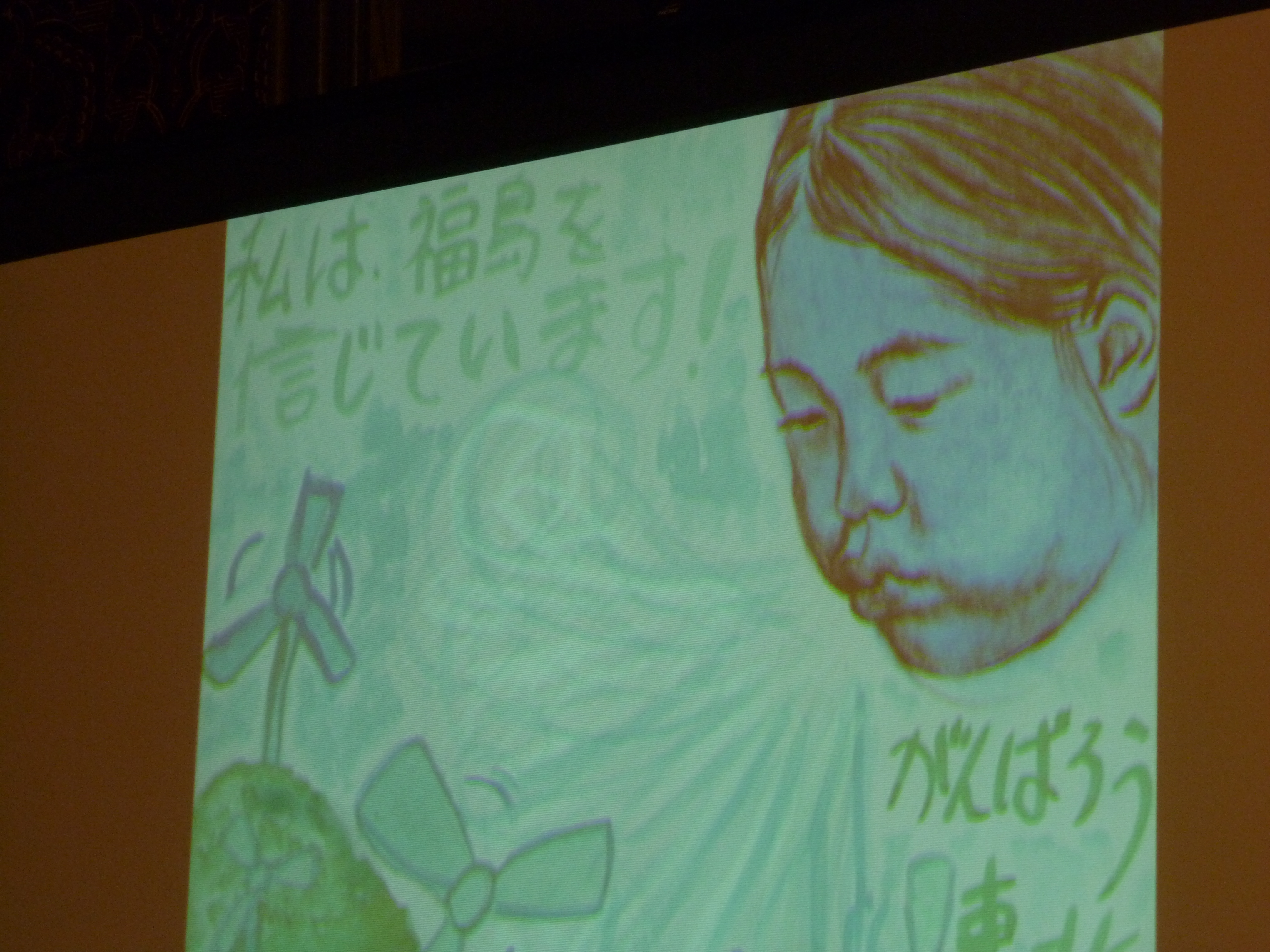
Image courtesy of the Childrens Psychotherapeutic Art Project Japan
The first part of the session was presented by Rik from Kick Nuclear
 He began by highlighting the difference in explosions at reactor 3 and the other explosions at the Daichi Nuclear power plant site.
Rik then discussed the levles of contamination and showed that a much larger area should be evacuated especially as the term “cold shutdown” that TEPCO and the Japanese Government were claiming and which was even verified by the International Atomic and Energy Association (IAEA) in 2011. This points to collusion between the IAEA and the Japanese nuclear lobby.
Rik also mentioned at this point that the Earthquake was the cause and showed photographic evidence and early measurements of Xenon near the Daichi site perimeter fence before the Tsunami hit.
Rik then went on to discuss the issue of reactor design pointing to the pipes at the bottom of the reactor containment vessel being a serious defect in safety design. He then went on to explain the possible flow of the corium (melted fuel rod bundles) from this chamber making its way through the suppression chamber located to the side of the reactor containment vessel.
Also, the topic of actual measurements on the site were mentioned, specifically, that up to 70 Sieverts per hour had been measured at the meltdown sites and this would make clean up and decommissioning very difficult. Only 6 Sieverts an hour can kill quickly.
“This shows that TEPCO are prevaricating” Rik said.
Touching on groundwater issues being of concern it was mentioned that the reactor site is above a water course and on land that is prone to subsidence and that this causes worries concerning the Spent fuel pools that are atop the reactor vessels and a possible future threat to anyone downwind of this nuclear disaster site.
Next to speak was Dr Paul Dorfmann
First Dr Dorfmann talked of the difficulties in moving the nuclear fuel from the site.
He said “A huge amount of radiation has been found”. 
He then mentioned that health effects can not be assessed owing to the lack of data and information coming from official sources in Japan. However, he points out that the official allowable radiation limit of 20 mSv/y, is not taking into account children and pregnant women and is actually designed for Adult male nuclear workers.
Dr Dorfman also points out that although Thyroid cancer is treatable other effects post operation should not be dismissed as readily as some in the health profession dismisses them.
“The treatable effects on life should not be ignored” said Dr Dorfmann
Dr Dorfmann then went on to discuss nuclear costs as a major downside of the nuclear industry citing that the cost of the Fukushima cleanup has been estimated to cost more than1.5 billion in future years whilst the insurance cover is a mere 169 million Euro. He said that if nuclear was fully insured to cover these accidents that the costs of nuclear energy from this single issue, would increase the cost of nuclear by some 60 percent. He also stated that this would increase domestic bills by some 25 percent.
“nuclear is simply not insurable” Dr Dorfmann stated
Fukushima is a mirror to the world of nuclear nightmare:
Deadly Fukushima Crisis Further Corrodes Viability of Nuclear Energy, Tuesday, 11 March 2014 By H Patricia Hynes, Truthout | Op-Ed”……..Fukushima is a mirror to the world of nuclear nightmare: core meltdowns still not understood or under control; precariously perched fuel rods threatening catastrophe throughout Japan and beyond; hundreds of thousands of nuclear refugees and desperate nuclear workers living in anomie; ongoing radioactive contamination of the Pacific Ocean; and collusive government and industry locked in an entitled estate of denial and secrecy against the will of the country’s citizens.
Promoting nuclear power as a “low-carbon” alternative to fossil fuels – as some prominent climate change scientists are doing – is a myopic bargain with the devil. New generations of safer nuclear power plants that purportedly would reduce the risk of ruinous Fukushima-like accidents are decades away from market readiness, too late for stemming the climate change juggernaut. Much more far-sighted is the charismatic former prime minister of Japan, Junichiro Koizumi, an erstwhile nuclear power promoter. Since Fukushima, he calls for abandoning nuclear power, given its mammoth costs and Japan’s seismically active coast, and for his country to unite in creating a renewable society unparalleled in the world. Such a social movement, he foresees, would lift the country’s public spirit and recharge its economy.
Scrapping nuclear power has palpably sped the transition to efficiency and renewable energy. In 2012, Fukushima prefecture signed an agreement to build the country’s largest solar park, and in 2013 Fukushima announced plans to build the world’s largest offshore wind farm – both part of the prefecture’s plan to generate 100 percent of its electricity using renewable sources by 2040. Countries in Europe with the most ambitious solar and wind goals are phasing out nuclear power (Germany) or have adopted a no-nuclear power policy (Denmark and Portugal).
As for the United States, we have enough resource capacity to power the United States with solar and wind. Wind energy in the Great Plains and solar energy in the Southwest could meet current electrical energy needs more than a dozen times over, and this estimate does not include the capacity of offshore wind. Critically acclaimed studies, among them one conducted by researchers Jacobson of Stanford and Delucchi of the University of California-Davis, have laid out a roadmap for energy policy in the next two to four decades, using solely a mix of energy efficiency, wind, water and solar technologies.
In July 2012, an under-the-radar research laboratory within the US Department of Energy (DOE) – the National Renewable Energy Laboratory (NREL) – released an initial investigatory report on the potential for renewable energy. The report is, in DOE’s words, “the most comprehensive analysis of high-penetration renewable electricity of the continental United States to date.” The major finding of the Renewable Electricity Futures Study supports a nuclear-free, zero-carbon renewable energy future:
Renewable electricity generation from technologies that are commercially available today, in combination with a more flexible electric system, is more than adequate to supply 80% of total U.S. electricity generation in 2050 while meeting demand on an hourly basis in every region of the country.
The age of renewables will arrive when fossil fuels and nuclear power decline irreversibly, predicted German economist and renewable energy pioneer Hermann Scheer, stimulating renewables to increase irreversibly. The path to this age of renewables is political will forged by the will of the people – a struggle reinforced by Fukushima that ensues today in Japan and worldwide. http://www.truth-out.org/opinion/item/21551-deadly-fukushima-crisis-further-corrodes-viability-of-nuclear-energy
Deception is essential for the nuclear industry to survive
“Should the public discover the true health cost of nuclear pollution, a cry would rise from all parts of the world and people would refuse to cooperative passively with their own death.”
Thus the desperate drive – in which a largely compliant mainstream media have been complicit – to deny the Fukushima catastrophe, a disaster deeply affecting life on Earth.
No one died, no one’s health was damaged’ – Fukushima’s big lie The Ecologist, Karl Grossman 8th March 2014 The nuclear industry and its media cheerleaders have raised a chorus of misinformation over Fukushima, writes Karl Grossman. But their attempts to suppress the truth are ultimately doomed to failure.
With the third anniversary of the Fukushima Daiichi nuclear catastrophe coming next week, the attempted Giant Lie about the disaster continues – a suppression of information, an effort at dishonesty of historical dimensions.
It involves international entities, especially the International Atomic Energy Agency, national governmental bodies – led in Japan by its current prime minister, the powerful nuclear industry and a global ‘nuclear village’ of scientists and others with a vested interest in atomic energy.

Deception was integral to the push for nuclear power from its start. Continue reading
-
Archives
- February 2026 (233)
- January 2026 (308)
- December 2025 (358)
- November 2025 (359)
- October 2025 (376)
- September 2025 (258)
- August 2025 (319)
- July 2025 (230)
- June 2025 (348)
- May 2025 (261)
- April 2025 (305)
- March 2025 (319)
-
Categories
- 1
- 1 NUCLEAR ISSUES
- business and costs
- climate change
- culture and arts
- ENERGY
- environment
- health
- history
- indigenous issues
- Legal
- marketing of nuclear
- media
- opposition to nuclear
- PERSONAL STORIES
- politics
- politics international
- Religion and ethics
- safety
- secrets,lies and civil liberties
- spinbuster
- technology
- Uranium
- wastes
- weapons and war
- Women
- 2 WORLD
- ACTION
- AFRICA
- Atrocities
- AUSTRALIA
- Christina's notes
- Christina's themes
- culture and arts
- Events
- Fuk 2022
- Fuk 2023
- Fukushima 2017
- Fukushima 2018
- fukushima 2019
- Fukushima 2020
- Fukushima 2021
- general
- global warming
- Humour (God we need it)
- Nuclear
- RARE EARTHS
- Reference
- resources – print
- Resources -audiovicual
- Weekly Newsletter
- World
- World Nuclear
- YouTube
-
RSS
Entries RSS
Comments RSS
 nuclear-news