Interactive map shows how far you live from a nuclear reactor
 A new interactive map tells you exactly how far you live from a nuclear reactor By Joseph Stromberg smithsonianmag.com March 13, 2014 “………Currently, if a radiological emergency occurs, the Nuclear Regulatory Commission recommends that anyone living within 10 miles of a plant to tune in to their local radio or television Emergency Alert System and heed the instructions from state or local officials. The commission also suggests that anyone within 50 miles to take action to protect local food and water supplies. Recently, some have have argued that the evacuation zone should be extended this far as well—and in 2011, after the Fukushima disaster in Japan, authorities from the Nuclear Regulatory Commission recommended that Americans living within 50 miles of the plant to evacuate……..
Sloppy safety at New Mexico nuclear facility!

 Fed report slams safety lapses at New Mexico nuclear facility LA Times, By Joseph Serna March 15, 2014, Workers at a New Mexico nuclear waste storage facility that suffered an underground fire and radiation leak last month lack adequate safety training, oversight or a proper response plan for emergencies, a federal investigation has found.
In a report released Friday, Energy Department investigators faulted employees at the Waste Isolation Pilot Plant, or WIPP, near Carlsbad, for failing to maintain equipment and failing to correct procedures regulators have faulted before — issues that became apparent when a truck caught fire Feb. 5 followed by a radiation leak Feb. 14……..
WIPP’s continued closure could create a backup of defense nuclear waste. A federal treatment plant in Idaho and a laboratory in the San Francisco Bay Area both send their waste to the 2,150-foot-deep repository.
Steve Pearce, a Republican congressman who represents the New Mexico district that houses WIPP, said he expected the plant to address the shortcomings pointed out in the report.
“This transparent report highlights the sloppy procedures that caused the fire,” Pearce said in a statement. “New Mexicans expect and deserve to know the full truth. Fortunately, no one was seriously hurt, but it must never happen again.” http://www.latimes.com/nation/nationnow/la-na-nn-nuclear-safety-new-mexico-20140315,0,3056041.story
With 5 Million Tons of uranium waste to clean up, Colorado Mining Corp. Spills more
 Colorado Mining Corp. Spills 20,000 Gallons Of Uranium Waste Amid Negotiations To Clean Up 15 Million Tons More Opposing Views, By Sarah Fruchtnicht, Sat, March 15, 2014
A broken pipe at a dismantled Colorado mill spilled 20,000 gallons of uranium waste just as the corporate owner is negotiating with state and federal authorities to clean up another 15 million tons of radioactive uranium tailings.
The Colorado mining and milling corporation Cotter Corp. is working with the Environmental Protection Agency and the Colorado Department of Public Health and Environment (CDPHE) to negotiate one of the nation’s longest-running cleanups in history. The agencies are expected to help Cotter clean up, gather data, and figure out what to do with 15 million tons of radioactive uranium tailings.
They could remove the tailings, which would cost more than $895 million, or bury the waste.
In the meantime, a 6-inch plastic pipe, part of a 30-year-old system on Cotter’s 2,538-acre property in Canon City, broke and spewed 20,000 gallons of uranium-laced waste………
A community group, Colorado Citizens Against Toxic Waste, is pressing Cotter and the state for more facts about the spills and cleanup operations.
Energy Minerals Law Center attorney Travis Stills says the public deserves to know more.
“There’s an official, decades-old indifference to groundwater protection and cleanup of groundwater contamination at the Cotter site — even though sustainable and clean groundwater for drinking, orchards, gardens and livestock remains important to present and future Lincoln Park residents,” Stills said. “This community is profoundly committed to reclaiming and protecting its groundwater.” http://www.opposingviews.com/i/society/environment/colorado-mining-corp-spills-20000-gallons-uranium-waste-amid-negotiations
Unfolding, continuing crisis at Fukushima
Nuclear crisis at Fukushima continues to unfold: a trilogy of reports by PBS NewsHour’s Miles O’Brien (video) http://boingboing.net/2014/03/14/nuclear-crisis-at-fukushima-co.htmlNext, “Fishing for data in the radioactive waters off Fukushima.”
With help from fisherman and citizen scientists, researchers in Japan and the U.S. are tracking the nucleotides in the ocean creatures who swim in the plume of water tainted with radiation from Fukushima. Their research is part of a long-term effort to figure out when — if ever — certain fish will be safe to eat.
Xeni Jardin at 1:45 pm Fri, Mar 14, 2014 Miles O’Brien, science correspondent for PBS NewsHour, has produced a series of three must-see investigative reports revisiting the Fukushima nuclear crisis in Japan. His stories explore how the radiation leaks triggered by the earthquake and tsunami are continuing to affect life there, and beyond.
First, above, “Fukushima nuclear crisis continues to unfold.”
The site of the Fukushima nuclear disaster in Japan remains a post-apocalyptic landscape of abandoned towns, frozen in time. Science correspondent Miles O’Brien got a rare tour inside the plant, where three nuclear reactors melted down after the earthquake and tsunami in 2011, to learn more about the long-term solutions for stemming the radioactive contamination.
Next, “Fishing for data in the radioactive waters off Fukushima.”
With help from fisherman and citizen scientists, researchers in Japan and the U.S. are tracking the nucleotides in the ocean creatures who swim in the plume of water tainted with radiation from Fukushima. Their research is part of a long-term effort to figure out when — if ever — certain fish will be safe to eat.
VIDEO: toxic legacy of uranium mining on Indigenous Land
Video “A Slow Genocide of the People”: Uranium Mining Leaves Toxic Nuclear Legacy on Indigenous Land Democracy Now Friday March 14, 2014 The iconic Grand Canyon is the site of a battle over toxic uranium mining. Last year, a company called Energy Fuels Resources was given federal approval to reopen a mine six miles from the Grand Canyon’s popular South Rim entrance. A coalition of Native and environmental groups have protested the decision, saying uranium mining could strain scarce water sources and pose serious health effects. Diné (Navajo) tribal lands are littered with abandoned uranium mines. From 1944 to 1986, 3.9 million tons of uranium ore were chiseled and blasted from the mountains and plains of the region. More than 1,000 mines have closed, but the mining companies never properly disposed of their radioactive waste piles, leading to a spike in cancer rates and other health ailments.
Broadcasting from Flagstaff, Arizona, we speak with Taylor McKinnon, director of energy with Grand Canyon Trust, and Klee Benally, a Diné (Navajo) activist and musician. “It’s really a slow genocide of the people, not just indigenous people of this region, but it’s estimated that there are over 10 million people who are residing within 50 miles of abandoned uranium mines,” Benally says. Benally also describes the struggle to preserve the San Francisco Peaks, an area considered sacred by 13 Native tribes, where the Snowbowl ski resort is using treated sewage water to make snow.
Nuclear power a danger to Orgeon
Nuclear power advocates, ‘cease and desist’ in light of dangers http://www.gazettetimes.com/news/opinion/mailbag/letter-nuclear-power-advocates-cease-and-desist-in-light-of/article_506a4674-ab45-11e3-8229-0019bb2963f4.htmlMy Kirk Nevin, Corvallis, 15 Mar 14 My impression, gained from talking to a fair number of my fellow Corvallis citizens, is that very few Oregonians think nuclear power has a future in our beautiful state.
For those who still harbor thoughts of producing electricity with nuclear facilities, I suggest you read the March 12 editorial on page A24 of the New York Times, “Fukushima’s Continuing Tragedy.”
The continuing tragedy is, of course, a reference to “the third anniversary of the triple disaster that struck eastern Japanese prefectures of Iwate, Miyagi and Fukushima: the earthquake, tsunami and the nuclear plant meltdowns in Fukushima.” The events killed almost 16,000 people, with many more still missing.
Oregon has an uncanny similarity to the Japanese area affected, with the same potential for earthquakes, tsunamis, and the inevitable nuclear meltdown.Message to the folks who are continuing to promote nuclear power in Oregon: Please cease and desist. You have no right to subject us to such a potential scenario of destruction and devastation in Corvallis. This is our home.
A big mistake to resurrect global nuclear technology
A Nuclear Colloquy: Lowry and Ford on “The Nuclear Bazaar”, New Paradigms Forum
Note:
Dr. David Lowry is an independent research policy consultant specializing in nuclear issues, working with politicians, NGOs and the media. He is a former director of the European Proliferation Information Centre [EPIC] in London. His text below, which he recently submitted to NPF, is the written version of his presentation to a workshop on “Challenging NPT-backed Nuclear Power Expansion” at the Campaign for Nuclear Disarmament (CND) annual conference in London on October 9, 2010.
Avoiding Atomic Armageddon:
Why we should not rejoin the nuclear bazaar
by Dr. David Lowry
The venerable veteran Labour politician, Tony Benn, who once was responsible for the British nuclear power programme when he was Technology Minister in the late 1960s, when recently asked by The Times if he had made any political mistakes in his life, responded:
“Yes, nuclear power: I was told it was, when I was in charge of it, that atomic energy was cheap, safe and peaceful. It isn’t.” (Times Magazine, 11 September 2010) Continue reading
Nuclear Hotseat #142: Fukushima Anniversary SPECIAL: Voices from Japan – English & Japanese Versions
http://www.nuclearhotseat.com/blog/

DOWNLOAD HERE (ENGLISH):
http://lhalevy.audioacrobat.com/download/87dd3a27-5808-33b9-85f5-f3d0d956b3a3.mp3
ダウンロードをして聞く場合はここをクリックして下さい。DOWNLOAD HERE (JAPANESE):
http://lhalevy.audioacrobat.com/download/4a0ea58f-d49d-b893-9281-49aa6166cfe1.mp3
FEATURED INTERVIEWS:
- Hiroaki Koide, Asst. Professor, Kyoto University Research Reactor Institute
- Taro Yamamoto, actor and member of the Japanese Diet Upper House.
http://ajw.asahi.com/article/0311disaster/fukushima/AJ201307220053 - Midori Kiuchi, popular television and movie actress
- Kaori Suzuki, Director of the Tarachine Citizens Radiation Monitoring Center
- Ruiko Muto, lead plaintiff of a large group of Fukushima residents who have filed a criminal complaint against TEPCO and the Japanese government. http://japanfocus.org/-Muto-Ruiko/3784 http://ajw.asahi.com/article/behind_news/people/AJ201206160009
Fukushima Three Years Later: Myths & Misconceptions | Interview with Tim Judson and Kevin Kamps
Published on 12 Mar 2014
Abby Martin takes a look at the state of the Fukushima nuclear power plant three years after the massive earth quake and subsequent tsunami that led to the meltdown; discussing the long term impacts of continued radiation leaks with Kevin Kamps, radioactive waste watchdog of BeyondNuclear.org, and Tim Judson, executive director at the Nuclear Information and Resource Center.
LIKE Breaking the Set @ http://fb.me/BreakingTheSet
FOLLOW Abby Martin @ http://twitter.com/AbbyMartin
RIP – Tony Benn the anti nuclear advocate and friend to all !!
Published on 14 Mar 2014
“Tony Benn had died. He is one of my favourite politicians if not my favourite, for the way he steadfastly spoke his mind with honesty, clarity and passion throughout 50 years as an MP.
He was of aristocratic blood but turned down his peerage (that would have made him a Lord) so that he could carry on serving in the House of Commons.
One of my ambitions in life was to have a cup of tea with Tony Benn and now, I never will.”
Dan Bull 14 March 2014
In 2009, Iain Dale spent two hours, over several mugs of tea, quizzing Tony Benn.
Tony Benn, the longest-serving Labour MP in history, raised a few wry smiles when he resigned from 50 years in the House of Commons “to devote more time to politics”.

Image and quote source ; http://www.telegraph.co.uk/news/newstopics/nationaltreasures/2181615/Tony-Benn-portrait.html
Question ; Keynes once said, when the facts change, I change my mind. What have you changed your mind on?
Tony Benn answers “Many things. Nuclear power, for example. In 1955 when Eisenhower said he was going for ‘Atoms for Peace’ I became a passionate supporter of it. Having been brought up on the Bible I liked the idea of swords into ploughshares. I advocated nuclear power as Minister of Technology. I was told, and believed, that nuclear power was cheap, safe and peaceful. Having been in charge of nuclear power I discovered it wasn’t cheap, wasn’t safe and when I left office I was told that during my period as Secretary of State for Energy, plutonium from our nuclear power stations went to the Pentagon to make nuclear weapons. So every nuclear power station in Britain is a bomb factory for America. I was utterly shaken by that. Nothing in the world would now induce me to support nuclear power. It was a mistake. Israel is another one. I was rowing on the Sea of Galilee in May 1945 when the war ended. I was all in favour of a Jewish homeland, but now I see what has happened and it was absolutely wrong.” http://www.totalpolitics.com/print/1288/in-conversation-tony-benn.thtml
Former Labour MP Tony Benn on how Britain Secretly Helped Israel Build Its Nuclear Arsenal
TONY BENN: Well, of course, Mordechai Vanunu, who was arrested by — he was kidnapped in London by the Israelis — he was telling the Sunday Times what was going on — in prison, much of it in solitary confinement, recently released with restrictions. But he warned us about Dimona. And I did know later about Dimona, as an Israeli military establishment, but I never knew until yesterday, or until it came out a few days ago, that we had helped to assist the Israelis in building it.
AMY GOODMAN: And you, as technology minister, would have had to sign off on this if you had known, is this right?
TONY BENN: Well, it wasn’t put to me at all. It wasn’t put to ministers. I mean, this is the trouble with the nuclear industry, I came not to believe what I was told, and that throws a doubt on more than nuclear power: the question of democracy, if officials can operate as a state within a state. Where is the democratic control of policy? So it was a very, very serious thing to happen. And, of course, it also comes up at a time when, as you’ve been pointing out, there’s a lot of pressure now on Iran not to develop nuclear technology in any form.
http://www.democracynow.org/2006/3/10/former_labour_mp_tony_benn_on
Former British energy minister Tony Benn discusses his time in charge of the nuclear industry and why he changed his views about the controversial energy source.
Part of Tenner Films’ project ’13 Short Films About Atomic Power’
MINISTER from Vicki Lesley on Vimeo.
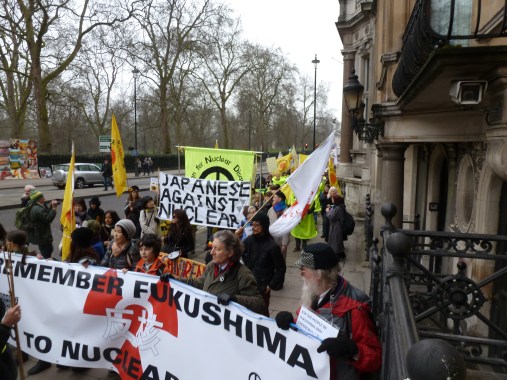
Fukushima Demonstration London 15th March: The UK Green Party joins British and Japanese campaigners to oppose nuclear power
14 March 2014
THE Green Party will join British and Japanese anti-nuclear campaigners tomorrow to commemorate the third anniversary of the Fukushima nuclear disaster in Japan. Full details below.
The demonstration, organised by CND, Kick Nuclear and Jan UK, will coincide with events taking place around the world to highlight the legacy of the meltdown at the Fukushima Daiichi nuclear plant and to call for an end to nuclear power.
Natalie Bennett, Green Party leader, said:
“This anniversary is another reminder about the grave safety concerns presented by nuclear power, and the fact that no solution to the problem of long-term storage of nuclear waste has been found.
“The British government, in thrall as it is to giant multinational energy interests, is clinging to a failed 20th-century technology.
“This is not only taking a dangerous path, but is a significant distraction from the need to invest in renewable energy and energy conservation which we need for a stable, secure, affordable energy future.”
Event Details
March on Parliament and Rally
12:30pm, Saturday 15th March
Hyde Park Corner to Parliament
Meet: 12:30pm by Hyde Park Corner tube station, near the ‘Hyde Park’ exit.
March via Japanese Embassy and offices of Tokyo Electric Power Company (TEPCO – the owners of Fukushima) to Parliament.
Rally: 3:00–4:30pm at Old Palace Yard, opposite House of Lords. Attendees include Green Party leader Natalie Bennett, fashion designer Katharine Hamnett and Fukushima evacuees.
Events organised jointly by CND, Kick Nuclear and Japanese Against Nuclear (UK)
More UK events here
Summary of Speakers comments at the Houses of Parliament Fukushima debate on the 10 March 2014
“there is a need for Japan to allow psychological therapeutic treatments available more widely and I hope that the UN and International community might help with this” said Geoff
“The next industrial revolution will be renewable”
“we cant evacuate children and we cant certify the safety for their return so we will not move children” Prefectoral official
Chantelle said that “Swiss energy policy hopes to see smaller decentralised methods of electricity production that would be safer and more efficient.”
One of the speeches here by Dr David Lowry
Link to other videos of event
http://www.youtube.com/playlist?list=PLCN9aJReHnmpcVEF-zDMSA9fTpEjedREo
Japan puts two reactors on shortlist for restart screening
Kyushu Electric’s Sendai reactors are located about 980 kms (600 miles) southwest of Tokyo. The utility is one of the most reliant of Japan’s regional electricity monopolies that provide nuclear power, supplying about a third of Japan’s energy needs before Fukushima.
By Mari Saito and Kentaro Hamada
TOKYO (Reuters) – Japan put two reactors on a shortlist for a final round of safety checks on Thursday, moving a step closer to reviving the country’s nuclear industry, three years after the Fukushima disaster that led to the shutdown of all plants.
Two days after the third anniversary of the meltdowns at the Fukushima nuclear station, Japan’s nuclear regulator placed two reactors operated by Kyushu Electric Power Co on a list for priority screening at a meeting of officials reviewing restart applications.
No timing for a potential restart was decided at the meeting and the next stage of checks incorporates a period of public hearings, which may be a fraught process given widespread scepticism about a return to nuclear power.
This week in nuclear news

Christina Macpherson’s websites & blogs
Japan is the focus, with many anti nuclear protests across the world, on the anniversary of the Fukushima nuclear disaster, and in Tokyo, groups organising to work for renewable energy and against nuclear power. But the ‘Nuclear Village’ is still in control, as Japan moves to develop the Rokkasho plutonium-making complex. Meanwhile the government plans to restart nuclear power, though most reactors are unlikely to meet the new safety rules.
Confusing plans to return evacuees to Fukushima prefecture, with some areas clearly unable to be decontaminated for decades Fukushima radioactive material continues to leak into the Pacific,and to be detected in the North West Pacific Japan has cracked down on reporting about Fukushima.
Ukraine is a concern, but experts advise that it is not likely to get nuclear weapons.
UK does a deal to buy Russian nuclear technology even as it is hosting a summit about putting sanctions on Russia due to the crisis in Crimea!
USA. Nuclear is not faring too well. A nasty radioactive leak at a nuclear waste facility in New Mexico. The government has stalled costly plans to build a Mixed Oxide Fuel Fabrication (MOX) plant More news that nuclear power is dying, for economic reasons
China – some encouraging news Wind Leaves Nuclear Behind
Are the people of Japan, especially the children, OK?
 Gundersen: Fukushima will be bleeding into Pacific for next 100 years — Such a worldwide catastrophe — Molten cores being released into groundwater and moving off site — ‘Radioactive lake’ developing beneath reactors — New Yorker: “Human disaster that may never end” (VIDEO) http://enenews.com/gundersen-fukushima-wil-lbe-bleeding-into-pacific-for-next-100-years-such-a-worldwide-catastrophe-molten-cores-being-released-into-groundwater-and-moving-off-site-radioactive-lake-develo?utm_source=feedburner&utm_medium=email&utm_campaign=Feed%3A+ENENews+%28Energy+News%29
Fairewinds Energy Education, Mar. 12, 2014:
Arnie Gumdersen, Fairewinds chief engineer (at 0:45 in): Is most of the cleanup complete? Are the people of Japan, especially the children, OK? Are the Japanese evacuees returning home? And, are the oceans OK? Sadly the answers are no.
Gundersen (at 5:15 in): The aftermath of this catastrophe remains as hazardous as ever. The power plant site itself, entire sections of the surrounding Fukushima Prefecture and the Pacific Ocean are contaminated in ways that humans never imagined, so no method of mitigation exists. The Fukushima catastrophe will continue to be life-threatening and continue to cause extreme hardship for Tepco employees and cleanup workers,the former Fukushima residents, who and the Pacific ocean — its habitats and its on the ecosystem […] The reactors continue to release the radioactive remnants from the molten cores into the surrounding groundwater that’s migrating off site. […] Tokyo Electric appears to have little control over the deteriorating environment, and it behaves like the victim, rather than the perpetrator of the greatest industrial mishap of all time. What will the future bring? The Fukushima Daiichi site will continue to bleed radiation into the Pacific Ocean for 100 years. As contaminated water beneath the site slowly evolves into a radioactive lake. […] Most likely the cleanup of the entire site is at least a century away, if ever. How has this calamity evolved into such a worldwide catastrophe? It happened because the Japanese government chose to protect Tepco, its financial interest and the goals of the nuclear power industry.
The New Yorker, Mar. 11, 2014: “A story of human disaster that may never end.” Seattle Weekly, Mar. 11, 2014: “The 3/11 snowfall was the beginning of Japan’s nuclear winter.”
In Fukushima region, people are radiation guinea pigs
 Official: Japan will be ruined if public doesn’t realize they’re being exposed to Fukushima radiation — “99.99% of the people are being sacrificed” — Rest of world will be taken down too (AUDIO) http://enenews.com/lawmaker-if-japanese-cant-face-truth-thattheir-exposure-could-be-ruined-by-fukushima-radiation-will-take-rest-of-world-down-with-it-99-99-of-the-people-are-being-sacrificed-audio?utm_source=feedburner&utm_medium=em
Forum with Michael Krasny on KQED, Mar. 10, 2014 — Kenji Kushida, Stanford University (at 43:00 in): This crisis doesn’t stop, it keeps on going, there’s no easy solution in sight. […] This current situation is basically unprecedented.
Message from Arao Shunsuke, Fukushima resident, , Mar. 10, 2014: […] Fukushima Daiichi is nowhere near under control, there are still massive problems […] we must be prepared for a long term battle which will go beyond the present generation. […] in Nakadori and other places in Fukushima, a million people are being forced to live exposed […] Many citizens of Fukushima mutter “we are guinea pigs.” […] Meanwhile TEPCO has not taken any responsibility for spreading radiation not just throughout Fukushima, but throughout the world. […] From the point of view of disposal of the radioactive waste also, people are realizing that we are nearing the point of collapse. […] We are continuing our journey on this small but beautiful planet, through the limitless universe. All of us must join our strength so that this delicate vehicle, which we are riding, which we have borrowed from our children and grandchildren, can be protected and handed over to them intact.
‘Nuclear Hotseat’ hosted by Libbe HaLevy,, Mar. 10, 2014 (at 49:30 in) — Taro Yamamoto, celebrity and lawmaker elected in 2013 to represent the Tokyo district in Japan’s Upper House: “Idiotic ideas — like restarting the nuclear plants — are being considered here in Japan. It really boils down to exposure to radiation. Why is nuclear dangerous? Because it exposes people to radiation […] in Japan you can talk about nuclear energy, but the subject off radiation is taboo. You almost never here the subject discussed on TV or the mass media. In various places the true situation about radiation exposure is being hidden. If Japanese people can’t face up to this problem then this country will be ruined. It will take the rest of the world down with it. […] I think it is wrong that people’s lives are being sacrificed because of money and the company profits. […] 99.99% of the people are being sacrificed.”
-
Archives
- February 2026 (233)
- January 2026 (308)
- December 2025 (358)
- November 2025 (359)
- October 2025 (376)
- September 2025 (258)
- August 2025 (319)
- July 2025 (230)
- June 2025 (348)
- May 2025 (261)
- April 2025 (305)
- March 2025 (319)
-
Categories
- 1
- 1 NUCLEAR ISSUES
- business and costs
- climate change
- culture and arts
- ENERGY
- environment
- health
- history
- indigenous issues
- Legal
- marketing of nuclear
- media
- opposition to nuclear
- PERSONAL STORIES
- politics
- politics international
- Religion and ethics
- safety
- secrets,lies and civil liberties
- spinbuster
- technology
- Uranium
- wastes
- weapons and war
- Women
- 2 WORLD
- ACTION
- AFRICA
- Atrocities
- AUSTRALIA
- Christina's notes
- Christina's themes
- culture and arts
- Events
- Fuk 2022
- Fuk 2023
- Fukushima 2017
- Fukushima 2018
- fukushima 2019
- Fukushima 2020
- Fukushima 2021
- general
- global warming
- Humour (God we need it)
- Nuclear
- RARE EARTHS
- Reference
- resources – print
- Resources -audiovicual
- Weekly Newsletter
- World
- World Nuclear
- YouTube
-
RSS
Entries RSS
Comments RSS
 nuclear-news