New Zealand – Scientists gather to focus on nuclear technology cooperation
Government Parties to the Regional Cooperative Agreement are Australia, Bangladesh, People’s Republic of China, Cambodia, India, Indonesia, Japan, the Republic of Korea, Malaysia, Mongolia, Myanmar, Nepal, New Zealand, Pakistan, the Republic of Palau, the Philippines, Singapore, Sri Lanka, Thailand, and Vietnam. –
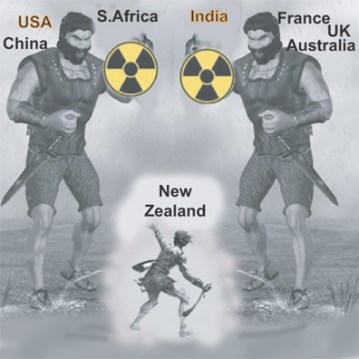
Image source ; https://nuclear-news.net/2010/07/10/online-films-recall-new-zealands-anti-nuclear-battle/
Source: GNS Science – Press Release/Statement:Headline: Scientists gather to focus on nuclear technology cooperation – 31/03/2014
Nearly 50 representatives from 20 countries of the Asia and Pacific region and the International Atomic Energy Agency (IAEA) are in Wellington this week to discuss cooperation and promotion of the many peaceful uses of nuclear technology.
The four-day event at Te Papa between 1 and 4 April is the 36th meeting of the Regional Co-operative Agreement for Research, Development and Training Related to Nuclear Science and Technology for Asia and the Pacific (RCA). It was last hosted in New Zealand in 1997.
The IAEA member states of the Asia and Pacific region set up the RCA initiative in 1972 with the aim of encouraging co-operative research and development in the peaceful uses of nuclear science.
Its main areas of focus are using nuclear science and isotope technologies to help make significant improvements in agriculture, human health, industry and the environment. This leads to tangible social, economic and environmental benefits in member countries.
The RCA achieves this through sharing knowledge and expertise among member countries.
This week’s meeting will review the many existing projects and explore new possibilities for cooperation among member countries.
Background:
Government Parties to the Regional Cooperative Agreement are Australia, Bangladesh, People’s Republic of China, Cambodia, India, Indonesia, Japan, the Republic of Korea, Malaysia, Mongolia, Myanmar, Nepal, New Zealand, Pakistan, the Republic of Palau, the Philippines, Singapore, Sri Lanka, Thailand, and Vietnam.
The RCA’s mission is to:
- Identify and implement nuclear technologies that address regional needs
- Ensure transfer of nuclear technologies to end users
- Coordinate cooperative research in applications of nuclear science and technology
- Promote the benefits of nuclear technologies and identify partners and funding mechanisms
- Develop regional networks for exchange of technologies, training, and equipment.
The main focus areas for the RCA are agriculture, human health, environment, and industry. Examples of projects undertaken under the auspices of the RCA include:
Industry
- Non-destructive testing for quality control in industrial processes
- Using radio-tracers to improve efficiency in petrochemical production and in sewage treatment plants
- Using nuclear technology to develop new materials from natural polymers
- Using isotope analysis to improve the efficiency of geothermal energy plants
Agriculture
- Developing super water-absorbing materials and plant growth promoters for agricultural applications
- Using isotope analysis to improve soil conservation in agriculture
- Improved livestock productivity through isotope analysis
- Improving the quality of crops through the use of isotope technology in plant breeding
- Using isotope technologies to improve insect and pest control
Environment
- Using nuclear analytical techniques to determine the sources of air pollution
- Using isotopic analytical techniques to manage freshwater quality
- Using isotope technology to turn the tide against marine pollution
Human health
- Improving the efficiency of radiotherapy
- Improving the effectiveness of nuclear medicine in cancer treatment
- Improving the use of nuclear medicine in management of cardiovascular diseases.
- Improving the effectiveness of tissue grafting through nuclear technology.
[Arclight2011] More here;
Mongolia
- Pct. saying corruption very serious: 86% (tied for the highest)
- Pct. claiming public officials corrupt: 77% (12th highest)
- Pct. claiming police corrupt: 66% (49th highest)
- 2012 GDP per capita: $5,372
Mongolia had one of the world’s fastest growing economies in 2012, when its GDP rose an estimated 12.3%, according to the IMF. But corruption has been identified by USAID as a critical threat to the country’s continued growth as well as to its democracy. Corruption has become pervasive in the country, after “rapid transition to democracy and a market economy created huge demands on bureaucracy that lacks the [means] to prevent corruption,” according to the organization. Encouragingly, less than half of all people surveyed in the country said that corruption had increased in the past two years, versus 53% of respondents worldwide. Also, while 77% of people considered public officials to be corrupt, just 12% believed the country’s government to be run by a few large, purely self-interested entities.
http://www.usatoday.com/story/money/business/2013/07/14/most-corrupt-countries/2512785/
Here is an interactive map that shows how “trustworthy” the rest are;
http://www.businessinsider.com/the-most-corrupt-countries-in-the-world-2013-12
No comments yet.
1 This Month


18 March Webinar @ 1 PM EST: An Assessment of SMR Projects: The Case of Canada
register for the zoom:
https://us02web.zoom.us/webinar/register/WN_o8BIIOUvQ2ONJR1nta65DQ#/registration


of the week – STOP SMALL MODULAR REACTORS IN CANADA
To see nuclear-related stories in greater depth and intensity – go to https://nuclearinformation.wordpress.com
-
Archives
- March 2026 (141)
- February 2026 (268)
- January 2026 (308)
- December 2025 (358)
- November 2025 (359)
- October 2025 (376)
- September 2025 (258)
- August 2025 (319)
- July 2025 (230)
- June 2025 (348)
- May 2025 (261)
- April 2025 (305)
-
Categories
- 1
- 1 NUCLEAR ISSUES
- business and costs
- climate change
- culture and arts
- ENERGY
- environment
- health
- history
- indigenous issues
- Legal
- marketing of nuclear
- media
- opposition to nuclear
- PERSONAL STORIES
- politics
- politics international
- Religion and ethics
- safety
- secrets,lies and civil liberties
- spinbuster
- technology
- Uranium
- wastes
- weapons and war
- Women
- 2 WORLD
- ACTION
- AFRICA
- Atrocities
- AUSTRALIA
- Christina's notes
- Christina's themes
- culture and arts
- Events
- Fuk 2022
- Fuk 2023
- Fukushima 2017
- Fukushima 2018
- fukushima 2019
- Fukushima 2020
- Fukushima 2021
- general
- global warming
- Humour (God we need it)
- Nuclear
- RARE EARTHS
- Reference
- resources – print
- Resources -audiovicual
- Weekly Newsletter
- World
- World Nuclear
- YouTube
-
RSS
Entries RSS
Comments RSS
 nuclear-news
Leave a comment