IPCC cautiously tells us that climate change is already very serious indeed
As grim as the Working Group 2 report on impacts is, it explicitly has very little to say about the catastrophic impacts and vulnerability in the business as usual case where the Earth warms 4°C to 5°C [7°F-9°F] — and it has nothing to say about even higher warming, which the latest science suggests we are headed toward.
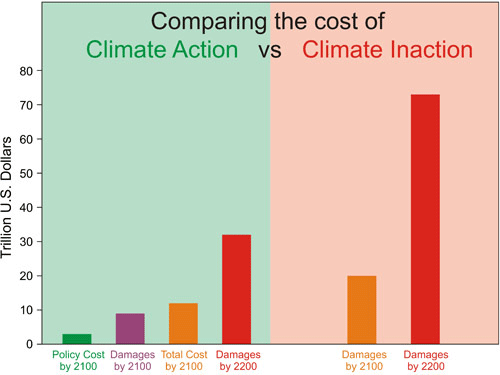
Conservative Climate Panel Warns World Faces ‘Breakdown Of Food Systems’ And More Violent Conflict THINK PROGRESS, BY JOE ROMM ON MARCH 30, 2014 THE U.N. INTERGOVERNMENTAL PANEL ON CLIMATE CHANGE (IPCC) HAS ISSUED ITS SECOND OF FOUR PLANNED REPORTS EXAMINING THE STATE OF CLIMATE SCIENCE. THIS ONE SUMMARIZES WHAT THE SCIENTIFIC LITERATURE SAYS ABOUT “IMPACTS, ADAPTATION, AND VULNERABILITY” (BIG PDF HERE). AS WITH EVERY RECENT IPCC REPORT, IT IS SUPER-CAUTIOUS TO A FAULT AND YET STILL INCREDIBLY ALARMING.
It warns that we are doing a bad job of dealing with the climate change we’ve experienced to date: “Impacts from recent climate-related extremes, such as heat waves, droughts, floods, cyclones, and wildfires, reveal significant vulnerability and exposure of some ecosystems and many human systems to current climate variability.”
It warns of the dreaded RFCs (“reasons for concern” — I’m not making this acronym up), such as “breakdown of food systems linked to warming, drought, flooding, and precipitation variability and extremes.” You might call them RFAs (“reasons for alarm” or “reasons for action”). Indeed, in recent years, “several periods of rapid food and cereal price increases following climate extremes in key producing regions indicate a sensitivity of current markets to climate extremes among other factors.” So warming-driven drought and extreme weather have already begun to reduce food security. Now imagine adding another 2 billion people to feed while we are experiencing five times as much warming this century as we did last century!
No surprise, then, that climate change will “prolong existing, and create new, poverty traps, the latter particularly in urban areas and emerging hotspots of hunger.” And it will “increase risks of violent conflicts in the form of civil war and inter-group violence” — though for some reason that doesn’t make the list of RFCs.
In short, “We’re all sitting ducks,” as IPCC author and Princeton Prof. Michael Oppenheimer put it to the AP. AN OVERLY CAUTIOUS REPORT
As grim as the Working Group 2 report on impacts is, it explicitly has very little to say about the catastrophic impacts and vulnerability in the business as usual case where the Earth warms 4°C to 5°C [7°F-9°F] — and it has nothing to say about even higher warming, which the latest science suggests we are headed toward.
The report states:
- “Relatively few studies have considered impacts on cropping systems for scenarios where global mean temperatures increase by 4°C [7°F] or more.
- “… few quantitative estimates [of global annual economic losses] have been completed for additional warming around 3°C [5.4°F] or above.”………
THE HIGH COST OF INACTION
The IPCC’s discussion of economic costs is equally muddled:
“… the incomplete estimates of global annual economic losses for additional temperature increases of ~2°C are between 0.2 and 2.0% of income. Losses are more likely than not to be greater, rather than smaller, than this range…. Losses accelerate with greater warming, but few quantitative estimates have been completed for additional warming around 3°C or above.”
It would have been nice if the IPCC had mentioned at this point that keeping additional temperature increases to ~2°C requires very aggressive efforts to slash carbon pollution starting now. As it is, the deniers, confusionists, and easily confused can (incorrectly) assert that this first sentence means global economic losses from climate change will be low. Again, that’s only if we act now.
As Climate Science Watch noted Saturday, “Other estimates suggest the high impacts on global GDP with warming of 4ºC (For example the Stern Review found impacts of 5-20% of global GDP).”
The costs of even higher warming, which, again, would be nothing more than business as usual, rise exponentially. Indeed, we’ve known for years that traditional climate cost-benefit analyses are “unusually misleading” — as Harvard economist Martin Weitzman warned colleagues, “we may be deluding ourselves and others.” Again, that’s because the IPCC is basically a best case analysis — while it largely ignores the business-as-usual case and completely ignores the worst case……http://thinkprogress.org/climate/2014/03/30/3420723/climate-breakdown-of-food-systems/
Decommissioning – a bonanza for nuclear firms
 Government set to award £7bn nuclear decommissioning contract http://www.ft.com/intl/cms/s/0/7a4ee910-b7fa-11e3-92f9-00144feabdc0.html By Gill Plimmer 31 March 14, A private sector consortium will be told on Monday it has won the £7bn job of decommissioning Britain’s oldest nuclear power plants.
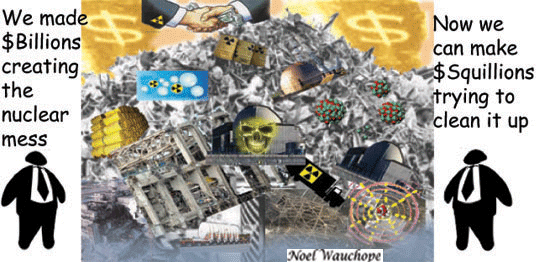
The work is one of the largest and most sensitive public sector contracts to be awarded in the UK so far. The reactors, built in the 1960s originally to produce plutonium to make nuclear weapons, include those at Sizewell, Hinkley and Dungeness. They are now at the end of their lives and the government is preparing to decommission them this year. The overall contract is worth about £7bn over 14 years.
The Nuclear Decommissioning Authority, the government-funded body responsible for Britain’s state-owned nuclear sites, started the competition two years ago, and work is expected to start in September.
Currently the sites are being run by Magnox, a company owned by Salt Lake City-based EnergySolutions. It is bidding for the new work in partnership with Bechtel. The only Magnox station still in use is in Wylfa in Anglesey, though this is due to stop producing electricity in the next two years.
The contract covers Britain’s 10 reactors as well two old nuclear research sites in Oxfordshire and Dorset. The oldest nuclear power plant, Calder Hall in Cumbria, was the world’s first commercial scale nuclear reactor and was opened by the Queen in 1959 before it closed a decade ago.
The incumbent Magnox is competing against consortiums made up of Amec, Atkins and Rolls-Royce; CH2M Hill, Areva and Serco; and Babcock and Fluor. The clean-up contract that the companies hope to take over employs about 3,000 workers on the 12 ageing nuclear sites across the country.
Unions are concerned that awarding the company to an overseas consortium willerode Britain’s nuclear expertise.
“The reality is the way we are breaking up our nuclear industry will go down as another Great British missed opportunity,” Gary Smith, a GMB spokesman said. “Britain was a world leader in nuclear. Successive governments have hived off our nuclear industry piecemeal. There is absolutely no strategy around nuclear which reflects the fact that wider energy policy is a mess.”
Is living next to a nuclear reactor bad for your health?
 Donna Gilmore, who runs the critical sanonofresafety.org website, said she understands the limitations of the controversial Diablo study, but that the well-vetted French and German leukemia studies should be all the proof we need.
If the NAS eventually finds the same thing, the question will become: What do we do about it?
Researchers consider: How risky is that radiation? http://www.ocregister.com/articles/nuclear-607540-diablo-health.html 31 March 14, The baby teeth of kids living near the Diablo Canyon nuclear power plant contained radioactive Strontium-90 – which can cause bone cancer and leukemia – at levels nearly one-third higher than in the baby teeth of other California kids, says a controversial study released last week.
The big question is: Did it cause bone cancer and leukemia? Continue reading
MOX nuclear plant consumed $billions – now to be closed
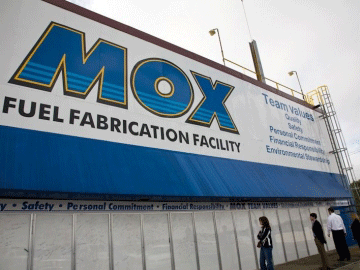 DOE shuts $4 billion ‘plutonium-eater’ reactor Ecologist, Douglas Birch 12th March 2014 A nuclear reactor designed to burn up surplus Cold War plutonium has been closed by the US Department of Energy. Initially it was meant to cost $1bn. So far it has cost $4bn. To complete and operate would cost $25-34bn.
After a year of study meant to examine the viability of the two-decade old program, the department’s leadership made clear in budget documents for fiscal year 2015 that the plant is no longer affordable within budget limits set by Congress.
The mad world of nuclear economics
Initially advertised as a $1 billion program, the plant has already consumed more than $4 billion and was projected to cost up to $10 billion to complete over the next five years. Its total costs – including operation over 15 years – were estimated at nearly $34 billion by a special study conducted for Energy Secretary Ernest Moniz.
The plant, which lay at the center of a diplomatic deal with Russia that was blessed by three U.S. presidents, was supposed to transform at least 34 tons of plutonium withdrawn from retired U.S. nuclear weapons into so-called Mixed Oxide (MOX) fuel to be burned in civilian nuclear power plants. Russia agreed to undertake a similar effort, but the cancellation of the U.S. plan may affect that decision.
The department’s review “has determined that the MOX fuel approach is significantly more expensive than planned and it is not viable within the FY 2015 funding levels”, the White House’s Energy Department budget proposal states……..http://www.theecologist.org/News/news_round_up/2317472/doe_shuts_4_billion_plutoniumeater_reactor.htm
The realities of nuclear diplomacy between Iran and the West
Iran and the Language of Nuclear Diplomacy http://guardianlv.com/2014/03/iran-and-the-language-of-nuclear-diplomacy/ by Christopher Spencer on March 30, 2014. The ongoing negotiations related to Iran and its nuclear program reflect the realities of the diplomacy of nuclear weapons. A current scholar of international relations observed that Iran learned a valuable lesson from the fate of Saddam Hussein in Iraq. That lesson is that a state cannot directly oppose the United States in a violent fashion without possessing nuclear weapons. It was the supposed presence of weapons of mass destruction in Iraq that formed the justification for the U.S. invasion of the country and the subsequent removal of Hussein’s regime. It is important to note that the U.S., as well as many other countries, categorizes weapons of mass destruction to include chemical, biological, and nuclear weapons. In terms of foreign policy or military application, the use of a chemical weapon is the same as a nuclear weapon to the U.S.
The mullahs in Iran were carefully watching the interaction between the U.S. and Iraq. It is true that aspects of the Iranian nuclear program pre-date the 2003 U.S. invasion of Iraq, but it can be argued that this event cemented the desire in the Iranian leadership to pursue a nuclear capacity of their own and to accelerate the process of acquiring it. Iran sees itself as a powerful player in the Middle East and seeks to expand that power further. They claim to represent the Shi’a sect of Islam and stand in opposition to Sunni regimes in states such as Saudi Arabia. The possession of nuclear weapons would offer Iran a valuable “shield” against possible aggression from the U.S.
Nuclear weapons have always been more valuable for the threat of their use rather than their actual deployment. The entire foreign policy of the Cold War confrontations between the U.S. and the Soviet Union was based on the fact that both states possessed a nuclear arsenal capable of destroying civilization several times over. This made direct confrontation between the two super powers almost impossible to fathom, and indeed the one time it did nearly occur during the Cuban Missile Crisis of 1962 is perhaps the closest the world has ever come to annihilation. This is another lesson in the language of nuclear diplomacy that Iran has learned during its pursuit of nuclear weapons.
Another more contemporary example would be that of North Korea. The belligerent state constantly flaunts its nuclear capacity and uses it as a negotiating tool in order to extract concessions from the international community. When they need additional food or energy imports, they will conduct a nuclear test or reopen a closed nuclear facility and then tell the world community to give them more goods in exchange for shutting down or scaling back the program. The fact that the North Korean regime possesses some functional nuclear devices forces more powerful actors like the U.S. to deal with them differently. The U.S. is vastly more powerful than North Korea, but it must acknowledge the North Korean nuclear capacity and the potential possibility of such weapons being used against local allies like South Korea or Japan.
It is this “latitude” that Iran is seeking by pursing a nuclear program of its own. Despite the rhetoric from Iranian leaders regarding the destruction of Israel, it is almost unthinkable that Iran would deploy a nuclear device against Israel, either directly or through the use of a terrorist organization as an intermediary. Such an action would almost assuredly result in retaliation from the world community that would destroy the current Iranian regime, if not the entire country itself. The question must then be asked about the stability of the Iranian regime. Would they essentially commit suicide by deploying a nuclear weapon against Israel, or do they seek the diplomatic and foreign policy protection that a nuclear capability provides?
This is not to say that a nuclear armed Iran would be a positive development for the Middle East or the world. An Iran with more diplomatic latitude would be a danger not only to the region but the rest of the world. Furthermore, other Middle East states like Saudi Arabia and Egypt have stated that if Iran develops a nuclear capability, they will seek nuclear weapons of their own. A nuclear arms race in the Middle East would not benefit the world at all. But this is the language of diplomacy for Iran and its pursuit of nuclear weapons.
the perils of trying out a new nuclear reactor design
City’s nuclear age lasted only a year Argus Leader. South Dakota Eric Renshaw11:23 p.m. CDT March 29, 2014 In 1959, Northern States Power Co. began construction on what would become the Pathfinder Nuclear Generating Station just south of Interstate 90 between Sioux Falls and Brandon…….. After spending much time and money assembling the plant and trying to get the superheater working the way it should, they finally pushed the plant to run at full output, which lasted about 30 minutes. During that 30 minutes, it was decided that they should never do that again. The flaws in the superheater became evident, and it was deemed too expensive to repair. They’d put enough into it and had learned a lot. It did run at less than peak output from August 1966 to September 1967, though it was never put on the grid.
Pathfinder ceased operation in October 1967 and was converted to a gas- and coal-powered station. The fuel was shipped away in 1970, and the reactor vessel was removed from the plant in 1990 after it had had time to cool down a bit. Its cooling tower collapsed in July 2000, and production stopped in that building………http://www.argusleader.com/story/life/2014/03/30/citys-nuclear-age-lasted-year/7043837/
Climate change. The latest IPCC report is coming

Christina Macpherson’s websites & blogs
The IPCC latest Climate Change report will be out today.
And I’m dreading it. I’m dreading what it means for our children and grandchildren , and even us!
I’m also dreading the attention that will be paid by the Australian and world’s aristocracy and plutocracy of middle aged white males – to the pressure from fossil fuel and nuclear lobbies – in response to this report.
Prepare to see science trashed by our lords and masters.

Nigeria – Nuclear experts call for resuscitation of programme, say NAEC is incompetent
“Nigeria made a commitment to upgrade its radiation protection infrastructure in 1996 and quickly became a model for demonstrating that it’s time to get serious …” 🙂 http://www.iaea.org/Publications/Magazines/Bulletin/Bull472/htmls/rad_pro/nigeria.html
Calling on government to ensure that staff of the centres are paid allowances that had been hanging since December 2011 he said, “Due to the nature of the industry, its staff cannot go on industrial action but notwithstanding, government should consider health issues and pay peculiar allowance as radiation in the industry is dangerous to health of the staff.”
He however warned that, if the situation continue, and the working environment is not improved, the staff would be forced to move to another industry hence jeopardizing all the investment government has made on nuclear energy in the country.
Nigerian experts and the IAEA Team met in Abuja from 11 to 14 March 2013

By A’isha Biola Raji
Published On: Mon, Mar 31st, 2014
Nuclear experts from Centre for Energy Research and Training (CERT) Zaria have shown their grievance over what they described as “strangulation “of the Nigerian Nuclear Energy Program by the Nigerian Atomic Energy Commission (NAEC).
The experts said this at a press conference held in Abuja. According to them, since NAEC took over from Energy Commission of Nigeria (ECN) in 2006, research activities have dwindled, as salary payment havebecome epileptic.
According to Dr. Paul Ogunleye, CERT, he said prior to the establishment of NAEC, the two centres, CERD (Center for Energy Research and Development) and CERT had no difficulty in discharging their duties as allowances were being paid as at when due. “Now that fund is coming from NAEC which only became active in 2006, there are difficulties in running the centre”, he said.
He said government should find solution to the plight of the centres, “The understanding of the working relationship between ECN and its centres across the country is attributed to the successes recorded in the growth and development of nuclear science and technology in Nigeria”, Dr. Ogunleye said.
Deutsche Bank Said to Mull Forgoing IPO Amid Nuclear China Hiring Probes
Hong Kong’s Independent Commission Against Corruption seized computer records and documents after searching Fang’s office, according to two people with knowledge of the matter who asked not to be identified because the investigation is confidential. A spokeswoman for New York-based JPMorgan and a spokesman for ICAC declined to comment.
China, which is curtailing coal consumption in favor of cleaner energy to fight air pollution, plans to add 8.6 gigawatts of nuclear power capacity this year, the National Energy Administration said in January. That’s almost equal to the U.K.’s annual nuclear-energy capacity.
China General Nuclear operates the Daya Bay nuclear center in Shenzhen, China’s biggest by capacity, according to its website. It changed its name from China Guangdong Nuclear Power Group last April, the website shows.
UK minister George Osborne and Guo Liming, of Taishan Nuclear Power, in front of a nuclear reactor being built in Guangdong, China. Photograph: Bobby Yip/EPA
Image source ; http://www.theguardian.com/environment/2013/oct/17/nuclear-expert-warning-chinese-role-uk-plants

Cathy Chan
http://washpost.bloomberg.com/Story?docId=1376-N39ZH96KLVR501-4JVH7BIIS3QUB8H74QTBT6H899
March 31 (Bloomberg) — Deutsche Bank AG is weighing whether to refrain from working on China General Nuclear Power Group’s initial public offering amid a probe into hiring practices in Asia, three people with knowledge of the matter said.
Germany’s largest bank employs the daughter of Shenzhen- based China General Nuclear’s chairman, He Yu, said the people, who asked not to be named as the deliberations are confidential. The Frankfurt-based lender, which has helped the company prepare for the IPO for about nine months, received a request for information on its hiring practices from the U.S. Securities and Exchange Commission late last year, one of the people said.
Global investment banks have come under scrutiny after the U.S. opened a criminal investigation last year into whether JPMorgan Chase & Co. violated anti-bribery laws by employing children of China’s elite. JPMorgan, the biggest U.S. bank, has dropped out of two share sales for Chinese companies since that probe began, according to people with knowledge of the actions.
Ukraine: Energoatom gets cover for nuclear liability limited to a staggering 1.6 billion dollars

March 28, 2014
Ukrainian nuclear energy operator Energoatom has bought cover for its nuclear liabilities from INGO Ukraine Insurance Co. for 1.7 million Ukrainian hryvnia ($153,068) and 5.07 million Special Drawing Rights, Forinsurer reported citing Interfax.
The operator has four nuclear power plants in Zaporizhzhya , South Ukrainian , Rivne and Khmelnitsky stations with 15 generating units equipped with water-cooled power reactors and total installed electrical capacity of 13,835 MW, Forinsurer added.
Google translation of full article
“Energoatom ” identified insurance company ” INGO Ukraine ” (Kyiv ) for signing a contract for liability insurance for nuclear damage.
As reported in the disclosure of information about the tender purchases , acceptance took place on March 27.
Price accepted the offer of 1,629 million USD. and 5.07 million Special Drawing Rights ( SDRs).
“Energoatom” is the operator of all four operating nuclear power plants in Ukraine. Operates Zaporizhzhya , South Ukrainian , Rivne and Khmelnitsky stations with 15 generating units equipped with water-cooled power reactors with a total installed electrical capacity of 13,835 MW.
ASK ” INGO Ukraine ” since 1994 . Part of an international insurance group “Ingo ” and a member of the Ukrainian Nuclear Insurance Pool . | Inerfaks Ukraine
Forinshurer – Insurance Journal forinsurer.com
http://www.businessinsurance.com/article/20140328/NEWS09/140329824
Original article
New Zealand – Scientists gather to focus on nuclear technology cooperation
Government Parties to the Regional Cooperative Agreement are Australia, Bangladesh, People’s Republic of China, Cambodia, India, Indonesia, Japan, the Republic of Korea, Malaysia, Mongolia, Myanmar, Nepal, New Zealand, Pakistan, the Republic of Palau, the Philippines, Singapore, Sri Lanka, Thailand, and Vietnam. –
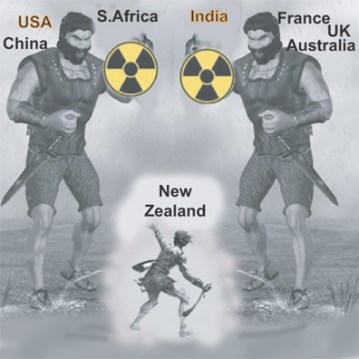
Image source ; https://nuclear-news.net/2010/07/10/online-films-recall-new-zealands-anti-nuclear-battle/
Source: GNS Science – Press Release/Statement:Headline: Scientists gather to focus on nuclear technology cooperation – 31/03/2014
Nearly 50 representatives from 20 countries of the Asia and Pacific region and the International Atomic Energy Agency (IAEA) are in Wellington this week to discuss cooperation and promotion of the many peaceful uses of nuclear technology.
The four-day event at Te Papa between 1 and 4 April is the 36th meeting of the Regional Co-operative Agreement for Research, Development and Training Related to Nuclear Science and Technology for Asia and the Pacific (RCA). It was last hosted in New Zealand in 1997.
Cold nuclear war heats up! UK versus Russian nuclear contracts! China next?
Monday, 31 March 2014
http://www.onenewspage.co.uk/n/Business/750cnmhsz/UK-Russia-nuclear-cooperation-under-review-over-Ukraine.htm
Civil nuclear cooperation between the UK and Russia is under review, as western governments discuss potential sanctions against Moscow over the presence of Russian forces in Ukraine‘s Crimean peninsula, nuclear24 has learned.
A UK government spokesperson said today: “The UK has been very clear that there will be costs and consequences to Russia, and we have already taken some actions such as suspending preparation for the G8 meeting.
Subscription only ( Or free trial) on above link
Shinzo Abe Prime Minister of Japan Addresses RUSI-SPF Conference on UK-Japan Relations
(This is a provisional translation of the speech)
Your Royal Highness Prince Andrew, Duke of York,
Ladies and gentlemen,
I am very grateful to have been invited to this splendid gathering to consider the history of Japan-U.K. bilateral relations and its future path.
I would like to express my respect to Dr. Chiaki Akimoto, Director of RUSI Japan as well as the many others at both RUSI and the Sasakawa Peace Foundation for their great efforts in convening this meeting.
We are very honoured to welcome His Royal Highness Prince Andrews, Duke of York today. I find his attendance here exceptionally gratifying as we advance the development of Japan-U.K. bilateral relations.
This year, the First Sea Lord of the Royal Navy is scheduled to visit Japan soon. As if to coincide with it, visiting Japan also is HMS Daring, one of the most advanced ships of the Royal Navy. It is very regrettable that Prince Andrew will not be able to view the joint activities that might be taking place between Daring and the JMSDF……….
Arnie Gundersen on Al Jazeera Discussing Fukushima Anniversary
Today on Fairewinds’ Film series Fairewinds’ Chief Engineer Arnie Gundersen discusses the ongoing struggle for the people impacted by the ongoing Fukushima Daiichi disaster in his recent interview on Al Jazeera USA
“… small microscopic particles are getting into peoples lungs and the Japanese government is not taking this seriously..”
“… people forced to return..”
“.. destroy the fabric of a country, it happened in Russia and its now happening in Japan ..”
“.. about 400 tons for over a thousand days … until our government tells me whats in the fish i remained very concerned about eating the fish coming from the Pacific ..”
March 27th, 2014
http://fairewinds.org/arnie-gundersen-al-jazeera-discussing-fukushima-anniversary/
The WIPP problem, and what it means for defense nuclear waste disposal
Plutonium 239 is a major safety concern because of its high radiation levels and long half-life—24,100 years. About 200,000 times more radioactive than the commonest naturally occurring uranium, plutonium 239 emits alpha particles as its principal form of radiation. Plutonium inhalation can cause permanent lung damage and even death. When taken in the body, microscopic amounts can penetrate deep into the lungs and deposit, via the bloodstream, in the liver, bones, and other organs.
Robert Alvarez
03/23/2014 –
http://thebulletin.org/wipp-problem-and-what-it-means-defense-nuclear-waste-disposal7002
“It’s a surprise when there are no surprises,” a cleanup worker told me a few years ago at the Hanford site in Washington state, once the world’s largest producer of plutonium for nuclear weapons and now home to a massive effort to stop leaking nuclear waste tanks from poisoning the Columbia River. This maxim can hold painfully true for a variety of events assigned an extremely small chance of happening. On February 4, 2014, assumptions of very low probability crumbled at the Energy Department’s Waste Isolation Pilot Plant (WIPP) near Carlsbad, New Mexico, when a fire in a large salt truck raged for hours, deep underground.
Ten days later, an even more unlikely accident happened: Wastes containing plutonium blew through the WIPP ventilation system, traveling 2,150 feet to the surface, contaminating at least 17 workers, and spreading small amounts of radioactive material into the environment.
More than a month after the fire, WIPP remains closed, and what happened underground remains unclear. It is not known whether the leak and the truck fire are connected; a waste-drum explosion or the collapse of a roof of one of the facility’s storage chambers could be to blame for the radiation event. As Energy Department contractors send robots to explore WIPP’s caverns, the future of the world’s only operating high-hazard radioactive waste repository is uncertain. “Events like this simply should never occur. One event is far too many,” Ryan Flynn, New Mexico’s environment secretary, said immediately after the accident. The US Energy Department, which oversees WIPP, views the fire and leak as simply small bumps in the long road of running a long-term waste repository. “Without question, there is absolutely not an iota of doubt …. We will re-open,” David Klaus, the Energy Department deputy undersecretary, told the public in Carlsbad on March 8. But less than two weeks later, New Mexico seemed to have the last word on the immediate response to the accident, when it cancelled its permit for additional disposal at WIPP.
What WIPP does, and what it contains.
Japan to add 11,000 MW of fossil fuels – Thinking about renewables for 2050? Maybe?
Media reports this week said targets for renewable energy had been inserted into the plan at the insistence of New Komeito, which is opposed to nuclear power.
[…]
Under industry ministry rules in force since 2012, the main monopolies are in general required to hold competitive auctions for any new plants that start operations from April 2019 to reduce costs.
The monopolies can bid for the plants themselves or in alliance with other companies. In some cases, the monopolies can bypass the auctions but will need to pass government screening to ensure costs have been kept at a minimum. Last year’s auction for 2.6 gigawatts of coal-fired plants only attracted bids for 680 MW.

http://www.businessspectator.com.au/news/2014/3/31/energy-markets/japan-add-11000-mw-fossil-fuels
31 March 2014
Japan’s utilities are again stepping up plans to increase electricity output from coal and natural gas to replace lost nuclear power, with a prolonged shutdown of reactors continuing and a rising prospect that many units may not come back online.
This week Tokyo Electric Power Co, operator of the wrecked Fukushima nuclear plant, and other regional monopolies are planning to add 11,000 megawatts (MW) of gas- and coal-fired electrical capacity, according to company announcements and media reports.
The difference this time is that the utilities will seek to contract the building of generators to other companies because their finances have been strained by the high-cost fossil fuels needed to replace nuclear units.
Three years after the Fukushima nuclear crisis all of Japan’s 48 operable reactors remain shut, with no restarts scheduled.
“Given the current unwillingness of the government to have stronger support for nuclear power they have to be prepared for the future replacement,” said Tatsujiro Suzuki, a vice chairman of the Japan Atomic Energy Commision, who is stepping down on Monday.
Opposition within the ranks of the ruling Liberal Democratic Party and its coalition partner New Komeito has held up approval of a basic energy framework draft that defines nuclear power as an important source of energy.
1 This Month

of the week – Shut Down Drone Warfare!


Tell the Ukrainian Government to Drop Prosecution of Peace Activist Yurii Sheliazhenko

Petition to revoke the licensing of the Near Surface Nuclear Disposal Facility (NSDF) at Chalk River. https://www.ourcommons.ca/petitions/en/Petition/Details?Petition=e-7247
To see nuclear-related stories in greater depth and intensity – go to https://nuclearinformation.wordpress.com
-
Archives
- April 2026 (91)
- March 2026 (251)
- February 2026 (268)
- January 2026 (308)
- December 2025 (358)
- November 2025 (359)
- October 2025 (376)
- September 2025 (257)
- August 2025 (319)
- July 2025 (230)
- June 2025 (348)
- May 2025 (261)
-
Categories
- 1
- 1 NUCLEAR ISSUES
- business and costs
- climate change
- culture and arts
- ENERGY
- environment
- health
- history
- indigenous issues
- Legal
- marketing of nuclear
- media
- opposition to nuclear
- PERSONAL STORIES
- politics
- politics international
- Religion and ethics
- safety
- secrets,lies and civil liberties
- spinbuster
- technology
- Uranium
- wastes
- weapons and war
- Women
- 2 WORLD
- ACTION
- AFRICA
- Atrocities
- AUSTRALIA
- Christina's notes
- Christina's themes
- culture and arts
- Events
- Fuk 2022
- Fuk 2023
- Fukushima 2017
- Fukushima 2018
- fukushima 2019
- Fukushima 2020
- Fukushima 2021
- general
- global warming
- Humour (God we need it)
- Nuclear
- RARE EARTHS
- Reference
- resources – print
- Resources -audiovicual
- Weekly Newsletter
- World
- World Nuclear
- YouTube
-
RSS
Entries RSS
Comments RSS
 nuclear-news
