Like Japan, UK seems to be developing an academic ‘Nuclear Village’
The nuclear industry has control of policy in Japan. That’s for sure. I’m just wondering how many other countries are falling under the spell of nuclear industry’s money and influence. Looks as if Britain is well on the way

Closer collaboration announced between the University of Bristol and the National Nuclear Laboratory , University of Bristol 12 Mar 14 The University of Bristol and the UK’s National Nuclear Laboratory have signed a statement of intent to work more closely to explore opportunities in joint research, R&D and training, which will provide support to industry aligned with the Government’s Nuclear Industrial Strategy……..
The Nuclear Research Centre (NRC), formed by the University in partnership with Oxford University in 2011, aims to strengthen nuclear energy related research and teaching in the region to support the delivery of the Government’s strategy on low-carbon, secure energy.
Recently the University has been re-establishing its existing relationships with a number of strategic industrial partners, and this includes the recent signing of a ‘Statement of Intent’ with NNL to support the growing need for a physical research hub in the South West…….http://www.bristol.ac.uk/news/2014/march/national-nuclear-laboratory.html
3 Comments »
Leave a reply to arclight2011part2 Cancel reply
1 This Month
26 April – Chernobyl: Inside the Meltdown airs on National Geographic on Sunday 26th April from 4pm

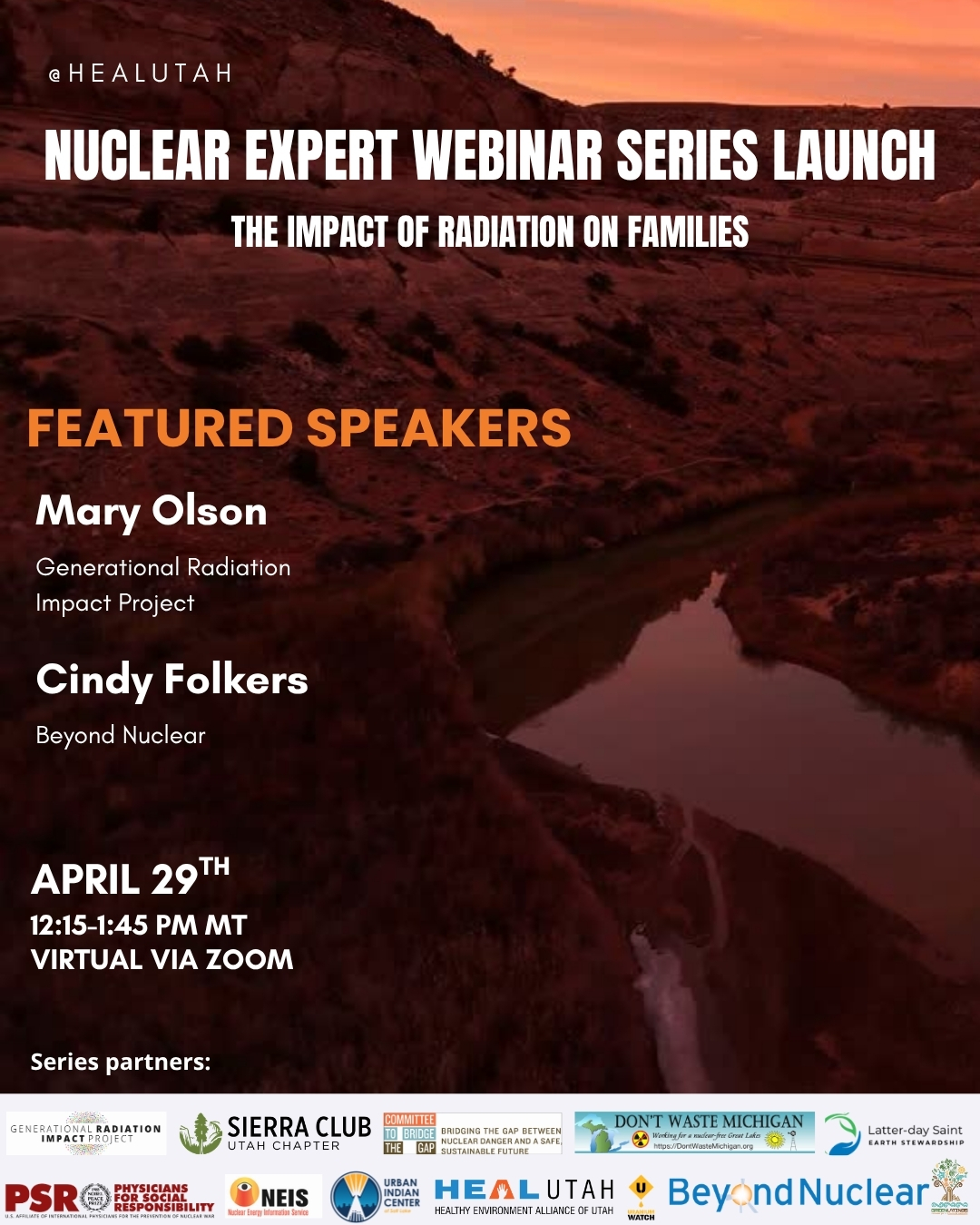
29 April – Nuclear Expert Webinar #1 – Radiation Impacts on Families with Mary Olson and Cindy Folkers
- 12:15 PM MT – 1:45 PM MT
- Location: Virtual – REGISTER TODAY

4 May -West Suburban Peace Coalition to discuss Iran war at May Educational Forum
Monday, May 4, 7:00 – 8:00 PM Central Standard Time
Title: : How Trump’s Narrative Tries to Shape the Reality of the War on Iran.
Contact Walt Zlotow, zlotow@hotmail.com 630 442 3045 for further information
14 May – online event From Bombs to Data Centres: the Face of Nuclear Colonialism

Pine Ridge Uranium is the real threat, not Tehran- Tell Burgum: Stop the Extraction.
Chernobyl: The Lost Tapes – A good documentary on Chernobyl on SBS available On Demand for the next 3 weeks– https://www.sbs.com.au/ondemand/tv-program/chernobyl-the-lost-tapes/2352741955560
To see nuclear-related stories in greater depth and intensity – go to https://nuclearinformation.wordpress.com
-
Archives
- April 2026 (317)
- March 2026 (251)
- February 2026 (268)
- January 2026 (308)
- December 2025 (358)
- November 2025 (359)
- October 2025 (376)
- September 2025 (257)
- August 2025 (319)
- July 2025 (230)
- June 2025 (348)
- May 2025 (261)
-
Categories
- 1
- 1 NUCLEAR ISSUES
- business and costs
- climate change
- culture and arts
- ENERGY
- environment
- health
- history
- indigenous issues
- Legal
- marketing of nuclear
- media
- opposition to nuclear
- PERSONAL STORIES
- politics
- politics international
- Religion and ethics
- safety
- secrets,lies and civil liberties
- spinbuster
- technology
- Uranium
- wastes
- weapons and war
- Women
- 2 WORLD
- ACTION
- AFRICA
- Atrocities
- AUSTRALIA
- Christina's notes
- Christina's themes
- culture and arts
- Events
- Fuk 2022
- Fuk 2023
- Fukushima 2017
- Fukushima 2018
- fukushima 2019
- Fukushima 2020
- Fukushima 2021
- general
- global warming
- Humour (God we need it)
- Nuclear
- RARE EARTHS
- Reference
- resources – print
- Resources -audiovicual
- Weekly Newsletter
- World
- World Nuclear
- YouTube
-
RSS
Entries RSS
Comments RSS
 nuclear-news
Bruce Yardley appointed Chief Geologist
Professor Bruce Yardley (University of Leeds) has been appointed to the new role of Chief Geologist by The Radioactive Waste Management Directorate (RWMD) of the Nuclear Decommissioning Authority (NDA).
Bruce YardleyHe will advise RWMD and its stakeholders on all Earth-science aspects of geological disposal. The appointment is part-time, and will run concurrently with his work as professor in the School of Earth and Environment, University of Leeds.
RWMD Managing Director Bruce McKirdy told Geoscientist: “Professor Yardley has a long standing interest in issues associated with the disposal of radioactive waste. He is recognised internationally for his work in geology and geochemistry and his experience will help us to further develop and explain our plans.
Bruce Yardley said: “Geological disposal is the only internationally recognised permanent solution for dealing with higher activity radioactive waste safely and securely. It is vital that as a country we take responsibility for this legacy waste and focus on finding suitable sites for its long term disposal. I am confident that we have sites in the UK where our geology will effectively isolate our waste, to help safeguard the future for countless generations to come.”
Edmund Nickless, Executive Secretary of the Geological Society, said: “I welcome the appointment of Professor Yardley as Chief Geologist to the NDA-RWMD. Through his work in academia and as a Chartered Geologist, Bruce brings together research and industry perspectives on the geoscience relevant to radioactive waste management. He has made a considerable contribution to the geological life of this country, having been a Council Member and Science Secretary of the Geological Society and recipient of our 2009 Coke Medal. I am sure he will be an equally invaluable source of experience and expertise at the NDA-RWMD. The creation of the new role of Chief Geologist is a significant step forward as the organisation seeks to develop further its geoscience science capability.”
http://www.geolsoc.org.uk/Geoscientist/March-2014/Bruce-Yardley-appointed-Chief-Geologist
Viewpoint – Knowledge is nuclear power
Does the UK need a skills renaissance before it can lead a nuclear new build revolution? Dr Mike Bluck, of Imperial College London and Rolls-Royce Nuclear University Technology Centre, both UK, thinks so.
The UK is now committed to building a fleet of new nuclear reactors to meet both our future energy demands and our responsibility to reduce carbon emissions. In the short term, this involves the construction of established designs such as the French European Pressurised Reactor and, potentially, the GE Hitachi Advanced Boiling Water Reactor. To some, this might suggest that the UK is simply a well-informed customer. But in reality, this is not and never can be the case. There are clear economic and environmental liabilities and the UK has a responsibility to position itself at the very centre of these developments. Consequently, new build has been a trigger for growth across the sector and the UK must gear itself to match these demands.
To support this nuclear renaissance, development and expansion of R&D, regulatory support and supply chain are required. In addition to this commitment to new build, life extension of our current fleet is necessary to bridge the energy gap until the new reactors are on-line. Ultimately, our current ageing fleet of advanced gas-cooled reactors will reach the end of their lives and require decommissioning. In all cases, safe waste management or disposal is required. In the longer term (2025 and beyond), Generation IV systems are envisaged, possessing inherent safety and the potential to burn actinides with a concomitant reduction in waste. Further into the future, nuclear fusion may become a reality – but only if we can develop the advanced materials that these reactors demand. To meet these ends, we require a significantly greater research capability and a cohort of future leaders.
The renaissance in UK nuclear infrastructure over the last decade has led to increased R&D funding from research councils: the setting up of the National Skills Academy for Nuclear, the Nuclear Advanced Manufacturing Research Centre and the Dalton Cumbrian Facility – and a recognised need to spend more on nuclear R&D. Nuclear is an EPSRC energy priority and there have been related improvements in nuclear education over the last decade, including new undergraduate and Masters programmes at Cambridge, Imperial and UCLan, and the National Skills Academy Nuclear Certificate of Nuclear Professionalism.
EPSRC funding of nuclear-related R&D has increased, from a portfolio of £12m in 2005 to £50m in 2014, in recognition of these demands. However, the number of PhD-level nuclear graduates remains small, and despite the creation of a Nuclear EngD programme in 2008, it is considerably lower than the industry’s need. This has led to the recent awarding of significant financial support in the form of two EPSRC-funded Doctoral Training Centres, both supported by a wide range of industrial and regulatory partners, such as EDF Energy, Areva, AMEC, Rolls-Royce, NNL, NDA, Westinghouse and Atkins.
A next-generation nuclear Centre for Doctoral Training (CDT) has been established as a collaboration between the Universities of Manchester, Leeds, Liverpool, Lancaster and Sheffield, and will go some way in bridging this gap. The second nuclear energy CDT is being led by Imperial College, the University of Cambridge and The Open University, and has been awarded £4m by the EPSRC. The centre will build on modelling and experimental capabilities, and enable design improvements to future reactors, new ones to be built and operated more safely, and current reactors to operate for longer. The research conducted here will also support the cleanup and decommissioning of the UK’s contaminated nuclear sites and moves towards more sustainable disposal methods deep underground. It will also train a cohort of PhD students on all aspects of the nuclear fuel cycle, including reactor design, reactor physics, thermal hydraulics, safety, materials performance, ageing, monitoring and waste management.
These are all steps in the right direction. Without highly skilled and trained experts with a global vision and international outlook for the UK’s nuclear industry, regulators, Government and academia, we don’t stand a real chance.
Author : Dr Mike BluckMaterials World Magazine, 01 Mar 2014
http://www.iom3.org/news/knowledge-nuclear-power
UK NUCLEAR – 70% of current senior staff are due to retire in the next 10 years.
….’We in Britain should be leading the nuclear power industry, because we have such a glorious past,’ notes Judge. ‘When I was young, the smartest graduates would want to become nuclear engineers or physicists. Now, the dream is to do an engineering undergrad, then an MBA, then to get shipped off to a bank to become an energy analyst.’….. Lady Barbara Judge 🙂
….The International Energy Agency has estimated that there will be £930bn of investment in new nuclear reactors in the next 20 years, and £230bn in decommissioning and waste storage…..
The business secretary, Vince Cable, added: “We need to sharpen [the UK’s] competitive advantages to become a top table nuclear nation.”
“In 2010, the Climate Change Committee identified the low-carbon technologies the UK should develop and deploy in order to become world leading. The list included offshore wind and marine energy. It did not include nuclear. With the cost of offshore wind predicted to be on par with or cheaper than nuclear by 2020, there is no rationale for distorting policy to prop up the nuclear dinosaur.”
Nuclear-free future not an option for UK energy strategy, says chief adviser
Prof John Beddington affirmed importance of atomic power to UK at the launch of long-term nuclear strategy
Nuclear-free future not an option for UK energy strategy, says chief adviser
Prof John Beddington affirmed importance of atomic power to UK at the launch of long-term nuclear strategy
Damian Carrington
guardian.co.uk, Tuesday 26 March 2013 15.22 GMT
Nuclear-free future not an option for UK energy strategy, says chief advis3r
Prof John Beddington affirmed importance of atomic power to UK at the launch of long-term nuclear strategy
Damian Carrington
guardian.co.uk, Tuesday 26 March 2013 15.22 GMT
Jump to comments (213)
Climategate John Beddington Chief Scientific Adviser to the UK Government
Chief scientific adviser to the UK government, John Beddington, said nuclear power is an important part of the UK’s energy future. May 2009. Photograph: David Wimsett/UPPA/Photoshot
A nuclear energy-free future for the UK is not something the coalition “is thinking seriously about”, the government’s chief science adviser said on Tuesday at the launch of the country’s long-term nuclear strategy.
The government said its nuclear strategy would help seize the economic opportunities of a £1 trillion global market and provide 40,000 UK jobs.
Prof Sir John Beddington, the government’s chief scientific adviser, said new nuclear power was essential: “We really can’t see a future for the UK energy sector, if we are to meet our climate change obligations and have resilience in the power sector, without a significant component of nuclear. A non-nuclear scenario is not one the government is thinking seriously about.”
Beddington led a review of the nuclear research and development programme needed if the government’s high-nuclear scenario for future energy is to be feasible. Prof David Mackay, chief scientific adviser at the department of energy and climate change, said this scenario – one of four set out in the 2011 carbon plan – envisaged 75GW of nuclear capacity in 2050 providing 86% of the UK’s electricity, a situation he compared to France today.
The industrial strategy, welcomed by the nuclear industry which worked with government to develop it, covers every part of the nuclear chain from new build, operations and maintenance and waste management. It includes:
• £15m for new research facilities in the UK.
• Collaboration with the $450m US government programme to build small, modular reactors than can be transported or stacked together.
• £12.5M to join the Jules Horowitz Test Reactor programme being constructed in France to develop future advanced nuclear fuels.
• Examining new technologies including thorium reactors, which cannot meltdown, and fast reactors, which can be fuelled by waste plutonium.
• A focus on training the next generation of nuclear engineers, as 70% of current senior staff are due to retire in the next 10 years.
The energy secretary, Ed Davey, said: “Nuclear and other forms of low-carbon power mean highly skilled jobs and sustainable growth. We need all our energy options in play in the fight against climate change, and to keep the lights on in a way that is affordable to consumers.”
The business secretary, Vince Cable, added: “We need to sharpen [the UK’s] competitive advantages to become a top table nuclear nation.”
Craig Bennett, at Friends of the Earth, said: “The nuclear industry has always over-promised and under-delivered and it is extremely risky for this government to bet the UK’s energy future on new designs of nuclear reactors that we don’t know the cost of and we don’t know will ever be built. In contrast, there are huge opportunities for the government to throw its weight behind renewable and energy efficiency technologies that already exist and are proven to work.”
The government is in the middle of tense negotiations with EDF, the energy company controlled by the French state, over the guaranteed price it will receive for electricity from its two planned reactors at Hinkley Point in Somerset. But Mackay said the government would be committed to future nuclear power even if the EDF deal fell through.
Mackay alluded to the enormous projected cost of the EDF reactors, when describing the attraction of small modular reactors. “One reason for interest in them is that they are easier to finance than the large reactors we have now, so they may be more attractive to the economy,” he said. Beddington added: “There is the potential of synergy by working with the US, which is setting up a large SMR programme. It creates the possibility for piggy-backing on the US work.”
Future decisions on the UK’s energy mix “will depend on political and financial issues”, said Beddington. “Our job was to [recommend the R&D measures needed] to ensure that if the choice was made in future to go for the higher nuclear level, we could do it.” He said his panel had presented some advice to government in December: “The broad response is that it has been accepted.”
Greenpeace’s policy director, Doug Parr, said: “In 2010, the Climate Change Committee identified the low-carbon technologies the UK should develop and deploy in order to become world leading. The list included offshore wind and marine energy. It did not include nuclear. With the cost of offshore wind predicted to be on par with or cheaper than nuclear by 2020, there is no rationale for distorting policy to prop up the nuclear dinosaur.”
Mackay said the approach to dealing with the UK’s 100 tonne stockpile of plutonium was changing from a heavy focus on the mixed-oxide fuel (MOX) approach, a programme which has suffered huge and costly failure in the past, to include consideration of advanced “fast” reactors, which can consume plutonium.
The International Energy Agency has estimated that there will be £930bn of investment in new nuclear reactors in the next 20 years, and £230bn in decommissioning and waste storage.
In January, the government suffered a serious setback when councils in Cumbria rejected a proposal to host a deep geological disposal site. The prime minister, David Cameron, said previously that a permanent waste solution should be in place before new reactors were built.
http://www.guardian.co.uk/environment/2013/mar/26/nuclear-free-future-energy-strategy
A CONVERSTAION WITH A NUCLEAR WORKER
.. thank you for your lengthy and thought out reply, as well as your offer of a tour!! that was most unsuspected.. things are a bit hectic for me in the next couple of weeks but let me think on it..
in response to you email i copied it to aid easy reading of my responses
[I don’t know what ICRP is, but the point I’m driving home is that all your readings are only background count, that you can’t do anything about. All your videos are pointless as they only detect background count. Seeing something rise from 0.20 to 0.3o uSv/hr is still simply background count…]
the icrp is being phased out as the dose model, richard wafeford (ex bnfl sellafield) is working on an internal dose measuring system i believe, in light of the situation in daichi and sorrounds.. your point on dose levels as opposed to density in air is like discussing chalk and cheese imo… and we should also talk content of gases and particlulates…. but there are huge arguments globally on this and i will leave that to the staistitians amongst us.. life is too short!!
[You’re wrong about refuelling dose rate too. Again, there is no measurable increase (not from Sizewell anyway) of dose external to the plant during outages. Again, the figures you’re quoting are background count still.]
in germany they warn the locals if they are refuelling and are going to do a release to allow them to relocate for a couple of days.. especially important for the children and pregnant women.. its very a civilised way of doing this.. i dont agree with the draw a cirle around the plant idea .. something like a NILU weather forecast and plume prediction software should be used.. it would be more effective, imo.. the levels that you manage to stay too are comendable and the worst hits have come from the west of uk during my 6 month video investigation of the largest pollution incidences in the uk for 6 years.. the record was broken at least twice in 2012.. best not to mention the olymipcs eh? 🙂 you might want to skip them videos.. 🙂 i was having a bit of fun after the effects of ionising radiation on my brain (effect reortedly noticed in wildlife in the pypriat regions.. 🙂 )
[I don’t think young people in Croydon are an accurate representation of the national intellect!]
true!! 🙂 you likely have to be slightly disturbed to live down there..
[The nuclear specific training that we provide on site for our operators is better than it’s ever been due to constantly being improved upon and integrating operational experience that wasn’t available 20 years ago. IMO the operators these days are far better trained than earlier ones. What knowledge / experience do you have of current training and previous training to draw your conclusions from?]
i was teaching engineering to socially deprived young people in south and west london.. including croydon area 🙂 specifically as a motor project manager.. did an MA course in Psychology and groupwork, specifically fascillitation and counselling… i am also an old git so my enginnering training was with the @wheel@ and a club hammer//
to explain my point further concerning this, i would point out that in my ten years working with kids in the uk, none knew anything about any engineering from a young age until i engaged them… an interesting couple of projects i was involved with… it might be worth noting that i had kids from 10 to 23 working on one project in Mitcham that was checked by ofsted and found to have exemplary practise.. the project is now a carpark?? and the kids are back to the nintendo/xfactor/facebook lifestyle.. thats my point on uk technical training.. only leaves some private schools with technical teaching from an early age.. but the most talented of those kids will go onto corporate management spots. hope i made my point better on this one?
[Also, although you won’t agree but the evidence is there proving this, the industry transparency is extremely good now. Better than any industry. Our regulator has full access to all our record systems and any investigations that warrant regulator input are published publicly on the ONR website. Nothing is hidden, quite the opposite infact, our management actively encourage and reward people who come clean about things.]
ok !! this is a pretty transparent discussion we are having.. and i dont mean to tar all works with the same brush.. but other peoples coverups are effecting the integrity of the industry globaly.. hope that point was a better attempt at my point.. however i did call sizewell on the day i got a nearly 1 microsievert/hr spike on the back of steady high endwithin YOUR normal variation.. this went on for a couple of days though lessening.. no one knew what a nicrosievert was!! 🙂 should be on your recorded phone records.. 🙂
got me worrying.. i was eventually given to a very surprised engineer who did know about dose but he quickly and efficiently passed me to an …. answer phone!! hehe! how i laughed!! it was an interesting project for those six months.. no one has even attempted to recreate it, and EURDEP will not allow lower readings to be seen.. 😦 which is a shame because it would be cool to track radon and other isotopic clouds.. but my mother always said i was strange?? 🙂
i think it stifles the science when the science is stifled and limited to being defensive.. but i appreciate thats a point we could argue…
[Why wouldn’t people like yourself be found in a nuclear establishment? You say “trust” and “secrecy”? First of, no special clearance is required to work at most plants, and why would the “older” people not be trusted? That’s just ridiculous…]
ok, the clearance point wasnt acurrate.. my main point people would not go into the nuclear trade is because they dont know about it.. i am an enginner and have spent 2 years looking into the ins and outs of nuclear.. and still i am not able to grasp all the differing nuances and technical knowledge that is available.. how can a kid fresh from college hope to get a real feel for engineering when their younger years were bereft of a good technical knowledge base.. there is alot to learn and one of the weaknesses in the nuclear and other industries is compartmentalisation of knowledge.. because of the specific knowledge per job is massive and complicated i suppose compartmentalisation is inevitable.. i think this is a weak spot from a strategy point of view and i suppose it cant be helped..
[You also say that the nuclear management in the UK failed to break from cold war ethos? What do you mean? My company, EDF Energy very quickly sent over workers to help, sent resources and money to help Japan, and we’ve also instigated the Japanese Earthquake Response team (JER) that is spending millions on our own plants to give us more equipment and healthier response to the truly unknown event and beyond design basis stuff that Japan proved can happen. ]
i have been keeping tabs on the japanese governmental and corporate response to daichi. and understand those limitations effecting outside agencies that came to help.. (did your boys get inside reactor 1 building and did they find earthquake damage had caused the meltdown there? just asking?)
however, considering the first five days release data is missing from daichi i am pleased to see the uk as part of the rescue team and that also makes those workers brave and focused.. a good sign in your industry .. imo
i read the european report on the state of british reactors though it was not covered by the media at the time ?? 🙂
[At Sizewell we have a 30 million building being built just to house JCBs, 4x4s, generators, portable pumps etc, that are only for use during those extreme times. They’ll probably never get used, but that’s fine.]
is this the national response team that i heard was being formed because of the report? it will be based in sizewell? would love to check that kit out.. especially the radiological testing vehicle? give me one of them and i will work for you for free.. might need a maths course first 😦 i will check the whole of the uk out before i die!! now that would be transparent!! eh?
ask yer PR advisers.. if the uk is radiologicaly sound it will be advertising you cant buy!! think about it anyway!! 🙂
“They’ll probably never get used, but that’s fine”
seems like a good waste of kit 🙂
[You’re drawing conclusions from thin air. ]
but with a gieger counter 🙂
[If you spent any time at a plant, spoke with the employees, management teams, spoke to the regulator, fully understood how all the process fit together, you’ll realise the situation. ]
point taken..
[I’ll happily give you a tour and show you some of the stuff we do. Our management are very encouraging of opening the plant up and allowing the public to see and understand how it all works. Only then can you draw accurate conclusions on the state of the industry in the UK.]
Fair point and thanks for the offer.. it might be an interesting visit and give you guys a chance to make your case..
i will have to give this some thought and plan a list of questions both technical and i also like the human perspective that is often missing from technical articles.. i really have enjoyed this conversation . thanks for taking the time to respond..
gotta crash now
regards
……………………………………………………………
Following my conversation, i thought you might find this interesting
No chick sexers, please, but Britain needs more nuclear safety engineers
“British graduates from university courses were also too inexperienced to take on senior roles.
Nuclear safety engineers and mechanical engineers in the oil and gas industry were also put on the list as Prof David Metcalf, the committee’s chairman, warned the report raised “important issues concerning the continuing need to upskill British workers, particularly in engineering”.
Companies, universities and the government needed to work together to develop a joined-up strategy as the current programmes were “too fragmented”, he said.”
http://www.telegraph.co.uk/news/uknews/immigration/9873366/No-chick-sexers-please-but-Britain-needs-more-nuclear-safety-engineers.html
were good for sexing chickens though? see what i mean?
‘We in Britain should be leading the nuclear power industry, because we have such a glorious past,’ notes Judge. ‘When I was young, the smartest graduates would want to become nuclear engineers or physicists. Now, the dream is to do an engineering undergrad, then an MBA, then to get shipped off to a bank to become an energy analyst.’
https://nuclear-news.net/2013/02/15/tepco-hires-uk-propaganda-chief/
an interesting subject i am sure you would agree!
regards Arclight
Q147 Stephen Metcalfe: Professor MacKay, can I ask you to cast your mind back to March 2011 and the Fukushima emergency? You would have had a fairly key role to play in that in advising both DECC and SAGE, presumably. Can you tell us what types of advice you were giving them at that time?
Professor MacKay: I am not being modest if I say that I did not play a key role. I was in DECC, and the DECC nuclear team led DECC’s internal 24hour rolling response to the situation. I was on the Scientific Advisory Group for Emergencies-SAGE-chaired by Sir John Beddington. I sat in on those discussions and I asked questions, but there were many far more expert people there. I think the right role for chief scientific advisers in such situations is to make sure that the very best advice is getting through to Government, and that is what Sir John Beddington did. The SAGE meeting had in the room or on the telephone line people from all the relevant Departments, such as Defra, the Department of Health, the Environment Agency, RIMNET and the Food Standards Agency. The Chief Nuclear Inspector was there, and scientific expertise was coming in from the National Nuclear Laboratory, from Imperial College, from the Dalton Nuclear Institute in Manchester and from the Health and Safety Executive. Detailed calculations were done on computers by the Health Protection Agency and the Met Office, with those people working together to analyse what was on the site in Fukushima, what could credibly come out and under what circumstances, where it would go depending on the weather direction, and what the health consequences would then be in the reasonable worst case that we were imagining, which, fortunately, did not come to pass at all. My role was to support John Beddington in ensuring that the right questions were being asked. I chatted with the experts who were there in the room and I kicked the tyres on the evidence they were giving. It was excellent evidence and I feel I was hardly needed, to be honest.
http://www.publications.parliament.uk/pa/cm201213/cmselect/cmsctech/428/120319.htm