Hundreds gather for anti-fracking march in Manchester (PHOTOS, VIDEO)
http://www.shatteringnews.com/hundreds-gather-for-anti-fracking-march-in-manchester-photos-video/

A recent survey carried out by the Manchester Evening News found that 73 percent of Greater Manchester residents are opposed to the controversial gas extraction technique – so on Sunday at noon, up to 1,000 demonstrators gathered in downtown to march from Piccadilly Gardens to Cathedral Gardens.
Many of the speakers and demonstrators included members of the long-standing Barton Moss protest camp in neighboring Irlam, just south of Manchester. There, energy firm IGas is carrying out test drilling to explore potential shale gas reserves beneath the green belt site at Barton Moss.
[PHOTO 7] #Salford Says… Anti #fracking demo #Manchester 09/03/14 pic.twitter.com/sbQzT1sknb
— Sara Firth (@SaraFirth_RT) March 9, 2014
The purpose of the march in Manchester was to send a clear message to the government and energy companies that the vast majority of Britons oppose fracking, Martin Porter, a spokesman for the Barton Moss camp and a member of Frack Free Greater Manchester, told the Manchester Evening News.
“The purpose of the day is to send a message out that we don’t want fracking in Manchester or anywhere else. At the moment, Barton Moss is at the center of attention across the country but before long two thirds of people in England and Wales might find a fracking rig on their doorstep,” Porter said.
[PHOTO 5] ‘Water is Life’. Anti #fracking demo #Manchester 09/03/14 pic.twitter.com/G2vkLZBtQl
— Sara Firth (@SaraFirth_RT) March 9, 2014
A number of campaign groups were represented at the demonstration, including Friends of the Earth, the Green Party, and the Campaign Against Climate Change.
RT reporter Sarah Firth says people at the march complained that there is not enough awareness on fracking and therefore it is dangerous to pursue.
“Clever” Abe sees nothing wrong in Miyakoji district

Anne
Published on 8 Mar 2014
Abe visits Fukushima ahead of March 11 anniversary
Prime Minister Shinzo Abe visited Fukushima Prefecture on Saturday, 3 days before the 3rd anniversary of the earthquake, tsunami and nuclear disasters.
In Tamura City, he met with residents of Miyakoji District. They’ll be allowed to return to their homes on April 1st when an evacuation order for the district is expected to be lifted. It will be the first evacuation order lifted since the nuclear accident.
Remember Fukushima – No to Nuclear Power Mon 10th, Tue 11th & Sat 15th March 2014
Japanese and British citizens join together in London
to mark 3rd anniversary of the Fukushima nuclear disaster
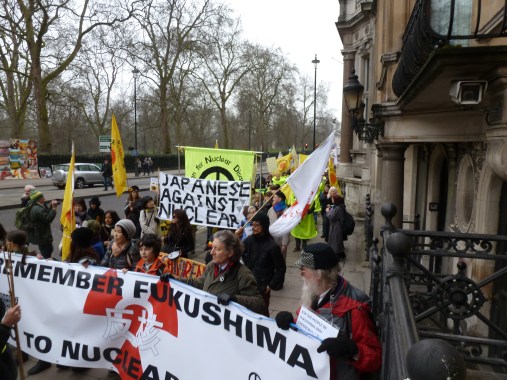
Japanese and UK citizens groups are jointly hosting a series of events in London to mark the third anniversary of the Fukushima nuclear disaster during a week when many similar events are taking place throughout the world. See below for the events details.
Fukushima is an ongoing catastrophe. On 11th March 2011, a massive earthquake triggered the triple melt-down of the Fukushima Daiichi nuclear reactors. 160,000 people were forced to leave their homes. Many are still living in temporary accommodation with little compensation or support. They face a terrible choice between returning to their heavily contaminated homes and villages or abandoning them in order to stay away from contamination. Radiation has entered the biosphere, which directly affects the food chain. A high incidence rate of thyroid cancer has been identified in Fukushima children.
The stricken reactors continue to pour 400 tons a day of highly radioactive water into the Pacific, with no end in sight. Many parts of the reactor buildings are impossible for humans to enter, due to lethal doses of radioactivity. Already weakened, they are in danger of collapse in any further earthquake. This could cause the spent fuels pool to drain and the fuel rods to catch fire. In the worst case scenario, this would lead to the evacuation of half of Japan.
The vast majority of people in Japan now want nuclear power to be abolished. Despite the strength of anti-nuclear sentiment and the high risk of a further apocalypse, the Japanese government is planning to revive nuclear industry, by restarting several nuclear reactors in Japan and exporting nuclear technology to many countries including the UK.
Remember Fukushima! No to nuclear power! The events will send a clear message to governments and people throughout the world that our future must be sustainable.
Further information on the current state of the Fukushima Daiichi can be found here: ENE NEWS or Simply Info
Events details
Public Meeting
7-9pm, Monday 10th March
Committee Room 10, House of Commons
What lessons should we learn from Fukushima?
Expert speakers: Dr Paul Dorfman, Dr David Lowry, Dr Chantal Galhinger.
Citizen speakers: Rik (Kick Nuclear), Geoff Read (Strong Children Japan), nuclear evacuee.
There will be Q&A to and discussion after the speeches.
Candle-lit Vigil
6-8pm, Tuesday 11th March (3rd Fukushima anniversary)
Outside Japanese Embassy, 101 Piccadilly, near Green Park tube station
We will be thinking of people, families and communities affected by the triple disaster.
Programme includes: Fukushima evacuee’s experience, 2 minutes silence, speeches on effects of Fukushima on people and society, songs, Buddhist chanting and open-microphone.
March to the Parliament & Rally
12:30pm, Saturday 15th March Hyde Park Corner to Parliament
Meet: 12:30pm by Hyde Park Corner tube station, near the “Hyde Park” exit for 1pm start. March via Japanese Embassy and offices of Tokyo Electric Power Company (TEPCO – the operator of Fukushima Daiichi), Piccadilly Circus, Trafalgar Square to Parliament.
Rally: 3:00–4:30pm at Old Palace Yard, opposite House of Lords.
Speakers include: fashion designer Katharine Hamnett, Samarendra Das from India’s anti-nuclear power campaign, Fukushima evacuees, campaigners from South West Against Nuclear, Nuclear Free Lakeland & Green Party, letter to Japanese government.
Programme also includes: music, singing, a human chain, a die-in and a minute silence, and open microphone.
Events are jointly organised by
Himawari JAN UK
Kick Nuclear
CND
For further information
In English, contact David Polden (London Region CND) on 0207-607 2302 or david.lrcnd@cnduk.org
In Japanese, contact through website
– ends –
Nevada’s renewable energy boom
Johnson and Salerno: Nevada is cashing in on renewable energy Ken Johnson and Eliza.beth Salerno RGJ.com 9 Mar 14,While Americans know wind and solar energy are clean, they often aren’t aware of the economic success story behind these renewable-energy technologies.
Wind and solar power have economic benefits that reach far and wide. They have become increasingly affordable, attracting billions in private development, and today are both mainstream and reliable energy sources across America.
Nevadans in the eastern part of the state often see something that may at first look to be a mirage: sleek, powerful wind turbines towering over what was once only barren, untapped desert. But the Spring Valley wind farm is as real as the increased revenue to small businesses during the project’s development, the $500,000 in property taxes Spring Valley paid to White Pine County last year and the $275 million in capital investment wind power has attracted to the state so far.
Just west of Las Vegas, the almost 400-megawatt Ivanpah plant is now the world’s largest concentrating solar power plant — and a great example of how smart public policies create new energy infrastructure. The solar Investment Tax Credit, the 1603 Treasury Program and the Bureau of Land Management’s streamlined permitting processes all worked so that 140,000 more homes can use reliable, sustainable and economical solar energy.
There’s more to wind and solar power than the economic and environmental benefits they create for Nevada. These renewable energy sources foster economic benefits across America……….http://www.rgj.com/article/20140309/OPED04/303090007/Johnson-Salerno-Nevada-cashing-renewable-energy
Finland’s Green partner in government maintains anti nuclear stance
Green Minister firm on anti-nuclear power stance UUTISET 8 Mar 14 A majority of the coalition government plans to approve a new permit for the construction of a nuclear plant on northwest Finland. However one of the government’s junior partners – the Green League – says it’s not backing down from its opposition to more nuclear power……. the Greens say they will not renege on their opposition to the construction of new nuclear capacity in Finland. ….http://yle.fi/uutiset/green_minister_firm_on_anti-nuclear_power_stance/7126905
1 This Month

of the week – Shut Down Drone Warfare!


Tell the Ukrainian Government to Drop Prosecution of Peace Activist Yurii Sheliazhenko

Petition to revoke the licensing of the Near Surface Nuclear Disposal Facility (NSDF) at Chalk River. https://www.ourcommons.ca/petitions/en/Petition/Details?Petition=e-7247
To see nuclear-related stories in greater depth and intensity – go to https://nuclearinformation.wordpress.com
-
Archives
- April 2026 (57)
- March 2026 (251)
- February 2026 (268)
- January 2026 (308)
- December 2025 (358)
- November 2025 (359)
- October 2025 (376)
- September 2025 (257)
- August 2025 (319)
- July 2025 (230)
- June 2025 (348)
- May 2025 (261)
-
Categories
- 1
- 1 NUCLEAR ISSUES
- business and costs
- climate change
- culture and arts
- ENERGY
- environment
- health
- history
- indigenous issues
- Legal
- marketing of nuclear
- media
- opposition to nuclear
- PERSONAL STORIES
- politics
- politics international
- Religion and ethics
- safety
- secrets,lies and civil liberties
- spinbuster
- technology
- Uranium
- wastes
- weapons and war
- Women
- 2 WORLD
- ACTION
- AFRICA
- Atrocities
- AUSTRALIA
- Christina's notes
- Christina's themes
- culture and arts
- Events
- Fuk 2022
- Fuk 2023
- Fukushima 2017
- Fukushima 2018
- fukushima 2019
- Fukushima 2020
- Fukushima 2021
- general
- global warming
- Humour (God we need it)
- Nuclear
- RARE EARTHS
- Reference
- resources – print
- Resources -audiovicual
- Weekly Newsletter
- World
- World Nuclear
- YouTube
-
RSS
Entries RSS
Comments RSS
 nuclear-news