Regular Press Conference by Matsumoto Mayor Mr. Sugenoya – Concern for the children of Fukushima
Published on 5 Mar 2014
A frank speech from 27 December 2013 that discusses the experience and lessons of Chernobyl not being accepted by the Japanese Government and organizations such as the IAEA in the crucial early stage of the nuclear disaster.
Mr Sugenoya breaks down the health mistakes that were made and the decisions that continue to be made.
The mistakes and lies of Chernobyl have caused children in Belarus etc to have increasing health problems and congenital defects even though the children are living in the supposed “Low level” contaminated areas.
Mr Sugenoya asks for support for the Fukushima childrens respite project from less contaminated Japanese municipalities.
Nuclear Hotseat #141: Shocking Cancer Stats at Diablo Canyon with Dr. Jerry Brown
http://www.nuclearhotseat.com/1793/
DOWNLOAD HERE:
http://lhalevy.audioacrobat.com/download/7dbd40ca-029c-d65d-d141-a30499b83427.mp3
Libbe HaLevy’s Nuclear Memoir Ebook
#1 in Category on Amazon Kindle 3 Days in a Row!
Buy it here:
 INTERVIEWS:
- Dr. Jerry Brown, director of the Safe Energy Project for the Santa Barbara-based World Business Academy, talks about the new study commissioned from esteemed epidemiologist Joseph Mangano. It reveals shocking cancer statistics in counties adjacent to the Diablo Canyon Nuclear Power Plant. Link to a free pdf of the study: www.WorldBusiness.org
- Don Hancock of Southwest Research and Information Center provides an update on the Valentine’s Day radiation release at the Waste Isolation Pilot Plant (WIPP) in Carlsbad, New Mexico. Thirteen above ground workers now know to have been exposed to Plutonium, Americium. How big was the release and how far did it go? And when will we know? www.sric.org for updates.
– See more at: http://www.nuclearhotseat.com/1793/#sthash.nGC2usVb.dpuf
Greenpeace action in Spain at Garona Nuclear Power Plant

Action in Spain at Garona #nuclear power plant http://t.co/gB85l46r04 #outofage #energy #EU2030
Ow.ly – image uploaded by @greenpeace_esp
France’s expensive battle to manage nuclear wastes

they need to stop making the stuff
How France is disposing of its nuclear waste, 4 March By Rob Broomby British Affairs Correspondent, BBC World Service Half a kilometre below ground in the Champagne-Ardenne region of eastern France, near the village of Bure, a network of tunnels and galleries is being hacked out of the 160 million-year-old compacted clay rocks.
Half a kilometre below ground in the Champagne-Ardenne region of eastern France, near the village of Bure, a network of tunnels and galleries is being hacked out of the 160 million-year-old compacted clay rocks.
The dusty subterranean science laboratory built by the French nuclear waste agency Andra is designed to find out whether this could be the final resting place for most of France’s highly radioactive waste, the deadly remains of more than half a century of nuclear energy.
Emerging from the industrial lift there are a series of passageways about the size of an underground rail tunnel.
The walls are reinforced with steel ribs and sprayed with grey concrete and there are huge bore holes drilled 100m into the rock walls which would hold the capsules of radioactive waste. If the scheme gets the final approval, the first waste could be inserted here in around 10 years.
France generates around three quarters of its electricity from nuclear power but despite decades of activity it is no nearer a solution to the perils of nuclear waste.
Many countries agree the hazardous material – some of it at temperatures of 90C – has to be disposed of deep below ground where it can be isolated from all living things for tens of thousands of years whilst the radiation slowly reduces.
Despite advanced schemes in Finland, not a single country worldwide has an operational underground repository.
“What we did first was to demonstrate that safety can be achieved through a repository in this clay formation,” says Gerald Ouzounian, the head of international affairs for Andra, told Costing the Earth on BBC Radio 4.
Technical test
Since 2006, they have been developing experiments to prove they can do it technically. Equipment has been set up to simulate the heat the waste will generate and to monitor the impact on the clay.
“There are still risks of water ingress especially from the shafts and the top,” says Mr Ouzounian, so they are testing ways to seal the waste using a bentonite clay plug.
French law requires companies to build a retrievable scheme, meaning that for the first few hundred years at least, they can remove the waste again should future generations find a better way to get rid of it.
But it is above ground that the real battle is taking place…….http://www.bbc.com/news/science-environment-26425674
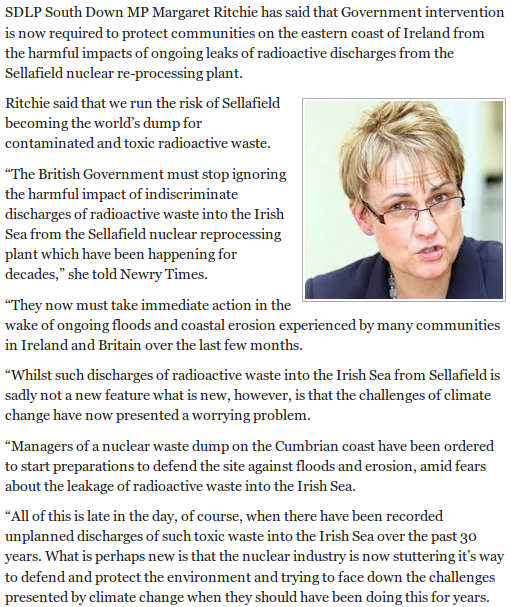
Irish minister slams UK policies at Sellafield and demands action to protect communities!
http://newrytimes.com/2014/03/05/government-action-required-to-protect-communities-from-radioactive-discharge-ritchie/
Posted by Paul Malone
5 March 2014
Impacts of Fukushima nuclear disaster – long-lasting and devastating
Fukushima Three Years On. Devastating Environmental and Health Impacts By Dr. Janette Sherman Global Research, March 04, 201 Counterpunch by Janette Sherman M.D and Joseph Mangano
The third anniversary of the Fukushima meltdown will occur on March 11th. The news is that Prime Minister Shinzo Abe and major Japanese corporations want to re-open the 50 other nuclear power plants that closed when Fukushima blew up, calling them a friendly economic source of cheap power.
Will this end up with business as usual? We were recently asked if we thought that Fukushima could ever be cleaned up. We have to say “no,” based upon what we know of the biology, chemistry and physics of nuclear power and isotopes and the history of nuclear development. Chernobyl melted down in 1986 and is still releasing radioisotopes.
Not all life systems were examined around Chernobyl, but of those that were – wild and domestic animals, birds, insects, plants, fungi, fish, trees, and humans, all were damaged, many permanently, thus what happens to animals and plants with short-term life spans is predictive of those with longer ones.
Worldwide, some 985,000 “excess” deaths resulted from the Chernobyl fallout in the first 19 years after the meltdown. In Belarus, north of Chernobyl, which received concentrated fallout; only 20% of children are deemed to be “healthy” although previously 80% were considered well. How can a country function without healthy and productive citizens? Notable in the U. S. is the Hanford Nuclear Site in Washington State, built some 70+ years ago by 60,000 laborers, and currently leaching radioisotopes into the Columbia River. DuPont was the original contractor, but since, multiple corporations, each paid mllions of dollars and have yet to contain the leaking radioactivity.
Every nuclear site is also a major industrial operation, contaminated not only with radioactive materials, but multiple toxic chemicals, such as solvents and heavy metals……..
Fukushima is still leaking large quantities of Cs-137 and Sr-90 into the Pacific Ocean, where all forms of marine life will absorb them – from algae to seaweed, to fish, to sea mammals and ultimately to humans who consume the contaminated sea life. Our recently released peer-reviewed paper confirms hypothyroidism in newborns in California, whose mothers were pregnant during the early releases from Fukushima. Thyroid abnormalities were detected early in Marshall Islanders and in Belarus residents of Gomel located near Chernobyl.
Radioactive iodine, known to interfere with thyroid function entered the U. S. from Fukushima in late March, shortly after the meltdowns, and was carried by dairy products resulting in damage to the unborn. It takes ten half-lives for an isotope to decay. Sr-90 and Cs-137 have half-lives of approximately 30 years, which means three centuries will occur before the initial releases are gone, and the releases have not stopped. There are some 26 nuclear reactors in the United States with the same design as those at Fukushima, and they pose a significant risk to people and the environment……..
The Indian Point Nuclear Power Reactors are located some 35 miles from mid-town Manhattan, with 18 million people living within 50 miles of the site.What would be the environmental, human and economic costs if the Indian Point reactors were to fail? The current estimated price tag to “clean up” the TEPCO mess at Fukushima is $500 billion (that’s billion, with a “B.”
For us who have trouble thinking of such numbers, it will take 96,451 years to spend $10.00 per minute. Unless we close the existing nuclear power plants and build no new ones, we are destined to repeat the on-going stories of Fukushima, Chernobyl, Three Mile Island in Pennsylvania, and the myriad other sites that have already caused untold environmental, health, social, and economic costs. So will it be sanity or business as usual? Perhaps it was Albert Einstein who defined insanity as doing the same thing over and over and expecting a different result.
We must choose a sane path away from nuclear energy. Business as usual is insane.
Janette D. Sherman, M. D. is the author of Life’s Delicate Balance: Causes and Prevention of Breast Cancer and Chemical Exposure and Disease, and is a specialist in internal medicine and toxicology. She edited the book Chernobyl: Consequences of the Catastrophe for People and Nature, written by A. V. Yablokov, V. B., Nesterenko and A. V. Nesterenko, published by the New York Academy of Sciences in 2009. Her primary interest is the prevention of illness through public education. She can be reached at: toxdoc.js@verizon.net and www.janettesherman.com
Joseph Mangano, MPH MBA, is the author of Mad Science (pub. 2012) as well and many articles on the effects of nuclear power. He is an epidemiologist, and Executive Director of the Radiation and Public Health Project and can be reached at: (www.radiation.org). http://www.globalresearch.ca/fukushima-three-years-on-devastating-environmental-and-health-impacts/5371907
Ukraine worried about security of its nuclear reactors
Ukraine says stepping up protection of nuclear plants
VIENNA Tue Mar 4, 2014 (Reuters) – Ukraine is reinforcing the protection of its nuclear power plants, it told the U.N. atomic watchdog on Tuesday, because of “a grave threat to the security” of the country posed by the Russian military…….http://www.reuters.com/article/2014/03/04/us-ukraine-crisis-iaea-idUSBREA231V820140304
Japan’s nuclear safety chief promises local monitoring of radiation
NRA’s Tanaka pledges radiation information The Yomiuri Shimbun, 4 Mar 14, Shunichi Tanaka, chairman of the Nuclear Regulation Authority, has promised to provide local governments situated near certain nuclear plants with information concerning the possible diffusion of radioactive substances in the event of a nuclear accident. The plants are those to which priority will be given in carrying out safety checks aimed at reactivation.
In a recent interview with The Yomiuri Shimbun, ahead of the third anniversary of the start of the nuclear crisis at Tokyo Electric Power Co.’s Fukushima No. 1 nuclear power plant, Tanaka said: “Discussing plans for evacuating residents on the premise of an infinitely large-scale accident is impossible. We’ll offer a database to help residents make their own decisions more easily.”
The policy is to aid local governments in compiling comprehensive disaster-prevention plans.
The central government’s Nuclear Emergency Response Guidelines oblige local governments within a 30-kilometer radius of a nuclear power plant to draft disaster plans…..http://the-japan-news.com/news/article/0001087254
How countries cope, or don’t cope, with nuclear wastes
that they should stop making the stuff
How France is disposing of its nuclear wastes, 4 March By Rob Broomby British Affairs Correspondent, BBC World Service“…..Repository plans have foundered in Britain and America due to local democratic opposition.
Britain copied the Scandinavian model based on voluntarism which allowed local communities to opt in but also built confidence by giving them a right to say no.
The British scheme was set to explore an underground laboratory in Cumbria near the Sellafield nuclear site. The local district council approved the scheme but the strategic authority – the council in Carlisle – blocked it in January 2013, sending the nuclear planners back to the drawing board.
A UK Government white paper to be published in the summer is widely expected to tweak the approval process to curb a county council’s influence. The hunt is now on for a new location.
In France, the cash was the answer. They are already spending £50m ($80m / 60m euros) every year to support local community projects and massage consent in what is a sparsely populated and neglected area.
They even arranged the underground laboratory to ensure its two entrances were in different communities so they could pay them both off and ensure wider approval.
“I supported the laboratory from the start and I won’t go back on that now,” says the local mayor Francois Henri. But he admits that if his community had wanted to block the project there would be little they could do to stop it.
“It is a project which is of national interest. Nobody has the power to stop or to block it,” says Gerald Ouzounian………
In France, the cash was the answer. They are already spending £50m ($80m / 60m euros) every year to support local community projects and massage consent in what is a sparsely populated and neglected area.
They even arranged the underground laboratory to ensure its two entrances were in different communities so they could pay them both off and ensure wider approval.
“I supported the laboratory from the start and I won’t go back on that now,” says the local mayor Francois Henri. But he admits that if his community had wanted to block the project there would be little they could do to stop it.
“It is a project which is of national interest. Nobody has the power to stop or to block it,” says Gerald Ouzounian………http://www.bbc.com/news/science-environment-26425674
Union awaits info on leak at New Mexico nuke dump
WIPP officials say they have yet to determine what caused the leak. The results of more air, soil, vegetation and water samples are expected in the coming days.
http://www.washingtontimes.com/news/2014/mar/4/union-awaits-info-on-leak-at-new-mexico-nuke-dump/
ALBUQUERQUE, N.M. (AP) – A union representing some 200 workers at the nation’s only underground nuclear waste dump said Tuesday its wants to be sure employees are safe when the repository reopens after a radiation leak that exposed at least 13 people.
The Waste Isolation Pilot Plant near Carlsbad has been off-limits to most workers for nearly three weeks. Only essential workers have been called to duty and others have been using the down time to keep current with regular training requirements at an off-site training center, said officials from United Steelworkers of America.
Union officials said they’re waiting for more information from the U.S. Department of Energy and Nuclear Waste Partnership LLC, the contractor that runs the repository.
“What we’re trying to understand is what happened, where this contamination came from and then understand how to correct this problem and make certain that something similar is not going to happen again,” said Jim Frederick, assistant director of the union’s health, safety and environment department.
Some of the 13 workers who were exposed during the Feb. 14 night shift were union members. Another 140 employees showed up for work the following day, and union officials say if there’s any doubt about whether they were exposed, more tests should be done.
Greenpeace report says that ageing nuclear reactors threaten a new era of risk for Europe
Today’s actions coincide with the launch of a major new independent report (1) commissioned by Greenpeace that exposes the scale of Europe’s ageing nuclear stock. The report found that out of 151 operational nuclear reactors in Europe (excluding Russia), 67 are more than 30 years old, 25 more than 35 years and seven of them over 40 years.
Analysis in the report shows that 44% of European nuclear reactors are over thirty years old. The average age across Europe is now 29 years, while a typical design lifespan of a reactor is 30 or 40 years. These findings raise the prospect of a new era of nuclear risk across Europe unless governments resist calls for reactors to be operated beyond their intended lifetimes.
Commenting of the report’s findings, one of the co-authors Jan Haverkamp said:
By asking to extend the lifetimes of their old and deteriorating nuclear power plants, the big European electricity companies are simply hoping to extract more profit from their nuclear cash cows, while leaving Europe’s citizens facing greater risks and enormous consequences in the event of an accident.’
‘The lifetime extension of European nuclear reactors would lock us into an old and dangerous energy source for decades. When they meet to discuss energy policy at a summit in late March in Brussels, European leaders must seize the opportunity to end the age of risk and pollution and support a binding renewables target to hasten the age of clean energy.’
The new report looks at the technical risks of ageing nuclear reactors and considers the economic and political factors relevant to reactor lifetime extension. It makes clear that in spite of upgrades and repairs, the overall condition of nuclear reactors deteriorates in the long term, not least because components key to safety such as the reactor pressure vessel and containment cannot be replaced. The likelihood of an accident and the number of potential complications therefore increase over time. However, decisions whether to extend the lifetimes of old reactors may be swayed by economic and political arguments, since old reactors have already paid back on their capital costs.
1 This Month


18 March Webinar @ 1 PM EST: An Assessment of SMR Projects: The Case of Canada
register for the zoom:
https://us02web.zoom.us/webinar/register/WN_o8BIIOUvQ2ONJR1nta65DQ#/registration


of the week – STOP SMALL MODULAR REACTORS IN CANADA
To see nuclear-related stories in greater depth and intensity – go to https://nuclearinformation.wordpress.com
-
Archives
- March 2026 (141)
- February 2026 (268)
- January 2026 (308)
- December 2025 (358)
- November 2025 (359)
- October 2025 (376)
- September 2025 (258)
- August 2025 (319)
- July 2025 (230)
- June 2025 (348)
- May 2025 (261)
- April 2025 (305)
-
Categories
- 1
- 1 NUCLEAR ISSUES
- business and costs
- climate change
- culture and arts
- ENERGY
- environment
- health
- history
- indigenous issues
- Legal
- marketing of nuclear
- media
- opposition to nuclear
- PERSONAL STORIES
- politics
- politics international
- Religion and ethics
- safety
- secrets,lies and civil liberties
- spinbuster
- technology
- Uranium
- wastes
- weapons and war
- Women
- 2 WORLD
- ACTION
- AFRICA
- Atrocities
- AUSTRALIA
- Christina's notes
- Christina's themes
- culture and arts
- Events
- Fuk 2022
- Fuk 2023
- Fukushima 2017
- Fukushima 2018
- fukushima 2019
- Fukushima 2020
- Fukushima 2021
- general
- global warming
- Humour (God we need it)
- Nuclear
- RARE EARTHS
- Reference
- resources – print
- Resources -audiovicual
- Weekly Newsletter
- World
- World Nuclear
- YouTube
-
RSS
Entries RSS
Comments RSS
 nuclear-news