Deceptive fog in information about Fukushima radiation
To stem any such public anxiety, TEPCO and Japanese government officials minimized the damage at Dai-ichi and assured its population that the situation was certainly not another Chernobyl. Untrue. In important ways, the Japan situation is worse: …
The good news is that there is some movement as citizens, news media and public officials are starting to demand answers about Fukushima radiation. The bad news is that it’s difficult to pry out documented facts from TEPCO and/or the Japanese government as both continue to stonewall requests for information.
it’s way beyond time for a full-court-press approach by the U.S. and global community to challenge what may be a whitewashed cover-up, and with intensified scientific research and accurate figures and diagnosis, to get to the bottom of what’s happening at the Fukushima Dai-ichi power plant. Doing nothing is not an option.
 Cutting through Fukushima Fog: Radiation in U.S. Bernard Weiner, Dissident Voice March 3rd, 2014 Governments cite “national security” concerns and “official secrets” as their justification for withholding information from the public. Corporations rationalize their secrecy behind concerns about “patent infringement,” shielding their trademarked “proprietary” secrets from competitors. But most of the time, such obfuscation is really derived from the time-honored villains of systemic corruption and what is politely known as CYA in military and bureaucratic slang.
Which brings us to Fukushima.
From the very beginning of this catastrophic emergency — the earthquake/tsunami off the Japanese coast in March of 2011, when nuclear reactors at a power plant were flooded and then exploded and began their meltdowns — the public in Japan and around the world have not been told the full story of what’s been happening at the Dai-ichi nuclear-power plant in Fukushima province.
The utility that runs the plant, TEPCO (Tokyo Electric Power Company), is notoriously close-mouthed about its operation. To this day, aided by a recently passed “government secrets” act in Japan, we have no confirmable idea of the extent of the damage: how much radiation is really leaking out into the Pacific Ocean and where the currents are taking it, the density and direction of the radioactive plumes carried by the wind, the radioactive effects up and down the marine food-chain. Not only is there precious little data-reporting released to the public — journalists who violate the “state secrets” law can be thrown into prison for 10 years — but what little information that does appear, both in Japan and in the U.S., seems to be hidden inside a different language, with a vocabulary(“bequerelles,” “millisieverts,” “millirems,” the difference between “radiation,” “radioactive” and “radiation dose,” and so on) that is utterly confusing to most non-nuclear scientists.
Beware the Hyperbole
Each side of the argument tends to go hyperbolic when presenting its version of the Fukushima catastrophe. TEPCO officials regularly suggest that all is proceeding well at Dai-ichi, and that the radiation effects are mostly localized and things should go back to normal in the foreseeable future. But other scientists and journalists have concluded that the situation is critical, getting worse and is increasingly dangerous to humanity.
The issue of radiation on the loose is a scary one, and has an economic component as well as a social-psychological one that could convince governments to tone down news that carries with it the possibility of instigating mass panic and anxiety-induced mass migrations. A lot is at stake — economic stability, the U.S.-Japan alliance, cancer clusters, etc. — so it’s not surprising that each side is passionately trying to capture and control the narrative.
TEPCO, for example, often dispenses flat-out lies, whoppers that have to be “corrected” much later; for example, earlier this month, TEPCO admitted that the strontium-per-liter level leaking from Dai-ichi reactor #1 was five times higher than its earlier estimate. (Note: Strontium-90′s half-life is around 29 years. It mimics calcium and goes to our bones.)……….
Deficient thinking. TEPCO is a for-profit company. Bad news would hurt the corporation. No news is better for the bottom line. It became evident even in the early hours and days of the meltdown that the utility spokesmen and their government supporters were telling lies, withholding key facts about nuclear dangers and radiation leakages, putting the best face on a momentously dangerous situation. But even from a distance, and still true today, the meager information that was gleanable from Dai-ichi seemed to indicate an ad hoc, chaotic and incompetently-managed plan to contain the crisis. At the very least, public safety concerns cry out for an international (United Nations? IAEA?) body of radiation experts and engineers to run the dangerously-damaged power plant, but there is little action, or even a sense of urgency expressed, for such a solution.
To stem any such public anxiety, TEPCO and Japanese government officials minimized the damage at Dai-ichi and assured its population that the situation was certainly not another Chernobyl. Untrue. In important ways, the Japan situation is worse: the Chernobyl reactors were housed inland and eventually were buried within a cement sarcophagus; Dai-ichi, with its reactors melting down, is still actively releasing radiation into the air and into the bay/ocean (and probably the aquifer) where it sits, and there is no reported plan for how the leaking reactors might be encased. In addition, thousands of spent fuel rods at Dai-ichi, still highly radioactive, are being moved, one by one over several years, to a “safer location,” in a project never before tried anywhere on earth. One bad accident and/or another major earthquake in the vicinity, and a radiological cataclysm could occur.
U.S. Sailors Radiated…….some news did get out in public. According to recently revealed U.S. Navy documents, more than 70 sailors on the Navy helicopters or among those who serviced those copters on the aircraft carrier USS Reagan suffered major radiation exposure, even after the ship was moved 100 miles away from Fukushima. The sailors’ health complaints are consistent with victims who have suffered major radiation exposure. Neither the Japanese nor South Korean nor Guam governments would permit the Reagan to dock as it was radioactively “hot.” The affected members of the crew have an ongoing civil suit for one-billion-dollar damages pending against TEPCO…….
Good News/Bad News
The good news is that there is some movement as citizens, news media and public officials are starting to demand answers about Fukushima radiation. The bad news is that it’s difficult to pry out documented facts from TEPCO and/or the Japanese government as both continue to stonewall requests for information. (And Japan’s government is talking about re-opening more than 30 nuclear reactors across Japan.)
Despite the informational blackout, the following admission came five months ago from TEPCO executive-level fellow Kazuhiko Yamashsita: “I’m sorry, but we consider the situation is not under control.” Another Japanese nuclear engineer, Yastel Yamada, said that TEPCO is way over its head: “The cleanup job is too large for their capability.”……
What the U.S. could do…..Given the diametrically conflicting views of the Fukushima disaster, it’s way beyond time for a full-court-press approach by the U.S. and global community to challenge what may be a whitewashed cover-up, and with intensified scientific research and accurate figures and diagnosis, to get to the bottom of what’s happening at the Fukushima Dai-ichi power plant. Doing nothing is not an option. http://dissidentvoice.org/2014/03/cutting-through-fukushima-fog-radiation-in-u-s/
1 Comment »
Leave a reply to Anonymous Cancel reply
1 This Month
26 April – Chernobyl: Inside the Meltdown airs on National Geographic on Sunday 26th April from 4pm
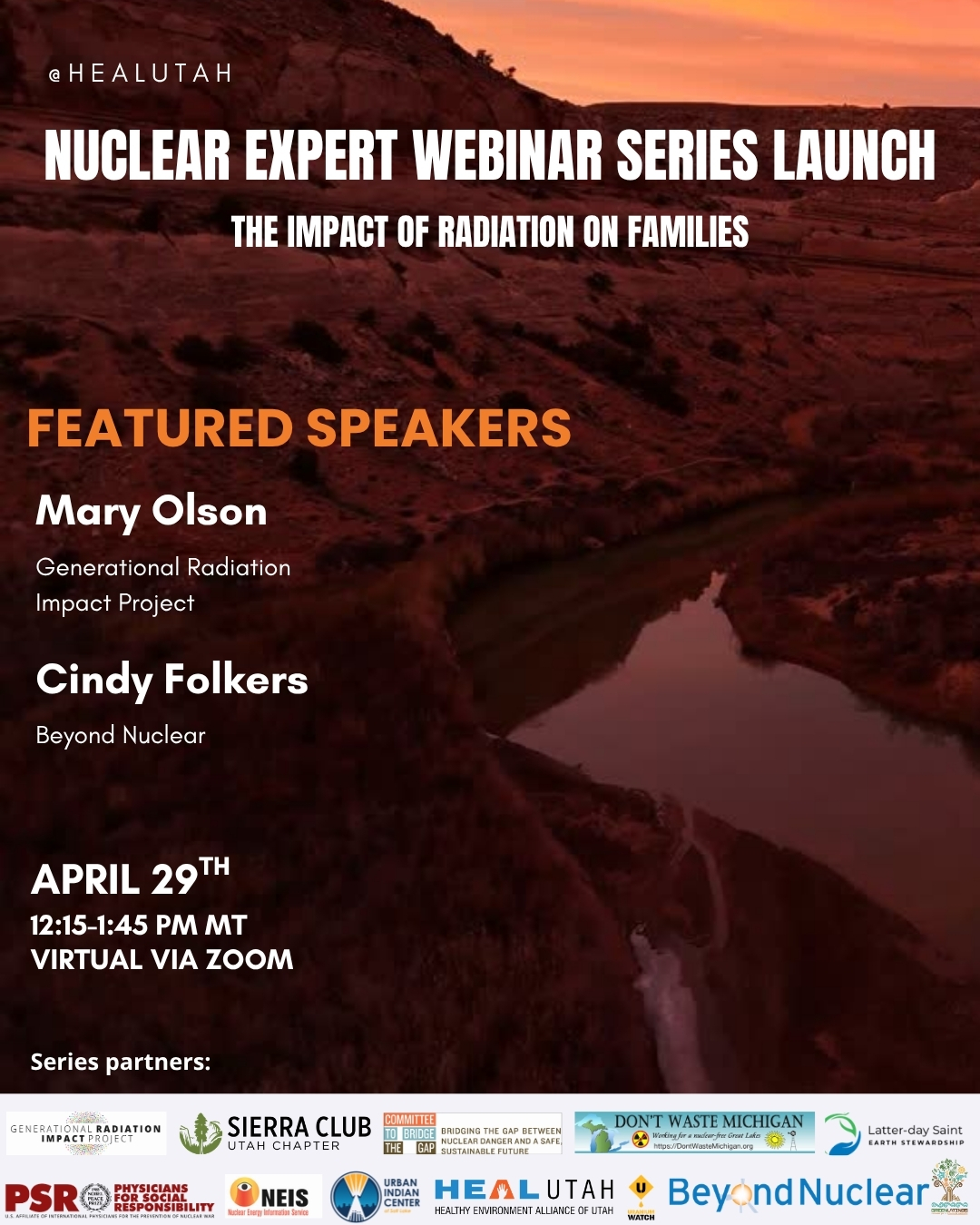
29 April – Nuclear Expert Webinar #1 – Radiation Impacts on Families with Mary Olson and Cindy Folkers
- 12:15 PM MT – 1:45 PM MT
- Location: Virtual – REGISTER TODAY

4 May -West Suburban Peace Coalition to discuss Iran war at May Educational Forum
Monday, May 4, 7:00 – 8:00 PM Central Standard Time
Title: : How Trump’s Narrative Tries to Shape the Reality of the War on Iran.
Contact Walt Zlotow, zlotow@hotmail.com 630 442 3045 for further information
14 May – online event From Bombs to Data Centres: the Face of Nuclear Colonialism

Pine Ridge Uranium is the real threat, not Tehran- Tell Burgum: Stop the Extraction.
Chernobyl: The Lost Tapes – A good documentary on Chernobyl on SBS available On Demand for the next 3 weeks– https://www.sbs.com.au/ondemand/tv-program/chernobyl-the-lost-tapes/2352741955560
To see nuclear-related stories in greater depth and intensity – go to https://nuclearinformation.wordpress.com
-
Archives
- April 2026 (317)
- March 2026 (251)
- February 2026 (268)
- January 2026 (308)
- December 2025 (358)
- November 2025 (359)
- October 2025 (376)
- September 2025 (257)
- August 2025 (319)
- July 2025 (230)
- June 2025 (348)
- May 2025 (261)
-
Categories
- 1
- 1 NUCLEAR ISSUES
- business and costs
- climate change
- culture and arts
- ENERGY
- environment
- health
- history
- indigenous issues
- Legal
- marketing of nuclear
- media
- opposition to nuclear
- PERSONAL STORIES
- politics
- politics international
- Religion and ethics
- safety
- secrets,lies and civil liberties
- spinbuster
- technology
- Uranium
- wastes
- weapons and war
- Women
- 2 WORLD
- ACTION
- AFRICA
- Atrocities
- AUSTRALIA
- Christina's notes
- Christina's themes
- culture and arts
- Events
- Fuk 2022
- Fuk 2023
- Fukushima 2017
- Fukushima 2018
- fukushima 2019
- Fukushima 2020
- Fukushima 2021
- general
- global warming
- Humour (God we need it)
- Nuclear
- RARE EARTHS
- Reference
- resources – print
- Resources -audiovicual
- Weekly Newsletter
- World
- World Nuclear
- YouTube
-
RSS
Entries RSS
Comments RSS
 nuclear-news
[…] […]
Pingback by Anonymous | March 4, 2014 |