What Tokyo has to look forward to when the fascist Olympics come to town – Persecution!

Yevgeny Vitishko, the Russian environmentalist who drew damning attention to gross ecological violations surrounding the Sochi 2014 Olympics today was transferred from administrative custody to an unknown prison colony to serve three years for spray-painting a fence.
But for several hours, he his whereabouts were completely unknown to activists, his family and police and corrections officials refused to discuss it. His release from jail in Tuapse, 72 kilometers northwest of Sochi – where he was held for 15 days on trumped up charges of swearing in public – was supposed to have occurred at 1:20 pm local time.
He would have then been allowed to return to his home, see his family and collect his personal affairs before being transferred to the prison colony for the next three years.
Instead, it was finally tentatively confirmed three hours later that he had been transferred earlier in the day to Krasnodar, the capital of the Russian region where the Olympics are being held – a violation of the conditions of his transfer as established by the Krasnodar regional court on February 12.
Judges in Krasnodar said Vitishko would not only be allowed to return home prior to going to the penal colony, but that he would be released from the Tuapse jail on his own recognizance to see his family, collect his things and then turn himself into penal colony correctional officials.
According to Dmitry Shevchenko, a fellow activist of Vitishko’s at the Environmental Watch on the North Caucasus, Vitishko should have been released at 1:20. Activists and well wishers as well as Norway’s TV2 had gathered for his release.
But when he failed to appear, no one could get a straight answer from jail officials as to Vitishko’s whereabouts.
Shevchenko told Bellona in a telephone interview that Vasily Vinishenko, the head of the local detention center in Tuapse where Vitishko was being held, told waiting activists that Vitishko had already been sent to Krasnodar.
During a call to the duty officer at the Tuapse jail by Shevchenko, he was told Vitishko was still in the custody of the detention facility.
The duty officer told Shevchenko in yet a later telephone call to the jail that Vitishko had been released at 1:24 pm local time.
At the same time, Vitishko’s wife, Larisa, received a call from the Tuapse jail. She told Bellona that a duty officer there had informed her Vitishko had been freed, but then immediately detained again.
Øystein Bogen, a reporter with TV2 news in Norway, who had been sent to cover the release of Vitishko, posted on his twitter account at 2:10 pm local time that, “Vitisko vanished without a trace from remand detention in Tuapse. The police cannot account for where he is.”
URGENT! LOCK THE GATE ON NUCLEAR WASTE: LILLYHALL LANDFILL

Beneath the Dark Mountain, lies the Dark Secret… the earth is Unearth – and can never be unearthed.

TODAY Workington made a stand against higher activity low level nuclear waste arriving in tipper trucks to be dumped in plastic bin bags into Lillyhall landfill.
Over 100 people stopped to sign letters to Cumbria County Council ”why should we have it on our door step!” was the cry !
Secretary of State Ed Davey has told campaigners that the landfill site has already been awarded a permit by the Environment Agency (over the heads of local councillors and the public) to take High Volumes of building rubble from decommissioning activities “primarily from Sellafield”. Asbestos laced with tritium will also be arriving from Chapel Cross in Scotland with a “controlled release of radioactivity to ground waters.” This is acceptable to government so long as it does not leak to other European countries: “The proposal was also subject to Article 37 of the Euratom Treaty which requires Member States to provide the Commission with general data so that they may give an opinion on whether the proposal is likely to have an impact on other Member States. The opinion of the Commission in this case was that it would not. The Commission visit ion the site in 2013 and reported that they were content with what they saw.” WE ARE NOT CONTENT WITH WHAT WE SEE which is the dispersal of radioactivity to our environment by all means possible including dumping radioactive wastes into landfill.
PLEASE TAKE ACTION TO PREVENT CONTAMINATION OF OUR GROUNDWATER WITH RADIOACTIVE WASTES
JOIN THE DEMO OUTSIDE COUNTY OFFICES KENDAL from 10am Wednesday 26th February
Public “relatively safe” from Fukushima, IAEA says
Feb. 18, 2014
VIENNA, Feb. 18 (UPI) — The International Atomic Energy Agency said work remaining at Japan’s crippled Fukushima nuclear site will be challenging but the public is “relatively” safe.
“In general, it is expected that the situation onsite will remain very challenging as the recovery operations progress,” the United Nations’ nuclear watchdog group said in a statement Monday.
“Based on “the information” that has been made available, the IAEA considers that all members of the public are safe and that the food supply is safe and is being appropriately managed.”
Last week, Tokyo Electric Power Co., the plant’s operator, reported high levels of the radioactive element Cesium in groundwater samples near monitoring wells associated with the plant.
A 13-page report from the IEA said Monday monitoring of the air around the plant detected “no significant” increase in radiation levels.
A 9-magnitude earthquake and tsunami crippled the nuclear facility in 2011. Environmental groups like Greenpeace accused the Japanese utility company of failing to manage cleanup operations effectively.
REFILE -Japan to fast-track some nuclear restarts; may break logjam
..NRA chairman Shunichi Tanaka said comments by Motegi or pressure from utilities did not affect decisions by the regulator. “This has absolutely no impact on our review,” he said. “There is no chance we will be swayed.”…
http://www.reuters.com/article/2014/02/19/japan-nuclear-restarts-idUSL2N0LO0DQ20140219
Feb 19 (Reuters) – Japan will fast-track the restart of some nuclear reactors, the regulator said on Wednesday, potentially breaking a logjam that has kept the country without nuclear power in the wake of the 2011 Fukushima disaster.
Making a priority list for a few nuclear plants will move them forward in an approval process that has become bogged down in laborious safety checks and paperwork.
It remains unclear when any of Japan’s 48 reactors could come back on-line, but fast-tracking the process is good news for the nuclear industry, which had been hoping to begin the restarts by the middle of this year.
The Nuclear Regulation Authority (NRA), an independent body created in 2012, said it will craft a priority list of plants that meet its earthquake and tsunami criteria as early as next month, selecting a few to expedite from six pressurised water reactors run by Kansai Electric Power Co, Kyushu Electric Power, Hokkaido Electric Power and Shikoku Electric Power.
Japan’s nuclear shutdown has forced the resource-poor nation to import costly fossil fuel, pushing the economy into a record 18 months of trade deficits.
Post-tsunami deaths outnumber disaster toll in Fukushima caused by depression
….However, with the aid of magnetic resonance imaging (MRI), EEG and positron emissions tomography (PET) it is possible to prove that cerebral changes in Chernobyl liquidators and veterans of the first Gulf War, as well as the war in Bosnia, are very similar….(Ratical article below)
…Campaigners say the sense of impermanence and the fracturing of families and communities has led to a marked increase in medical problems among evacuees, especially mental illnesses like depression….
….While both Iwate and Miyagi suffered higher tolls in the initial disaster, the number of indirect deaths in both prefectures is lower than in Fukushima, at 434 and 879 respectively.
The small Fukushima city of Minamisoma has been the worst-hit, with 447 deaths indirectly blamed on the disaster, followed by 317 in Namie town and 225 in Tomioka town….
http://www.channelnewsasia.com/news/asiapacific/post-tsunami-deaths/1006448.html
Health complications stemming from Japan’s 2011 tsunami have killed more people in one Japanese region than the disaster itself, the local authority said on Thursday.
TOKYO: Health complications stemming from Japan’s 2011 tsunami have killed more people in one Japanese region than the disaster itself, the local authority said on Thursday.
Data compiled by officials and police show that almost three years after the huge waves smashed ashore, 1,656 people living in Fukushima prefecture have died from stress and other illnesses related to the disaster, compared with 1,607 who were killed in the initial calamity.
“The biggest problem is the fact that people have been living in temporary conditions for so long,” Hiroyuki Harada, a Fukushima official dealing with victim assistance, told AFP.
“People have gone through dramatic changes of their environment. As a result, people who would not have died are dying,” he said.
Along with the prefectures of Miyagi and Iwate, Fukushima was one of the worst hit parts of Japan when a huge 9.0 undersea earthquake sent a wall of water barrelling into the coast.
The waves swept more than 18,000 people to their deaths across the country, and destroyed entire communities.
Fukushima was also hit with the resulting nuclear disaster after cooling systems at the Daiichi nuclear plant were knocked out, sending reactors into meltdown and forcing the evacuation of tens of thousands of people.
Almost three years on, many people remain displaced, whether because their homes around the power plant have not been declared safe or because rebuilding along the coast has been slow.
Officials say that as well as those who died in the early stages of the disaster, through lack of initial care because medical facilities were hobbled, a growing number of people are dying from the physical and mental stress of staying at shelters, including through suicide.
Physical and mental stress
Arnold Gundersen : Fukushimas mystery leaks explained and most toxic leak to date, now stopped with a plastic garbage bag!
From Fairewinds Energy Education on Vimeo.
TEPCO is behaving as though it is the victim of the largest industrial accident in the history of time rather than the perpetrator. Fairewinds Energy Education’s Arnie Gundersen analyzes new leaks at Fukushima Daiichi Unit 3 and discusses TEPCO’s negligence in not applying engineering rigor to its analysis of the leaks.
Link to Fairewinds Speech at the New York Academy of Medicine: bit.ly/1lnUCEa
Please support our work: fairewinds.org/donate/
http://asiancorrespondent.com/119786/japan-highly-radioactive-fukushima-leak-doesnt-reach-ocean/
Japan: Highly radioactive Fukushima leak ‘doesn’t reach ocean’ – stopped with plastic bag!
By AP News Feb 20, 2014
TOKYO (AP) — Highly radioactive water has overflowed from a storage tank at Japan’s crippled nuclear power plant, but the operator says it did not reach the Pacific Ocean.
The operator, Tokyo Electric Power Co., said Thursday that the leak involved partially treated water from early in the crisis, meaning it was more toxic than previous leaks. Three reactors melted at the Fukushima Dai-ichi plant following the 2011 earthquake and tsunami, with radioactive water partially recycled and stored in more than 1,000 tanks.
TEPCO says about 100 tons of the contaminated water overflowed through a rainwater drainage pipe, where plant workers attached a garbage bag to contain the leakage. TEPCO says the leak has since stopped after workers closed the valves and did not escape into the Pacific.
Special Delivery! Greenpeace demonstrators deliver 5 tonnes of coal, two containers of nuclear waste to European leaders in Paris

Greenpeace demonstrators dumped coal on the doorstep of French President Francois Hollande Wednesday morning, February 19, 2013. (Photo: Greenpeace)Greenpeace activists delivered a truckload of nuclear waste and five tonnes of coal to the home of French President François Hollande at daybreak Wednesday, hours before German Chancellor Angela Merkel was set to arrive at the site.
Unfurling a banner that read “Energy Transition in Europe, here and now!” the activists were calling on the two leaders to abandon their current use of “dangerous” energy sources, such as coal and nuclear, and to commit to a “real energy transition.”
“France and Germany talk the talk on the switch to a renewable energy future, but now they must show that they will walk the walk,” said Sébastien Blavier, Greenpeace France nuclear campaigner, in a press statement following the action. “The only way to achieve the energy transition that Europe needs is to set a binding 45% renewable energy target for 2030.”
According to the Associated Press, at 6:30 AM, the protesters drove a truck carrying the coal as well as two containers of nuclear waste water up to the presidential palace and proceeded to dump the coal onto the palace grounds. Activists said that although the waste water contained tritium with “above-normal levels of radioactivity, it was not a threat to cleanup crews or police as long as it wasn’t spilled.”
Paris police arrested 12 of the protesters.
Despite both countries’ pledge to an energy transition, the protesters say that their continued reliance on these energy sources undermines their climate ambitions.
NTDTV posted a video of the action online:
This work is licensed under a Creative Commons Attribution-Share Alike 3.0 License.
In secret, Japan may be developing nuclear weapons
Report: Japan Secretly Developing Nuclear Weapons Tokyo begins arms build-up in response to East China Sea tension Paul Joseph Watson Prison Planet.com February 18, 2014 Asia Weekly, a Hong Kong-based news outlet, is reporting that Japan is secretly developing a nuclear weapons program in response to increasing hostilities with China over the East China Sea dispute.
According to the report, paraphrased by the Want China Times, “With the capability to build at least 2,000 nuclear warheads, Japan has recently demanded the United States return 300 kilograms of plutonium. A Japanese military analyst told Yazhou Zhoukan that Washington has paid close attention to the potential development of nuclear weapons in Japan.”
Asia Weekly, known as Yazhou Zhoukan, is a popular Chinese-language platform with a 20 year publishing history.
The article notes that Mitsubishi, Hitachi and Toshiba all possess expertise in the area of nuclear energy and along with 200 other small companies could all be called upon to kickstart a nuclear weapons program. Japan already has over 40 tonnes of plutonium in its possession.
Influential voices like Major General Yoshiaki Yano of the Japan Ground Self-Defense Force are also calling on Tokyo to adjust its nuclear policy.
The story arrives hot on the heels of reports that China is extremely concerned about Japan’s initial resistance at handing back weapons-grade plutonium to the United States which was bought back in the 1960′s for research purposes but has the potential to be turned into 50 nuclear bombs.
Earlier this year, Prime Minister Shinzo Abe announced that within the next six years Japan would revise its pacifist constitution, which limits its military activities to self-defense……….http://www.prisonplanet.com/report-japan-secretly-developing-nuclear-weapons.html
USA tax-payers to fork out $6.5 billion for Vogtle nuclear power plant
 Nation’s first new nuclear plant expected to secure $6.5 billion in federal loan guarantees By MATTHEW DALY, Dallas News, The Associated Press 18 February 2014 WASHINGTON — The Energy Department is poised to approve $6.5 billion in federal loan guarantees for the first nuclear power plants built from scratch in this country in more than three decades. Energy Secretary Ernest Moniz was expected to announce final approval of the deal at a speech on Wednesday, a day before he visits the $14 billion Vogtle nuclear plant now under construction in eastern Georgia.
Three government officials familiar with the deal confirmed its details Tuesday. They asked not to be identified because the deal has not been made public.
Atlanta-based Southern Co. is building the plant with several partners about 30 miles southeast of Augusta, Ga. The project is widely considered a major test of whether the industry can build nuclear plants without the endemic delays and cost overruns that plagued earlier rounds of building in the 1970s. Vogtle was originally estimated to cost around $14 billion, but government monitors have warned the final cost is likely to be higher……..
Owners of at least four nuclear reactors have shuttered plants in recent months or announced plans to do so, including California’s troubled San Onofre nuclear plant. Utilities have decided it is cheaper to close plants rather than spend big money fixing them and risk the uncertainty of safety reviews……..http://www.dallasnews.com/business/energy/20140218-nation-s-first-new-nuclear-plant-expected-to-secure-6.5-billion-in-federal-loan-guarantees.ece
Concerns about North Korea – possibility of radiological weaponry
The one possibility that has been largely overlooked is that this nuke-themed accessory might have been North Korea’s way of conveying the possibility of its use of radiological dispersal devices, better known as “dirty bombs.”………..http://www.foreignpolicy.com/articles/2014/02/17/cheap_and_dirty_bombs
Renewable energy transforming education in 1000s of India’s schools
Thousands of schools across the country are shifting towards renewable energy. Leading this emerging trend is Kerala, where the state government has been actively promoting both solar and bio-mass energy.
There are 4,000 government-run schools in the state’s urban areas.
Indian schools switch over to solar power Source: Thomson Reuters Foundation – Mon, 17 Feb 2014 Author: Stella Paul ANANTHAGIRI HILLS, India – Tenth grade exams are a couple of months off, and Gennu Labudu, a science teacher at Penakota village school in southern India’s Andhra Pradesh state, is expecting his class to do exceptionally well this time. Thanks to a solar photovoltaic (PV) mini-plant that produces and stores solar electricity in the school, Labudu’s students can now study even at night.
In the neighbouring village school in Zenabadu, a solar-powered motor pumps water day and night. It makes eight-year old pupil Laxmi Perikala very happy. The boarder can drink a glass of water whenever she wants, unlike in her village where she has to fetch it from a pond 40 steps below. “It is very difficult. Every time, I carried a pitcher, my neck would hurt,” she said………
Zenabadu and Penakota are two of the 59 schools in the region run by the Integrated Tribal Development Agency (ITDA), a government body that works for tribal welfare. The ITDA is providing each school with a 1 kilowatt (kW) solar PV kit as a back-up power system, and a solar-run water pump.
According to Venkata Murthy, state coordinator at The Energy Research Institute (TERI), which is ITDA’s implementing partner on the solar scheme, installation has been completed in 20 schools and the rest will be done in two years’ time. The full project cost of 1.4 million rupees (around $2 million) is being funded by the central government.
“Each of these schools usually needs about 6 to 7 kW. So the solar power here is to be used only when there is a failure in grid-power supply,” Murthy said. That happens most days, especially in the evenings.
EMERGING TREND
The ITDA initiative is not an isolated one. Thousands of schools across the country are shifting towards renewable energy. Leading this emerging trend is Kerala, where the state government has been actively promoting both solar and bio-mass energy.
There are 4,000 government-run schools in the state’s urban areas. Under a scheme called the Kerala Sustainable Urban Development Project, which promotes renewable energy within urban planning, each school will benefit from 1 kW solar panels and a biogas plant. The scheme was launched in January, and several schools have already received their equipment………http://www.trust.org/item/20140217103035-wml93/?source=hptop
Radiation alarm at New Mexico nuclear disposal plant
 CNN: Alarm due to radiation spike brings ’1st-of-its-kind’ response at US nuclear site — Inspections cancelled, no one able to enter facility due to ‘high radiation’ levels — Reuters: Plans got called off over ‘safety thing’ — Gov’t: ‘Pretty sure’ we know where leak is — Local TV calls it ‘emergency’ (VIDEO) http://enenews.com/cnn-alarm-from-radiation-spike-leads-to-first-of-its-kind-response-at-u-s-nuclear-site-no-one-able-to-enter-facility-to-check-where-high-radiation-levels-are-coming-from-reuters-inspect
CNN, Feb. 17,, 2014: Radiation alarm at New Mexico nuclear disposal plant […] a first-of-its-kind response at a nuclear disposal facility outside of Carlsbad, New Mexico, an Energy Department spokesman told CNN. An air monitor at the Waste Isolation Pilot Plant detected the spike in an isolated area half a mile below the ground. The incident prompted an immediate shutoff of filtered air from the facility into the environment […] “This is the first time we had to close off air filtered by the facility to the outside,” Energy Department spokesman Gregory Sahd told CNN. Investigators from the Department of Energy expect test results this week […] Officials believe there is no danger to the community […] the area officials believe was affected has been closed off. “We’re pretty sure we know where it’s at.”
Reuters, Feb. 16, , 2014: [The alarm indicated] unsafe concentrations of radiation […] DOE officials said appeared to be the first such mishap since the facility opened in 1999. […] the source of the high radiation readings had yet to be determined, and a plan to send inspection teams below ground to investigate was put on hold as a precaution. […] “They will not go in today. It’s a safety thing more than anything. We’re waiting until we get other assessments done before we authorize re-entry,” DOE spokesman Bill Mackie said. […] Just a few dozen essential personnel, including security officers, remained at the site over the weekend. […] “We’re in shutdown mode,” Mackie said.
AFP, Feb. 17, 2014: Investigators have not yet identified the source of the radiation […] Earlier this month, an underground blaze prompted the evacuation of a different part of the site […]
The Mirror, Feb. 16, 2014: Worrying: A possible radiation leak has taken place at a underground military nuclear waste site — Officials in the US say unusually high levels of radioactive particles were found at the site in New Mexico […] It was not yet clear what caused the air-monitoring system to indicate that radioactive particles were present at unsafe levels. […]
Russia’s insecure stockpile of nuclear weapons material
Moscow’s struggle to protect nuclear material |
US intelligence reports renew fears over Russia’s weapons stockpile security.Aljazeera, Frank Bass Last updated: 18 Feb 2014 Washington DC – More than two decades after the collapse of the Soviet Union, the planet’s largest stockpile of nuclear weapons materials remains insecure, according to a series of US intelligence reports obtained by Al Jazeera’s Investigative Unit.
In the wake of the Soviet collapse into 15 independent states, hundreds and perhaps thousands of grammes of nuclear material – including highly enriched uranium used in atomic bombs – were spirited away from Russia’s nuclear heartland. “We assess that undetected smuggling of weapons-usable nuclear material has occurred, but we do not know the total amount of material that has been diverted or stolen since the dissolution of the Soviet Union,” the US Director of National Intelligence (DNI) said in a 2011 report, the latest unclassified document released by the intelligence community.”Russia’s vast stockpile of nuclear material, scattered across multiple facilities, continues to present an attractive theft target,” US officials wrote in their report. “Security of this material has improved since the fall of the Soviet Union, but we lack information on the extent of recent thefts, and vulnerabilities remain. Probable Russian-origin weapons-usable nuclear material has continued to circulate on the black market.” “We judge it highly unlikely that Russian authorities have been able to recover all of the stolen material.”……
In January, a Nuclear Threat Initiative report found Russia’s control of materials was in the bottom third of nuclear states, and its overall score remained unchanged from 2012. The report said Russia has the second-highest risk factors of any nuclear state, ahead of only Pakistan. Those risk factors include political instability, ineffective governance, pervasive corruption, and the presence of groups determined to obtain nuclear materials……….. View the reports below: http://www.aljazeera.com/indepth/features/2014/02/moscow-struggle-protect-nuclear-material-201421710591960385.html
|
America’s history of planning for radiological warfare
Plan for all 50 USA States to have a renewable energy future
Stanford scientist to unveilhttp://www.eurekalert.org/pub_releases/2014-02/su-sst021314.php Stanford Professor Mark Jacobson and his colleagues recently developed detailed plans to transform the energy infrastructure of New York, California and Washington states from fossil fuels to 100 percent renewable resources by 2050. On Feb. 15, Jacobson presented a new roadmap to renewable energy for all 50 states at the annual meeting of the American Association for the Advancement of Science (AAAS) in Chicago.
The online interactive roadmap is tailored to maximize the resource potential of each state. Hovering a cursor over California, for example, reveals that the Golden State can meet virtually all of its power demands (transportation, electricity, heating, etc.) in 2050 by switching to a clean technology portfolio that is 55 percent solar, 35 percent wind (on- and offshore), 5 percent geothermal and 4 percent hydroelectric.
“The new roadmap is designed to provide each state a first step toward a renewable future,” said Jacobson, a professor of civil and environmental engineering at Stanford. “It provides all of the basic information, such as how many wind turbines and solar panels would be needed to power each state, how much land area would be required, what would be the cost and cost savings, how many jobs would be created, how much pollution-related mortality and global-warming emissions would be avoided.”
The 50-state roadmap will be launched this week on the website of The Solutions Project, a national outreach effort led by Jacobson, actor Mark Ruffalo (co-star of The Avengers), film director Josh Fox and others to raise public awareness about switching to clean energy produced entirely by wind, water and sunlight. Also on Feb. 15, Solutions Project member Leilani Munter, a professional racecar driver, will publicize the 50-state plan at a Daytona National Speedway racing event in Daytona, Fla., in which she will be participating.
“Global warming, air pollution and energy insecurity are three of the most significant problems facing the world today, said Jacobson, a senior fellow at the Stanford Woods Institute for the Environment and Precourt Institute for Energy. “Unfortunately, scientific results are often glossed over. The Solutions Project was born with the vision of combining science with business, policy, and public outreach through social media and cultural leaders – often artists and entertainers who can get the information out – to study and simultaneously address these global challenges.”
1 This Month
26 April – Chernobyl: Inside the Meltdown airs on National Geographic on Sunday 26th April from 4pm

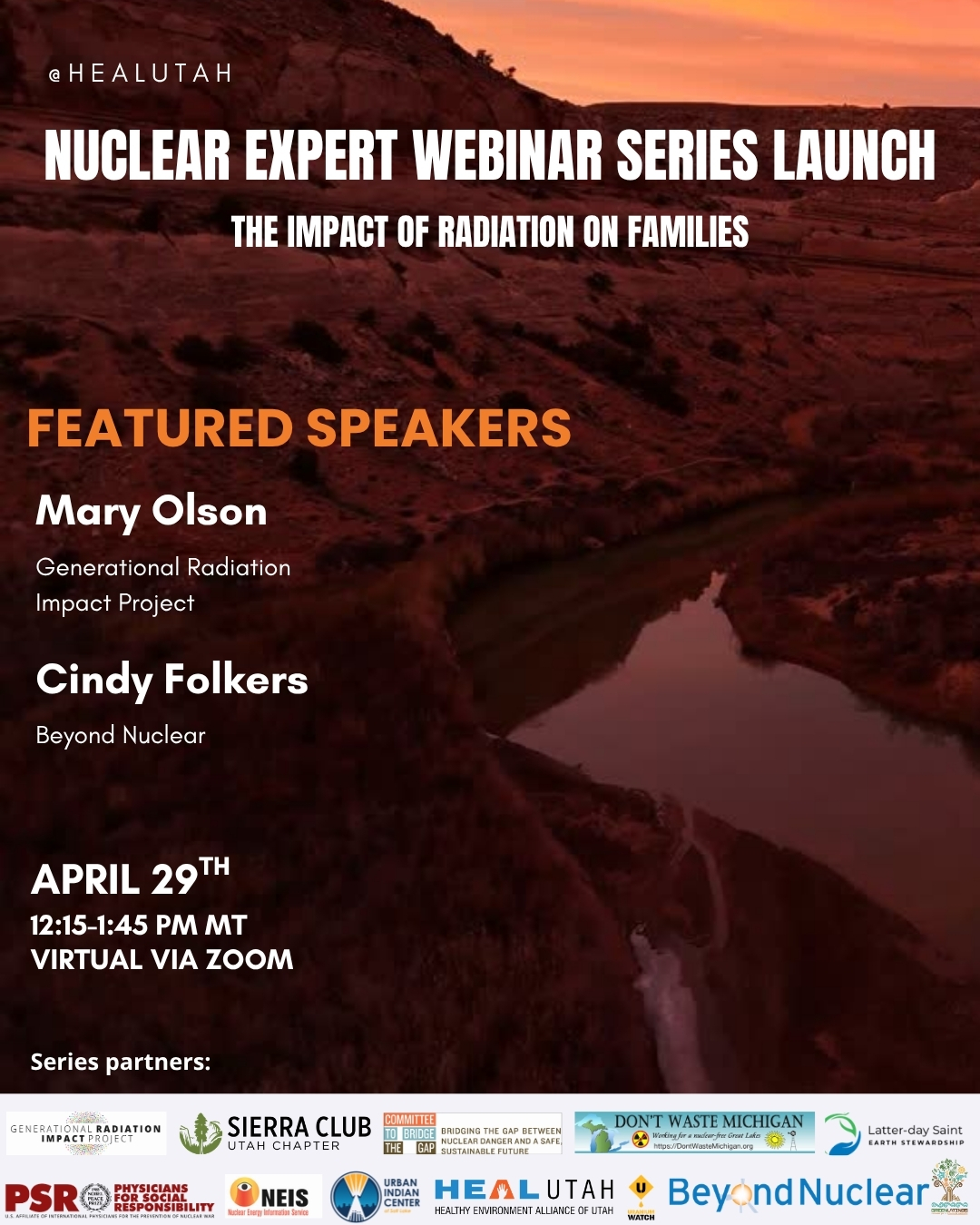
29 April – Nuclear Expert Webinar #1 – Radiation Impacts on Families with Mary Olson and Cindy Folkers
- 12:15 PM MT – 1:45 PM MT
- Location: Virtual – REGISTER TODAY

4 May -West Suburban Peace Coalition to discuss Iran war at May Educational Forum
Monday, May 4, 7:00 – 8:00 PM Central Standard Time
Title: : How Trump’s Narrative Tries to Shape the Reality of the War on Iran.
Contact Walt Zlotow, zlotow@hotmail.com 630 442 3045 for further information
14 May – online event From Bombs to Data Centres: the Face of Nuclear Colonialism
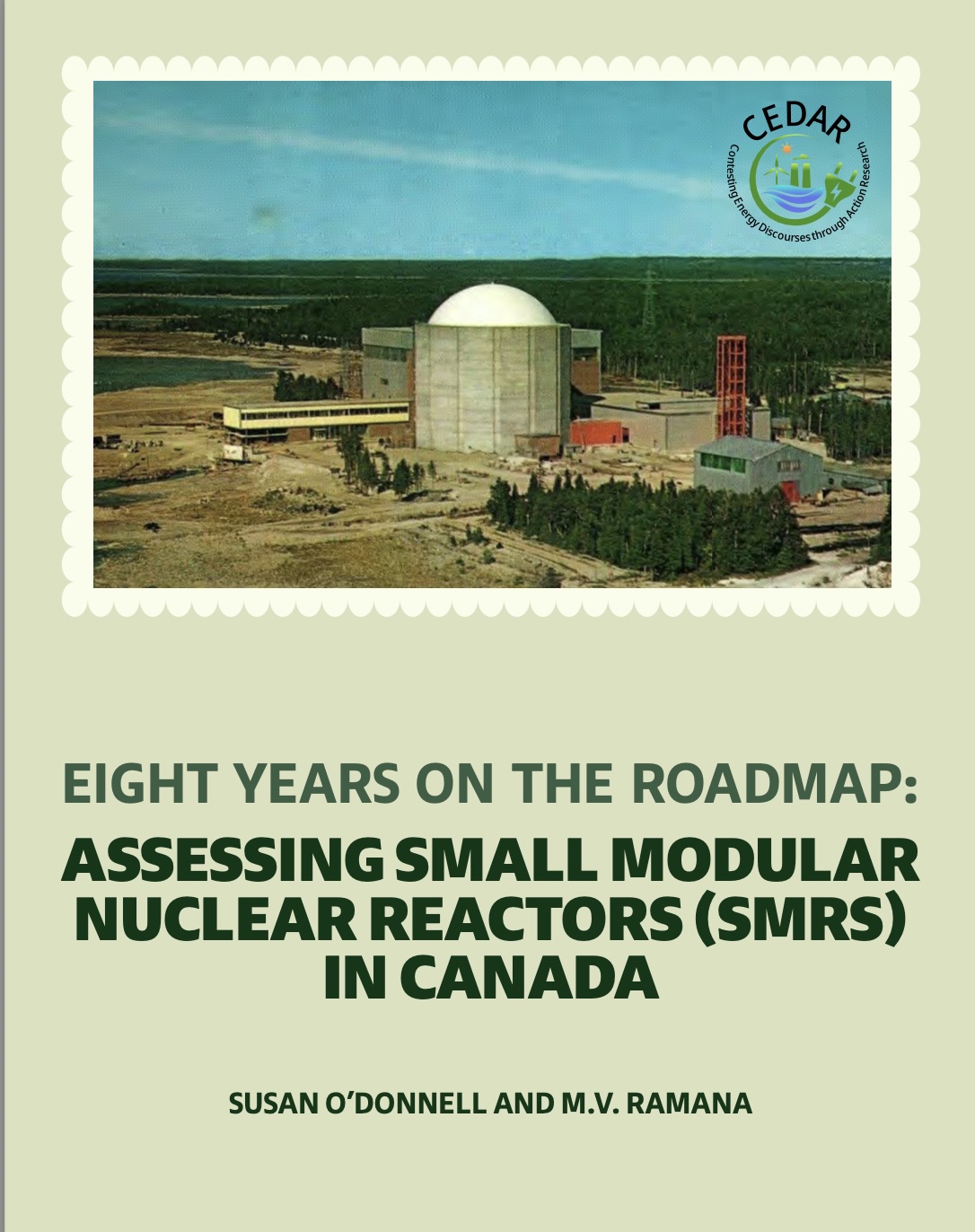

Pine Ridge Uranium is the real threat, not Tehran- Tell Burgum: Stop the Extraction.
Chernobyl: The Lost Tapes – A good documentary on Chernobyl on SBS available On Demand for the next 3 weeks– https://www.sbs.com.au/ondemand/tv-program/chernobyl-the-lost-tapes/2352741955560
To see nuclear-related stories in greater depth and intensity – go to https://nuclearinformation.wordpress.com
-
Archives
- April 2026 (317)
- March 2026 (251)
- February 2026 (268)
- January 2026 (308)
- December 2025 (358)
- November 2025 (359)
- October 2025 (376)
- September 2025 (257)
- August 2025 (319)
- July 2025 (230)
- June 2025 (348)
- May 2025 (261)
-
Categories
- 1
- 1 NUCLEAR ISSUES
- business and costs
- climate change
- culture and arts
- ENERGY
- environment
- health
- history
- indigenous issues
- Legal
- marketing of nuclear
- media
- opposition to nuclear
- PERSONAL STORIES
- politics
- politics international
- Religion and ethics
- safety
- secrets,lies and civil liberties
- spinbuster
- technology
- Uranium
- wastes
- weapons and war
- Women
- 2 WORLD
- ACTION
- AFRICA
- Atrocities
- AUSTRALIA
- Christina's notes
- Christina's themes
- culture and arts
- Events
- Fuk 2022
- Fuk 2023
- Fukushima 2017
- Fukushima 2018
- fukushima 2019
- Fukushima 2020
- Fukushima 2021
- general
- global warming
- Humour (God we need it)
- Nuclear
- RARE EARTHS
- Reference
- resources – print
- Resources -audiovicual
- Weekly Newsletter
- World
- World Nuclear
- YouTube
-
RSS
Entries RSS
Comments RSS
 nuclear-news