Futaba, a town deserted because of Fukushima nuclear radiation
Outside, on the rooftop of the Futaba town office, one can clearly see the isolation and desolation of this dying town where time has stopped.
For the first time since the aftermath of March 2011 accident at the Fukushima No. 1 nuclear power plant, an Asahi Shimbun reporter entered the town office of Futaba on Feb. 25…….
About 96 percent of Futaba, including areas around the town office, has been designated a difficult-to-return zone because annual accumulated radiation levels exceed 50 millisieverts.
The zone is surrounded by barricades, making it impossible for people to enter freely.
Wearing a mask and a white protective gear that covered my entire body and carrying a dosimeter, I entered Futaba after obtaining permission from the town office. A town official, who guided me around Futaba, wore similar clothing.
After leaving the town office, we headed to the Nagatsuka district in the central part of Futaba, where there were no signs of residents.
All 6,400 residents have fled the town………
The Futaba swimming beach was crowded with about 85,000 people in 2010. The seaside facility operated by the town office was damaged by the 2011 tsunami.
From a higher floor of the facility, we could see the Pacific Ocean extend to the horizon and gentle waves hitting the beach……
Peering over the barricade, however, we saw withered grass at places where houses were washed away by the tsunami. Infrastructure improvements and decontamination work have not made progress.
Hiraiwa’s house is located in the area. Nothing has changed (since May 2013),” he said.http://ajw.asahi.com/article/0311disaster/fukushima/AJ201402260048
All nuclear power plants raise the question of the danger of a “dirty bomb”
Nuclear power plant: Security, dirty bombs and civil rights Daily Star, Quamrul Haider, 27 Feb 14, ONE cconsequence of nuclear power that dominates all others is the safety and security of a nuclear reactor facility. The use of nuclear power inevitably brings an unquantifiable but real danger of nuclear blackmail and sabotage from terrorists, extremists, criminals and lunatics. The safe and secure transportation of nuclear materials is also of great concern……
The production of staggering amount of plutonium gives rise to the risk of its diversion to make nuclear weapons by rogue nations and terrorists. The grim reality is that any country that has nuclear power plants will have access to the materials and technology needed for developing nuclear bombs…….
In the often heated controversy over the future of nuclear power, it is the risk of proliferation of nuclear weapons that appears to be the one most intractable to technical resolution and, as well, most insistently fundamental to the way people feel about nuclear power. If worldwide plutonium industry develops, then theft of plutonium, or even growth of an international black market in plutonium, seems quite likely. A market of few hundred kilograms worth millions of dollars per year is large enough to interest criminal groups and to have a major impact on nuclear terrorism.
The information and non-nuclear materials needed to make a “dirty” fission bomb is now widely distributed and available to the general public on the internet. Dozens of nations have or could acquire skills and facilities required to design and build dirty bombs using plutonium diverted from their civilian nuclear power programmes. Although crude, inefficient and unpredictable, such devices would nonetheless be highly destructive. Furthermore, fission explosives small enough to be transported by automobile could be built by small groups of people, even conceivably by individuals working alone, if they somehow manage to acquire the needed 10 kilograms of plutonium.
The concerns about plutonium arise not only for its explosive properties but also for its extreme radiotoxicity. Dispersed into the atmosphere by nuclear explosive devices, a small quantity of plutonium could cause an indeterminate number of deaths from lung cancer or fibrosis of the lung. The psychological impact of such a situation would be profound, normal activity in the affected area would be disrupted and decontamination could be very expensive.
Thus if nuclear power plants are to be well-enough protected to be totally immune to the above risks, the unavoidable consequence is a society dominated by prohibitions, surveillance and constraints, all justified by the magnitude of the danger. Consequently, it is inevitable that preference should be given to pliant and obedient character type workers. The use of nuclear energy, therefore, epitomises the centralisation of the government’s power, thereby resulting in infringement on the civil rights of the citizens.
The writer is Professor of Physics at Fordhams University, New York.
Japan’s militarism, and its nuclear stockpile, blasted by China
China blasts Japan’s pro-military tendencies, nuclear stockpile CCTV.com 02-27-2014 BEIJING, Feb. 26 (Xinhua) –– China on Wednesday strongly denounced the Japanese government’s pro-military tendencies and controversial view on history, and threw doubts on the country’s nuclear material stockpile.
PRO-MILITARY WORDS, HISTORY VIEW
In an interview with the Wall Street Journal last week, Etsuro Honda, Japanese Prime Minister Shinzo Abe’s economic aide who is also a key architect of Abe Economics, said Japan needed a strong economy so it could build a more powerful military and stand up to China.
When asked to comment on the remarks, Chinese Foreign Ministry spokeswoman Hua Chunying told a regular press briefing on Wednesday, “Those words show that Abe Economics is in fact aimed at serving Japan’s military expansion, which mirrors the country’s pre-war militarism……
Japan, led by its right-wing forces, is on a dangerous direction and is becoming a troublemaker which would harm regional peace and stability, Hua said.
Hua also commented a recent report from the United States Congressional Research Service (CRS), which expressed worry over Abe’s view on history…….
DOUBTS ON NUKE STOCKPILE
While commenting on reports that the Japanese government is to hand over its plutonium stockpile to the United States, Hua said China supports the U.S. to demand Japan return those nuclear materials.
She urged Japan to return weapons-grade nuclear materials at an early date.
Since the nuclear security summit in Washington in 2010, the U.S. government has been pressing Japan to return 331 kilograms of weapons-grade plutonium given to the country during the Cold War…….The U.S. plans to reach an agreement with Japan before the nuclear security summit in the Netherlands in March…….http://english.cntv.cn/20140227/100003.shtml
Pacific coast could get Fukushima radiatio by April
Fukushima radiation could reach Pacific coast by April http://www.sfgate.com/science/article/Fukushima-radiation-could-reach-Pacific-coast-by-5264277.php David Perlman, February 26, 2014 SAN FRANCISCO –– Radiation from the Fukushima nuclear disaster has not yet reached ocean waters along the Pacific coast, but low levels of radioactive cesium from the stricken Japanese power plant could arrive by April, scientists reported Monday.
The report came even as some Internet sites continue claiming that dangerously radioactive ocean water from Fukushima is showing up along California beaches – reports that have been denied by health officials and scientists since they first surfaced more than a month ago.Ken Buesseler, a chemical oceanographer at the Woods Hole Oceanographic Institution on Cape Cod, Mass., reported that four coastal monitoring sites in California and Washington have detected no traces of radiation from the Fukushima Dai-ichi nuclear plant destruction – “not yet,” he said during a telephone press briefing.
The briefing took place in Honolulu during a meeting of the American Geophysical Union‘s Ocean Sciences section. The meeting is being held with scientists from both sides of the Pacific to discuss problems caused anywhere in the Pacific by the offshore earthquake and tsunami that hit Japan on March 11, 2011
Nuclear power industry’s decline – death by economics
Economics Keeps Killing the Nuclear Power Renaissance http://www.slate.com/blogs/moneybox/2014/02/19/nuclear_renaissance_killed_again_by_economics.htmlBy Matthew Yglesias Ed Crooks reports for the Financial Times that in states with competitive electricity markets, nuclear power plants simply can’t compete and are at risk of shutting down:
Where nuclear plants have to go head-to-head with gas-fired plants, and with wind and solar power that are supported by regulatory mandates, they are finding it hard to compete.
“Competitive markets can be efficient, but right now they aren’t,” says Marvin Fertel, president of the Nuclear Energy Institute, the industry group.
“We’ve seen a real problem that needs to be fixed.”
It has been clear for years that the shale gas boom made it hard for costly new reactors to compete. Over the past year, though, it has become clear that even some existing plants are no longer commercially viable.
Nuclear power usually gets discussed in the context of some wag trying to make the point that even though the environmental movement got a lot of juice in the 1970s from anti-nuclear campaigning, nuclear power is actually quite clean and from a climate change perspective it would be good for green groups to be more nuclear-friendly.
As best I can tell, that’s all basically true. The problem with nuclear power is actually the economics. These plants are extremely expensive to build, moderately expensive to operate, and despite decades of hype and promise we really don’t seem to be getting much better at it. Natural gas has become really cheap recently thanks to new developments in shale mining, and solar power is at least getting cheaper. If you just care about money, gas is clearly the way to go. If you care about the environment too, then subsidizing solar makes sense. Nuclear seems extremely well-suited to the rather unusual problems of power generation on a military submarine but as a mainstream electricity source it has a lot of problems. The scenario in which an existing plant becomes uneconomical to operate is pretty extreme and I think efforts to deliberately shut down existing plants that are economically misguided, but politics aside there just doesn’t seem to be a future for new plants
Tax-payerswill feel the pain, if nuclear companies default
if the companies default, it will matter little difference that they are nuclear, not solar. The taxpayers will feel it all the same.
David McCumber: Nuclear waste is a nuisance National Review Online By David McCumber, February 25, Last Wednesday, the Obama administration announced $8.3 billion in public loan assistance to three nuclear power producers.
The subsidies, in the form of a $6.5 billion loan guarantee and a second loan deal worth $1.8 billion, will go to help build two nuclear reactors at the Vogtle plant in Georgia — the first new nuclear-power construction in the United States in 30 years. The reduced-rate loans will go to the project co-owners: Southern Company’s Georgia Power subsidiary, Oglethorpe Power, and Municipal Electric Authority of Georgia.Southern, which owns 46 percent of the venture, will also receive $2 billion worth of tax credits and other federal incentives. Secretary of Energy Ernest Moniz said that the new plans for the Vogtle plant would help put the U.S. on a “path toward a low-carbon energy future.”
While that may be so, the loans are also unnecessary and costly, Wonkblog’s Steven Mufson writes.
The loan guarantees will save Southern $225 million to $250 million in tax-subsidized reduced interest rates, but those savings are not necessary for the project. Southern itself said that it didn’t need the loans, as it could have borrowed from a traditional commercial bank and received unsubsidized loans instead. The company now plans to pass on the millions in savings to ratepayers.
However, Mufson notes that those ratepayers are already funding much of the construction cost of the reactors in the form of increased rates once the plant is complete. So the “savings” the ratepayers will receive will come as a reduction of the amount their rates will increase once the reactors are on line. Instead of a rate increase of 12 percent, Southern is predicting a spike between 6 percent and 8 percent. This government-subsidized funding comes shortly after a series of three blows to the nuclear industry. The continuing economic stagnation that began in the late 2000s, competition from low-priced natural gas, and safety concerns after the Fukishima plant reactor leak in Japan have combined to put this new nuclear plant on unsure footing.
The Vogtle project was already $737 million over budget as of last year. Some estimate that it is $1.6 billion over budget now. ….. if the companies default, it will matter little difference that they are nuclear, not solar. The taxpayers will feel it all the same.http://www.nationalreview.com/article/371822/taxpayers-fund-nuclear-plants-alec-torres
Uranium – is it a country? Tracking the origins of nuclear power.
Published on 27 Feb 2014
The documentary heads to Australia revealing the hidden side of nuclear power: uranium — where it comes from, where it goes to and the dangerous left-overs from the mining process. You can order the DVD including various subtitles and additinal film material on our homepage starting from 12 Euro: http://www.strahlendesklima.de/en/ura…
Strahlendes Klima e.V. is a non-commercial registered organisation.
-
Category
-
Licence
Creative Commons Attribution licence (reuse allowed)
Fukushima Video FLAGGED as “Inappropriate Content” (update 9/13/13) – MsMilkytheclown1 whose temporarily out of temporary retirement
Published on 27 Feb 2014
Wow, How did this get flagged and taken down off of YouTube for “inappropriate content”!? It got flagged yesterday. So did RedButtonStudio’s remix of the same video… but RumorECurioso still had it up safe and sound. I did a little editing from the original, but not much. I don’t know how to find out What “inappropriate content” WAS, nor Who Flagged it, but I have a pretty good idea.
Here’s the original
Fukushima: Top TEPCO Exec Admits Leaks ARE Out of Control update 9/13/13
http://youtu.be/RFuWdY61mRo
Published on Sep 13, 2013
TEPCO official: Leakage ‘not under control’
http://tinyurl.com/ktke9za
TEPCO official says Fukushima plant situation “out of control” […] A [Tepco] senior official […] said Friday that situation in the stricken plant was “out of control,” according to local media. The remark was made by Kazuhiko Yamashita, who holds the executive-level title of fellow, at a meeting with Japanese opposition lawmakers in the city of Koriyama in Fukushima prefecture, said Japan’s Kyodo News. His words came less than a week after Prime Minister Shinzo Abe assured the world at a meeting of the International Olympic Committee (IOC) at Argentina that the situation in the damaged nuclear plant is “under control.” …
http://tinyurl.com/mw7wrgg
Euronews, 9/13/13 A senior [Tepco] official…admitted that the situation there is “not under control”. However, within hours Tepco released a statement saying the official, Kazuhiko Yamashita, meant to say something different. His comments came in response to a question at a meeting with the opposition Democratic Party. The politician asked whether the company considered the situation at the plant to be under control. “I’m sorry, but we consider the situation is not under control,” came the reply from Yamashita. In its subsequent statement, Tepco said what the official meant to say was that there were continuous problems with storage tanks, and when radioactive water leaked out it remained in front of the plant….
Tritium rises in groundwater in Fukushima Daiichi
The operator of the Fukushima Daiichi nuclear power plant says that it found sharply rising tritium levels at a monitoring well near a wastewater storage tank.
Tokyo Electric Power Company says the level of radioactive tritium at one of the wells rose to 130,000 becquerels per liter on Thursday. That’s more than twice the government-set level for its release into the sea.
One of the storage tanks leaked more than 300 tons of highly radioactive water in August. The water is likely to have seeped into the soil.
The company has since increased the numbers of monitors to check the radioactive materials in groundwater near the tank.
The tritium level in the well was 64,000 becquerels per liter on Tuesday and rose to 97,000 becquerels on Wednesday. The well is located 20 meters north of the leaking tank.
Meanwhile, the tritium in another well on the southern side of the tank was 290 becquerels per liter. The level is declining slightly.
Officials say the rise was apparently caused by a leak from the tank last month, but they can’t exactly determine how that happened. They are also investigating past leaks from pipes connecting the tanks.
9/13/13
These articles just posted but not in today’s update:
TEPCO lowers radioactive water leakage estimate
Japan seeks methods to stop tainted water leaks
TEPCO under-reported cesium measurements
enenews.com
Fukushima melted fuel “could have burned through floor and now in earth underneath reactors”
Report: Senior official admits Fukushima plant “out of control” — Tepco then claims he “meant to say something different” (VIDEO)
Energy Analyst: Concern a ‘reverse tsunami’ of radioactivity now moving back into Pacific from Fukushima plant — Nuclear catastrophe remains out of control and hemorrhaging
AFP: Fukushima nuclear reactor spews steam, Japanese operator clueless about cause — Time: Scientists have not yet explained why it would start appearing
Hawaii TV: Fukushima plume to reach coast of U.S. next year — “Radiation increase will be measurable” (PHOTO)
Microbiology Professor: “Gov’t needs to ban all fish imports from all regions of Japan” — Nuclear Professor: “No one can block fish migration along with sea currents”
Award-winning Filmmaker on Fukushima: “People have low white blood cell counts… children and adults experiencing more nosebleeds and rashes” -Japan Times
National Geopraphic: Fears are mounting that Fukushima radiation could lead to dangerous contamination levels in seafood from Pacific — At least for now fish are not glowing so ‘eat up’!
Japan Times: Talk of Olympics being taken away from Tokyo if problems at Fukushima worsen over next couple of years
Gundersen: Fukushima Unit 4 fuel racks distorted from quake and roof falling into pool — Nuclear rods likely to snap and won’t be able to be removed (AUDIO)
Song by HumbleHorse called When the Bombs Fall on Soundcloud
-
Category
-
Licence
Standard YouTube Licence
Japan’s NRA blast TEPCO for serious safety problems
Nuclear experts believe that the overall decommissioning of the earthquake and tsunami battered plant in Japan’s northeast is expected to take around 40 years, with the removal of all nuclear fuel from the No. 4 reactor building being completed by the end of this year.
TEPCO has stated, however, that it had only successfully removed around 9 percent of more than 1,500 unused and spent fuel assemblies in the wrecked reactor building’s storage pool.
http://en.apdnews.com/news/71937.html
Xinhua | TOKYO Thur,Feb 27,2014
Japan’s Nuclear Regulation Authority (NRA) blasted Tokyo Electric Power Co. Wednesday for its inappropriate handling of fuel rods at its Kashiwazaki-Kariwa plant in Niigata Prefecture which caused some of the highly volatile rods to be damaged.
The NRA said that workers at the plant had tried forcibly to jam the rods into fuel assemblies when they wouldn’t fit, leaving some 26 fuel assemblies with “abnormalities.”
NRA Chairman Shunichi Tanaka stated that the safety culture at TEPCO has “serious problems,” adding that the fuel handling problems could only be seen from inside the utility.
The nuclear regulator added that some of the rods were actually found to be touching each other in the assemblies and that the NRA was not made aware of the problem until 2012.
Initially the NRA considered the danger to be a Level 1 accident on a scale of 8, but on further investigation downgraded its assessment of the danger from being an “anomaly.”
By comparison the March 2011 tsunami-triggered multiple meltdowns at the accident-prone utility’s Fukushima Daiichi plant were judged to be a Level 7 accident, according to the NRA’s judgments.
The NRA found that workers at the plant had been mishandling the fuel rods and the assemblies at least until 1998, when procedures were changed.
On Tuesday, TEPCO said of its stricken Daiichi nuclear power plant in Fukushima prefecture that cooling operations were stopped at its No. 4 reactor unit’s spent fuel pool, due to workers damaging an electrical cable.
TEPCO said that workers damaged the cable while they were drilling near electrical equipment, causing an alert and the shut down of cooling operations at the No. 4 spent fuel pool, as well as the halting of an ongoing operation to remove hundreds of spent nuclear fuel rods from the pool.
The operator of the plant also said Tuesday a fire was triggered by the damage to the cable, although workers were able to extinguish this, the utility said.
Though the Japanese government on Jan. 15 announced injecting 4 trillion yen (38.3 billion U.S. dollars) in additional state backing to help the ailing utility deal with a string of mishaps at its facilities as it works towards decommissioning its stricken, yet volatile reactors, the problems continue, much to the consternation of Tanaka.
On Feb. 13. samples of water TEPCO tested contained radioactive cesium at records not seen at the Fukushima plant since the 2011 disaster.
A UK Radioactive Waste Dump is Born without Fanfare or Fuss – Shhhh!!
By on February 26, 2014

Image: Protestors outside County Offices – this issue has been hidden by the media and given no attention by national mainstream environmental groups – why is this when the proposed radioactive and chemical discharges to groundwaters are of a magnitude never before seen.
TV: “Disturbing new development in WIPP radiation leak, surprising words today” — “What went wrong and why, those are some of the questions swirling around” — County official calls it ‘a disaster’ (VIDEOS)
Published: February 27th, 2014 at 8:30 pm ET
By ENENews
KRQE, Feb. 27, 2014 at 7:44p ET: Disturbing new development in the WIPP radiation leak. Surprising words today that 13 workers at the WIPP near Carlsbad tested positive for radiation exposure after the leak almost 2 weeks ago. […] No one knows yet how bad the situation is in that storage area […] DOE said 13 WIPP staff who were working above ground the day of the leak have tested positive for radiation. Officials said it is too early to know what that means for the workers’ health, but that people in contact with them are not at risk. Residents are still concerned. “I don’t think the people really know what’s going on at WIPP,” said Carlsbad resident, Robert Ortiz. […] In a letter to the people of Eddy and Lea counties, DOE said the radiation that got into the air Valentine’s Day was likely at very low levels, no more risky than a chest X-ray. […] The next priority is testing the employees who worked the day after the leak.
KRQE, 7:39p ET: What went wrong and why — those are some of the questions swirling around a radioactive leak at a waste storage facility near Carlsbad that contaminated 13 people.
Eddy County Manager Rick Rudometkin: “Whenever you have a disaster of any kind, there are always issues. You always mitigate the disaster and you move forward.”
Watch the KRQE broadcasts here — and here
See also;
http://majiasblog.blogspot.fr/2014/02/plutonium-from-carlsbad-new-mexico.html
OT – Glenn Greenwald and Jeremy Scahill (2014) “Death By Metadata”
Published on 27 Feb 2014
Feb 20, 2014
1 This Month
To see nuclear-related stories in greater depth and intensity – go to https://nuclearinformation.wordpress.com/
12 February – Webinar The Big Push: New Nuclear Projects in Canada
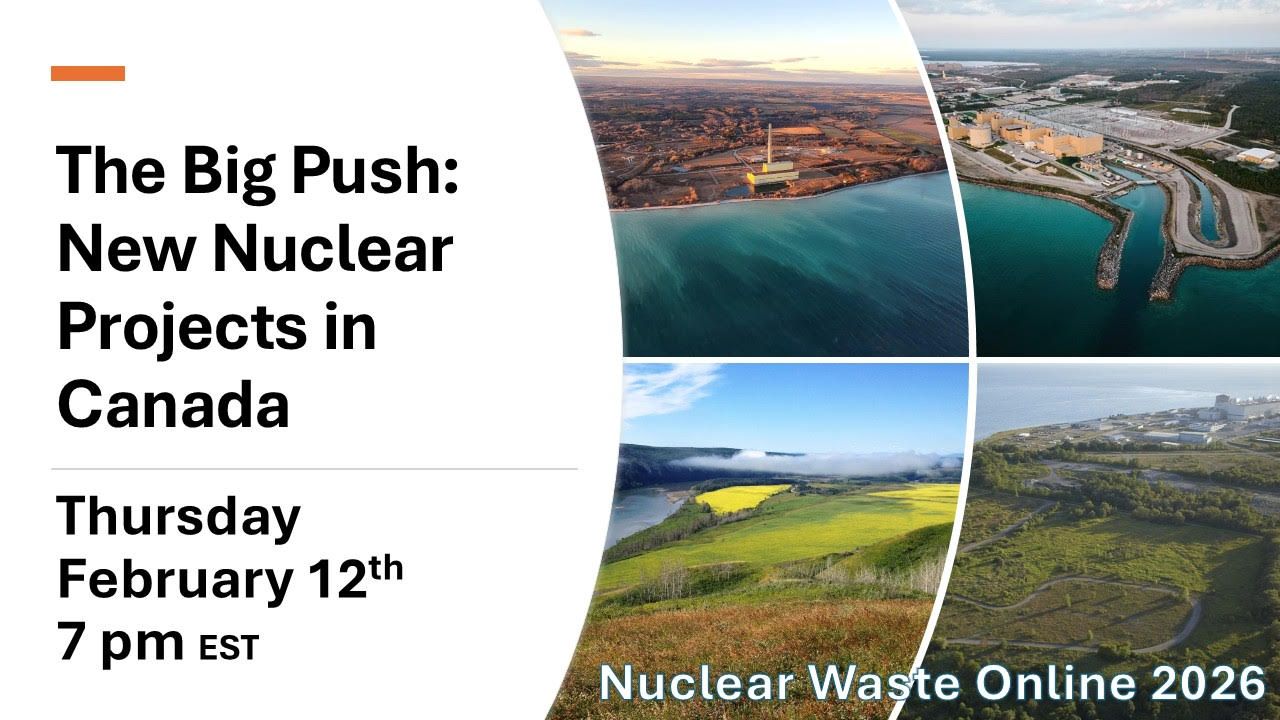
Thursday, February 12, 7 pm Eastern | 2nd of 4 sessions in the 2026 Nuclear Waste Online webinar series
Join a webinar on the push for new nuclear generation in Canada. Go to Northwatch.org to register or use the registration link https://us02web.zoom.us/webinar/register/WN_ZfWOf1GITqSRIZX8CB-A9w
-
Archives
- February 2026 (115)
- January 2026 (308)
- December 2025 (358)
- November 2025 (359)
- October 2025 (376)
- September 2025 (258)
- August 2025 (319)
- July 2025 (230)
- June 2025 (348)
- May 2025 (261)
- April 2025 (305)
- March 2025 (319)
-
Categories
- 1
- 1 NUCLEAR ISSUES
- business and costs
- climate change
- culture and arts
- ENERGY
- environment
- health
- history
- indigenous issues
- Legal
- marketing of nuclear
- media
- opposition to nuclear
- PERSONAL STORIES
- politics
- politics international
- Religion and ethics
- safety
- secrets,lies and civil liberties
- spinbuster
- technology
- Uranium
- wastes
- weapons and war
- Women
- 2 WORLD
- ACTION
- AFRICA
- Atrocities
- AUSTRALIA
- Christina's notes
- Christina's themes
- culture and arts
- Events
- Fuk 2022
- Fuk 2023
- Fukushima 2017
- Fukushima 2018
- fukushima 2019
- Fukushima 2020
- Fukushima 2021
- general
- global warming
- Humour (God we need it)
- Nuclear
- RARE EARTHS
- Reference
- resources – print
- Resources -audiovicual
- Weekly Newsletter
- World
- World Nuclear
- YouTube
-
RSS
Entries RSS
Comments RSS
 nuclear-news