(UPDATED) (Now They Tell Us) Highly Radioactive Pieces Found in Naraha-Machi in June/July 2013 Came from #Fukushima I NPP, TEPCO Now Says
http://ex-skf.blogspot.co.uk/2014/02/now-they-tell-us-highly-radioactive.html
14 February 2014
(UPDATE-2) Of all news outlets, it was Yomiuri who reported the news (two days late) and mentioned the last remaining potential route for the debris pieces – Reactor 3 explosion. From Yomiuri Shinbun (2/24/2014) (2014年2月14日 読売新聞): [This date is wrong but i think it should be the 14 February 2014? – Arclight2011 ]
原子炉建屋の水素爆発で飛び散ったのか、海から流されてきたのかなど、理由は不明という。
The reason [why the debris pieces were there] is unknown; they could have been scattered by the hydrogen explosion in the reactor building, or they could have come from the ocean.
This news continues to be mostly ignored by both the mainstream media and the alternative net media. Very strange.
==========================
(UPDATE 2/13/2014) The only news I’ve found so far about these debris pieces in Naraha-machi is from FNN local Fukushima news. Even that news hides the fact that the radioactivity of maximum 2.92 million becquerels of radioactive cesium IS PER 0.4 GRAM SAMPLE.
==========================
Specifically, four small pieces of debris found at the river mouth in Naraha-machi 15 kilometers from the plant may have come from Reactor 3.
The first piece of debris were found in June 2013, but TEPCO didn’t mention the discovery until July after three more such high-radiation pieces were found. Even then, they published a half-baked result of the analysis, which was nothing more than the measurement of gamma radiation and beta radiation in microsieverts per hour. (See my post on July 2, 2013 for the first discovery.)
TEPCO disclosed the result of the analysis of the debris done by Japan Atomic Energy Agency (of Monju fame) during the regular February 12, 2014 press conference, and no major news outlet has reported the news so far. Only bloggers took note. (I suppose the mainstream media is busy educating themselves on the intricacies of the State Secrecy Protection Law, even though it hasn’t gone into effect yet.)
According to TEPCO, the pieces of debris were not only highly contaminated with radioactive materials released from Fukushima I Nuclear Power Plant but they actually, most likely came from the plant. The degree of contamination from radioactive materials found on the small pieces of debris is similar to that on the debris found around the Reactor 3 building.
From TEPCO’s handout for the press, 2/12/2014 (in Japanese):
Very high contamination from cesium-134, cesium-137, and presence of cobalt-60 (in blue rectangle, added by me). Note the unit is Bq per sample, not kilogram. For example, Sample No.3 (0.4 gram) has 2.0 x 10^6 Bq, or 2 million becquerels of cesium-137:

Very high all-beta:
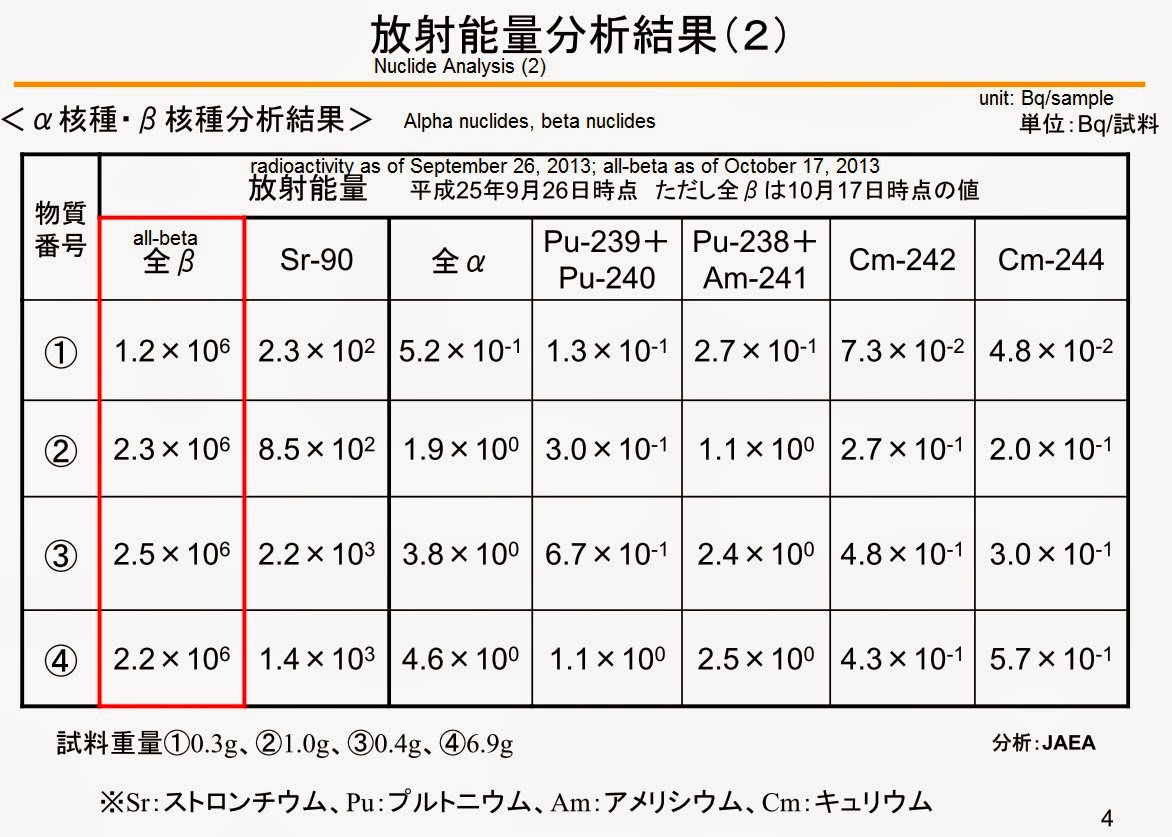
But the composition of radioactive materials (ratio) on the debris pieces shows almost all radioactivity comes from cesium-134 and cesium-137:

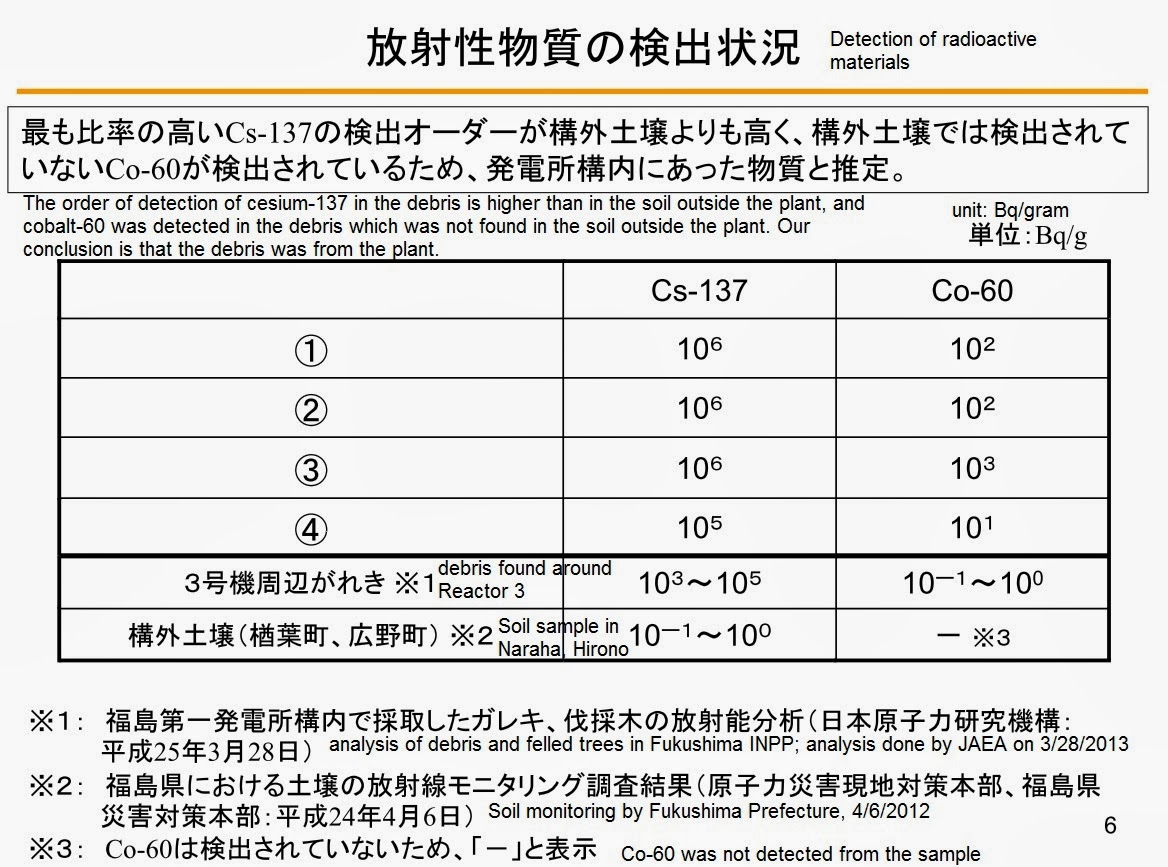
Radioactivity of the debris pieces, compared to those of the debris around the Reactor 3 building and of the soil in Naraha-machi and neighboring Hirono-machi. The debris pieces have about the same order of magnitude of contamination as the debris around Reactor 3 for cesium-137, and one to three orders of magnitude higher contamination for cobalt-60. Unit is Bq per gram:
What are the debris pieces made of? Polyethylene, polyolefine, wood:
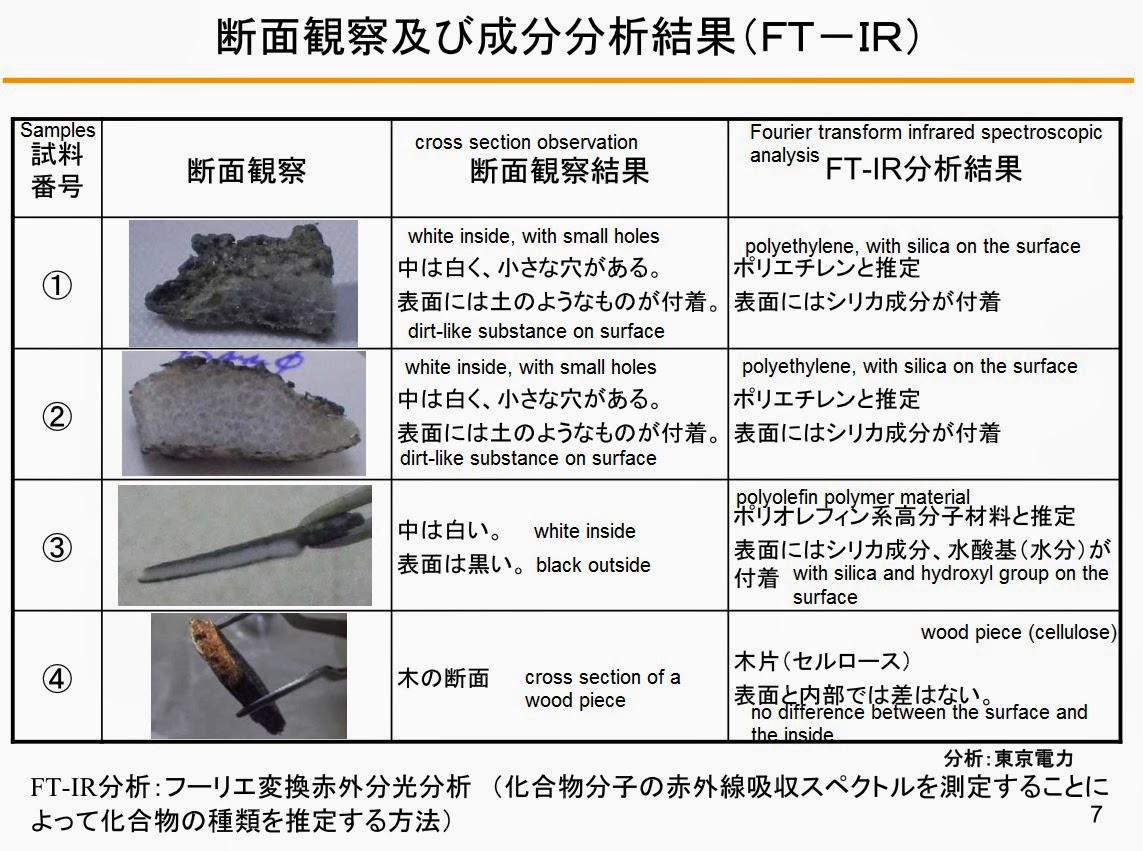
TEPCO and JAEA’s conclusion:
1. These small pieces of debris came from Fukushima I Nuclear Power Plant, most likely from the Reactor 3 building.
2. The high-beta radiation found on the pieces are not from beta-nuclides but from beta radiation from cesium-134 and cesium-137, judging by the composition of the radioactivity.
3. How they got to the river mouth is unknown. It could be by the ocean, or by land. The analysis is inconclusive on that point.
As far as incurious TEPCO goes, this is the end of the analysis. There will be no further analysis whether there is any contribution from MOX fuel that was in the Reactor 3’s Pressure Vessel.
During the press conference, TEPCO’s PR people could barely answer the questions on this issue, other than to say this was done by JAEA.
No comments yet.
1 This Month

of the week – Shut Down Drone Warfare!


Tell the Ukrainian Government to Drop Prosecution of Peace Activist Yurii Sheliazhenko

Petition to revoke the licensing of the Near Surface Nuclear Disposal Facility (NSDF) at Chalk River. https://www.ourcommons.ca/petitions/en/Petition/Details?Petition=e-7247
To see nuclear-related stories in greater depth and intensity – go to https://nuclearinformation.wordpress.com
-
Archives
- April 2026 (57)
- March 2026 (251)
- February 2026 (268)
- January 2026 (308)
- December 2025 (358)
- November 2025 (359)
- October 2025 (376)
- September 2025 (257)
- August 2025 (319)
- July 2025 (230)
- June 2025 (348)
- May 2025 (261)
-
Categories
- 1
- 1 NUCLEAR ISSUES
- business and costs
- climate change
- culture and arts
- ENERGY
- environment
- health
- history
- indigenous issues
- Legal
- marketing of nuclear
- media
- opposition to nuclear
- PERSONAL STORIES
- politics
- politics international
- Religion and ethics
- safety
- secrets,lies and civil liberties
- spinbuster
- technology
- Uranium
- wastes
- weapons and war
- Women
- 2 WORLD
- ACTION
- AFRICA
- Atrocities
- AUSTRALIA
- Christina's notes
- Christina's themes
- culture and arts
- Events
- Fuk 2022
- Fuk 2023
- Fukushima 2017
- Fukushima 2018
- fukushima 2019
- Fukushima 2020
- Fukushima 2021
- general
- global warming
- Humour (God we need it)
- Nuclear
- RARE EARTHS
- Reference
- resources – print
- Resources -audiovicual
- Weekly Newsletter
- World
- World Nuclear
- YouTube
-
RSS
Entries RSS
Comments RSS
 nuclear-news
Leave a comment