EDF Energy reports £863m profit on high nuclear output
13/02/2014
EDF Energy made an operating profit of £863 million in 2013 and invested over £1.1 billion, according to annual results published on Thursday.
Underlying profitability was down 12.9 per cent on 2012, with adjustments to the value of gas generation assets outweighing an increase in nuclear output.
However, earnings before interest, tax, depreciation and amortisation (Ebitda) rose 1.4 per cent to £1,689 million.
The company’s eight nuclear power stations generated 60.5TWh of electricity, the highest output in eight years.
Dungeness B is set to be kept open until 2028, with a 10-year life extension likely to be announced in 2014. That means seven stations will still be running in 2023, when new plant Hinkley Point C is due to come online.
On the supply side, EDF Energy made a net gain of quarter of a million household customers. It boasted the cheapest standard variable tariff of the major suppliers for 95 weeks out of 104 in 2012 and 2013.
EDF Energy chief executive Vincent de Rivaz said: “Our financial performance means we can make the big investments the country needs to give it the reliable low carbon energy it needs now and in the future. It also means we can invest in jobs and skills for the long term.
“The investment we are making in our existing nuclear power stations has resulted in their best performance for eight years. We believe that their operating lives can be safely extended and we expect to be able to announce a 10 year life extension for Dungeness B before the end of 2014. This means existing nuclear can hand over directly to the next generation of nuclear power stations without the need for more fossil fuel generation.
“Our customer numbers also continue to grow. We took early action to limit price rises and will continue to work closely with policy-makers to bear down on rising costs for consumers. We will listen to our customers and their concerns and take action on their behalf wherever we can.”
Author: Megan Darby,
AWE Burghfield and Aldermaston shortlisted as nuclear submarine waste dumps
Thursday, 13th Feb 2014
Reporter: Jane Meredith
THE ATOMIC Weapons Establishment (AWE) sites in Aldermaston and Burghfield have today (Thursday) been listed by the MOD among potential sites to store waste from decommissioned nuclear submarines for the next 26 years – with a public consultation to take place later this year on this.
In a statement today (February 13), the MOD shortlisted five possible sites to store waste from nuclear-powered submarines that have left naval service, as part of the MOD’s Submarine Dismantling Project (SDP).
These include: both AWE sites at Aldermaston and Burghfield, owned by the MOD and run by AWE Plc; Sellafield in West Cumbria, owned by the Nuclear Decommissioning Authority (NDA); Chapelcross in Dumfriesshire, also owned by the NDA; and Capenhurst in Cheshire, which is run by Capenhurst Nuclear Services.
Illicit nuclear trade a ‘worsening problem’ – 20 known thefts of highly enriched uranium or plutonium
…Tobey said the nuclear trafficking threat today is a lot different than it was 30 to 40 years ago.
Now there are terrorists bent on wholesale destruction – as much as they can – and there is widespread dissemination of basic nuclear-weapons-related knowledge via the Internet, he said. You no longer have to go to a library and check out a book, he said…..
http://knoxblogs.com/atomiccity/2014/02/13/illicit-nuclear-trade-worsening-problem/#more-11618
The trafficking of nuclear materials and technologies related to nuclear weapons is a growing threat, experts said Thursday at the 6th annual Nuclear Deterrence Summit, but they said there are numerous ways to try to mitigate — if not eliminate — the problem.
David Albright, president of the Institute for Science and International Security, and Will Tobey, senior fellow at the Belfer Center for Science & International Affairs, identified some of the supply chains for illicit trafficking that could lead to proliferation of nuclear weapons in countries such as Iran and among terrorists and “non-state actors.”
“I think it’s a worsening problem,” said Albright, whose institute released a report in October that addressed the future concerns.
Over the next 5 to 10 years, black market trading is likely to be conducted by several nations seeking nuclear weapons or wanting to maintain existing weapon arsenals or capabilities, Albright said.
Tobey said there have been about 20 known thefts of highly enriched uranium or plutonium, the nuclear materials that can be used to make a nuclear weapon. The good news is that those materials were later seized by authorities, but the bad news is that the places from which they were stolen – mostly bulk-processing facilities – didn’t know the nuclear materials were gone until after they’d been recovered.
Devonport Naval Base not on nuclear waste shortlist
….“All of the potential sites have a proven track record in handling radioactive material in a safe and secure way….

| Posted: February 13, 2014
The Westcountry will not be used as a holding site for nuclear waste from the country’s redundant submarine fleet, the Ministry of Defence (MoD) has confirmed.
Campaigners had feared that Devonport Naval Base in Plymouth could have been used to store radioactive material with submarines due to be dismantled on site in future.
However, the MoD has now published its shortlist of five sites from which one will be chosen as the place that radioactive waste from decommissioned submarines is stored until the 2040s, when a planned permanent disposal facility is up and running.
It includes the Atomic Weapons Establishment sites at Aldermaston and Burghfield in Berkshire, Sellafield in West Cumbria, Chapelcross in Dumfriesshire, and Capenhurst in Cheshire.
Until a permanent site is established. the MoD is looking for sites to store the reactor components – categorised as radioactive waste – from its submarines that are no longer in service.
Don’t Get Excited about Nuclear Fusion Yet
…But we’re a long way from that. Until we get there, oil and gas are our cheapest sources of energy. It’s going to be tough to shake the world off of fossil fuels. Just how tough is it? Tougher than splitting the atom. It’s as tough as fusing two atoms together…..
http://www.wealthdaily.com/articles/dont-get-excited-about-nuclear-fusion-yet/5029
Significant new findings a long way from viable
By Joseph Cafariello
Thursday, February 13th, 2014
In romance, they say that breaking up is hard to do. But in nuclear energy, getting together is even harder.
Ever since scientists successfully harnessed the immense energy released by splitting the atom, (known as nuclear fission – such as takes place inside a nuclear bomb), they have been hard at work trying to harness the greater amounts of energy released from binding atoms together (known as nuclear fusion – such as takes place inside the sun).
After more than 60 years of trying, finally we have a breakthrough. The scientific journal Nature reported yesterday that scientists at the Lawrence Livermore National Laboratory near San Francisco “have successfully triggered significant amounts of fusion by zapping a target with their laser”.
The research could one day bestow upon humankind not only the most powerful source of energy we know of, but one of the safest and cleanest too.
Since the fusion process combines two hydrogen atoms into one helium atom, its fuel source (water) is abundant and cheap, while its waste bi-product (helium) can be combusted to generate more electricity by powering steam turbines.
By contrast, the fission process used in nuclear power plants today requires mining uranium, a limited resource, and produces toxic waste that remains radioactive for hundreds of thousands of years.
The challenge for scientists, however, is that fusing has always consumed more energy than was harnessed out. If they could just develop a fusion process that is economically feasible, the world could benefit from the ultimate source of power.
This is why yesterday’s announcement is so promising. For the first time in fusion research, “We’ve gotten more energy out of the fusion fuel than we put into the fusion fuel,” LLNL lead scientist Omar Hurricane proudly announced.
The Force Behind Fusion
Nuclear-Armed Nations to Sit Out Humanitarian Meeting
The world’s recognized nuclear powers are expected to skip a meeting this week on the humanitarian consequences of potential nuclear strikes, Kyodo News reports.
“No nuclear weapon state, permanent member of the U.N. Security Council … will participate,” Mexican Ambassador to Japan Claude Heller said on Wednesday, one day before the scheduled start of the Second Conference on the Humanitarian Impact of Nuclear Weapons in Nayarit, Mexico. “The information that we have received is that there is right now no registration [of delegates] by the nuclear-weapons states.”
The Nuclear Nonproliferation Treaty acknowledges the atomic arsenals of five countries, none of which took part in a similarly focused meeting held last year in Oslo, Norway. Representatives from 127 countries joined that conference, and even wider participation is anticipated at this week’s two-day gathering.
A rebuff from the recognized nuclear-armed nations — China, France, Russia, the United Kingdom and the United States — could heighten tensions between those countries and non-nuclear weapons states, according to Kyodo. Members of the latter group have led calls to move toward eliminating atomic arms, and the nuclear powers may fear the humanitarian conferences could foment discussion of potentially abolishing their stockpiles, the news agency said.
The nonproliferation accord calls for “good faith” efforts by its signatories to pursue eventual nuclear disarmament.
(UPDATED) (Now They Tell Us) Highly Radioactive Pieces Found in Naraha-Machi in June/July 2013 Came from #Fukushima I NPP, TEPCO Now Says
http://ex-skf.blogspot.co.uk/2014/02/now-they-tell-us-highly-radioactive.html
14 February 2014
(UPDATE-2) Of all news outlets, it was Yomiuri who reported the news (two days late) and mentioned the last remaining potential route for the debris pieces – Reactor 3 explosion. From Yomiuri Shinbun (2/24/2014) (2014年2月14日 読売新聞): [This date is wrong but i think it should be the 14 February 2014? – Arclight2011 ]
原子炉建屋の水素爆発で飛び散ったのか、海から流されてきたのかなど、理由は不明という。
The reason [why the debris pieces were there] is unknown; they could have been scattered by the hydrogen explosion in the reactor building, or they could have come from the ocean.
This news continues to be mostly ignored by both the mainstream media and the alternative net media. Very strange.
==========================
(UPDATE 2/13/2014) The only news I’ve found so far about these debris pieces in Naraha-machi is from FNN local Fukushima news. Even that news hides the fact that the radioactivity of maximum 2.92 million becquerels of radioactive cesium IS PER 0.4 GRAM SAMPLE.
==========================
Specifically, four small pieces of debris found at the river mouth in Naraha-machi 15 kilometers from the plant may have come from Reactor 3.
The first piece of debris were found in June 2013, but TEPCO didn’t mention the discovery until July after three more such high-radiation pieces were found. Even then, they published a half-baked result of the analysis, which was nothing more than the measurement of gamma radiation and beta radiation in microsieverts per hour. (See my post on July 2, 2013 for the first discovery.)
TEPCO disclosed the result of the analysis of the debris done by Japan Atomic Energy Agency (of Monju fame) during the regular February 12, 2014 press conference, and no major news outlet has reported the news so far. Only bloggers took note. (I suppose the mainstream media is busy educating themselves on the intricacies of the State Secrecy Protection Law, even though it hasn’t gone into effect yet.)
According to TEPCO, the pieces of debris were not only highly contaminated with radioactive materials released from Fukushima I Nuclear Power Plant but they actually, most likely came from the plant. The degree of contamination from radioactive materials found on the small pieces of debris is similar to that on the debris found around the Reactor 3 building.
From TEPCO’s handout for the press, 2/12/2014 (in Japanese):
Very high contamination from cesium-134, cesium-137, and presence of cobalt-60 (in blue rectangle, added by me). Note the unit is Bq per sample, not kilogram. For example, Sample No.3 (0.4 gram) has 2.0 x 10^6 Bq, or 2 million becquerels of cesium-137:

Very high all-beta:
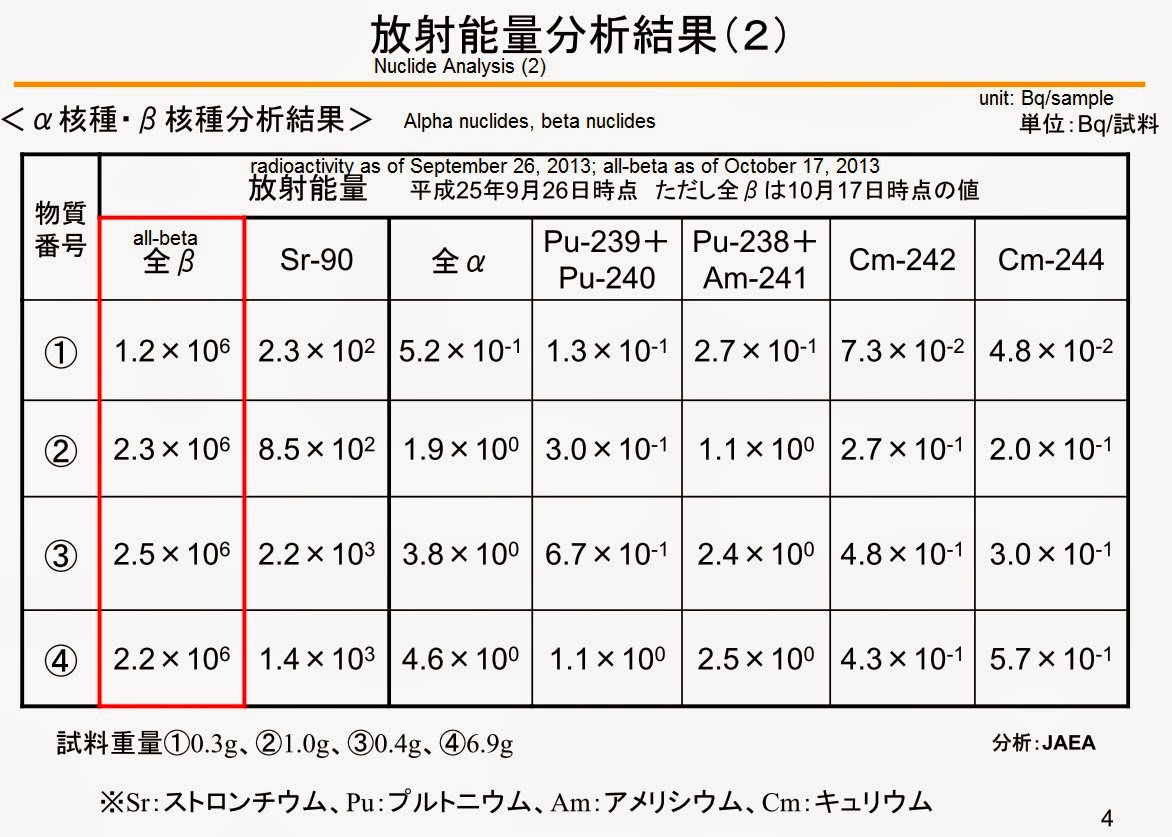
But the composition of radioactive materials (ratio) on the debris pieces shows almost all radioactivity comes from cesium-134 and cesium-137:

Radioactivity of the debris pieces, compared to those of the debris around the Reactor 3 building and of the soil in Naraha-machi and neighboring Hirono-machi. The debris pieces have about the same order of magnitude of contamination as the debris around Reactor 3 for cesium-137, and one to three orders of magnitude higher contamination for cobalt-60. Unit is Bq per gram:
Continue reading
Nukes over wind turbines? UK Research & Development policies are warped
10:50 10 February 2014 by Stuart Parkinson
http://actionawe.org/nukes-over-wind-turbines-uk-rd-policies-are-warped/
Weapons of mass destruction get five times as much public research cash in the UK as renewable energy. Time for a rethink, says Stuart Parkinson
The scale of a nation’s public spending on different areas of research and development can be very revealing. For example, what sort of a nation would spend five times as much on developing weapons of mass destruction – including delivery systems – than on the R&D for renewable energy that is so central to tackling climate change? Figures just published reveal one such nation to be the UK.
Using data from freedom of information requests, campaign group Scientists for Global Responsibility (SGR), of which I am executive director, has pieced together recent R&D spending by the UK government on a series of major weapons systems and compared them with public R&D spending on measures to tackle major drivers of armed conflict, such as resource depletion, social and economic injustice, and climate change. This is the first time such an analysis has been carried out – for the UK or indeed anywhere else. What we have uncovered is deeply disturbing.
During the three financial years spanning 2008 to 2011, annual R&D spending on all aspects of UK nuclear weapons systems was over £320 million per year. This included: over £100m a year on warheads; over £120m a year on early development work for new submarines planned to carry the nuclear-armed Trident missiles; and over £90m a year on R&D for new nuclear reactors to propel those submarines.
Only about £12m a year of the total was focused on nuclear disarmament. Since the end of this period, the Ministry of Defence (MoD) has moved on to the next stage of developing these new submarines, so more recent spending, which is not yet publicly available, is likely to have risen significantly.
Grim background
This is against a background of real-term cuts across UK universities and other publicly funded R&D. And it is in stark relief to spending in areas such as renewable energy – crucial to help tackle climate change and resource depletion. Figures reported to the International Energy Agencyput the UK’s public R&D spending on renewable energy at only £60m a year over the same three-year period – less than 20 per cent of the nuclear weapons spend. And, unlike nuclear weapons, public spending on renewable energy R&D has fallen since 2011 due to government budget cuts.
Over 100 members of the U.S. Congress call for diplomacy with Iran on nuclear program

U.S. Rep David Price, initiator of the pro-diplomacy letter to President Obama
http://www.abolition2000.org/?p=3194#more-3194
13 february 2014
With talks on a permanent agreement between P5+1 countries and Iran set to begin in Vienna in a few days, 104 Members of the US House of Representatives sent President Obama a bipartisan letter initiated by Congressman David Price (Democrat, North Carolina), supporting continued diplomatic engagement with Iran.
The letter counters efforts in the U.S. Senate, in particular through the draft Nuclear Weapons Free Iran Act (S 1881), to undermine the talks by placing additional sanctions on Iran.
A grass-roots campaign in the US, led by United for Peace and Justice and the Campaign for a Nuclear Weapons Free World, has helped limit the support for the Senate Bill and build support for the Bi-partisan letter supporting diplomacy.
In a press release on the pro-diplomacy letter, Representative David Price (D-NC) said, “I believe that we must take advantage of the opportunity before us to pursue a peaceful, diplomatic resolution to Iran’s nuclear program, and that we must resist calls by some in Congress to prematurely enact a bill or resolution that risks inadvertently derailing or impeding our ongoing negotiations.”
“While difficult and uncertain, diplomacy represents our best hope to prevent nuclear weapons in Iran and ensure the safety of our families and others around the world. Congress should not undermine diplomacy by giving the Iranian hardliners an excuse to scuttle the negotiations. So many of our colleagues have expressed their determination for diplomacy, and so many more share the same view,” added Representative Lloyd Doggett (D-TX), a senior member of the Ways and Means Committee.
The text of the letter and the list of signers in alphabetical order are included below.
***
Dear Mr. President,
As Members of Congress—and as Americans—we are united in our unequivocal commitment to prevent Iran from obtaining a nuclear weapon. The proliferation of nuclear weapons in the Middle East would threaten the security of the United States and our allies in the region, particularly Israel.
The ongoing implementation of the Joint Plan of Action agreed to by Iran and the “P5+1” nations last November increases the possibility of a comprehensive and verifiable international agreement. We understand that there is no assurance of success and that, if talks break down or Iran reneges on pledges it made in the interim agreement, Congress may be compelled to act as it has in the past by enacting additional sanctions legislation. At present, however, we believe that Congress must give diplomacy a chance. A bill or resolution that risks fracturing our international coalition or, worse yet, undermining our credibility in future negotiations and jeopardizing hard-won progress toward a verifiable final agreement, must be avoided.
We remain wary of the Iranian regime. But we believe that robust diplomacy remains our best possible strategic option, and we commend you and your designees for the developments in Geneva. Should negotiations fail or falter, nothing precludes a change in strategy. But we must not imperil the possibility of a diplomatic success before we even have a chance to pursue it.
Sincerely,
List of 104 congressmen here
This week in Mexico: 130 nations discuss Humanitarian Impact of Nuclear Weapons
http://www.psr.org/nuclear-weapons/blog/this-week-in-mexico.html

The preliminaries to the Second International Conference on the Humanitarian Impacts of Nuclear Weapons got under way today in Nayarit, Mexico. I am here representing both PSR and as Co-President, International Physicians for the Prevention of Nuclear War (IPPNW).
Red Cross Societies from across Latin America and the Caribbean convened for a two day Regional Meeting to discuss implementation of the Red Cross’ 4 year action plan to work for the elimination of nuclear weapons. The meeting was also attended by representatives from the Red Cross in Canada, Australia, Nigeria, Lebanon, New Zealand, Norway and Austria.
Masao Tomanaga from JPPNW, PSR’s sister IPPNW affiliate in Japan, addressed the meeting this morning on the effects of the nuclear attack on Nagasaki, and I made a presentation on the nuclear famine following limited nuclear war and the medical consequences of large scale nuclear war.
At the same time, 130 energetic campaigners from the International Campaign to Abolish Nuclear Weapons (ICAN) met just down the street to plan strategy for moving ICAN forward in the next few months. Both the Red Cross members and many of the ICAN campaigners will be attending the formal government conference–hosted by the government of Mexico–which opens Thursday morning.
Power struggle over EU nuclear safety
….In its suggested amendments, the EC has proposed mandatory stress tests for European nuclear facilities every six years and a set of criteria to ensure national regulators are truly independent from interference from the government or from the industry when they make decisions……
http://www.world-nuclear-news.org/RS-Power-struggle-over-EU-nuclear-safety-1302145.html
13 February 2014
National regulators should remain responsible for nuclear safety in the European Union (EU), the nuclear industry has argued. The European Commission has proposed to increase its powers in a new safety directive.
European Nuclear Safety Regulators Group (ENSREG) chairman Gerald Hennenhöfer suggested that the commission does not have the experience to ensure and assess the safety of European nuclear power plants.
He was speaking at a public hearing in Brussels organised by the European Parliament on the amendments proposed last summer by the commission to the European Union (EU) nuclear safety directive, which would give the EC regulatory power regarding the safety of nuclear power plants in Europe.
“The new directive should take a goal-setting approach to strengthen the responsibility, the competence and the independence of national regulators.”
Jean-Pol Poncelet
Director general of Foratom
The commission would be able to take EU countries to court if they do not implement technical recommendations from mandatory peer reviews that would also be authorised by the revised directive. Hennenhöfer said the EC should not have the sole right to make such recommendations or decide if they have been flouted. “We can work together towards a peer review system and would be able to set up a new regulatory body in the future that would have the necessary expertise,” he said.
Director general of Foratom, the European nuclear trade body, Jean-Pol Poncelet agreed that national regulators should remain in charge of the safety of the nuclear facilities in their countries. “This responsibility cannot be shared or diluted without risking undermining their authority and consequently the effectiveness and credibility of the safety measures,” he said. “There is a risk for confusion and even double jeopardy if more than one regulator is involved.”
IAEA Delivers Final Report on Decommissioning Efforts at Fukushima Daiichi
…..The team also examined Japan’s efforts to monitor radiation condition in the marine environment, including seawater, sediments and biota, which were further discussed with officials of the Nuclear Regulation Authority (NRA)…..
http://www.iaea.org/newscenter/news/2014/decommissioning.html
13 February 2014
The International Atomic Energy Agency (IAEA) delivered a report on 12 February 2014 to the government of Japan describing the findings of a two-part review of the nation’s efforts to plan and implement the decommissioning of TEPCO’s Fukushima Daiichi Nuclear Power Station (NPS).
At Japan’s request, the IAEA organized two expert teams to provide an independent review of Japan’s Mid-and-Long-Term Roadmap towards the Decommissioning of TEPCO’s Fukushima Daiichi Nuclear Power Station Units 1-4. The first team visited Japan from 15 to 22 April 2013 and the second from 25 November to 4 December 2013.
“Japan has established a good foundation to improve its strategy and to allocate the necessary resources to conduct the safe decommissioning of Fukushima Daiichi,” said team leader Juan Carlos Lentijo, IAEA Director of Nuclear Fuel Cycle and Waste Technology.” The situation, however, remains very complex, and there will continue to be challenging issues that must be resolved to ensure the plant’s long-term stability.”
The expert teams examined a wide variety of issues relating to decommissioning the power plant, including Tokyo Electric Power Company’s (TEPCO’s) efforts to remove fuel assemblies from Reactor Unit 4’s Spent Fuel Pool and to manage the growing volume of contaminated water at the site.
We’re one step closer to nuclear fusion but still miles away
……All things considered, the interest in nuclear fusion is alive and kicking despite progress being made at a necessarily tedious pace and at the cost of billions of dollars. After the laser facility at NIF came online in 2009, it set for itself a deadline of September 2012 by which to the ignition of a fusion reaction – and missed, prompting politicians to deprioritise the project and chop funding by $60 million. In the same year, on the other hand, Russia and China announced plans for two ‘superlaser’ facilities to replicate inertial fusion.
Once any of them achieves a sustainable fusion reaction, countries will quickly start designing power plants. Already, engineers at the Naval Research Laboratory, USA, are drawing up plans for a Fusion Test Facility that will let them experiment with nuclear fusion with an aim to generate electric power. Let’s then give ourselves till the end of this century, eh?….
http://www.thehindu.com/opinion/blogs/blogs-the-copernican/article5685659.ece
The National Ignition Facility, USA, has breached an important milestone on the road to achieving sustainable nuclear fusion. On the other hand, it is a partial achievement because it hasn’t got everything right yet.
My favourite source of limitless energy lies in fiction, in Arthur Clarke’s The Songs of Distant Earth to be exact. In the book, Clarke describes a spaceship called ‘Magellan’ powered by zero-point energy, where energy is pulled out of nothing (or out of other dimensions – but since those dimensions are otherwise inaccessible, their existence would mean nothing to our dimension).
Clarke wasn’t entirely wrong – as usual – with his vision: using zero-point energy, or vacuum energy, is a scientifically viable possibility, albeit not in the way he’d imagine it. It requires tremendous advancements in technology to achieve. Perhaps he knew that, too: the novel is set in the late 40th century, a time by which humankind is likely to have at least fully understood how to produce more energy than is consumed in producing it.
In 2014, the only Earth-bound candidate (apart from Frank Wilczek’s time crystals) in a position to lay claim to this honour is nuclear fusion. This is a phenomenon already at work in the hearts of stars, but in laboratories on Earth, scientists are still grappling with getting minute details right so they can achieve sustainable nuclear fusion.
Blowing the fuse
On February 12, a team from the $1.2-billion National Ignition Facility (NIF), California, announced that they’d breached the first step: producing a fusion reaction that released more energy than it consumed, over experiments in September and November, 2013. Viewed against a historical backdrop that started in the early 1980s, this is a remarkable achievement. Viewed against a futuristic ‘frontdrop’, it pales in comparison to what should come next.
At NIF, scientists practice one of two known techniques to achieve nuclear fusion, at least if simulations based on theoretical models are to be believed: inertial containment. The principle is simple. Atoms of hydrogen are heavily compressed inside a very small capsule until they fuse together to form atoms of helium, releasing large amounts of energy. This is how a nuclear fusion reaction is triggered.
But in order to make it practicable, scientists have to make this reaction continue and sustain it. To get there, the reaction has to be controlled in such a way that more atoms of hydrogen and helium use some of the heat produced to compress themselves further, producing another fusion reaction, and so on. Beyond this stumbling block, needless to say, is the panacea to most energy problems conceivable by humankind.
Not exactly the reaction we’re looking for
Before we start speculating, however, it’s important to get some things right about the NIF achievement. For starters, they achieved “fusion fuel gains exceeding unity”, according to their paper. If fusion fuel gain is less than unity, then the amount of fuel produced divided by the amount of fuel consumed is a number less than 1. At unity, the value of the fraction is of course 1. Exceeding unity, therefore, means more fuel was produced than was consumed. The operative clause here is ‘fuel consumed’.
The folks at NIF used strong lasers pulsing for a few nanoseconds to deliver trillions of watts of energy to the contents of the capsule. However, not all the energy is consumed by the atoms but only a fraction. And if they have achieved fusion – which they have – it means the amount of energy produced by fusion was greater than the fraction they consumed, not greater than all the energy they were given. According to their paper published in Nature, the total energy delivered by the lasers was 1.9 megajoules while the reaction produced about 17 kilojoules.
As Omar Hurricane, the lead author of the published paper, told The Guardian, “We are finally, by harnessing these reactions, getting more energy out of that reaction than we put into the DT fuel.”
Even so, they were missing something here that’d make the process more efficient. This is where the history comes into play.
To get inertial containment right, scientists have to broadly look out for three things. First, the lasers have to be designed to perfectly deliver specific quantities of energy over carefully described intervals. Second, the lasers produce X-rays inside the capsule that then energise the atoms – the X-rays have to be as symmetrical as possible to act evenly. Third, the contents of the capsule have to be as spherically arranged as possible to minimise instability.
The contents being made to implode are a mixture of deuterium (D) and tritium (T) – both isotopes of hydrogen. They are coated as a fine patina on the insides of the capsule, which is made of gold. When laser pulses strike the gold, it emits X-rays that then driven the isotopes inward at such energy and speed (almost 1.12 million km/hr) that they are forced to fuse. Because the flux of X-rays can’t be possibly perfectly controlled, the focus was mostly on getting…
The perfect shot into the perfect capsule
1 This Month

of the week – Shut Down Drone Warfare!


Tell the Ukrainian Government to Drop Prosecution of Peace Activist Yurii Sheliazhenko

Petition to revoke the licensing of the Near Surface Nuclear Disposal Facility (NSDF) at Chalk River. https://www.ourcommons.ca/petitions/en/Petition/Details?Petition=e-7247
To see nuclear-related stories in greater depth and intensity – go to https://nuclearinformation.wordpress.com
-
Archives
- April 2026 (57)
- March 2026 (251)
- February 2026 (268)
- January 2026 (308)
- December 2025 (358)
- November 2025 (359)
- October 2025 (376)
- September 2025 (257)
- August 2025 (319)
- July 2025 (230)
- June 2025 (348)
- May 2025 (261)
-
Categories
- 1
- 1 NUCLEAR ISSUES
- business and costs
- climate change
- culture and arts
- ENERGY
- environment
- health
- history
- indigenous issues
- Legal
- marketing of nuclear
- media
- opposition to nuclear
- PERSONAL STORIES
- politics
- politics international
- Religion and ethics
- safety
- secrets,lies and civil liberties
- spinbuster
- technology
- Uranium
- wastes
- weapons and war
- Women
- 2 WORLD
- ACTION
- AFRICA
- Atrocities
- AUSTRALIA
- Christina's notes
- Christina's themes
- culture and arts
- Events
- Fuk 2022
- Fuk 2023
- Fukushima 2017
- Fukushima 2018
- fukushima 2019
- Fukushima 2020
- Fukushima 2021
- general
- global warming
- Humour (God we need it)
- Nuclear
- RARE EARTHS
- Reference
- resources – print
- Resources -audiovicual
- Weekly Newsletter
- World
- World Nuclear
- YouTube
-
RSS
Entries RSS
Comments RSS
 nuclear-news