………..on what grounds does John assert that the Asia Pacific is a major growth area in nuclear power?
Before Fukushima, Indonesia, Malaysia, Thailand and Singapore were all toying with the idea of building reactors. In the region at present, only Vietnam is. Further north, plans for the rapid expansion of nuclear reactor construction in China, Taiwan and South Korea have been slowed or delayed indefinitely as citizens increasingly express their opposition to all aspects of nuclear technology. In Japan itself, opposition to restarting any of the nation’s more than fifty idle reactors has been steadily growing since Fukushima. Two former prime ministers – Hosokawa and Koizumi – have added their support to this opposition, which may well prevent the Abe Government in forthcoming elections from re-starting any reactors in the immediate future. In such a negative climate, it is not particularly accurate to suggest that the region is a ‘nuclear growth area’.
Third, why does John focus on Iran as the world’s main catalyst of nuclear proliferation? Yes, Iran’s nuclear program began with a certain degree of secrecy, but that was under the Shah with American backing. (Incidentally, every country with a nuclear program began its development in secrecy). Since 1979, the Islamic revolutionaries have simply carried on with and amplified the Shah’s projects, including enrichment.
Nor, as John asserts, is Iran’s enrichment program in violation of Iran’s commitments under the NPT. The country has a perfect right to develop all aspects of peaceful nuclear technology. Indeed, other signatories have an obligation to help it. By asserting, as John does, that no country has a legitimate reason to proceed with a wholly national program in proliferation-sensitive areas, simply reinforces the double standard of the NPT. It is analogous to Washington’s ‘permission’ to allow Japan to proceed with both an enrichment and a re-processing industry whilst prohibiting the Republic of Korea from doing the same. It is the same double standard that applies to nuclear disarmament, where the nuclear ‘haves’ are obliged to dismantle their nuclear weapons in exchange for nuclear ‘have-nots’ promising neither to acquire nor build their own. The nuclear ‘haves’ have patently failed to disarm.
I accidentally happened upon this photo while researching some things about the 1986 Chernobyl nuclear disaster and I freaked out! How did this worker get so close to this mass of melted nuclear fuel in the basement of Chernobyl without receiving several lethal doses of radiation?
Approaching it would mean certain death. The individual shown in the below image is either completely insane or outright suicidal.
I am quite certain that this worker, as well as the person who took the photograph, are now both deceased. Probably from either cancer or acute radiation sickness.
Russian state nuclear power corporation Rosatom is willing to use Belarusian companies that have gained good reputations in the construction of the first nuclear power plant in Belarus for projects in third countries, Rosatom Chairman Sergei Kirienko said in a meeting with Belarusian President Alexander Lukashenko on Monday.
During the meeting Lukashenko proposed that Rosatom use Belarusian companies to build nuclear power plants in third countries.
“I am counting on this that we learn something here [in the construction of the first Belarusian nuclear power plant] and can build at other sites with you,” the Belarusian president said. “If we learn to build nuclear power plants, we are willing to use your technology and move with you where you are building throughout the world,” he added.
Lukashenko asked Kirienko if Russia would invite Belarusian companies to other sites.
“That is so. We, honestly, also looked at the [joint] experience with a view to the future,” Kirienko said. “And we really are willing to use the most qualified organizations that have proved themselves in the building of the first Belarusian nuclear power plant,” he said.
He added that this would include building plants in third countries as well as Russia.
“We already have 22 blocks contracted out throughout the world in our portfolio currently,” he said.
A deal was recently signed with Hungary and tenders were won for construction of reactors in Finland and Jordan. “
On January 18, 2014 activists from a Puget Sound-based nuclear abolition group engaged in a nonviolent direct action at the US Navy’s West Coast nuclear submarine and nuclear weapons base.
Members of Ground Zero Center for Nonviolent Action held a peaceful vigil and nonviolent direct action at the main gate to Naval Base Kitsap-Bangor in Silverdale, Washington. They protested the U.S. government’s continued deployment of the Trident nuclear weapons system, and increasing military presence in Asia due to its Asia-Pacific Pivot. Its continued reliance on nuclear weapons as an instrument of foreign policy by force projection is in contravention of both U.S. and international laws.
The Trident submarine base at Bangor, just 20 miles from Seattle, contains the largest concentration of operational nuclear weapons in the US arsenal. Each of the 8 Trident submarines at Bangor carries up to 24 Trident II (D-5) missiles, each capable of being armed with as many as 8 independently targetable thermonuclear warheads. Each nuclear warhead has an explosive force of between 100 and 475 kilotons (up to 30 times the force of the Hiroshima bomb). 60 percent of the Trident fleet is based at Bangor, with 40 percent at King’s Bay, Georgia.
On Saturday afternoon the group maintained a peaceful vigil on the roadside outside the base entrance. Honoring Martin Luther King Jr’s strong stand against war and nuclear weapons, participants held a large banner with a quote from Dr. King: “When scientific power outruns spiritual power, we end up with guided missiles and misguided men.”
Two participants entered the roadway, symbolically closing the base, and were removed by Washington State Patrol officers. Cited for traffic violations – “Pedestrian on Roadway Illegally” – were Gilberto Perez, Bainbridge Island, WA and Michael Siptroth, Belfair, WA. Perez, a Buddhist monk who has visited Jeju Island in South Korea, held a banner (in Korean) calling for “No Naval Base on Jeju.”
Another participant, Tom Krebsbach, Brier, WA walked onto the base in an attempt to deliver a message, in the form of a poem, to the base commander. Naval security authorities arrested Krebsbach, and took him to a base facility for processing. He was released a short while later, after having been cited for Trespassing (18 USC 1382).
The 22-year old political prisoner, journalist of Bobrujskij Courier Yauhen Vaskovich is sent to the solitary cell, a fine for bad behavior in prison, almost every month. By now, he has spent 247 days in solitary confinement, report human rights defenders, which means nearly ten months out of less than three years of imprisonment.
Last time Yauhen was placed in the isolator before the New Year, on December 27, for ten days.
Such regime of serving the sentence (he is allowed only one food parcel up to two kilos a year) made impact on the physical state: being 186 cm tall, he weighs only 65 kilos.
His mother says he does not complain in letters; she supposes it is not allowed to write things like that. The lawyer meets him regularly. After January 20 the mother is going to pay a visit to his son, which is allowed only once a year.
Meanwhile, Yauhen’s colleagues from the Belarusian Christian Democracy are worried by the situation and alarm human rights defenders and international organizations to protest against the tortures of the prisoner.
We remind that Yauhen Vaskovich, and his friends Artsiom Prakapenka and Pavel Syramolatau, were sentenced to 7 years in prison for attacking the KGB building in Babruysk (on the night of October 17, 2010). They were found guilty of hooliganism and causing costly damage to property (the damage to the outer façade was estimated at 253 000 Br, which was in 2010 about 85$). Now Yauhen Vaskovich is in Mahilou prison No4. Pavel Syramalotau pleaded for pardon and was released in September 2012. Yauhen Vaskovich and Artsiom Prakapenka are refusing to appeal for pardon.
The prominent Belarusian human rights activist has been nominated for the Nobel Peace Prize for the third time.
Polish MPs, members of the ruling Civic Platform and the opposition Law and Justice party, collect signatures to submit his nomination.
“Like the Polish Solidarity movement represented by Lech Walesa received the Nobel Prize, Belarusian human rights activists represented by Bialiatski should be given the Nobel Peace Prize,” he says.
As many as 160 Polish MPs signed for Bialiatski’s nomination, Nasha Niva newspaper reports referring to Gazeta Wyborcza.
Bialiatski has been remaining a nominee for the last few years in prison.
Bialiatski used his bank accounts to help victims of repressions of the Lukashenka regime. Activists from Viasna human rights centre offered aid to all wrongfully convicted people regardless of their political views.
The Belarusian authorities received details of Bialiatski’s bank accounts from the judicial bodies of Lithuania and Poland. He was imprisoned on accusations of tax frauds.
Loren Thompson, head of the Lexington Institute, a defense-oriented public policy advocacy group, said he thinks part of the problem may be the “diminished status” of the nuclear mission in the post-Cold War era.
“Although missile forces remain crucial to deterring nuclear attack, they are no longer seen as a prestigious assignment in the Air Force,” he said. He noted that in 2008, then-Defense Secretary Robert Gates expressed worry about stewardship of the mission.
“This suggests these latest problems are part of a broader pattern,”
Air Force says latest missteps don’t equate to failure; others cite worrying pattern
WASHINGTON — At what point do breakdowns in discipline put the country’s nuclear security in jeopardy?
And when does a string of embarrassing episodes in arguably the military’s most sensitive mission become a pattern of failure?
Defense Secretary Chuck Hagel is now concerned “there could be something larger afoot here,” according to his chief spokesman, and “wants this taken very, very seriously.”
The disclosures of disturbing behavior by nuclear missile officers are mounting and now include alleged drug use and exam cheating. Yet Air Force leaders insist the trouble is episodic, correctible and not cause for public worry.
The military has a well-established set of inspections and other means of ensuring the safety of its nuclear weapons. But as in any human endeavor, military or civilian, the key to success is the people, not the hardware.
Until recently, Hagel had said little in public about the setbacks and missteps in the nuclear missile force reported by The Associated Press beginning last May.
Last week, Hagel made the first visit to a nuclear missile launch control center by a Pentagon chief since 1982. He praised the force’s professionalism, even though minutes before, officials had informed him that a few missile launch officers at another base were suspected of illegal drug use.
Air Force Secretary Deborah Lee James, just four weeks into her tenure as the service’s top civilian official, told reporters Wednesday that the Air Force’s chief investigative arm is investigating 11 officers at six bases who are suspected of illegal drug possession.
She said that probe led to a separate investigation of dozens of nuclear missile launch officers for cheating on routine tests of their knowledge of the tightly controlled procedures required to launch missiles under their control.
At least 34 launch officers, all at Malmstrom Air Force Base, Mont., have had their security clearances suspended and are not allowed to perform launch duties pending the outcome of the investigation.
They stand accused of cheating, or tolerating cheating by others, on a routine test of their knowledge of how to execute “emergency war orders.” Those are the highly classified procedures the officers would use, upon orders from the president, to launch their nuclear-tipped missiles.
The alleged cheaters are said to have transmitted test answers by text message to colleagues. That is a violation not only of their own personal integrity but also of security classification rules.
“We note all the technologies being considered have pros and cons and that no “perfect” solution exists. It may be that a multi-track approach offers best value for money.”
[…]
“The Nuclear Decommissioning Authority’s advice on plutonium management and on the potential options for its implementation are essential to the overall delivery of a final solution for plutonium disposition,” she said. “As we noted in our 2011 consultation response, there will be many steps to go through before we reach the point of taking a final decision on the technology for plutonium disposition. This will include a competitive tendering and procurement process to help secure best value to the taxpayer.
GE Hitachi Nuclear Energy PRISM technology back in the running as a means of generating energy from UK plutonium stockpile
By James Murray
21 Jan 2014
The UK’s ambitious plans for a new generation of nuclear reactors that could be fuelled using the country’s stockpile of waste radioactive material took an important step forward yesterday, as the Nuclear Decommissioning Authority (NDA) announced that it had identified three “credible” approaches for reusing separated plutonium.
The NDA last year undertook a review of the government’s “preferred option” of reusing plutonium as MOX fuel, and also looked at the credibility of alternative proposals put forward by GE-Hitachi and Candu.
The agency yesterday published a position paper on its review, indicating that a possible a U-turn could be on the cards as each of the three proposals represents a “credible reuse option” for the UK’s plutonium stockpile.
“This work has resulted in NDA concluding that reuse remains the preferred option and, based on the information provided and against our definitions, there are three credible reuse options: – reuse as MOX in light water reactors, reuse in CANDU EC6 reactors and reuse in PRISM fast reactors,” the NDA stated. “We note all the technologies being considered have pros and cons and that no “perfect” solution exists. It may be that a multi-track approach offers best value for money.”
Involved in the USS Ronald Reagan’s rescue efforts following the 2011 Fukushima nuclear plant meltdown, Steve Simmons began experiencing devastating symptoms several months after returning home.
“You’re starting to run fevers, your lymph nodes start swelling, you’re having night sweats, you’re getting spastic and you’re losing sensation in your legs, and you can’t feel your legs when you’re getting 2nd degree burns on them, and how do you explain those things?” Simmons told WUSA 9 News
A lot of articles online have linked the Fukushima spills to events such as starfish die-offs near California. What is your response to them?
There’s been a lot of undue alarm. In some terms it’s like shouting fire in a crowded theatre. It should be stopped. It’s not accurate. Radioactivity can cause harm and genetic damage, but not at the levels we’re expecting. A lot of those reports of effects on the US west coast were even before this radioactivity showed up. How does that work? It hasn’t even shown up on our coast.
I certainly wouldn’t change my behaviour, stop swimming in the Pacific or stop eating seafood.
[…]
The estimate was that someone who eats five times the amount of fish that an average American does, and eat only contaminated tuna for a year, would end up with a dose that would cause an extra two cancers in ten million people. The risk was not zero, but it was very small
Scientist launches crowd-funded survey of US west coast but says health concerns are overblown.
Ken Buesseler on a boat off the Fukushima Daiichi plant, after the 2011 tsunami caused meltdowns at three of its reactors.
Ken Buesseler was one of the first scientists to analyse the sea water off the coast of Fukushima, Japan, after the nuclear meltdowns that followed a devastating tsunami there in March 2011.
This week, the marine chemist, based at the Woods Hole Oceanographic Institution in Massachusetts, launched How Radioactive Is Our Ocean?, a crowd-funding website that urges people to support the collection and analysis of seawater samples along the west coast of the United States.
Although larger, wind-blown debris from the Japanese tsunami began to be spotted on North American shores shortly after the disaster, and migratory fish such as bluefin tuna have already shown up off California carrying radioactive isotopes from the spill, oceanic currents move much slower. The Fukushima spill therefore is unlikely to have anything to do with reports such as the mysterious die-off of sea stars in California. Now, however, contaminated sea water is finally due to arrive on the eastern side of the Pacific, and so it is time to start keeping watch.
How did you end up working on Fukushima fallout? Isn’t Woods Hole about as far as it’s possible to get from Japan?
I did my PhD looking at fallout from the 1960s nuclear-weapons testing. 1986 was the year I defended [my thesis], which of course was the year of the Chernobyl disaster. So I started out looking at artificial radionuclides in the ocean.
When Fukushima happened, the first things we saw were some of the numbers from the Tokyo Electric Power Company [which ran the reactors at the plant], and they had measured levels of the caesium isotopes 137 and 134 on scales of tens of millions of becquerels per cubic metre. The number pre-disaster was one or two of those units. We thought this was unprecedented for the ocean and we really need to find out how that’s being dispersed.
In terms of total release of radioactive materials — as opposed to local concentrations — how do the Fukushima leaks compare to those from previous radioactive releases, such as from weapons testing in the 1960s?
The total global fallout number for caesium from the 1960s tests was around 950 petabecquerels (a unit of quantity, rather than concentration). Chernobyl was around 100. Fukushima? We’re still debating that number. Fifteen to 30 is a rough estimate.
How concerned should people in the US be about this radioactive contamination reaching their seas?
“To actually get a harmful dose of tuna you have to eat 2.5 tons of tuna a year,” Martini says. “I really love Tuna, but I don’t love it that much.”
[…]
So the elder Knutson sent seven samples of his Pacific salmon off to a lab.
When the results came back, he says, “we found that these fish were clean… There were two samples that maybe had a trace of barely detectable, so we feel very good about the results.”
[…]
Neville has sampled more than 60 fish since Fukushima (2011). The levels of Cesium traced to Fukushima were so low that his lab couldn’t see it at all until he concentrated the samples.
Pete Knutson and his son Dustin sell local Pacific salmon at outdoor markets around the Seattle area. The sign on their stall at a recent market in Seattle’s Ballard neighborhood reads, “In response to multiple customer inquiries regarding the Fukushima incident, we’ve had our salmon tested for radiation. We’re pleased to announce that there is no reason to be concerned about eating our salmon this year.”
Pete Knutson’s Loki Fish company offers all kinds of salmon products and the Sunday Ballard farmer’s market in Seattle—whole, pickled, smoked, canned—whatever your pleasure.
Knutson’s been in the business of catching and selling fish for more than 40 years. But recently he had to do something new to meet his customers’ demands: test his fish for radiation.
Ever since the Fukushima meltdown, Knutson’s son Dustin says, people have expressed concerns.
“We had regulars at the U District market,” the younger Knutson says, “and they were saying, ‘sorry we’re not coming by any more.’ It was directly because they were worried about Fukushima.”
So the elder Knutson sent seven samples of his Pacific salmon off to a lab.
When the results came back, he says, “we found that these fish were clean… There were two samples that maybe had a trace of barely detectable, so we feel very good about the results.”
The barely detectable substance was Cesium. It’s a radioactive isotope that was released in the Fukushima meltdown. But the levels in the fish were hundreds of times below federal safety standards.
Of course seven fish is a pretty limited sample, but Knutson’s results are in line with other tests of Pacific fish since Fukushima.
Delvan Neville, a Ph.D candidate in Radiation Health Physics at Oregon State University, has analyzed dozens of samples of albacore tuna caught in the Pacific since the meltdown.
He says the highest level of radioactive contamination he’s found “is more than 1,000 times lower than the point where the FDA would even think about whether or not they need to let people eat that food.”
Tuna are top predators, and tend to concentrate any pollutants that are in the food chain. But what Neville’s found are Cesium levels so low he’s comfortable eating his samples.
Which was actually kind of fun, he says, “because then I was telling people as we were eating at the table what their approximate dose was due to Fukushima from the food they were eating, and it’s this ridiculously small number.”
Russia has agreed to provide Hungary with billions of dollars upfront to finance the planned extension of the Paks nuclear power plant south of Budapest – yet the deal is raising hackles over a lack of a proper bidding process and the absence of public consultation.
Russia has agreed to provide Hungary with billions of dollars upfront to finance the planned extension of the Paks nuclear power plant south of Budapest – yet the deal is raising hackles over the lack of a proper bidding process and the absence of public consultation.
Russian state nuclear corporation Rosatom agreed yesterday to expand the Paks plant for some $13.6 billion, doubling its size in the largest construction project in Hungary’s post communist history, and something Rosatom is portraying as a major move onto the EU nuclear market.
Russian President Vladimir Putin said that he and visiting Hungarian Prime Minister Viktor Orban had signed an agreement on the project at Paks, which already runs four Russian-made VVER-type reactors built in the 1980s. The new project will see two new reactor blocks built of the VVER-1200 type, which will boost the plant’s capacity to 4000 MW.
Putin and Orban added the Paks station was already responsible for producing 40 percent of the energy consumed in the EU member country. Vladimir Slivyak, co-chair of Russia’s Ecodefense, wrote in a blog on the independent radio station Echo of Moscow that bumping the output of the Paks plant to supply 80 percent of the country’s electricity seemed absurdly high.
Hungarian government ministers told news agencies that 80 percent of the financing would be covered by a 30 year loan from Russia, and the remainder would be financed by Hungary.
Environmental activists in Hungary are outraged over the decision between Putin and Orbin because it fails to take into account local public opinion about the giant nuclear build out.
The damaged fuel assemblies, some of which are broken, are currently being stored at the Paks’ plant’s cooling pool at it’s No 2 reactor. The No 2 unit, from which the fouled fuel rods were removed in 2003, had to undergo 18 months of repairs before coming back online.
Rosatom’s expansion abroad amid troubles at home
But much of Rosatom’s financial strategy is banking on building nuclear power plants abroad, as well selling and repatriating fuel from foreign nuclear power plants.
As a sign of how poorly things are going on its domestic market, Rosatom announced in November that it would be slashing its ambitious “2008 Roadmap” plans to construct 35 nuclear reactors in Russia by 2020 in half, cutting the number to a more humble 12.
Among other countries that have contracts with Rosatom are India, Iran, China, Belarus, Bangladesh, Jordan, Bulgaria, Vietnam, Ukraine, Armenia, Turkey and Finland. Clearly, Rosatom is placing its bets abroad. The Moscow Times reported that Russia has another 40 nuclear construction contracts under consideration.
Duringtwoyears,thedirectorfollowedoftheinhabitantsandthefamiliesofthetownofMinamisoma,located20kmaway fromthenuclear power plantofFukushima Daichi.Betweenrevoltandresignation,theyraisethequestion:to moveorremainon the spot,livewiththecontaminationandthefearofthefuture?
Fukushima Mother: Then Yuka started to get panic attacks. She got headaches, stomach aches, sore throats… It would change every day. Shortly after around the end of April she would spend her days crying in here room. It all made me very nervous. Kento was edgy allo the time, too. […]
Fukushima Father: Perhaps she didn’t really know she was doing, but she made several attempts to jump from the first floor. She even tried to kill herself by dousing herself with petrol and setting it alight.
Fukushima Mother: She led a normal life until March 11 last year, when there was the accident at the nuclear power plant. She can’t forgive herself for being this way. Every time she cries she asks, “Why did this nuclear disaster happen to us?”
Throughsomeparallelsegments:–afamilydecidesto leavethesiteandmoves/–another,whosefatherworkedinapower stationat the timeoftheaccident,becameafloristwhichbecomeveryprofitablebecause ofthemanyburialsandcommemorations/– An oldaforest rangerattendsthemetamorphosisofthelandscape(theforestsandmountains)andquestionsthetraditionalreportwithnature, now upsetbythecatastrophe.
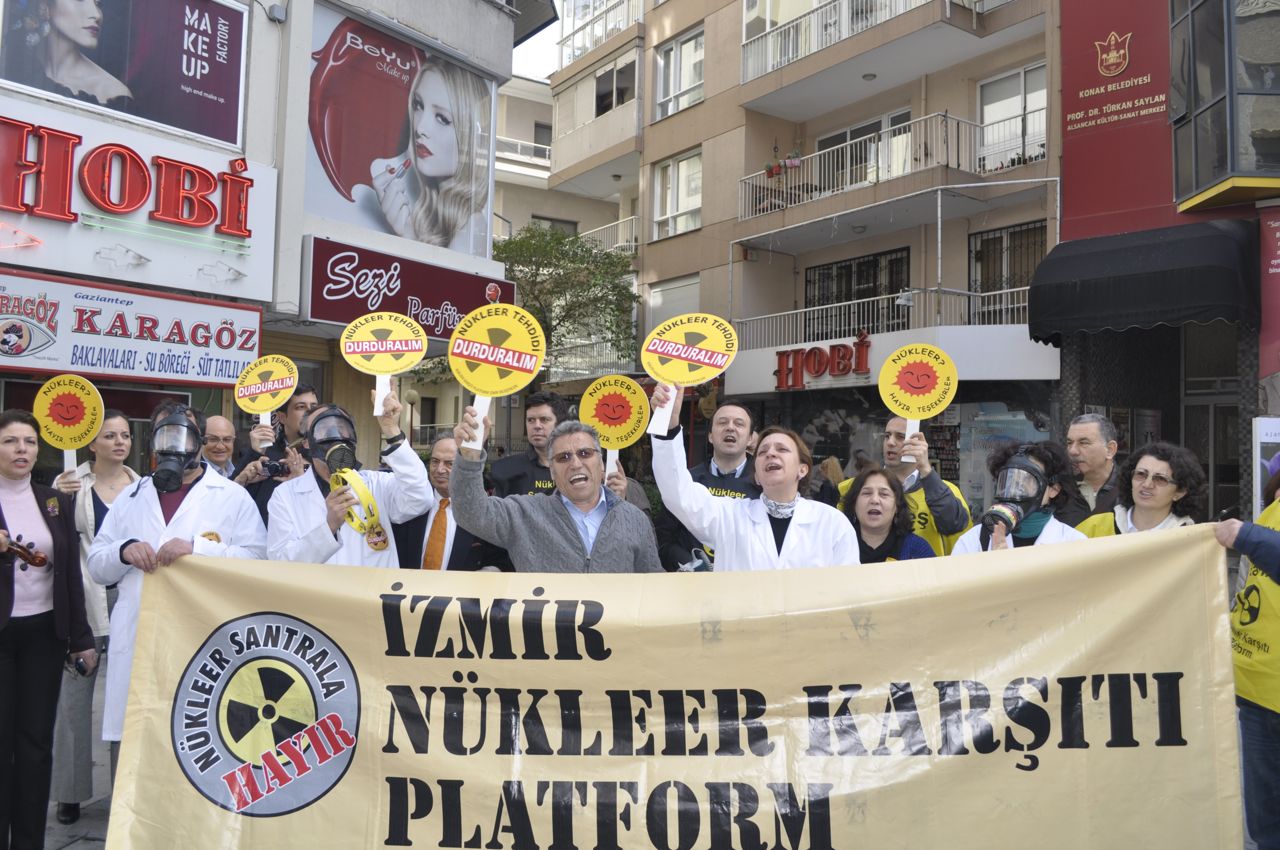
This message and the following letter is sent from Turkey by NKP .Nükleer Karşıtı Platform – Turkish Antinuclear 20 Jan 14 NKP is a broad and all-embracing alliance of NGO’s and activists against nuclear power in Turkey. It represents the largest joint effort in the environmentalist movement in the country.
Attached letter has been written for DIET members, to enable them to discover the backdrop of “Agreement between the Government of Japan and the Government of the Republic of Turkey for Co-operation in the Use of Nuclear Energy for Peaceful Purposes “signed by Mr. Abe and Mr. Erdogan in Istanbul.
We – the citizens-firmly believe this agreement must be scrapped when it is brought to the attention of the Japanese Parliament for ratification.
We also believe, as the leaders of a country who are still in battle against the Fukushima disaster, Japanese MP’s will act sincerely and reject ratifiying this agreement. It is crucial that our motives for opposing this agreement are well understood by you,hopefully this letter conveys our message well .
In May 2013, Turkey and Japan signed an agreement to construct a nuclear power plant in Sinop on Turkey’s western Black Sea coast. Mitsubushi Heavy Industries and the French Areva are supposed to be working on this project jointly. In 2010, Turkey signed a similar agreement with Russia to build the country’s first nuclear power plant in Akkuyu. Questionable “build-own-operate” model of Russia is unusual in nuclear industry and leaves many uncomfortable questions in mind about safety.
As Turkey moves toward these serious, potentially hazardous projects in a hurry, it fails to factor in the social, geological and environmental implications and seem unaware of potential lethal risks for millions of people living in the region as well as the vulnerable ecological communities in case something goes wrong just as it did in Fukushima recently and Chernobyl earlier. Turkey’s active fault lines in its political and economic structure, coupled with its inefficiencies in the areas of technology, regulations, infrastructure and shortage of qualified personnel pose a big threat to the efficient and safe execution of any such project. Turkey, just like Japan is in a seismically very active geography yet unlike Japan, she is quite unprepared for the risks of major earthquakes. Turkish safety culture is very different from Japan’s and risk management concepts are also perceived differently. This alone massively amplifies the risks of operating nuclear power plants in Turkey.
Our letter is calling the MPs representing Japanese people to scrap the intergovernmental nuclear agreement with Turkey that will soon be brought to the attention of DIET members for deliberation. The reasons behind this sincere call are detailed in the following paragraphs.
Turkey is deviating from practices of a modern democracy, as it becomes more and more authoritarian under the current government; people’s will on vital issues is dismissed. Evading ecologically sustainable energy options, the government has imposed obscure nuclear plans on the nation without any due debates either within its party program or in the parliament. The method of promoting these nuclear agreements are very much in line with the rest of the un-democratic practices of the Justice and Development Party (AKP), which has been in power for a decade.
Majority of Turkish people are against nuclear power plants and nuclear weapons. “Global Citizen Reaction to the Fukushima Nuclear Plant Disaster”, a survey conducted by IPSOS in April 2011 documents the fact that 80% of Turks are against acquiring nuclear energy. Yet, people and NGOs cannot find outlets for voicing their true concerns or objections on neither nuclear nor other similarly vital issue; democratic channels through which the citizens may promote change are blocked by the AKP regime. For the second consecutive year in 2013, the Committee to Protect Journalists has announced Turkey as the world’s leading jailer of journalists, followed closely by Iran and China. Continue reading →








 nuclear-news