IAEA Delivers “Final” Report on Remediation in Fukushima to Japan
The team recognized the efforts to reduce residual doses to less than 1 mSv per year, but stressed that this target is a long-term goal, and that it cannot be achieved in a short time – for example, through decontamination work alone. The IAEA is ready to continue to support Japan in its remediation efforts, at its request.
[…]
Japanese authorities were encouraged to sustain current public communication efforts and enhance these whenever necessary, especially with a view to explaining to the public that, in remediation situations, any level of individual radiation dose in the range of 1 to 20 mSv per year is acceptable and in line with the international standards and with the recommendations from the relevant international organisations such as ICRP, IAEA, UNSCEAR and WHO. http://www.iaea.org/newscenter/news/2014/report-on-remediation.html
Above the IAEA report map and below the safecast map
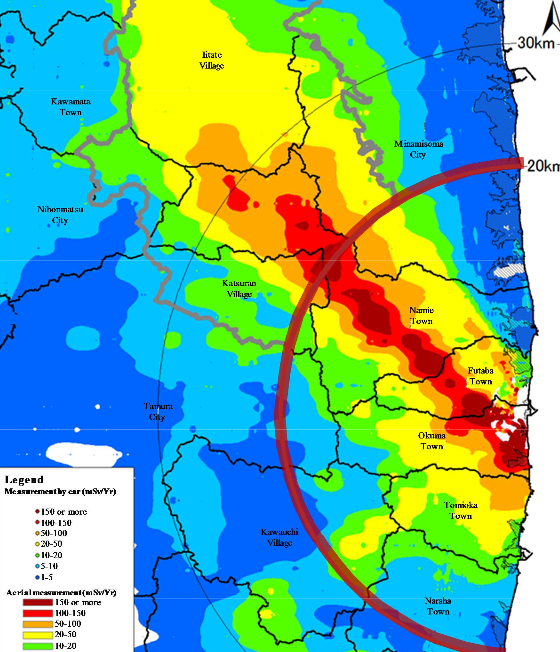
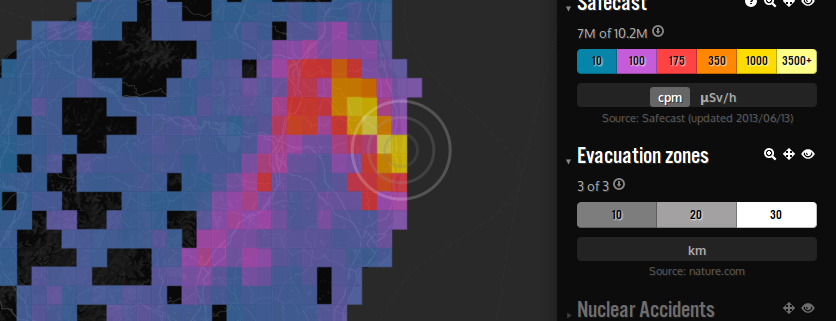
Japan Herald (IANS) Friday 24th January, 2014
http://www.japanherald.com/index.php/sid/219857386/scat/c4f2dd8ca8c78044/pp/2
The International Atomic Energy Agency (IAEA) Friday handed Japan the final report from an expert mission that reviewed remediation efforts in areas affected by the Fukushima Daiichi nuclear power plant accident.
The IAEA report, which is available online, describes the findings of the Follow-up IAEA International Mission on Remediation of Large Contaminated Areas Off-Site the Fukushima Daiichi Nuclear Power Plant, held Oct 14-21, 2013.
The plant was severely damaged by the March 11, 2011, earthquake-triggered tsunami.
The report highlights important progress in all areas to date, and offers advice on several points where the team feels it is still possible to further improve current practices.
“The mission team was impressed by the amount of resources allocated and by the intense work that Japan is carrying out in efforts to remediate the affected areas and promote the return of evacuees to their homes, together with efforts for reconstruction of those areas,” said Juan Carlos Lentijo, director of IAEA’s fuel cycle and waste technology division.
Lentijo led the 16-member mission team, which comprised international experts and IAEA staff working across a range of disciplines including radiation protection, remediation approaches and technologies, waste management and stakeholder involvement.
Lentijo led the 16-member mission team, which comprised international experts and IAEA staff working across a range of disciplines including radiation protection, remediation approaches and technologies, waste management and stakeholder involvement.
The team welcomed progress achieved following the first IAEA remediation mission in October 2011, including the remediation of farmland and forest areas.
The team also welcomed significant progress by municipalities and the national government in the development and establishment of temporary storage facilities for contaminated materials generated by on-going remediation activities.
In addition, the mission team noted the progress made towards the national government’s creation of interim storage facilities, with the cooperation of municipalities and local communities.
The mission observed that comprehensive implementation of food safety measures is in place to protect consumers and improve consumer confidence in farm produce, reflected in an increase in the economic value of the crops.
–IANS/WAM
– See more at: http://www.japanherald.com/index.php/sid/219857386/scat/c4f2dd8ca8c78044/pp/2#sthash.4LeqqYjY.dpuf
Nuclear Power Brings Fascism
 Is Nuclear Experimentation Fascism? OpEdNews Op Eds 1/22/2014 opednews.com By Ethan Indigo Smith Contributing Writer for Wake Up World “…..The United States was formerly one of the few anti-institutional, anti-oligarchical nations in the world, but we have succumbed to the oligarchical corporaculture that has been pushed for the last couple of hundred years, whether fused by labels like the divine rite of kings or by corporate personhood. The United States used to push for individual rights, but now we yield to violent fascism just like the rest of the intolerant world. Hell, we were once so anti-fascist and anti-oligarchy that it used to be illegal to do business in more than one American state, now the police and political system seems to only serve and protect business interests. But at what cost?
Imagine if this culture of anti-fascism were still the case, perhaps none of us would ever question our water supply, hijacked for a nuke plant or polluted by a petroleum conglomerate”.
Learning from History
Recent events at Fukushima have highlighted the uncontainable dangers of nuclear experimentation. If one examines trends, there are bound to be more accidents, spills and “unprecedented events’ within the nuclear industry.
The first nuclear power generation experiment began at Oak Ridge in 1948, and first massive one began in the Soviet city of Obninsk in 1954. In the 65 years that followed, there have been numerous known meltdowns at nuclear facilities around the world, as well as environmental, human and political destruction at other sites that did not (by luck only) experience full meltdown.
HANFORD, USA, 1943 — 1987…….
BIKINI ATOLL, NORTHERN PACIFIC OCEAN, 1946…….
WINDSCALE FIRE, UK, 1957….
SANTA SUSANA, USA, 1959…….
THREE MILE ISLAND, USA, 1979…….
CHERNOBYL, UKRAINE, 1986…..
ROCKY FLATS PLANT, USA 1987…..
FUKUSHIMA DAIICHI, JAPAN 2011….
WHO IS NEXT?
The list goes on. And while this is a short summary of some of the nuclear industry’s worst failings — both environmental and political — what it does not take into account that there are now over four hundred nuclear power generation experiments in operation worldwide, and more being built, each one representing another potential disaster. Now factor in the endless radioactive pollution and dumped material (buried and sunken near you) involved in the process even when things go “right’ (by nuclear industry standards) and you get a clearer view of the impact of nuclear experimentation.

Under the terms of current policy, the US Federal Government simply incurs the financial costs and burden of dealing with nuclear “events'”. and by the “Federal Government’ I mean the U.S. taxpayer.
Regimentation of Industry
Today, the United States of America is fascist. So is China, Japan, Russia, France, England, Japan and every single nuclear nation. Australia is de facto fascist, being a major extractor of uranium for the nuclear fuel chain. The United States of America is fascist by way of one single act: The Price Anderson Nuclear Industries Indemnity Act. There are many more acts and laws that strengthen nuclear fascism in the United States, but The Price Anderson Act seals the deal. Its main purpose is to indemnify the nuclear industry against liability claims arising from nuclear incidents. And other countries have their own nuclear deals which also guarantee that those who profit from the nuclear industry are not held accountable for their work………
Clearly nuclear experimentation does not co-exist alongside freedom of speech or transparent access to information. It can only exist in a fascist state, which suppresses information and opposition.
Severely Nationalistic Policies
The only part of the definition of fascism that nuclear experimentation does not technically fit is that nuclear experimentation operates on an international level, not just a nationalistic one. However it seems even nuclear disaster rings opportunity bells for nationalistic governments.
As reported by Bloomberg in 2013, “Japan will receive international help with the cleanup at the Fukushima atomic station once it joins an existing treaty that defines liability for accidents at nuclear plants, U.S. Energy Secretary Ernest Moniz said.” This means that the United States’ “offer” of assistance is conditional upon Japan signing onto an international convention known as the Convention on Supplementary Compensation for Nuclear Damage, designed only to protect US nuclear interests from liability in the event of an accident. The U.S. Government has lobbied for the international adoption of the convention for many years, and now it seems it has Japan over a barrell. Surely this political opportunism qualifies as “severely nationalistic’ behaviour. Yet it in the United States, it seems we can barely distinguish this kind of fascism from the actions of true democratic government…….
Nuclear experimentation is destructive on a level that supersedes our common understanding of time and space. The nuclear industry is risking the unriskable. Nuclear experimentation is political and it’s fascism. I’m only left to wonder”. did the institutions involved in nuclear experimentation design themselves according to the definition of fascism, or do they naturally fit the definition that perfectly?…..http://www.opednews.com/articles/Is-Nuclear-Experimentation-by-Ethan-Indigo-Smith-Fukushima_Nuclear-Cover-up_Nuclear-Meltdown_Nuclear-Waste-140122-627.html
Thorium is no solution to nuclear wastes
Thorium Fuel: No Panacea for Nuclear Power By Arjun Makhijani and Michele Boyd Institute for Energy and Environmental Research and Physicians for Social Responsibility
“…….Not a Waste Solution Proponents claim that thorium fuel significantly reduces the volume, weight, and long-term radiotoxicity of spent fuel. Using thorium in a nuclear reactor creates radioactive waste that proponents claim would only have to be isolated from the environment for 500 years, as opposed to the irradiated uranium-only fuel that remains dangerous for hundreds of thousands of years. This claim is wrong.
The fission of thorium creates long-lived fission products like technetium-99 (half-life over 200,000 years). While the mix of fission products is somewhat different than with uranium fuel, the same range of fission products is created. With or without reprocessing, these fission products have to be disposed of in a geologic repository.
If the spent fuel is not reprocessed, thorium-232 is very-long lived (half-life:14 billion years) and its decay products will build up over time in the spent fuel. This will make the spent fuel quite radiotoxic, in addition to all the fission products in it. It should also be noted that inhalation of a unit of radioactivity of thorium-232 or thorium-228 (which is also present as a decay product of thorium-232) produces a far higher dose, especially to certain organs, than the inhalation of uranium containing the same amount of radioactivity. For instance, the bone surface dose from breathing an amount (mass) of insoluble thorium is about 200 times that of breathing the same mass of uranium…..”http://ieer.org/wp/wp-content/uploads/2012/04/thorium2009factsheet.pdf
USA Defense Dept calls to ramp up spying
 “The report’s big technical conclusion centers on the importance of overhauling the monitoring framework used to find groups that represent a nuclear threat before they act ”
I wonder if they are thinking of people like Sr Megan Rice
Defense Dept. Calls For Expanded Nuclear Monitoring, Information Week, 22 Jan 14 US must ramp up surveillance and big data analytics tools to meet challenge of global nuclear proliferation monitoring, warns DOD Defense Science Board report. The world’s nuclear future looks a lot different than its past. As access to nuclear knowledge widens, so does the need to monitor nuclear proliferation globally. But that’s not something that the US government is fully equipped to address, according to a report released by the Defense Department’s Defense Science Board this month.
The report, “Assessment of Nuclear Monitoring and Verification Technologies,” argues that the lines between intelligence and traditional monitoring are blurring, therefore technologies for battling terrorism should also be used to address the threat of proliferation.
The report lists two types of proliferation of equal concern: “vertical,” the increase in capabilities of existing nuclear states; and “horizontal,” the increase in the number of states and non-state players owning or attempting to own nuclear weapons.
Future “monitoring will need to be continuous, adaptive, and continuously tested for its effectiveness against an array of differing, creative, and adaptive proliferators,” Dr. Paul Kaminski, chairman of the Defense Science Board, said in a memo included in the report.
The report argues that the standard for monitoring nuclear activity should happen as early in the planning and acquisition process as possible.
“New intelligence, surveillance, and reconnaissance (ISR) technologies, demonstrated in recent conflicts, offer significant promise for monitoring undesirable nuclear activity throughout the world,” the report said. However, the “advances in persistent surveillance, automated tracking, rapid analyses of large and multi-source data sets, and open source analyses to support conventional warfighting and counterterrorism have not yet been exploited by the nuclear monitoring community.”…..
The report’s big technical conclusion centers on the importance of overhauling the monitoring framework used to find groups that represent a nuclear threat before they act……http://www.informationweek.com/defense-dept-calls-for-expanded-nuclear-monitoring/d/d-id/1113521
NSA’s surreptitious infiltration of 1000s of computers
 Global Nuclear Insecurity http://majiasblog.blogspot.jp/2014/01/global-nuclear-insecurity.html 20 Jan 14
A story reported in The New York Times stopped me cold:
N.S.A. Devises Radio Pathway Into Computershttp://www.nytimes.com/2014/01/15/us/nsa-effort-pries-open-computers-not-connected-to-internet.html?nl=todaysheadlines&emc=edit_th_20140115&_r=0
WASHINGTON — The National Security Agency has implanted software in nearly 100,000 computers around the world that allows the United States to conduct surveillance on those machines and can also create a digital highway for launching cyberattacks. While most of the software is inserted by gaining access to computer networks, the N.S.A. has increasingly made use of a secret technology that enables it to enter and alter data in computers even if they are not connected to the Internet, according to N.S.A. documents, computer experts and American officials.
The technology, which the agency has used since at least 2008, relies on a covert channel of radio waves that can be transmitted from tiny circuit boards and USB cards inserted surreptitiously into the computers. In some cases, they are sent to a briefcase-size relay station that intelligence agencies can set up miles away from the target.
Majia here: Holy Cow! Computers now can be hacked by radio waves that are miles from the target!I’m sure the technology must not be new since its being reported in the mainstream press.
What it does explain is why cybersecurity is now such a pressing issue. Remember when Richard Clark was warning about cyber-security threats? See here.
Think about it. Anyone with this technology could hack NUCLEAR PLANTS and CHEMICAL PLANTS and cause them to explode entirely remotely.
Both the Chinese and the Americans have the technology so no doubt Russia and Israel also have it.
We think we are so smart with our toys but all we’ve done is feed our most base and anti-social instincts.
Despite Prime Minister Abe, nuclear power IS an issue in Tokyo election
To say that nuclear power should not be an issue in the Tokyo gubernatorial election is ludicrous as the question of what to do about nuclear power affects everyone in this small, quake-prone country — including the tens of millions of people living and working in the nation’s capital.

 Can’t bury the nuclear issue, Japan Times Editorial, 23 Jan 14 Campaigning kicked off on Thursday for the Feb. 9 Tokyo gubernatorial election, which will not only decide the leader of the nation’s capital but also influence the debate on whether Japan should continue to rely on nuclear power — a major issue that will help determine the shape of Japan’s future.
The nuclear issue has assumed great importance because former Prime Minister Morihiro Hosokawa has entered the race with the backing of former Prime Minister Junichiro Koizumi and is running on a “zero nuclear” platform — a stance shared by Koizumi. Both Hosokawa and fellow candidate Kenji Utsunomiya, a former head of the Japan Federation of Bar Associations, are calling for the immediate halt of nuclear power generation. They oppose the Abe administration’s plan to restart idled nuclear power plants if their safety is confirmed by the Nuclear Regulation Authority.
Some people, in particular Prime Minister Shinzo Abe, oppose the idea of treating nuclear power as a major issue in the Tokyo gubernatorial election. In an apparent effort to prevent the nuclear power issue from rousing wide interest among Tokyo voters, Abe said energy policy is an issue not just for Tokyoites but for all Japanese, adding that various issues that the Tokyo governor must deal with should be discussed in a balanced manner.
Yet Tokyo, which consumes about 10 percent of Japan’s total electricity, is the biggest power user among Japan’s 47 prefectures. Continue reading
GE Hitachi fined for concealing flaws in nuclear reactor design

 U.S. fines GE Hitachi nuclear unit over flawed reactor design http://www.reuters.com/article/2014/01/23/usa-nuclear-ge-idUSL2N0KX2H820140123 WASHINGTON Thu Jan 23, 2014 (Reuters) – The U.S. Justice Department on Thursday said that General Electric Hitachi Nuclear Energy Americas LLC has agreed to pay $2.7 million to resolve allegations that it made false claims to U.S. regulators about a nuclear reactor component.
GE Hitachi, headquartered in Wilmington, North Carolina, is a subsidiary of the conglomerate General Electric Co and partially owned by Japan’s Hitachi Ltd.
The company allegedly made false statements to the U.S. Nuclear Regulatory Commission and the Department of Energy between 2007 and 2012 about the advanced nuclear Economic Simplified Boiling-Water Reactor (ESBWR), known as the steam dryer.
The settlement made no determination of liability on the company’s behalf. The NRC requires that applicants for nuclear reactor design certification show that vibrations caused by the steam dryer will not result in damage to a nuclear plant.
The government alleged that GE Hitachi concealed known flaws in its analysis of the steam dryer, falsely represented that it had properly analyzed the dryer, and had verified the accuracy of its modeling using reliable data.
“Transparency and honesty are absolutely critical when dealing with issues relating to the design of a nuclear reactor,” said Stuart Delery, assistant attorney General for the Justice Department’s Civil Division.
The lawsuit is captioned United States ex rel. Dandy v. General Electric Hitachi Nuclear Energy Americas LLC, General Electric Company, 7:12-cv-009 (E.D.N.C.)
Authorities carefully do not record the harm that uranium mining does to communities
There are few studies to verify the impacts of radiation poisoning on communities because no one with power will fund them, and those impacted are unable to fight corrupt politicians and corporations on their own because they’re poor, isolated, sick, or dead. It apparently doesn’t matter anyway because our County Commissioners and other uranium advocates disregard facts and personal experience as “anecdotal evidence.”
 Uranium mining decimates economies and communities Post Independent Citizen Telegram, Robyn Parker, 23 Jan 14 On Jan. 14, Mesa County Commissioners unanimously voted to permit a uranium mine near Gateway Canyons Resort and John Brown Road, a popular public lands access route. They argued that uranium mining will create a new tourism and recreation industry. Commissioner Justman explained how New Yorkers will appreciate an opportunity to brag to their friends about seeing a real uranium mine.
“How cool would that be?” he asked.
As a person who grew up in a community so contaminated by the uranium industry that the area was declared a Superfund site shortly before I graduated from high school, I can’t help but disagree with Mr. Justman and say it wouldn’t be cool at all. Virtually every point made at the permit hearing last week in favor of a new Mesa County uranium mine should have been used as argument to deny the permit, yet Commissioners perceived those weaknesses as assets. Continue reading
Offshore solar power plant: Japan leads the way
Is Japan’s Offshore Solar PowerPlant the Future of Renewable Energy?s found a new way to harness the power of harness the power the sun
By Vicky Gan SMITHSONIAN MAGAZINE
FEBRUARY 2014 cross Japan, 50 nuclear power plants sit idle, shut down in the aftermath of the 2011 Fukushima nuclear disaster. Nobody is certain when government inspectors will certify that the plants are safe enough to be brought back online. Anti-nuclear activists point to this energy crisis as evidence that Japan needs to rely more on renewables. One think tank has calculated that a national solar power initiative could generate electricity equivalent to ten nuclear plants. But skeptics have asked where, in their crowded mountainous country, they could construct all those solar panels
One solution was unveiled this past November, when Japan flipped the switch on its largest solar power plant to date, built offshore on reclaimed land jutting into the cerulean waters of Kagoshima Bay. The Kyocera Corporation’s Kagoshima Nanatsujima Mega Solar Power Plant is as potent as it is picturesque, generating enough electricity to power roughly 22,000 homes.
Other densely populated countries, notably in Asia, are also beginning to look seaward.
In Singapore, the Norwegian energy consultancy firm DNV recently debuted a solar island concept called SUNdy, which links 4,200 solar panels into a stadium-size hexagonal array that floats on the ocean’s surface.
Nuclear collusion by corporations, governments, and media
 Is Nuclear Experimentation Fascism? “…….Censorship and Suppression of Opposition Further fascism is evident through nuclear experimentation in the sense that it is a militaristic invention, put to use by engineering corporations that are linked with government entities, which also own news and information corporations. The GE/NBC corporation is the starkest, but not the only, example of this in the U.S.A. Being both the subject and reporter of news on the Fukushima Daiichi nuclear disaster, the GE/NBC corporation has placed itself in a clear conflict of interest. As the subsidiary of the failed nuclear reactor’s parent company, can you trust NBC News not to “spin’ glossy tales or omit details relating to the situation at Fukushima? Particularly details that might implicate GE in the chain of failings that caused the meltdown?
But news corporations are not the only parties able to censor or suppress information; government institutions have also closed ranks following the Fukushima disaster. As a prime example, the United States EPA (the supposed Environmental Protection Agency) went as far as disabling public access to radiation monitors in the wake of the Fukushima meltdown. Do they really believe what we can’t see won’t hurt us? Or is the EPA, as part of the US government, trying to avoid adverse political fallout?http://www.opednews.com/articles/Is-Nuclear-Experimentation-by-Ethan-Indigo-Smith-Fukushima_Nuclear-Cover-up_Nuclear-Meltdown_Nuclear-Waste-140122-627.html
Furthermore, the Fukushima disaster has led to a practical elimination of free speech and free reporting of information from within Japan. Japanese Prime Minister Shinzo Abe’s Designated Secrets Bill was arguably written for and because of the Fukushima disaster after authorities failed to manage the radioactive leaks and news spread around the globe. Since it could not contain the nuclear contamination, the Japanese government instead decided to contain information about it, creating laws that enable punishment of individuals for leaking or reporting information about their disastrous failure. Despite drawing criticism and protest at home and around the world, the Japanese parliament has since passed the law under which people convicted of leaking classified information will face 5 to 10 years in prison. http://www.opednews.com/articles/Is-Nuclear-Experimentation-by-Ethan-Indigo-Smith-Fukushima_Nuclear-Cover-up_Nuclear-Meltdown_Nuclear-Waste-140122-627.html
Tokyo governor election – a referendum on nuclear energy?
Former Japanese Premier Challenges Abe’s Nuclear Policy Tokyo Governor Race Threatens to Become Referendum on Atomic Energy, WSJ, By ALEXANDER MARTIN And TOKO SEKIGUCHI Jan. 22, 2014 TOKYO—Former Prime Minister Morihiro Hosokawa pledged on Wednesday to work toward keeping Japan’s nuclear reactors offline in his campaign platform for the coming Tokyo gubernatorial race, threatening to make the local election a referendum on Prime Minister Shinzo Abe’s pro-nuclear energy policies.
“Restarting nuclear reactors while we still have no place to dispose nuclear waste is a criminal act toward future generations,” Mr. Hosokawa said during a news conference where he laid out his campaign promises for the Feb. 9 election……..
Mr. Hosokawa’s candidacy poses a headache for Mr. Abe’s administration, which has been preparing to reactivate the nation’s 50 commercial reactors once they are deemed to comply with new safety standards introduced after the March 2011 Fukushima crisis.
The Tokyo Metropolitan Government is the fourth-largest shareholder of Fukushima Daiichi plant operator Tokyo Electric Power 9501.TO +1.02% Company (TEPCO) with a 1.2% stake, giving it the right to make proposals at the general shareholders’ meetings. Using this leverage, Mr. Hosokawa said he would pressure TEPCO not to restart any reactors………Mr. Hosokawa, 76, opposes any restarts and calls for pulling the plug on nuclear power entirely. And he aims to tap the antinuclear electorate with the support of fellow former Prime Minister Junichiro Koizumi. A political mentor to Mr. Abe who in recent months has become an avid antinuclear campaigner, Mr. Koizumi remains one of the nation’s most popular politicians after stepping down in 2006……
rival candidate Yoichi Masuzoe……supports a phasing out of nuclear power……..http://online.wsj.com/news/articles/SB10001424052702303448204579335982659523094?mg=reno64-wsj&url=http%3A%2F%2Fo
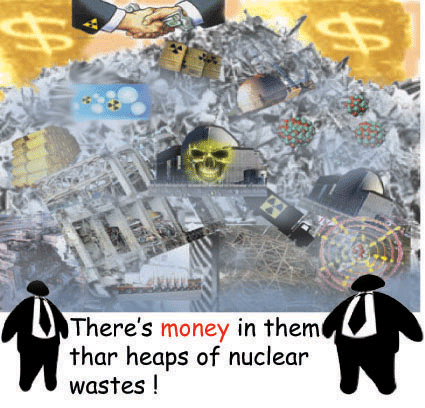
Private company making a bonanza from nuclear waste storage
Radioactive Gold Rush: Nuclear Waste Storage Is A Booming Business http://www.gizmodo.com.au/2014/01/radioactive-gold-rush-nuclear-waste-storage-is-a-booming-business/ KELSEY CAMPBELL-DOLLAGHAN First, dig a hole. Then, reinforce it with clay, concrete, steel, and plastic. Fill it with nuclear waste and cover it in 12 more metres of concrete. Then profit. That’s how one company in Texas has struck radioactive gold, charging companies $US10,000 per cubic foot to store nuclear refuse.
Safely burying “low-level” nuclear material is now a $US30 billion industry in the U.S., driven in part by an increase in old, contaminated parts removed from the country’s rapidly ageing nuclear power plants and radiation-related medical waste. The New York Times‘ Matthew Wald calls one storage pit “America’s most valuable hole in the ground,” describing the process of digging, protecting, and filling This booming business is dominated by a single, two-year-old company in Texas —Waste Control Specialists — who even charge extra depending on radioactivity levels. Think of it as surge pricing for nuclear waste.
Here’s how WCS describes its facility in Andrews County, Texas, on its website:
Located within a 1,200-ft. thick nearly impermeable red-bed clay formation, the Waste Control Specialists (WCS) site ensures safe and permanent disposal of radioactive waste by combining this unique natural barrier with a custom designed and engineered, 7-ft. thick, steel-reinforced concrete liner system… Offering the most robust facilities of their kind in the world, WCS is a long-term solution for the nation’s commercial and public radioactive waste generators.
Is it really safe for nuclear waste disposal to be controlled by private industry? Critics are divided. Some claim that these companies are using techniques lightyears beyond the government’s dated waste storage sites. Others argue that letting private interests dictate the location and security of potentially deadly materials is incredibly troubling. Right now, it’s the best option we have. [The New York Times]
New low cost battery promises to provide solar energy storage
Startup Thinks Its Battery Will Solve Renewable Energy’s Big Flaw, Technology Review, By Kevin Bullis on January 23, 2014 Aquion has started production of a low-cost sodium-ion battery aimed at making renewable energy viable. A former Sony TV factory near Pittsburgh is coming to life again after lying idle for four years. Whirring robotic arms have started to assemble a new kind of battery that could make the grid more efficient and let villages run on solar power around the clock.
Aquion, the startup that developed the battery, has finished installing its first commercial-scale production line at the factory, and is sending out batteries for customers to evaluate. It recently raised $55 million of venture capital funding from investors including Bill Gates. The money will help it ramp up to full-speed production by this spring…….
Most importantly, by providing an affordable way to store solar power for use at night or during cloudy weather, the technology could allow isolated populations to get electricity from renewable energy, rather than from polluting diesel generators. Combining solar power and inexpensive batteries would also be cheaper than running diesel generators in places where delivering fuel is expensive (see “How Solar-Based Microgrids Could Bring Power to Millions”).
The batteries could allow the grid to accommodate greater amounts of intermittent renewable energy. As Aquion scales up production and brings down costs, the batteries could also be used instead of a type of natural gas power plant—called a peaker plant—often used to balance supply and demand on the grid. When recharged using renewables, the batteries don’t need fuel, so they’re cleaner than the natural gas power plants…….
The battery is made of inexpensive materials including manganese oxide and water. In concept, it operates much like a lithium-ion battery, in which lithium ions shuttle between electrodes to create electrical current. But the new battery uses sodium ions instead of lithium ones, which makes it possible to use a salt water electrolyte instead of the more expensive—and flammable—electrolytes used in lithium-ion batteries.http://www.technologyreview.com/news/523391/startup-thinks-its-battery-will-solve-renewable-energys-big-flaw/
Russia aims to monopolise Europe’s nuclear industry?
Russia muscles into European nuclear industry, Global Post 23 Jan 14 A new deal with Hungary is set to boost Moscow’s influence as its grip on oil and gas wanes.BERLIN, Germany — A leading Hungarian official has said an agreement last week to give Russia a foothold in his country’s nuclear future is Budapest’s best deal in 40 years.
Hungary granted Russia’s state energy company Rosatom a $14-billion contractto double the capacity of the country’s sole nuclear power plant, a 2000-megawatt reactor in the Danube River city of Paks.
The funds would be offered as a 30-year loan package to be extended at below-market rates.
“These new reactors will surely enhance Hungary’s energy independence and security,” Russian President VladimirPutin told reporters.
 But one person’s bargain is another’s Faustian deal — in this case at least. Critics say the sweetheart deal may as well have been written by Mephistopheles, the demon of German folklore.
They say the project was never tendered for competitive bids despite an earlier expression of interest from the French energy company Areva. Skeptics worry it represents an effort by Putin to add nuclear energy to the oil and gas monopoly he’s used so effectively to cement Russia’s influence in Central and Eastern Europe.
“What are Hungarians to make of the fact that Prime Minister Viktor Orban has committed them to invest [billions] building two new nuclear reactors without consulting his own cabinet let alone parliament, industry experts, or the Hungarian people?” asked a pointed editorial in the English-language Budapest Beacon…..
The European Commission’s decision about the agreement’s compliance could have far-reaching implications.
In 2012, allegations of corruption surrounded the Russian bid to expand the Czech Republic’s Temelin nuclear reactor due to the involvement of a Czech firm under investigation for insider trading and breach of trust in connection with previous deals. Now it looks doubtful that project will go forward at all, according to Czech media.
Similarly, a Russian project to build a 2000-MW nuclear plant in Belene, Bulgaria, was excoriated as “a corrupt and completely illegitimate business project, aimed at producing abundant and expensive electricity in a country with excess capacity in a region of declining electricity demand,” in the words of Ognyan Minchev, a research fellow with the German Marshall Fund of the United States’ Balkan Trust for Democracy. The Bulgarian parliament voted to scrap plans for the reactor in February last year following a protracted debate over its environmental impact and a new investigation into the projected costs……http://www.globalpost.com/dispatch/news/regions/europe/140123/russia-nuclear-deal-hungary-power-influence
The harsh facts on U.S.S. Reagan’s sailors affected by Fukushima radiation
Is Nuclear Experimentation Fascism? OpEdNews 1/22/2014 By Ethan Indigo Smith (about the author) “…the crew of the U.S.S. Reagan. The U.S.S. Reagan was exposed to radiation after being redirected towards Japan to provide support immediately after the massive Tōhoku earthquake and tsunami off the coast of Japan.
According to an article in the New York Post, Senior Chief Michael Sebourn, a radiation-decontamination officer who tested the aircraft carrier for radiation found that “levels were incredibly dangerous and at one point, the radiation in the air measured 300 times higher than what was considered safe.” The article continues: “The former personal trainer has suffered a series of ailments, starting with severe nosebleeds and headaches and continuing with debilitating weakness” has lost 60 percent of the power in the right side of his body and his limbs have visibly shrunk.” As Senior Chief Michael Sebourn stated, “I’ve had four MRIs, and I’ve been to 20 doctors” No one can figure out what is wrong.” He has since retired from the Navy after 17 years of service.
And he is not alone. According to The Post, “crew members on the aircraft carrier and a half-dozen other support ships are battling cancers, thyroid disease, uterine bleeding and other ailments.” Of the 5,000 sailors on board, at least 70 have contracted some form of radiation sickness, and of those, “at least half” are suffering from some form of cancer,” said lawyer, Paul Garner, who is representing the sailors in a lawsuit against the operators of the Fukushima Daiichi energy plant. “We’re seeing leukemia, testicular cancer and unremitting gynecological bleeding requiring transfusions and other intervention,” said Garner.
In a Voice of Russia report, Mr. Garner elaborated: “it seems that there’s too many people at the same place at the same time without any family background or any reason to believe that they had these issues to now show up with these significant cancers and beyond. So we feel that time will tell in many instances”. especially, because they all had physicals and were all in top health.”
Navy sailor Lindsay Cooper, who was also present on the U.S.S. Reagan, stated that crew members suffered from excruciating diarrhea at the time. “People were s-“-tting themselves in the hallways,” Cooper recalled. “Two weeks after that, my lymph nodes in my neck were swollen. By July, my thyroid shut down.”
When asked about the U.S.S. Reagan’s ability to detect radiation early, sailor Cooper stated “we have a multimillion-dollar radiation-detection system, but” it takes time to be set up and activated”. She went on to describe that after being exposed, “we couldn’t go anywhere. Japan didn’t want us in port, Korea didn’t want us, Guam turned us away. We floated in the water for two and a half months” until Thailand took the stricken sailors in……..http://www.opednews.com/articles/Is-Nuclear-Experimentation-by-Ethan-Indigo-Smith-Fukushima_Nuclear-Cover-up_Nuclear-Meltdown_Nuclear-Waste-140122-627.html
1 This Month

of the week – Shut Down Drone Warfare!


Tell the Ukrainian Government to Drop Prosecution of Peace Activist Yurii Sheliazhenko

Petition to revoke the licensing of the Near Surface Nuclear Disposal Facility (NSDF) at Chalk River. https://www.ourcommons.ca/petitions/en/Petition/Details?Petition=e-7247
To see nuclear-related stories in greater depth and intensity – go to https://nuclearinformation.wordpress.com
-
Archives
- April 2026 (79)
- March 2026 (251)
- February 2026 (268)
- January 2026 (308)
- December 2025 (358)
- November 2025 (359)
- October 2025 (376)
- September 2025 (257)
- August 2025 (319)
- July 2025 (230)
- June 2025 (348)
- May 2025 (261)
-
Categories
- 1
- 1 NUCLEAR ISSUES
- business and costs
- climate change
- culture and arts
- ENERGY
- environment
- health
- history
- indigenous issues
- Legal
- marketing of nuclear
- media
- opposition to nuclear
- PERSONAL STORIES
- politics
- politics international
- Religion and ethics
- safety
- secrets,lies and civil liberties
- spinbuster
- technology
- Uranium
- wastes
- weapons and war
- Women
- 2 WORLD
- ACTION
- AFRICA
- Atrocities
- AUSTRALIA
- Christina's notes
- Christina's themes
- culture and arts
- Events
- Fuk 2022
- Fuk 2023
- Fukushima 2017
- Fukushima 2018
- fukushima 2019
- Fukushima 2020
- Fukushima 2021
- general
- global warming
- Humour (God we need it)
- Nuclear
- RARE EARTHS
- Reference
- resources – print
- Resources -audiovicual
- Weekly Newsletter
- World
- World Nuclear
- YouTube
-
RSS
Entries RSS
Comments RSS
 nuclear-news