A day in the life of a blogger – 20 January 2014

This post was not stopped by the owner
More to come in the next few days…
I wonder what happened? 🙂
arclight 2011
Russia advances some $14 Bln for Hungarian nuclear reactor build-out in dicey environmental bet

Russia has agreed to provide Hungary with billions of dollars upfront to finance the planned extension of the Paks nuclear power plant south of Budapest – yet the deal is raising hackles over the lack of a proper bidding process and the absence of public consultation.
Russian state nuclear corporation Rosatom agreed yesterday to expand the Paks plant for some $13.6 billion, doubling its size in the largest construction project in Hungary’s post communist history, and something Rosatom is portraying as a major move onto the EU nuclear market.
Russian President Vladimir Putin said that he and visiting Hungarian Prime Minister Viktor Orban had signed an agreement on the project at Paks, which already runs four Russian-made VVER-type reactors built in the 1980s. The new project will see two new reactor blocks built of the VVER-1200 type, which will boost the plant’s capacity to 4000 MW.
Putin and Orban added the Paks station was already responsible for producing 40 percent of the energy consumed in the EU member country. Vladimir Slivyak, co-chair of Russia’s Ecodefense, wrote in a blog on the independent radio station Echo of Moscow that bumping the output of the Paks plant to supply 80 percent of the country’s electricity seemed absurdly high.
Hungarian government ministers told news agencies that 80 percent of the financing would be covered by a 30 year loan from Russia, and the remainder would be financed by Hungary.
Environmental activists in Hungary are outraged over the decision between Putin and Orbin because it fails to take into account local public opinion about the giant nuclear build out.
As recently as last year, Hungarian environmentalists also expressed outcry over their government’s plan to repatriate to Russia a batch of spent nuclear fuel that was severely damaged during chemical treatment in 2003, saying the fuel transfer would openly neglect public health and environmental concerns. (arclight added info on hungary)
By Russian law, Moscow is obligated to take back spent nuclear fuel from fuel that it has supplied to other countries. But Bellona’s Andrei Ozharovsky, a nuclear physicist and frequent contributor to Bellona.ru, has argued that the degree of damage suffered by the fuel rods in question warrants their reclassification as waste, which would imply a whole new set of legislative safeguards in accepting it.
The damaged fuel assemblies, some of which are broken, are currently being stored at the Paks’ plant’s cooling pool at it’s No 2 reactor. The No 2 unit, from which the fouled fuel rods were removed in 2003, had to undergo 18 months of repairs before coming back online.
Rosatom’s expansion abroad amid troubles at home
But much of Rosatom’s financial strategy is banking on building nuclear power plants abroad, as well selling and repatriating fuel from foreign nuclear power plants.
As a sign of how poorly things are going on its domestic market, Rosatom announced in November that it would be slashing its ambitious “2008 Roadmap” plans to construct 35 nuclear reactors in Russia by 2020 in half, cutting the number to a more humble 12.
But, since the March 11, 2011 disaster at the Fukushima Daiichi nuclear power plant in Japan, Rosatom has shored up more than 20 nuclear reactor building contracts and has a foreign order portforlio totaling more than $74 billion, RIA Novosti reported.
Among other countries that have contracts with Rosatom are India, Iran, China, Belarus, Bangladesh, Jordan, Bulgaria, Vietnam, Ukraine, Armenia, Turkey and Finland. Clearly, Rosatom is placing its bets abroad. The Moscow Times reported that Russia has another 40 nuclear construction contracts under consideration.
Welcome to Fukushima Part 1 of 5
Go to the You Tube link for the other parts of the video (you will see them listed on the right
Published one March 14th, 2013 Director (S):
Alain de Halleux Pays: Belgium
During two years, the director followed of the inhabitants and the families of the town of Minamisoma, located 20 km away from the nuclear power plant of Fukushima Daichi. Between revolt and resignation, they raise the question: to move or remain on the spot, live with the contamination and the fear of the future?
Fukushima Mother: Then Yuka started to get panic attacks. She got headaches, stomach aches, sore throats… It would change every day. Shortly after around the end of April she would spend her days crying in here room. It all made me very nervous. Kento was edgy allo the time, too. […]
Fukushima Father: Perhaps she didn’t really know she was doing, but she made several attempts to jump from the first floor. She even tried to kill herself by dousing herself with petrol and setting it alight.
Fukushima Mother: She led a normal life until March 11 last year, when there was the accident at the nuclear power plant. She can’t forgive herself for being this way. Every time she cries she asks, “Why did this nuclear disaster happen to us?”
Through some parallel segments: – a family decides to leave the site and moves/– another, whose father worked in a power station at the time of the accident, became a florist which become very profitable because of the many burials and commemorations/– An old a forest ranger attends the metamorphosis of the landscape (the forests and mountains) and questions the traditional report with nature, now upset by the catastrophe.
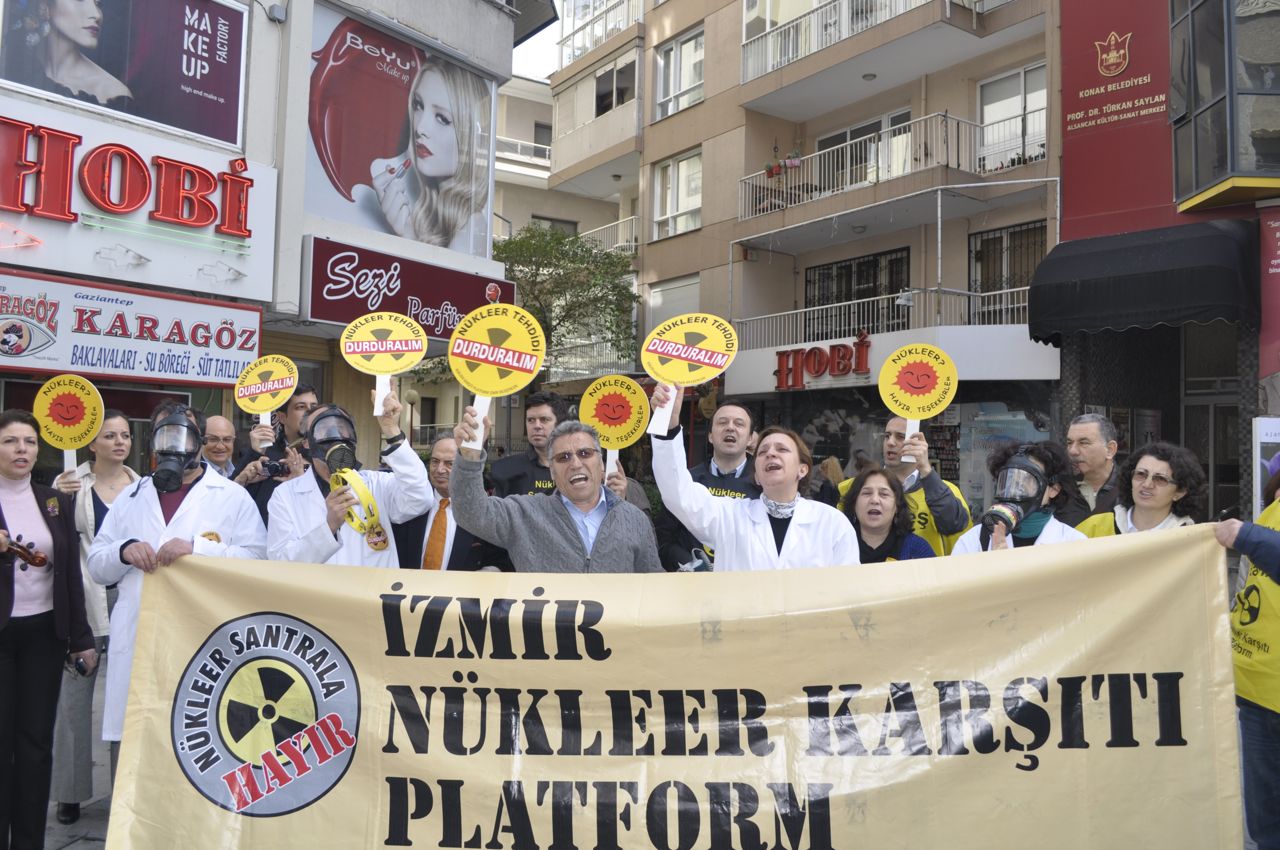
Turkish Antinuclear Alliance calls for scrapping the nuclear agreement with Japan
This message and the following letter is sent from Turkey by NKP .Nükleer Karşıtı Platform – Turkish Antinuclear 20 Jan 14 NKP is a broad and all-embracing alliance of NGO’s and activists against nuclear power in Turkey. It represents the largest joint effort in the environmentalist movement in the country.
Attached letter has been written for DIET members, to enable them to discover the backdrop of “Agreement between the Government of Japan and the Government of the Republic of Turkey for Co-operation in the Use of Nuclear Energy for Peaceful Purposes “signed by Mr. Abe and Mr. Erdogan in Istanbul.
We – the citizens-firmly believe this agreement must be scrapped when it is brought to the attention of the Japanese Parliament for ratification.
We also believe, as the leaders of a country who are still in battle against the Fukushima disaster, Japanese MP’s will act sincerely and reject ratifiying this agreement. It is crucial that our motives for opposing this agreement are well understood by you,hopefully this letter conveys our message well .
NKP – TURKISH ANTINUCLEAR ALLIANCE NKP- NÜKLEER KARŞITI PLATFORM http://www.nukleerkarsitiplatform.org https://www.facebook.com/nukleerkarsitiplatform https://twitter.com/NKPTurkiye
January 17, 2014
Istanbul,
In May 2013, Turkey and Japan signed an agreement to construct a nuclear power plant in Sinop on Turkey’s western Black Sea coast. Mitsubushi Heavy Industries and the French Areva are supposed to be working on this project jointly. In 2010, Turkey signed a similar agreement with Russia to build the country’s first nuclear power plant in Akkuyu. Questionable “build-own-operate” model of Russia is unusual in nuclear industry and leaves many uncomfortable questions in mind about safety.
As Turkey moves toward these serious, potentially hazardous projects in a hurry, it fails to factor in the social, geological and environmental implications and seem unaware of potential lethal risks for millions of people living in the region as well as the vulnerable ecological communities in case something goes wrong just as it did in Fukushima recently and Chernobyl earlier. Turkey’s active fault lines in its political and economic structure, coupled with its inefficiencies in the areas of technology, regulations, infrastructure and shortage of qualified personnel pose a big threat to the efficient and safe execution of any such project. Turkey, just like Japan is in a seismically very active geography yet unlike Japan, she is quite unprepared for the risks of major earthquakes. Turkish safety culture is very different from Japan’s and risk management concepts are also perceived differently. This alone massively amplifies the risks of operating nuclear power plants in Turkey.
Our letter is calling the MPs representing Japanese people to scrap the intergovernmental nuclear agreement with Turkey that will soon be brought to the attention of DIET members for deliberation. The reasons behind this sincere call are detailed in the following paragraphs.
Turkey is deviating from practices of a modern democracy, as it becomes more and more authoritarian under the current government; people’s will on vital issues is dismissed. Evading ecologically sustainable energy options, the government has imposed obscure nuclear plans on the nation without any due debates either within its party program or in the parliament. The method of promoting these nuclear agreements are very much in line with the rest of the un-democratic practices of the Justice and Development Party (AKP), which has been in power for a decade.
Majority of Turkish people are against nuclear power plants and nuclear weapons. “Global Citizen Reaction to the Fukushima Nuclear Plant Disaster”, a survey conducted by IPSOS in April 2011 documents the fact that 80% of Turks are against acquiring nuclear energy. Yet, people and NGOs cannot find outlets for voicing their true concerns or objections on neither nuclear nor other similarly vital issue; democratic channels through which the citizens may promote change are blocked by the AKP regime. For the second consecutive year in 2013, the Committee to Protect Journalists has announced Turkey as the world’s leading jailer of journalists, followed closely by Iran and China. Continue reading
Fukushima nuclear reactor 3 has a foot-wide leak, gushing water
 Wall St. Journal, Japan TV: ‘Problem on their hands’ at Fukushima, constant flow of water pouring from foot-wide leak at Reactor 3; “They don’t know where water it’s coming from” —WSJ: Radiation level spikes 60-fold in seconds nearby (VIDEO) http://enenews.com/japan-tv-problem-at-fukushima-constant-flow-of-water-pouring-from-foot-wide-hole-at-reactor-3-they-dont-know-where-the-water-is-coming-from-wsj-radiation-level-spikes-60-fold-in-seconds
Wall St. Journal, Jan. 17, 2014: As the bus carrying reporters [taking part in a media tour on Jan. 15] drove past by unit 3 toward units 1 and 2, readings on a dosimeter carried by an employee of plant operator [Tepco] spiked at over 600 microsieverts per hour, compared with a reading of around 10 microsieverts just seconds earlier. Reactors 1-3 are so highly contaminated that no one, even in a protective suit, can enter the buildings. That means almost all the cleanup work at the three units will have to be undertaken by remote-controlled robots.
NHK Newsline (Transcript), Jan. 18, 2014: The people in charge of the Fukushima Daiichi nuclear power plant have another problem on their hands. They say they found water pouring into a drain inside a reactor building. Officials at [Tepco] say they don’t know where the water is coming from and their not sure how much radioactivity it contains.
NHK, Jan. 18, 2014: Water leak found inside Fukushima reactor building […] spotted on the first floor of the reactor building on Saturday by a camera […] the water flow was about 30-centimeters wide [11.8 inches] and constant. TEPCO added that the water is likely flowing toward the building’s basement where a large amount of radioactive water has accumulated. TEPCO says that inside the reactor building there is water for cooling melted fuel and water in the spent fuel storage
pool. It says rain water may have entered the damaged building. TEPCO is trying to find out the source of the leaking water by analyzing footage […] radiation levels are too high for workers to approach the site.
Kyodo News, Jan. 18, 2014: Water leakage found inside No. 3 reactor of Fukushima plant: TEPCO […] Water that could contain radioactive material has been pouring [from a] 30-centimeter wide water leak […] It said the water had not leaked outside the building. TEPCO has been pouring cooling water on the No. 1 to 3 reactors to cool melted fuel, and water has been seen leaking through damaged parts of the No. 3 reactor’s containment vessel. […]
455 local assemblies in Japan calls for an end to nuclear power

 Study: Nearly one-third of localities call for end to nuclear power,http://ajw.asahi.com/article/0311disaster/fukushima/AJ201401190021 By TORU NAKAGAWA/ Staff Writer Nearly one-third of the nation’s local assemblies, including those at the prefectural level, have submitted statements calling for the abolition of nuclear power plants to the Diet since the Fukushima crisis in 2011, according to a study by The Asahi Shimbun.
Most of such statements by 455 assemblies were adopted in prefectures that share borders with prefectures hosting nuclear power plants. The declarations called for a sweeping change in the nation’s energy policy, and a large number also advocate a significant increase in renewable energy sources such as solar and wind power. Continue reading
Top USA Democrat opposes more sanctions on Iran

 Top Senate Democrat opposes more Iran sanctions as nuclear deal nears start January 19, 2014 FoxNews.com A top Senate Democrat said Sunday he does not support bipartisan legislation in his chamber to impose new sanctions on Iran — one day before the start of an international deal in which that country will curtail its nuclear program in exchange for the easing of existing sanctions.
“I think it’s a mistake,” Sen. Patrick Leahy, chairman of the Senate Judiciary Committee, told “Fox News Sunday.”
The Vermont Democrat argued that voting in favor of sanctions could alienate the five other world powers in the deal — Britain, China, France, Germany and Russia. “If [we] look like we’re prejudging the negotiations, they’re going to say, ‘Hey United States, you’re on your own,’” Leahy said. Continue reading
International Renewable Energy Agency predicts rapid increase in renewables’ market share
 Irena details plan to double renewables’ market share by 2030, The National, 20 Jan 14 More than 1,000 delegates from around the world gathered in Abu Dhabi on Saturday for the release of a detailed plan to double renewables’ share of the global energy market by 2030. Heads of state and ministers from more than 150 countries and representatives of 120 organisations took part in the opening of the International Renewable Energy Agency’s fourth annual assembly.
At the St Regis resort on Saadiyat Island, Irena detailed its “REmap 2030” plan for increasing adoption of renewable energies around the world.
The meeting is part of Abu Dhabi Sustainability Week, which incorporates conferences including the World Future Energy Summit and the International Water Summit, and the announcement of the Zayed Future Energy Prize winners.
Irena is the global centre for renewable-energy cooperation for its 123 member states, as well as the European Union.
The assembly announced the first six renewable-energy projects in developing countries to receive loans under Irena’s project partnership with the Abu Dhabi Fund for Development……
Figures from Middle East Economic Digest, Meed, show the total value of renewable-energy projects in the Middle East will be 36 times greater in the next decade……
Projects include Masdar 100-megawatt solar plant in Abu Dhabi, a 1,000MW solar park in Dubai, and ambitious projects planned for Saudi Arabia, Kuwait, Qatar and Oman. http://www.thenational.ae/uae/environment/irena-details-plan-to-double-renewables-market-share-by-2030#ixzz2qxvy478H
Solar and wind the solution for Pakistan’s energy: nuclear power plan is preposterous
 Stop running after nuclear energy, solar and wind power is the solution for Pakistan!, The Express Tribune By Ahsan Ashraf January 19, 2014 The efforts to attain nuclear power have increased globally in recent years. Several advocates in Pakistan, such as the recent article by Kazmi (Jan 7, 2014), have argued that nuclear power promotes economic development along with meeting the shortfall in energy supply.
A critical question I would like to ask is that, is nuclear power absolutely necessary for an economic development, given the potential safety risks and the vast amount of investment that it requires?
With Pakistan’s incredible potential of untapped renewable resources, why is Pakistan trying an untested nuclear technology when the rest of the world is moving towards greener energy solutions?
I feel that this is a preposterous idea. Continue reading
Parks Town USA still stuck with nuclear waste
Decision time yet again on whether to remove nuclear waste from Parks site, Trib Live Neighbourhoods, 19 Jan 14 By Mary Ann Thomas After more than 20 years of wrangling, the federal government has to decide — yet again — whether it will remove and ship out the buried nuclear waste at a dump on Route 66 in Parks.
The Pittsburgh District of the Army Corps of Engineers, the lead agency for a proposed 10-year cleanup that could cost up to $500 million, has not set a date for that decision. But before it does decide, the corps will hold a meeting in the spring to get public testimony on what it should do. The meeting has not been scheduled.
The project has grown much more complicated and expensive, causing the government to rethink what should be done. “People should be concerned that Congress has little appetite to clean up environmental messes and U.S. Rep. John Murtha is gone,” said Robert Alvarez, senior scholar at the Institute for Policy Studies in Washington and former senior policy adviser to the secretary of the Department of Energy during the Clinton administration
When the cleanup plans sputtered and stalled in the 1990s, Murtha, the late congressman from Johnstown, initiated legislation in 2002 mandating the Army Corps take over the cleanup and remove the nuclear contamination from the site.

Although that agency is the first to put shovel to ground and remove nuclear contaminants, it had to rethink its role two years ago when workers unearthed greater-than-expected amounts of complex nuclear materials. The project price tag skyrocketed.
Originally estimated at between $21.5 million and $65.6 million in 2002, estimates rose to $170 million in 2010. Those have since ballooned to $250 million to $500 million.
U-235 AND U-233 Two volatile types of uranium — U-235 and U-233 — are present on the site. Known as “fissile materials,” they can cause a nuclear chain reaction or be used for an improvised explosive.
What’s not clear is how much of the material has been found. The corps refuses to release any information on the variety and quantities of isotopes found so far. The Army denied a Freedom Of Information Act request for documents from the Valley News Dispatch in 2012 regarding the materials…… http://triblive.com/neighborhoods/yourallekiskivalley/yourallekiskivalleymore/5270680-74/nuclear-corps-site#ixzz2qxatTfJA
USA nuclear missile officers have been cheating on safety tests for years
Cheating on tests at nuclear facility was common, ex-officers LA Tines 19 Jan 14 WASHINGTON—Air Force officers responsible for safeguarding and operating nuclear-armed missiles at a base in Montana cheated for years on monthly readiness tests, but rarely faced punishment even though some commanders were aware of the misconduct, according to three former officers who served at the base.
Their assertions shed new light on a cheating scandal involving 34 officers at Malmstrom Air Force Base, who are under investigation for improperly sharing information about exam questions and failing to report the alleged misconduct.
Air Force Secretary Deborah Lee James called the alleged behavior “absolutely unacceptable.”
But the former officers, two of whom served at Malmstrom in the last decade, said that cheating on the three monthly written tests — covering missile safety, code handling and launch procedures — was so commonplace that officers who declined to participate were the exception.
“Everybody cheats on every test that they can, and they have for decades,” said one former officer who served at Malmstrom from 2006 to 2010, and said he had cheated on tests. “Maybe five percent [of the officers] don’t. But they know about it.” He asked not to be identified, citing fear of retribution by the Air Force.
…….A third former officer, Bruce Blair, said, “There were hundreds of officers at my wing at Malmstrom, and I don’t think that I know anybody who didn’t cheat.”
Blair was a launch officer from 1970-1974 and went on to help found the organization Global Zero, which seeks the elimination of nuclear weapons worldwide.
The tests are used to measure the readiness of more than 500 launch officers — stationed at the three bases nationwide — who are responsible for securing 450 Minuteman III intercontinental ballistic missiles in the U.S. nuclear arsenal, and keeping them ready for launch around the clock….http://www.latimes.com/nation/nationnow/la-na-nn-air-force-nuclear-cheating-20140118,0,5357820.story#axzz2qxE51QKr
A new development in efficient large-scale storage of solar power
Better Solar Through Chemistry, Renewable Energy News, 20 Jan 14 A new method of harvesting fuel from water developed by scientists from University of North Carolina could answer the question of how to effectively store solar power for use long after the sun goes down. An entire industry has grown around storing the power generated by solar energy systems, from banks of lithium-ion batteries to molten-salt technology, but UNC researchers believe chemistry will provide the key to large-scale solar power storage.
“So called ‘solar fuels’ like hydrogen offer a solution to how to store energy for night time use by taking a cue from natural photosynthesis” says Tom Meyer, Arey Distinguished Professor of Chemistry at UNC’s College of Arts and Sciences. “Our new findings may provide a last major piece of a puzzle for a new way to store the sun’s energy – it could be a tipping point for a solar energy future.”
Meyer’s team used a dye-sensitized photoelectrosynthesis cell, or DSPEC (an organic solar cell which mimics the process of photosynthesis in plants), to produce hydrogen fuel by separating water molecules into atoms. While hydrogen atoms are retained and stored for energy, oxygen is released into the atmosphere. Because the entire process is solar powered, it is also extremely efficient….. http://www.energymatters.com.au/index.php?main_page=news_article&article_id=4130
Pacific islanders becoming proficient in photovoltaic solar systems
 Renewable energy training http://www.fijitimes.com/story.aspx?id=257550 By TORIKA TOKALAU Monday, January 20, 2014 TECHNICIANS from around the Pacific began a three-week Vocational Training and Education for Clean Energy (VOCTEC) program at USP today.
The 14 participants from FSM, Kiribati, Samoa, PNG, Palau and Fiji will be trained as stand-alone Photovoltaic (solar) system trainers. After the program, the participants will hold technician trainings in their respective countries.
USP’s head of school for Engineering and Physics, Atul Raturi, said the main aim of the program was to build human capacity in renewable energy.
Nevada against nuclear waste dump for Yucca Mountain
Guy W. Farmer: Nuclear facts a dire reminder of Yucca perils Nevada Appeal , 19 Jan 14,A few folks are still telling us it would be good to turn Nevada into the nation’s nuclear waste dump, and that if we would endorse the proposed Yucca Mountain nuclear waste dump, they’d shower us with “free” federal dollars. Fortunately, that’s not going to happen.
1 This Month
Chernobyl: The Lost Tapes – A good documentary on Chernobyl on SBS available On Demand for the next 3 weeks– https://www.sbs.com.au/ondemand/tv-program/chernobyl-the-lost-tapes/2352741955560

of the week–London Campaign for Nuclear Disarmament

Tell the Ukrainian Government to Drop Prosecution of Peace Activist Yurii Sheliazhenko
To see nuclear-related stories in greater depth and intensity – go to https://nuclearinformation.wordpress.com
-
Archives
- April 2026 (126)
- March 2026 (251)
- February 2026 (268)
- January 2026 (308)
- December 2025 (358)
- November 2025 (359)
- October 2025 (376)
- September 2025 (257)
- August 2025 (319)
- July 2025 (230)
- June 2025 (348)
- May 2025 (261)
-
Categories
- 1
- 1 NUCLEAR ISSUES
- business and costs
- climate change
- culture and arts
- ENERGY
- environment
- health
- history
- indigenous issues
- Legal
- marketing of nuclear
- media
- opposition to nuclear
- PERSONAL STORIES
- politics
- politics international
- Religion and ethics
- safety
- secrets,lies and civil liberties
- spinbuster
- technology
- Uranium
- wastes
- weapons and war
- Women
- 2 WORLD
- ACTION
- AFRICA
- Atrocities
- AUSTRALIA
- Christina's notes
- Christina's themes
- culture and arts
- Events
- Fuk 2022
- Fuk 2023
- Fukushima 2017
- Fukushima 2018
- fukushima 2019
- Fukushima 2020
- Fukushima 2021
- general
- global warming
- Humour (God we need it)
- Nuclear
- RARE EARTHS
- Reference
- resources – print
- Resources -audiovicual
- Weekly Newsletter
- World
- World Nuclear
- YouTube
-
RSS
Entries RSS
Comments RSS
 nuclear-news