Quantify the flux of radiocesium in the Abukuma Basin (5,172km2)
Personal thanks to KitagawaTakashi
【速報】水脈による放射能汚染状況:
”This study aimed to quantify the flux of radiocesium in the AbukumaBasin (5,172km2), the largest river system affected by fallout fromthe Fukushima Daiichi Nuclear Power Plant (FDNPP) event.
Inthe period from 10 August 2011 to 11 May 2012 an estimated 84 to 92%of the total radiocesium transported in the basin’s fluvial systemwas carried in particulate form.”
極めて重要な情報が公開された。
振り落ちた放射能物質は、多くはそこに留まる。
風に乗りプルームによって運ばれたものも、
雨などによって降下し、多くはその場所に留まる。
その後、土壌に浸潤し、一部は、植物、動物などを通じ、
食物連鎖に入る。多くの移動は、環境循環による。
その最大のものが、水脈によるものである。(一部は海に流れる)
この懸念は、当初からあったが、その詳細が初めて公開された。
(Published16 January2014)
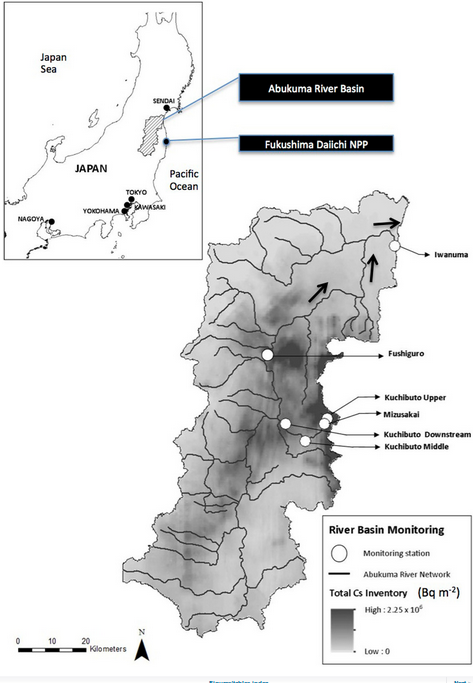
図は、阿武隈川流域の水脈と、現実にどの程度放射能物質が、
どの範囲に広がっているかの詳細図である。
色の濃さが、汚染度を表すが、濃い部分は、200万ベクレル/m^2にまで達している。
この図は、放射能汚染被害の範囲、ホットスポットの場所、
その汚染の程度を、地域ごとに詳細に示すものとして極めて有用であり、今後の基礎資料となるものであろう。
”
Duringthis monitoring period Typhoon Roke (September 2011) was observed toinduce a significant and temporally punctuated redistribution ofradiocesium. The storm-mobilised radiocesium was an estimated 6.18Terabecquerels corresponding to 61.4% of the total load delivered tothe coastal zone during the observation period.
The totalflux of radiocesium into the Pacific Ocean estimated at the outletstation (basin area 5,172km2) was 5.34TBq for 137Cs, and 4.74TBq for134Cs, corresponding to 1.13% of the total estimated radiocesiumfallout over the basin catchment (890TBq).
This wasequivalent to the estimated amount of direct leakage from FDNPP tothe ocean during June 2011 to September 2012 of 17TBq and the Level 3Scale Leakage on 21August 2013 (24TBq).”
Source: Published16 January 2014
“Initial flux of sediment-associatedradiocesium to the ocean from the largest river impacted by FukushimaDaiichi Nuclear Power Plant” By Yosuke Yamashiki, Yuichi Onda,Hugh G. Smith, William H. Blake,et.al.”
http://www.nature.com/srep/2014/140116/srep03714/full/srep03714.html
No comments yet.
1 This Month
Chernobyl: The Lost Tapes – A good documentary on Chernobyl on SBS available On Demand for the next 3 weeks– https://www.sbs.com.au/ondemand/tv-program/chernobyl-the-lost-tapes/2352741955560

of the week–London Campaign for Nuclear Disarmament

Tell the Ukrainian Government to Drop Prosecution of Peace Activist Yurii Sheliazhenko
To see nuclear-related stories in greater depth and intensity – go to https://nuclearinformation.wordpress.com
-
Archives
- April 2026 (139)
- March 2026 (251)
- February 2026 (268)
- January 2026 (308)
- December 2025 (358)
- November 2025 (359)
- October 2025 (376)
- September 2025 (257)
- August 2025 (319)
- July 2025 (230)
- June 2025 (348)
- May 2025 (261)
-
Categories
- 1
- 1 NUCLEAR ISSUES
- business and costs
- climate change
- culture and arts
- ENERGY
- environment
- health
- history
- indigenous issues
- Legal
- marketing of nuclear
- media
- opposition to nuclear
- PERSONAL STORIES
- politics
- politics international
- Religion and ethics
- safety
- secrets,lies and civil liberties
- spinbuster
- technology
- Uranium
- wastes
- weapons and war
- Women
- 2 WORLD
- ACTION
- AFRICA
- Atrocities
- AUSTRALIA
- Christina's notes
- Christina's themes
- culture and arts
- Events
- Fuk 2022
- Fuk 2023
- Fukushima 2017
- Fukushima 2018
- fukushima 2019
- Fukushima 2020
- Fukushima 2021
- general
- global warming
- Humour (God we need it)
- Nuclear
- RARE EARTHS
- Reference
- resources – print
- Resources -audiovicual
- Weekly Newsletter
- World
- World Nuclear
- YouTube
-
RSS
Entries RSS
Comments RSS
 nuclear-news
Leave a comment