Buesseler, K.O. 2014. – Fukushima and Ocean Radioactivity. Oceanography
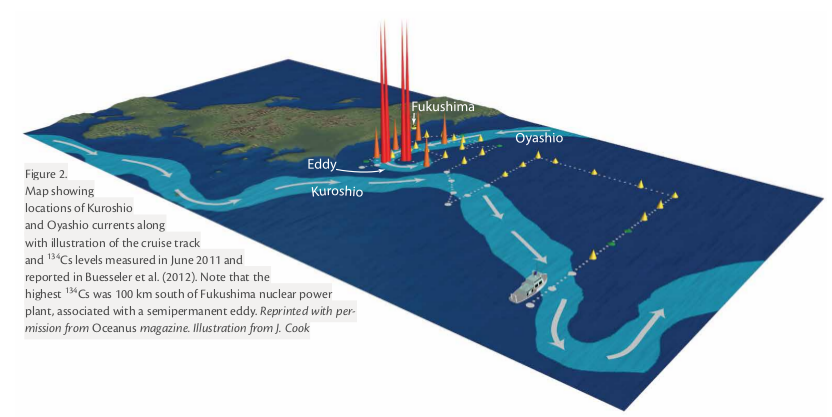
…The Fukushima disaster provides a critical tool for the ocean science community to study fundamental physical, chemical, and biological processes in the Pacific Basin for as long as we can detect traces of the suite of long-lived radionuclides that originated there. It should serve as a call for ocean scientists to turn their attention to all aspects of this event, which continues to unfold and to present a plethora of new challenges, opportunities, and questions….
EARLY ONLINE RELEASE
Posted January 5, 2014

THE FUKUSHIMA DISASTER PROVIDES
A CRITICAL TOOL FOR THE OCEAN SCIENCE
COMMUNITY TO STUDY FUNDAMENTAL PHYSICAL,
CHEMICAL, AND BIOLOGICAL PROCESSES IN
THE PACIFIC BASIN FOR AS LONG AS WE CAN
DETECT TRACES OF THE SUITE OF LONG-LIVED
RADIONUCLIDES THAT ORIGINATED THERE.
THE FACT THAT WE LIVE IN A RADIOACTIVE
WORLD AND THAT THE WORLD OCEAN ALREADY
CONTAINS A WIDE RANGE OF NATURAL AND
ANTHROPOGENIC RADIONUCLIDES IN NO
WAY DIMINISHES THE SCALE AND NATURE
OF EVENTS AT FUKUSHIMA .
Abstract
[…]
In Japan, seafood consumption rates are higher (57 kg yr –1), but even using the legal limit of 100 Bq kg –1 Cs in fish results in a dose of 75 μSv or more than 10 times lower than the international dose limit of 1 mSv yr –1 set for members of the public. At a Cs level of 100 Bq kg –1, the dose from 210Po is almost 20 times greater. As such, none of these potential doses from Cs would be expected to result in observable increases in cancer rates in the populations of Japan or the United States (Fisher et al., 2013).
Clearly, it is important to keep monitoring Cs in fish off Japan, espe- cially in bottom-feeding fish, but also in freshwater fish (which are higher in radioactive Cs due to lower stable Cs in fresh waters).
However, measuring fish is not enough to help with manage- ment decisions and planning hampered by lack of knowledge about the nature and amount of continuing sources from the NPP, rivers, and bottom sediments;
how they might change in the future; and the residence time for Cs in the sea- floor sediments off Japan. In addition recent reports of elevated 90Sr/137Cs in groundwater at the NPP suggest that
multiple isotopes and their sources and sinks need to be studied to understand the fate of these radionuclides in the ocean and uptake by biota to support targeted decisions about whether or
not to re-open fisheries. Strontium is a bone-seeking isotope that has a longer biological half-life in fish; however, unless consuming smaller fish whole,
we don’t usually consume fish bones. In any case, multiple isotopes and their sources and sinks need to be studied to understand the fate of these radio nuclides in the ocean and uptake by
biota in order to support targeted deci- sions about whether or not to reopen fisheries. Such decisions need to come with continued public education about the health benefits of eating seafood that outweigh the low risk from radionuclide doses, as these studies and other data on naturally occurring radionuclides have already shown.
[…]
SUMMARY
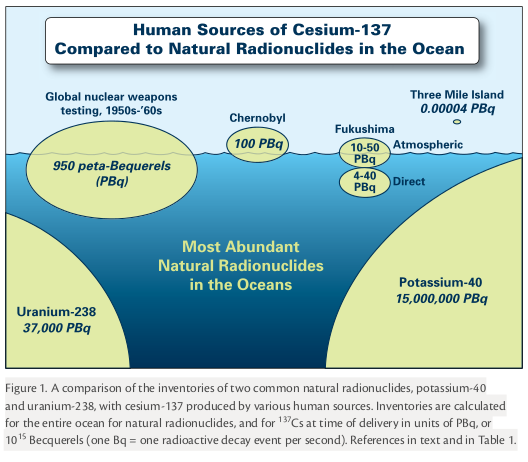
The fact that we live in a radioactive world and that the world ocean already contains a wide range of natural and anthropogenic radionuclides in no way diminishes the scale and nature of events at Fukushima. For the ocean, the continued, unintentional releases from the site of the damaged nuclear power plant are unprecedented and will likely resonate in the local ecology and both national and international policy for decades to come. The Fukushima disaster provides a critical tool for the ocean science community to study fundamental physical, chemical, and biological processes in the Pacific Basin for as long as we can detect traces of the suite of long-lived radionuclides that originated there. It should serve as a call for ocean scientists to turn their attention to all aspects of this event, which continues to unfold and to present a plethora of new challenges, opportunities, and questions.
CITATION
Buesseler, K.O. 2014. Fukushima and Ocean Radioactivity. Oceanography 27(1),
http://dx.doi.org/10.5670/oceanog.2014.02.
DOI
http://dx.doi.org/10.5670/oceanog.2014.02
COPYRIGHT
This article is an early online release from Oceanography, Volume 27, Number 1, a quarterly
journal of The Oceanography Society. Copyright 2014 by The Oceanography Society. All rights
reserved.
USAGE
Permission is granted to copy this article for use in teaching and research. Republication,
systematic reproduction, or collective redistribution of any portion of this article by photocopy
machine, reposting, or other means is permitted only with the approval of The Oceanography
Society. Send all correspondence to: info@tos.org or The Oceanography Society, PO Box 1931,
Rockville, MD 20849-1931, USA.
DOWNLOADED FROM HTTP://WWW.TOS.ORG/OCEANOGRAPHY
5 Comments »
Leave a comment
1 This Month

of the week – Shut Down Drone Warfare!


Tell the Ukrainian Government to Drop Prosecution of Peace Activist Yurii Sheliazhenko

Petition to revoke the licensing of the Near Surface Nuclear Disposal Facility (NSDF) at Chalk River. https://www.ourcommons.ca/petitions/en/Petition/Details?Petition=e-7247
To see nuclear-related stories in greater depth and intensity – go to https://nuclearinformation.wordpress.com
-
Archives
- April 2026 (103)
- March 2026 (251)
- February 2026 (268)
- January 2026 (308)
- December 2025 (358)
- November 2025 (359)
- October 2025 (376)
- September 2025 (257)
- August 2025 (319)
- July 2025 (230)
- June 2025 (348)
- May 2025 (261)
-
Categories
- 1
- 1 NUCLEAR ISSUES
- business and costs
- climate change
- culture and arts
- ENERGY
- environment
- health
- history
- indigenous issues
- Legal
- marketing of nuclear
- media
- opposition to nuclear
- PERSONAL STORIES
- politics
- politics international
- Religion and ethics
- safety
- secrets,lies and civil liberties
- spinbuster
- technology
- Uranium
- wastes
- weapons and war
- Women
- 2 WORLD
- ACTION
- AFRICA
- Atrocities
- AUSTRALIA
- Christina's notes
- Christina's themes
- culture and arts
- Events
- Fuk 2022
- Fuk 2023
- Fukushima 2017
- Fukushima 2018
- fukushima 2019
- Fukushima 2020
- Fukushima 2021
- general
- global warming
- Humour (God we need it)
- Nuclear
- RARE EARTHS
- Reference
- resources – print
- Resources -audiovicual
- Weekly Newsletter
- World
- World Nuclear
- YouTube
-
RSS
Entries RSS
Comments RSS
 nuclear-news
So I guess this thing in Japan is actually about as big as Chernobyl? The geniuses who decided to develop nukes should be disinterred and the remains desecrated. What will end history are you “scientific yes men.
[…] Buesseler, K.O. 2014. – Fukushima and Ocean Radioactivity. Oceanography […]
Damn good job!!!
It is time to ABOLISH ALL NUCLEAR FISSIONING APPLICATIONS OUTSIDE OF RESEARCH
ASAP!
What a shameless nuclear industry propaganda piece. Truth is even a small nuclear incident will have consequences that last 250,000 years! Nuclear energy is dirty, dangerous, deadly, and not cost effective. Future generations, if there are any, will hate us for this.