Published 4:39 PM CST Jan 09, 2014
Because of severe winter weather conditions, the Fort Calhoun nuclear power plant has been temporary shutdown.
…“Our results provide an important strategy for decreasing radiopollution in Fukushima area,” the team wrote. “An urgent risk has arisen due to biological intake and subsequent food web contamination in the ecosystem.”….
Tokyo Electric Power Co. officials check a wall along the coastline at Fukushima Daiichi Nuclear Power Plant in Japan on Nov. 7, 2013. Scientists said that microalgae are helping remove radioactive pollution from the waters around the plant, which suffered multiple meltdowns after an earthquake in March 2011.
Microscopic species could help clean up one of the world’s biggest environmental disasters, researchers claim.
In an article published in the Journal for Plant Research this week, a team of Japanese scientists said that six strains of microalgae, along with certain types of aquatic plants and other algae, could help remove radioactive pollution from the waters around the Fukushima Daiichi Nuclear Power Plant in Japan, which suffered multiple meltdowns after a devastating earthquake and tsunami in March 2011.
[READ: Suburbs Wipe Out Cities’ Green Initiatives]
In particular, the strains absorb radioactive cesium, iodine and strontium, which make-up most of the radioactive pollution in the area, the study said. The findings, researchers added, may ultimately help workers develop more methods for mopping up the area around Fukushima.
“Our results provide an important strategy for decreasing radiopollution in Fukushima area,” the team wrote. “An urgent risk has arisen due to biological intake and subsequent food web contamination in the ecosystem.”
Japan’s Ministry of Energy has estimated that cleanup around the plant will cost about $35 billion. Initially slated to be completed in March, the timeline was pushed back in December to 2017, the Japan Times reported
TOKYO, Jan. 9 (UPI) — Seventeen types of aquatic plant life can help remove radioactive materials from the atmosphere, Japanese scientists reported.
The Japanese plant scientists said their findings will add to existing bio-remedial options that could help to reduce radioactive pollution in Fukushima area, where an earthquake in 2011 spawned a nuclear disaster at the Fukushima 1 Nuclear Power Plant.
Their two years of research was published Thursday in a special edition of Springer’s Journal of Plant Research.
The research group, led by Yoshihiro Shiraiwa of the University of Tsukuba, identified 17 microalgae, aquatic plants and algae could efficiently remove radioactive cesium, iodine and strontium from the environment.
Because the strains identified are easy to harvest and dry, they could potentially be used to recover radioactive cesium from a huge volume of polluted water if the cesium is dissolved in the water, the researchers said.
“Biological concentration of radio-nuclides is an essential technology for bio-remediation of radio-polluted soils and water,” Shiraiwa said. “Therefore our results provide an important strategy for decreasing [radioactive pollution] in the Fukushima area.”
The researchers said more studies were needed on the algal strains before their findings could be implemented.
Radiation leaks from nuclear plant “renewed interest” in iodide, agency said in 2012

Kit Daniels
Infowars.com
January 9, 2014
A federal bid notice reveals that a Pentagon agency began stockpiling potassium iodide in 2012 due to its concerns over the Fukushima nuclear crisis, shedding light on why the Dept. of Health and Human Services is now ordering 14 million doses of iodide.
The Defense Logistics Agency posted a solicitation on FedBizOpps in 2012 asking contractors for 75,000 packages of potassium iodide tablets because the “recent earthquake in Japan in March of 2011 and the resultant nuclear crisis has renewed interest in this item.”
“The U.S. Army Medical Materiel Agency has submitted a MILSTRIP (Military Standard Requisitioning and Issue Procedures) for this item to ensure that critical operational forces are protected in the event of nuclear fallout,” the solicitation added.
Potassium iodide keeps radioactive iodine from being absorbed by the thyroid gland and therefore it is commonly taken in the event of a severe nuclear emergency, such as the current Fukushima crisis.
As Paul Joseph Watson reported on Jan. 1,HHS ordered an unprecedented 14 million doses of potassium iodide for delivery next month.
Read more: http://www.infowars.com/pentagon-agency-admits-it-began-stockpiling-potassium-iodide-due-to-fukushima/
Read more at http://investmentwatchblog.com/pentagon-agency-admits-it-began-stockpiling-potassium-iodide-due-to-fukushima/#vei4pPE808fmX73H.99
Published time: January 09, 2014
http://rt.com/news/fukushima-decontamination-system-stops-352/
The operator of the crippled Fukushima nuclear plant, TEPCO (Tokyo Electric Power Company) has stopped using its systems to decontaminate radioactive water at the facility, Japanese broadcaster NHK reported.
The Advanced Liquid Processing System, or ALPS, has been utilized to liquidate radioactive substances from contaminated water stored at the plant.
The crane to get rid of the container from the ALPS ceased working on Tuesday.
On Wednesday, TEPCO stopped operating all 3 ALPS systems at the facility. The company officials say the system may take a long time to restart.
The container where the radioactive substances are stored has to be replaced when it fills up.
TEPCO, the operator of the Fukushima Daiichi plant, crippled in the 2011 earthquake and tsunami, said that the company plans to decontaminate all radioactive water stored in the tanks by March 2015, NHK reported.
That’s despite the company officials telling The Japan Times a month ago that the radioactive water will be decontaminated by the end of fiscal 2014.
It’s not the first time that the ALPS system has experienced trouble: at the beginning of December, the system was reported to have broken down during trial operations.
The Advanced Liquid Processing System (ALPS) consists of 14 steel cylinders, through which the contaminated water is filtered. After the filtering, waste materials like the absorbent and remaining sludge are transferred to high-integrity containers (HICs) that are transported to a temporary storage facility.
The ALPS can remove 62 different types of radionuclides, including strontium and cobalt from contaminated water.
The year has started off badly for the Fukushima Daiichi plant: a few days ago, a Japanese worker, who participated in the mending of the plant to avoid further radiation leaks, has revealed that adhesive tape had been used to deal with the issue of sealing in radioactive water.
The 48 year-old, Yoshitatsu Uechi, an auto mechanic and tour-bus driver, was one of the 17 workers to be sent to the crippled facility to make more containers to store the contaminated water.
On New Year’s Day, plumes of strange steam rose from the Fukushima Daiichi plant, with TEPCO failing to provide details on the emissions of steam – in all probability radioactive.
On the international scene, the picture hasn’t been very bright, either.
Published 4:39 PM CST Jan 09, 2014
Because of severe winter weather conditions, the Fort Calhoun nuclear power plant has been temporary shutdown.
Omaha Public Power District said in a release that the sub-freezing temperatures caused an ice build-up on one of six sluice gates in the plant’s Missouri River water-intake structure.
The ice build-up was enough to keep the gate from fully closing. All of the gates must be able to close in case of flooding, so this meant the plant had to shut down, even though no flooding is predicted.
Workers checking the plant first noticed the ice buildup Wednesday night. Operators then began analyzing the situation and notified the Nuclear Regulatory Commission of the non-emergency condition that would require the plant to shut down.
OPPD said the plant went offline at 9 a.m. The shutdown took place with no complications.
Hans Kristensen, a nuclear weapons expert at the Federation of American Scientists, said publicity about missteps has made the ICBM force a “hot potato,” causing Pentagon officials to “scratch their heads about how to manage this program. You cannot reassure the public about this when you are having these failures all the time.”
F.E. WARREN AIR FORCE BASE, Wyo. (AP) — Hoping to boost sagging morale, Defense Secretary Chuck Hagel made a rare visit Thursday to an Air Force nuclear missile base and the men and women who operate and safeguard the nation’s Minuteman 3 missiles. But his attempt to cheer the troops was tempered by news that launch officers at another base had been implicated in an illegal-narcotics investigation.
Two officers at Malmstrom Air Force Base in Montana are being investigated for allegations of drug possession, said a service spokesman in Washington, Lt. Col. Brett Ashworth. Both of those being investigated are ICBM launch officers with responsibility for operating intercontinental ballistic missiles.
The launch officers’ access to classified information has been suspended, and they have been prohibited from serving on missile launch control duty while the Air Force is investigating, another defense official said. That official provided no further details and spoke only on condition of anonymity because he wasn’t authorized to discuss the matter publicly by name.
At the Wyoming nuclear missile base, meanwhile, Hagel addressed officers and airmen after a series of security lapses and discipline problems that were revealed in Associated Press news stories in 2013. Officials have said the service members are increasingly tired of working in what can seem like oblivion. They win no battles, earn no combat pay and only rarely are given public credit of any kind.
“You are doing something of great importance to the world,” Hagel told the group. Lest they sometimes doubt that importance, he said, “You have chosen a profession where there is no room for error — none.”
He made no direct reference to the problems revealed in the past year but declared, “How you do the job is really as important as the job itself. We depend on your professionalism.”
A day earlier, he said he realized the ICBM workforce has morale issues.
“It is lonely work,” he said. “They do feel unappreciated many times.”
Fairewinds Energy Education’s Arnie Gundersen discusses the risk to the US West Coast population from the ongoing releases from Fukushima Daiichi. Should we be worried about walking by or swimming in the Pacific? How safe are California’s beaches? What about eating Pacific seafood?
Posted On: Jan 8, 2014
Sean Balmer exits post after eight years following heavy criticism of organisation’s performance, particularly at Sellafield
The role of commercial director of the much criticised public body overseeing the cleanup of Britain’s old nuclear power stations has been axed amid a wider management shakeup.
The exit of Sean Balmer, who has been at the Nuclear Decommissioning Authority for eight years, follows recent heavy criticism of the organisation’s performance, particularly at Sellafield in Cumbria.
John Clarke, the chief executive of the NDA, has scrapped the commercial director post and created three new positions on his executive team including one full-time job looking after Sellafield, the UK’s largest atomic complex.
The moves also follow the departure of the chief operating officer, Mark Lesinski, before Christmas and the planned exit at the end of March of the head of human resources, Jim McLaughlin.
Clarke was subjected to ferocious criticism from politicians at a meeting of the Commons public accounts committee that expressed grave concerns over the estimated £70bn cost to the taxpayer of work at Sellafield.
The NDA boss appeared at before the committee alongside Tom Zarges, the boss of the NDA’s private sector contractor Nuclear Management Partners (NMP) which has just been controversially reappointed to clean up Sellafield.
Clarke insisted that the reappointment was the best way forward even though he admitted NMP had repeatedly failed to meet many of its targets, while Zarges said he was “humbled and truly sorry” for cost overruns and an expenses scandal.
Clarke said the latest management changes would improve the performance of his organisation. “It was always the case that the role of the NDA would change as the private sector takes a greater role in delivering our mission and it’s important that the make-up of our executive team reflects that,” he said.
“I’m confident that these changes will place us in good shape to face the challenges that lie ahead as we strive to accelerate the cleanup of the UK’s nuclear legacy while delivering value for money for the taxpayer,” he added.
Clarke said that Peter Lutwyche, from Jacobs Engineering, would take on the Sellafield director role while David Vineall, from Tata Steel, would take over from McLaughlin in the spring.
The NDA employs only 300 staff directly but is responsible for overseeing annual spending of over £2bn on cleaning up the sites where nuclear power stations have ceased operation having come to the end of their working lives.
The Sellafield facility, first used by the ministry of defence for making atom bombs, also includes Calder Hall which was Britain’s first nuclear power plant, the THORP atomic fuel reprocessing plant and the Magnox nuclear fuel reprocessing plant.
Since that accident the Japanese public has become much more interested in the prevention of future accidents with increasing calls for more safety.

“In addition to the standard duties, a PR person might have to shepherd an alcoholic and half-mad (but brilliant) author through a twenty-city interview tour or try to put a warm ‘n fuzzy spin on the company’s latest oil-spill.” http://ayuputriwllndr.blogspot.co.uk/2011/01/public-relations.html
MENAFN – – 1/9/2014
Jan 09, 2014 (Menafn – Voice of America News/ContentWorks via COMTEX) –Scientists Plan a Controlled Nuclear Meltdown
January 9, 2014
Japanese nuclear scientists say they plan to create a controlled nuclear meltdown looking for clues how to deal with possible future disasters.
The Japan Atomic Energy Agency said Thursday said it will use a scaled-down nuclear reactor to deliberately create conditions of a serious malfunction. The experiment will start later this year at a research facility in Ibaraki, north of Tokyo.
Meltdowns occur when the nuclear fuel in the reactor’s core, normally very hot in order to create steam for turbines that create electricity, overheats beyond its melting point. This can cause explosion and release of radioactive material, as has happened at the Fukushima nuclear plant in 2011, after it was hit by an earthquake and tsunami.
Since that accident the Japanese public has become much more interested in the prevention of future accidents with increasing calls for more safety.
Similar tests have been conducted by all major nations with nuclear power plants, including the U.S., but never in Japan.
a constant flow of water is necessary to keep the molten uranium from heating up. TEPCO has built thousands of tanks to store the daily flood of contaminated water, but it is running out of space.
“The tanks have mushroomed all over the power plant,” McNeill said. “Because if they don’t keep it cool, it heats up, radiation escapes and then we’re back to square one.”
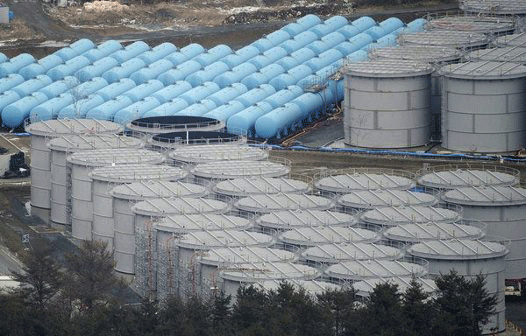
Is Fukushima at risk for another nuclear disaster?, Aljazeera America, 9 Jan 14 by Michael Okwu Nearly three years after the nuclear catastrophe at the Fukushima Daiichi Nuclear Power Plant, there remains concern about whether another disaster is right around the corner. America Tonight
At the Fukushima Daiichi plant, the Tokyo Electric Power Co., or TEPCO, is struggling to contain the ongoing nuclear disaster. Since the catastrophe almost three years ago, there has been disagreement about whether the plant is safe.
The official line from the Japanese government is that the situation is under control.
“The government is moving to the forefront and we will completely resolve the matter,” said Prime Minister Shinzo Abe in September, just before Tokyo was awarded the 2020 Summer Olympics.
But others, such as then–Tokyo Gov. Naoki Inose, have said the situation is “not necessarily under control.”…..
‘An ongoing crisis’ Journalist David McNeill has been covering Japan since 2000. America Tonight
“I think this is an ongoing crisis,” said David McNeill, a journalist who has lived in Japan since 2000 and has been covering the Fukushima disasterfrom the beginning. “What you’ve had is a series of ad hoc strategies designed to deal with the crisis that’s right in front of you.” Continue reading
 U.S. Nuclear-Weapons Plan Is So Expensive, It Can’t Be Implemented,National Journal by Douglas P. Guarino January 8, 2014 A new study says the strategy to update the U.S. triad of nuclear-armed aircraft, submarines and missiles would cost $1 trillion over the next 30 years, even under conservative assumptions
U.S. plan for modernizing the nation’s nuclear arsenal is so expensive that it cannot be implemented, the authors of a new study contend.
“It’s just not real,” Jeffrey Lewis, one of the report’s co-authors, said in reference to the current U.S. modernization blueprint. “It’s inconceivable to me that we will execute anything like the plan that they say they’re going to do.” The analysis, released on Tuesday by the James Martin Center for Nonproliferation Studies, says the strategy to update the U.S. triad of nuclear-armed bomber aircraft, submarines and ground-based missiles would cost $1 trillion over the next 30 years, even under conservative assumptions.
The estimate relies largely on official government figures, the authors say, and does not include costs associated missile defense, nonproliferation efforts and related intelligence programs Continue reading
 Japan’s energy pact with Turkey raises nuclear weapons concerns Asahi Shimbun, This article was compiled from reports by Sachiko Miwa in Tokyo and Kazuyuki Kanai in Istanbul., 7 Jan 14, A pact required for Japan’s first nuclear plant export after the Fukushima disaster faces opposition over concerns about a possible proliferation of nuclear weapons.
Debate over the issue is expected when the government seeks Diet approval for the nuclear energy agreement with Turkey during a session that convenes this month. Japan and Turkey agreed to conclude the nuclear energy pact, a precondition for exporting nuclear technology, in May. It requires the recipient country to use technology, as well as equipment and materials, only for peaceful purposes.
However, the pact includes a provision allowing Turkey to enrich uranium and extract plutonium, a potential material for nuclear weapons, from spent fuel if the two countries agree in writing. A senior Foreign Ministry official said the clause was added at the request of Turkey.
The agreement would also pave the way for exporting Japan’s enrichment and spent nuclear fuel reprocessing technologies if revisions are made.
The provision has sparked criticism that it contradicts Japan’s stance against nuclear weapons. Continue reading
 Fukushima Radiation Scare Hoaxes Fukushima Radiation Scare Hoaxes refers fictitious reports about dangerous radiation from the 2011 Fukushima Daiichi nuclear disaster.
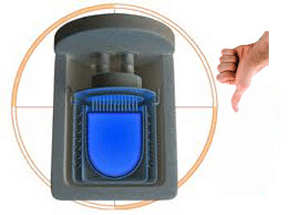 Small reactors just compound the waste problem because you generate more radioactive components (aside from all the nuclear fuel that turns into nuclear waste too) than a large nuclear reactor does per unit of energy generated. And placing them underground, while making them less tempting targets for terrorists, brings up issues of groundwater contamination and greater earthquake vulnerability in affected areas. The fact that you could use ground-source cooling to condense your cooling water a lot easier with these reactors is a benefit, so they aren’t completely a bad idea.
However, it should be made abundantly clear why some in the nuclear industry see these reactors as a way forward. As the article mentions, building large 1GW+ reactors has become an immensely risky undertaking from a financial perspective. Forget all the crap people harp on about Fukushima, the price tags on these reactors are the real killer. The new reactor under construction in Finland (Olkiluoto Unit 3) is coming in at 8.5B euros ($11.55B), or almost 3 TIMES it’s initial cost estimate. In dollar terms, that amounts to over $7.21 per watt!
http://en.wikipedia.org/wiki/Olkiluoto_Nuclear_Power_Plant
New reactors going up in the US are posting similar figures, although the massive web of government supports and insulation from market forces that the nuclear industry benefits from makes true cost figures for these reactors hard to pin down.
This is in the face of wind power getting INSTALLED for $1 – $2 per watt:
In short, the nuclear industry is scrambling for solutions before it becomes clear to everybody how irrelevant they are. Much like typewriters got really fancy and sophisticated in the 1990′s before going the way of the buggy whip and the rotary phone.
 Researchers grapple with UK’s nuclear legacy http://phys.org/news/2014-01-grapple-uk-nuclear-legacy.html#jCp 9 Jan 14 The University of Leeds will lead a consortium of 10 universities in a national research programme looking at ways of dealing with Britain’s nuclear waste. The £8 million project, funded by the Engineering & Physical Sciences Research Council (EPSRC), will start in February and bring together the nuclear industry, the Government’s nuclear advisors and the country’s leading academic researchers.
More than 40 doctoral and post-doctoral researchers will work over the next four years on issues including how best to handle different types of spent fuels, packaging and storing waste, and dealing with nuclear sludges in ponds and silos at nuclear power stations.
Professor Simon Biggs, Director of the University of Leeds’ Institute of Particle Science and Engineering, who will lead the University consortium, said: “The project is primarily focused on developing new technologies and providing confidence in the safe storage and disposal of legacy waste. The UK is a technology leader in this field and the core aim of this project is to maintain and further develop that skill base.”
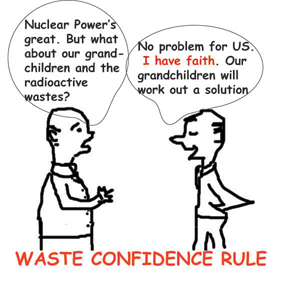
ed.note UK might have to copy the USA’s rule
He added: “This will be a truly interdisciplinary effort. We have civil engineers, chemists, chemical engineers, robotics experts, radiochemists, mechanical engineers and material engineers all working together on thirty different projects.”
The National Nuclear Laboratory (NNL), Nuclear Decommissioning Authority (NDA) and Sellafield Limited will be partners in the project, alongside the Universities of Leeds, Birmingham, Bristol, Imperial, Lancaster, Loughborough, Manchester, Sheffield, Strathclyde and UCL.
Much of the UK’s legacy waste is kept at the Sellafield site in Cumbria.
Sellafield Limited’s Research Alliance Manager Neil Smart said: “Today, Sellafield faces a challenge where there is no blueprint; emptying and demolishing some of the most difficult and complex nuclear buildings in the world – the decommissioning of historic reactors, reprocessing facilities and associated legacy ponds and silos.
“This massive challenge is however an opportunity to demonstrate that Sellafield is still at the forefront of the UK’s nuclear industry and we are delighted that the EPSRC is supporting appropriate academic research that will contribute to the scientific and technical underpinning of our mission. We look forward to engaging in these projects and benefiting from the outcomes, not only in terms of the science and technology but also the skilled people developed through these projects with the potential to enhance our workforce long into the future.”
 Nuclear Death, Warmed Over, HUFFINGTON POST, Jon Wolfsthal Deputy Director, James Martin Center for Nonproliferation Studies 01/08/2014 “……….The Nuclear Song Remains the
  Same The cold war is over is long gone, but the nuclear triad remains……..Atomic Pork Politics Elected officials are the ones pushing these expensive and unnecessary programs. The six senators from states where long-range missiles are deployed — Wyoming, Montana and North Dakota — are all pushing for the U.S. to build a new long-range missile. Congressional representatives from Georgia, Connecticut and Washington, where submarines are built and deployed — guess what — all support a new submarine. Same with the new bomber. They all want to ensure their slice of the nuclear pie stays the same, even without someone to point the weapons at.
Yet it appears no elected officials are aware that the full cost of replacing the nuclear arsenal will cost this much money. The Bomber will cost upwards of $100 Billion, not including the bombs and cruise missiles to go with it. The Submarine about as much, the missiles could cost even more. And the nuclear weapons that go on top — build and maintained in California, New Mexico, South Carolina and Nevada, will cost over 350 Billion over 30 years. U.S. budgets are prepared annually and the defense department only provides formal budget projections five years out. Yet these systems take 30 years to build and deploy. The situation is similar to the balloon mortgages that almost sank the U.S. economy, where it looks like we can afford the house but in year ten the monthly payments skyrocket.
For those who support maintaining a large nuclear arsenal, the fact that this number is not known or understood in Congress or the White House is a major danger……..http://www.huffingtonpost.com/jon-wolfsthal/nuclear-death-warmed-over_b_4560521.html

of the week – Shut Down Drone Warfare!


Tell the Ukrainian Government to Drop Prosecution of Peace Activist Yurii Sheliazhenko

Petition to revoke the licensing of the Near Surface Nuclear Disposal Facility (NSDF) at Chalk River. https://www.ourcommons.ca/petitions/en/Petition/Details?Petition=e-7247
To see nuclear-related stories in greater depth and intensity – go to https://nuclearinformation.wordpress.com
 nuclear-news