Keeping the lid on Fukushima information: the reason for Japan’s new Secrecy laws
t cannot be overly emphasized that the law undermines freedom of the press, people’s right to know and freedom of expression

 Japan & the Truth About Fukushima Daiichi nuclear power station Armstrong Economics, January 2, 2014 by Martin Armstrong, I have received a many requests about Japan and the Fukushima Daiichi nuclear power station disaster. I have many friends there and it deeply concerns me that the failure of the government to seal that site like the Russians did is threatening the world and Japan itself.
The reports of radiation hitting the West Coast of the USA are alarming and the debris that has been floating toward the USA is another issue unreported. However, the great concern is the secrecy laws imposed in Japan. Governments do not imprison people for criticizing officials unless there is really something they are trying to suppress. This in itself seems to be confirmation of our worst fears.
A Source from Japan Writes: Continue reading
Indefinite delay for restart of Japan’s idled nuclear reactors
 Restart of nuclear facilities and policy for nuclear waste disposal in Japan unlikely to be settled soon http://enformable.com/2014/01/restart-nuclear-facilities-policy-nuclear-waste-disposal-japan-unlikely-settled-soon/ In Japan, utilities are working to restart idled nuclear power plants across the nation and regain public support post-Fukushima. The Nuclear Regulation Authority, a newly established regulator, set new safety standards in July of 2013 which call for greater preparedness in regards to severe accidents, earthquakes, and tsunamis.
So far, 7 utilities have applied for regulatory officials to conduct safety screenings required to restart 9 plants. Officials still say that none of the plants are ready to restart because utilities have not adequately revised their estimations of potential earthquake activities.
This week, Shunichi Tanaka, chairman of the Nuclear Regulation Authority told reporters that there was no time limit on how long the safety screening process might take.
Even if operators are able to pass safety screens, they still need to obtain consent from local governments before the reactors can be restarted.
The task will not be easy in a nation which before the Fukushima Daiichi nuclear disaster had very little experience with management of severe accidents. The challenge is even greater considering the fact that the most experienced members of the workforce are aging and the new workforce has little to no prior experience with nuclear power.
As a nation Japan still has to revise a basic policy for the long-term disposal of nuclear waste. While government plans call for storage in deep underground repositories, experts caution that finding such locations in Japan will be difficult due to the seismicity of the area and lack of public trust. So far, no municipalities have come forward with any candidate sites.
Britain’s nuclear project means opposition to EU renewables targets, and potential job losses
UK opposition to new EU green eenergy targets could risk ‘half a million jobs’ theguardian.com, Thursday 2 January 2014 Britain’s demand to keep nuclear option open to reduce emissions will mean potential job losses, leaked report shows Adam Vaughan Over half a million new jobs over the next two decades could be at risk from the UK’s opposition to new EU targets for green energy, according to a leaked official report from the European commission.
Since last spring, European countries have been battling over what new climate change targets should be set to follow the existing ones for greenhouse gas emissions, renewable energy and energy efficiency, which run out in 2020. The UK, along with the Czech Republic, is strongly opposed to setting a new renewable energy goal for 2030, favouring an overall target for greenhouse gas emissions instead – which would entail an ambitious cut of 50% on 1990 levels. They want countries to be allowed the freedom to reach the target as they choose to, for example by relying heavily on nuclear power.
Energy and climate secretary, Ed Davey, has said: “We need a technology neutral approach to how individual countries meet their emissions targets … we will therefore oppose a renewable energy target at an EU level as inflexible and unnecessary.”
But a draft report, commissioned by the European commission on the impact of setting different targets and seen by the Guardian, says that including renewable energy and energy efficiency targets in addition to a greenhouse gas emissions target would create around 568,000 more jobs across Europe by 2030 than an emissions one alone. However, the cost of having renewable energy and efficiency targets would be 2.6% higher than with just an emissions target alone, the report notes.Germany, Denmark, Austria and Finland back a renewable energy target. A new energy efficiency target is considered unlikely.The wind industry said that not setting a renewable energy target would make it harder for developers to attract investment. ……
The new German government has already set a target of 40-45% of its electricity supply coming from renewable sources by 2025, higher than the 30-35% EU-wide target being discussed. By contrast, the UK has been one of the worst performers for share of energy generated by renewable sources, near the bottom of the European league table along with Malta and Luxembourg. http://www.theguardian.com/environment/2014/jan/02/uk-eu-renewables-targets
India’s nuclear regulator – nor independent, not effective
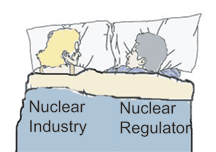
 Radiation regulatory regime needs independent powers Deccan Herald, Devender Singh, Jan 3, 2014:“……….In India, the Atomic Energy Regulatory Board (AERB) was set up in 1983 to carry out the regulatory and safety functions as envisaged in the Atomic Energy Act, 1962. Surprisingly, the AERB remains a subordinate authority under the Department of Atomic Energy (DAE) though India has ratified the Convention on Nuclear Safety. A regulatory body must be equipped to exercise its key regulatory functions — namely, standard-setting, authorisation, inspection and enforcement without any constraint — and must possess the core values of competence, independence, stringency and transparency.
……….Regulatory mechanism
The PAC noted that the regulatory mechanism concerning X-ray units was virtually non-existent. Out of a total of 57,443 medical X-ray facilities operating in the country, only 5270 units had been registered and were under the regulatory control of AERB, leaving the balance 91 per cent of the total units without registrations. The AERB admitted that with its very limited workforce of engineers and scientists, it was impossible to regulate all the X-ray machines. The marked accelerated growth of ionising radiation, such as medical X-rays used as an essential diagnostic tool pose grave risks to health of workers and the public in the vicinity of these facilities. There was an alarming shortfall of over 97 per cent regulatory inspections in case of diagnostic radiological facilities every year. ………http://www.deccanherald.com/content/378174/radiation-regulatory-regime-needs-independent.html
Why is USA government stocking up on potassium iodide pills?
Fukushima Anti-Radiation Pills? US Government Official Hangs Up When Asked About Potassium Iodide Purchase Department of Health and Human Services rep. says “no hidden agenda” behind 14 million dose buy By Paul Joseph Watson Global Research, January 03, 2014 An official with the Department of Health and Human Services hung up when asked if the federal government’s purchase of 14 million doses of potassium iodide was linked to the Fukushima crisis. As we reported earlier this week, the DHHS put out a solicitation asking for companies to supply 700,000 packages each containing 20 pills to be delivered before the beginning of next month.
Potassium Iodide helps block radioactive iodine from being absorbed by the thyroid gland and is used by victims of severe nuclear accidents or emergencies.
Questions immediately arose as to whether such a large purchase was routine or if it was linked to concerns about radiation from the crippled Fukushima nuclear plant impacting the west coast of America……..
Is the government’s purchase of 14 million doses of anti-radiation pills merely a routine order, or are they stockpiling potassium iodide in preparation for a nuclear catastrophe which could emerge out of the Fukushima crisis? Either way, the DHHS doesn’t seem too keen on answering questions………..http://www.globalresearch.ca/government-official-hangs-up-when-asked-about-iodide-purchase/5363630
Former MSNBC Host Told Not to Warn Public About Fukushima – The Young Turks
“Because the official government position is that it’s safe”
Fukushima News 1/2/14: Nuclear Expert: Fukushima Reactor Cores Melted Into The Ground
Published on 2 Jan 2014
Nuclear Expert: Fukushima reactor cores melted right down into the ground — That radioactive material is getting washed out into Pacific Ocean (AUDIO)
http://enenews.com/nuclear-expert-fuk…
Japan to set new policy for nuclear waste disposal
The Japanese government plans to revise a basic policy for disposing of nuclear waste so that it can play a more active role in selecting disposal sites.
The industry ministry says starting early this year it will act on proposals submitted in November by a panel of experts.
The government plans to store highly-radioactive waste from nuclear power plants deep underground. It has been asking local governments to come up with candidate sites under a law that came into effect in 2000.
But no municipalities have stepped forward, and the government has still not secured any candidate sites.
Nuclear plants unlikely to resume operations soon
Officials with the Nuclear Regulation Authority in Japan say no nuclear plants are likely to resume operations in the near future.
They set new safety standards last July following the 2011 accident at Fukushima Daiichi. The guidelines call on operators to prepare for severe accidents and to reinforce facilities to make them earthquake-resistant.
Seven utilities have applied for safety screenings for 9 plants so they can restart operations.
Annual New Year sit-in held in Nagasaki
A group of atomic bomb survivors and other citizens have staged an annual New Year’s Day sit-in in Nagasaki, calling for the elimination of nuclear arms.
About 60 people took part in the event at the city’s Peace Park on Wednesday.
Speaking at the rally, 91-year-old former Nagasaki mayor Hitoshi Motoshima said helping create a peaceful world is the duty of Japan which inflicted damage and pain against the people of Asian nations during World War Two.
FUKUSHIMA children living with nuclear fallout today

Published on 1 Jan 2014
FUKUSHIMA children living with nuclear fallout.
h/t http://www.frequency.com/video/fukushima-children-living-with-nuclear/141467341/-/5-770055
1 This Month

of the week – Shut Down Drone Warfare!


Tell the Ukrainian Government to Drop Prosecution of Peace Activist Yurii Sheliazhenko

Petition to revoke the licensing of the Near Surface Nuclear Disposal Facility (NSDF) at Chalk River. https://www.ourcommons.ca/petitions/en/Petition/Details?Petition=e-7247
To see nuclear-related stories in greater depth and intensity – go to https://nuclearinformation.wordpress.com
-
Archives
- April 2026 (103)
- March 2026 (251)
- February 2026 (268)
- January 2026 (308)
- December 2025 (358)
- November 2025 (359)
- October 2025 (376)
- September 2025 (257)
- August 2025 (319)
- July 2025 (230)
- June 2025 (348)
- May 2025 (261)
-
Categories
- 1
- 1 NUCLEAR ISSUES
- business and costs
- climate change
- culture and arts
- ENERGY
- environment
- health
- history
- indigenous issues
- Legal
- marketing of nuclear
- media
- opposition to nuclear
- PERSONAL STORIES
- politics
- politics international
- Religion and ethics
- safety
- secrets,lies and civil liberties
- spinbuster
- technology
- Uranium
- wastes
- weapons and war
- Women
- 2 WORLD
- ACTION
- AFRICA
- Atrocities
- AUSTRALIA
- Christina's notes
- Christina's themes
- culture and arts
- Events
- Fuk 2022
- Fuk 2023
- Fukushima 2017
- Fukushima 2018
- fukushima 2019
- Fukushima 2020
- Fukushima 2021
- general
- global warming
- Humour (God we need it)
- Nuclear
- RARE EARTHS
- Reference
- resources – print
- Resources -audiovicual
- Weekly Newsletter
- World
- World Nuclear
- YouTube
-
RSS
Entries RSS
Comments RSS
 nuclear-news