Nuclear dose allowances to increase further?
While trawling the web i came upon this message on the RADSAFE comments.. No mention of Japans 100mSv/year dose allowance ..
However, there are moves to increase the dose allowance of gamma, Beta and Alpha energies even further, with no mention of internal dose allowances.. A figure mentioned in the message is O.2 Rontgen a day or 71 mSv/year.
I find it interesting that now the Nuclear Health Physicists are supporting the failed ICRP model so as to not make any bad publicity. At least that is the discussion.. Read on..
Arclight2011
Source of comment ; http://health.phys.iit.edu/archives/2013-December/039276.html
Dear RADSAFERS,

Let me at the very outset wish all of you a happy, healthy and productive New Year.

I thought it is time to discuss some of the developments in radiation risk assessment.
A  review  titled
"Evidence for beneficial low level
radiation effects and
radiation
hormesis"by Dr L E
FEINENDEGEN  published in the British
Medical Journal concluded :

"Thus, the
linear-no-threshold (LNT) hypothesis for cancer risk is scientifically
unfounded and appears to be invalid in favour of a threshold or hormesis. This
is consistent with data both from animal studies and human epidemiological
observations on low-dose induced cancer. The LNT hypothesis should be abandoned
and be replaced by a hypothesis that is scientifically justified and causes
less unreasonable fear and unnecessary expenditure". (BJR , 78 (2005), 3–7)

Shortly thereafter, The French
Academy of Sciences chaired by Prof.  Tubiana came to similar conclusions. Several
papers appeared since then. Many of them concluded that LNT theory is  not supported by scientific evidence.

The French report concluded that
on the basis of our present knowledge, it is not possible to define the
threshold level (between 5 and 50 mSv?) or to provide evidence for it.

A draft  summary of the DOE funded Low Dose Radiation Research
Programme  over 10 years from
1998-2008  concluded

"To date, these data have
had major impact on understanding the biological processes triggered by low
doses of radiation but require additional research, development of methods of
using the data, and communication before such data can impact radiation
standards"

The quest for a scientifically
supported model continues. Every one fervently hopes that the model may provide
evidence for a quantitative value for a threshold dose.

What is the  way forward.? Fukushima has added another
dimension to the discourse. Evacuation  caused over 1000 deaths

In his article titled "Commentary on Fukushima and Beneficial
Effects of Low Radiation" Dr Jerry Cuttler made a persuasive and
thought provoking  statement and a recommendation

. "The ICRP’s concept of
radiation risk is wrong. It should revert to its 1934 concept, which was a
tolerance dose of 0.2 roentgen (r) per day based on more than 35 years of
medical experience".

I
request  RADSAFERS to please respond to the following:

1) How many radsafers  are willing to accept Dr Cuttler's
recommendation?
2) My take is to keep the current
ICRP recommendations in tact. Fear of radiation arises from the improper and
incorrect use of  concepts. ICRP earlier
and UNSCEAR now  has cleared the air. A
well focused  public information
programme  must be tried to  allay radiation phobia.

We should unambiguously state
thus:

"There is substantial  and convincing evidence for health risks
following high dose exposures. However, below 5–10 rem (which includes
occupational and environmental exposures), risks of health effects are either
too small to be observed or are nonexistent." (Part of the position
statement by the US Health Physics Society)
Do you agree with this proposal?
3) Dose levels at which any emergency
has to be handled   should be decided in advance;  all stake-holders must participate in that
exercise.

Is that acceptable?
Pakistan – Senate Defence Committee announces Task Force for Cyber Security Policy
Bolivia Wants Nuclear Energy, But Brazil And Other Latin American Countries Are Abandoning It
on January 03 2014 10:43 AM
Tiny Bolivia, the poorest nation in South America, packs a punch — or so says President Evo Morales, who welcomed the new year with an announcement: Bolivia is ready to pursue nuclear energy. Morales assured that the country has the necessary raw materials for the quest to be successful, and said nuclear power is a “right for every Bolivian.”
“Nuclear energy is not a privilege for developed countries, and others have to be deprived of it,” he said, adding that Bolivia is not a warlike country and nuclear energy would be used for “peaceful ends.”
Morales did make a point to say that it will take some time to develop the necessary technology, and that countries like France and Argentina were helping out. “It is time to take Bolivia off the last row in Latin American development,” he said.
However, Morales’ enthusiasm for this technology notwithstanding, the history of Latin America with nuclear energy is not very promising. Three countries in the region — Mexico, Brazil and Argentina — use nuclear power, all under the Treaty of Tlateloco of 1967, which forbids nuclear weapons and the use of nuclear energy for war. Others, like Chile and Cuba, have expressed interest in developing nuclear energy.
But no Latin American countries have been very successful with it, for various reasons.
NNSA says it needs New Mexico’s nuclear labs – “critical to future”
National Nuclear Security Administration, which runs both Sandia National Laboratories and Los Alamos National Laboratory, said the two labs were critical to the agency meeting several of its goals.
Reporter- Albuquerque Business First
Jan 3, 2014
In its 2013 wrap-up, the National Nuclear Security Administration, which runs both Sandia National Laboratories and Los Alamos National Laboratory, said the two labs were critical to the agency meeting several of its goals.
The largest capital project the agency completed for the year was the Radiological Laboratory Office Building Equipment Installation at LANL, which is the first nuclear project NNSA has delivered under budget and ahead of schedule.
NNSA also recognized New Mexico researchers who garnered four of “Popular Science” magazine’s 100 best innovations from 2013, which came from LANL and Sandia. Also, researchers from Sandia were responsible for radar drop tests of B61 nuclear bombs at the Tonopah Test Range in Nevada.
National Convention of Anti-Nuclear Movements begins tomorrow
The Indian ruling class’ colonial mentality was revealed by what Dr. Manmohan Singh said while accepting an honorary degree from the Oxford University on July 8, 2005: “As we look back and also look ahead, it is clear that the Indo-British relationship is one of ‘give and take’. The challenge before us today is to see how we can take this mutually beneficial relationship forward in an increasingly inter-dependent and globalized world that we live in.”

Confronting the Nuke-colonization of India: A National Convention of Anti-Nuclear Movements will be held in Idinthakarai, Tamil Nadu on January 4 and 5. This will be inaugurated by Admiral (retd.) L. Ramdas.In the context of the unprecedented threats facing the world due to global warming and the rapid depletion of conventional energy sources, the nuclear establishment is most opportunistically pushing nuclear energy as a climate-friendly energy source. However, all the activities associated with nuclear power generation – the mining and processing of uranium, the building of nuclear power stations involving huge amounts of cement and steel, the long construction process, the decommissioning of plants and the handling of radioactive waste – are highly unsafe and expensive, and cause enormous climate-changing pollution. Nuclear energy is not cheap, safe, clean or sustainable. It also does not offer a solution to our energy problems.
The Nuke-Colonization of India
However, the government of India headed by Dr. Manmohan Singh has been aggressively expanding nuclear power generation and enhancing nuclear business with countries such as the United States, Russia, France, Kazakhstan, Australia, Japan and others without any regard for the norms of democratic decision making. Throwing all the democratic precepts and practices to the air, the two-term UPA government unilaterally took upon the task of nuclearizing the highly and densely populated country, India, and securing a ludicrous legacy for the discredited prime minister.
A highly populated country like India does have an increasing need for energy. But for that very reason, the energy options we choose must be economical, sustainable, safe and environmentally-friendly. Moreover, energy distribution must be made more equitable, just and efficient.
What is happening in India right now is not just nuclearization of the country, but growing nuke-colonization, colonizing India all over again with the help of nuclear powers such as the United States, Russia, France etc. Both the Congress Party and the Bharatiya Janata Party (BJP) are complicit in this national crime!
General Electric moves from nuclear into the fracking buisness
GE has wisely chosen a high margin part of the oil and gas business that plays well with their exceptional skills in specialized materials and remote sensing. Not only does deep drilling require sophisticated materials, but it also requires mobile generators and an increasingly large array of treatment systems. Since hydraulically fractured wells exhibit depletion rates in the 5-10% per month range, maintaining a steady supply of gas from shale rock formations that require fracking means a continuing need to drill an ever larger number of wells.
3 January 2014
Bill Loveless from Platts Energy Week recently interviewed Mark Little, GE’s chief technology officer, about the company’s interests in the oil and gas extraction sector. Loveless and Little discussed GE’s planned investments into an Oklahoma-based research center that will be the first GE technology development laboratory that is focused on a single business sector.
Mark Little: We’re very excited about going to Oklahoma. We have a global network of research centers that support all of our businesses. The first one was in upstate New York. First industrial research lab ever in the United States. We built out from that to India, China, Germany, Brazil, other places in the US. We’re going to Oklahoma for the first time with the intent of having a single business focused center. All these other centers support every business. This one will be focused solely on oil and gas.
Why are we doing that? There’s such a rich technology opportunity here to get technology into the oil and gas space. We wanted to really focus on that; make a showcase for our customers from around the world to come and see this and to help us develop technologies that they need to make their operations more efficient and more productive.
The video of the interview can be found by clicking here.
After watching that interview, do you have any more doubt about why GE leaders spend little or no time marketing new nuclear power plants that would reduce the growing demand for natural gas in the lucrative US electrical power market?
Most UK nuclear sites at risk of flooding, unpublished report shows
…”Sea level rise, especially in the south-east of England, will mean some of these sites will be under water within 100 years,” said David Crichton, a flood specialist and honorary professor at the hazard research centre at University College London. “This will make decommissioning expensive and difficult, not to mention the recovery and movement of nuclear waste to higher ground.”….
….”It makes you wonder what other important information about the safety of our nuclear plants the government and EDF might be hiding,”….
Rising sea levels because of climate change put 12 of 19 sites at risk, unpublished government analysis shows
http://verschwoerer.soup.io/post/384229393/UK-nuclear-sites-at-risk-of-flooding
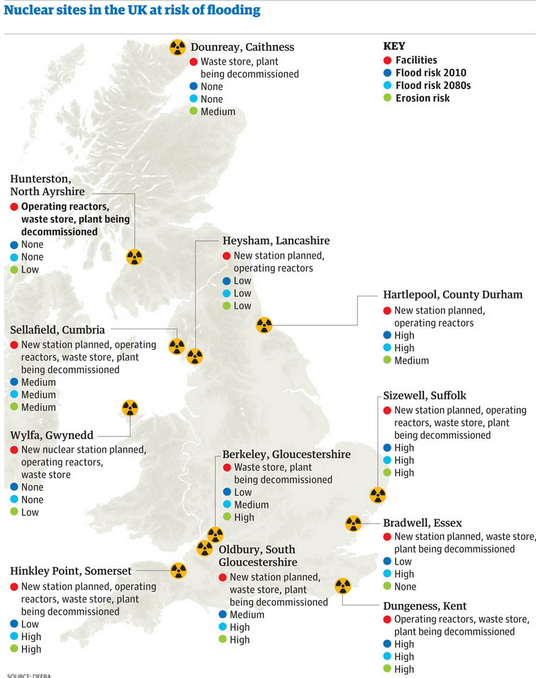
As many as 12 of Britain’s 19 civil nuclear sites are at risk of flooding and coastal erosion because of climate change, according to an unpublished government analysis obtained by the Guardian.
Nine of the sites have been assessed by the Department for Environment, Food and Rural Affairs (Defra) as being vulnerable now, while others are in danger from rising sea levels and storms in the future.
The sites include all of the eight proposed for new nuclear power stations around the coast, as well as numerous radioactive waste stores, operating reactors and defunct nuclear facilities. Two of the sites for the new stations – Sizewell in Suffolk and Hartlepool in County Durham, where there are also operating reactors – are said to have a current high risk of flooding. Closed and running reactors at Dungeness, Kent, are also classed as currently at high risk.
Another of the sites at risk is Hinkley Point in Somerset, where the first of the new nuclear stations is planned and where there are reactors in operation and being decommissioned.
According to Defra, Hinkley Point already has a low risk of flooding, and by the 2080s will face a high risk of both flooding and erosion.
Other new reactor sites that face some risk now and high risk by the 2080s are Oldbury in Gloucestershire and Bradwell, Essex.
The huge old nuclear complex at Sellafield, Cumbria, is said to face a medium risk of flooding now and later.
The analysis was conducted by officials from Defra’s floods and coastal erosion team as part of a major investigation into the impact of climate change on the UK. But when the results were published in January only summary numbers for the 2080s were mentioned and no individual sites were named.
Defra has now, however, released its full analysis in response to a request under freedom of information legislation. As a result, the department’s assessments of the risks for individual sites can be disclosed for the first time.
Many of the sites date back to the 1950s and 1960s, and are unlikely to be fully decommissioned for many decades. Seven of those containing radioactive waste stores are judged to be at some risk of flooding now, with a further three at risk of erosion by the 2080s.
Experts suggested the main concern was of inundation causing nuclear waste leaks.
Vermont nuclear decommissioning may be a model for other States
State Involvement Key for Decommissioning Old Nuclear Plants, Nasdaq, By Oilprice.com, January 03, 2014 The beginning of 2014 marks the final year of operation for the Vermont Yankee Nuclear Power Plant, ending a contentious battle between the state and the plant’s owner. On December 23, Entergy (ETR) and the state of Vermont announced a deal that will end all litigation surrounding the plant’s operation, shut down the plant at the end of 2014, and lead to a compressed schedule to study decommissioning.
The conflict started when Entergy sought a 20-year license renewal to keep the Yankee plant operating into the 2030’s. Vermont, however, requires approval from the state legislature for license renewal, the only state in the country that does so. Yet Entergy sued the state, arguing that authority over nuclear license renewals rests only with the Nuclear Regulatory Commission (NRC), and that federal authority trumps state authority.
Although a series of court decisions affirmed Entergy’s position, the company ultimately decided to close the plant anyway, largely due the inability to compete with cheap natural gas. In August 2013 it announced that it would cease operations at the end of 2014…….
The deal to close Vermont Yankee does offer a useful model for decommissioning as it tackles some of the key areas of conflict between the industry and the areas in which it operates. Entergy agreed to complete adecommissioning study in one year, much quicker than the four years allotted for by the NRC. It also agreed to move nuclear waste from onsite pool storage into dry casks within seven years, even though the NRC allows the company to keep waste in pools for sixty years. The deal also calls for Entergy to pay millions of dollars to the state for economic development for the county in which Vermont Yankee is located.
One of the interesting features of the deal is that it allowed for active involvement of the state in shaping the path towards decommissioning and waste disposal, which is often absent elsewhere. To be sure, huge question marks remain, including how the state will make up for the shortfall in electricity generation, and where funding for decommissioning will come from. But, the U.S. has thus far failed to implement a strategy to decommission old nuclear power plants. And with most of the 100 or so nuclear power plants obtaining 20-year license renewals, that conversation has been pushed off into the future. The Vermont Yankee deal, while incomplete, does offer lessons for decommissioning. http://www.nasdaq.com/article/state-involvement-key-for-decommissioning-old-nuclear-plants-cm315680#ixzz2pRYlLxGz
Fukushima nuclear reactor No 3 gives off new plumes of steam
Plumes of Mysterious Steam rise from Crippled Fukushima Nuclear Reactor By Russia Today
Global Research, January 03, 2014 Fresh plumes of most probably radioactive steam have been detected rising from the reactor 3 building at the crippled Fukushima nuclear plant, said the facility’s operator company.
The steam has been detected by surveillance cameras and appeared to be coming from the fifth floor of the mostly-destroyed building housing crippled reactor 3, according to Tokyo Electric Power Co (TEPCO), the plant’s operator.
The steam was first spotted on December 19 for a short period of time, then again on December 24, 25, 27, according to a report TEPCO published on its website.
The company, responsible for the cleanup of the worst nuclear disaster since Chernobyl, has not explained the source of the steam or the reason it is rising from the reactor building. High levels of radiation have complicated entry into the building and further inspection of the situation…….
Secret agreement between Fukushima Govt. Fukushima Medical University and IAEA
Fukushima Govt. & Fukushima Medical University Signed Secrecy Pact With IAEA fukuleaks.org January 1st, 2014 Tokyo Shimbun is reporting the results of their investigation into the dealings of the Fukushima prefecture government, the medical university and the IAEA. There has been ongoing suspicion about the openness and honesty of what has been ongoing in Japan. Tokyo Shimbun has confirmed that these government entities did sign a secrecy agreement with the IAEA. The Fukushima Medical University has been the main source of all public data on exposure and had been dictating what medical care many in the region were allowed to receive related to radiation issues.
Both the prefecture and the medical university have been the subject of growing distrust from the public due to their efforts to downplay problems and withhold information from the public. Tokyo Shimbun’s work has confirmed this problem to be the case. A machine translation of the article is below.
………The Memorandum of Understanding with the IAEA, in December last year, Fukushima Prefecture were signed respectively in October this year, Fukui Prefecture.
In Fukushima Prefecture, Prefectural University of Medicine has concluded with the IAEA for the health impact study prefecture, radiation for the management of radioactive waste and decontamination. There are “exemplary arrangements” document as detailed MOU provisions marked to be “to ensure the confidentiality of information designated as confidential by the other party” is included in the document……..http://www.fukuleaks.org/web/?p=11993
Elegant exposing of a paid climate denialist shill
In the end, what we have here is a paid shill writing garbage for more paid shills whose only goal is to misrepresent facts, lie and distort so the people who write their paycheques can continue to make money by polluting the Earth.
Heartland relying on more non-experts with vested interests to spin garbage uknowispeaksense 4 Jan 14 Normally I couldn’t care less what the privately funded (fossil fuels, pharmaceutical, tobacco etc) loony right-wing Heartland Institute have to say, but there’s only tennis on the television and I’m a little bored. Anyway, their blog, ironically called Somewhat Reasonable has a post entitled “There is no denying mother nature” written by some bloke by the name of Paul Crovo. I’m not sure I’ve ever read a larger pile of crap.
So, before we begin looking at this no doubt informative article about mother nature (biology, ecology, physics, chemistry etc) let’s check the credentials of the author.
Heartland describe Paul Crovo as “an energy analyst [working] for a major financial institution in Philadelphia……Allow me to paraphrase…Paul Crovo is a loony tea party capitalist petroleum analyst whose job it is to make money for his bank out of fossil fuels. He has no actual climate science expertise
A search of scientific literature databases reveals that globally, there were more than 55000 peer-reviewed papers published on the subject of climate change covering hundreds of different topics including atmospheric physics, ocean chemistry, cryosphere, species range shifts, hydrology, economics, disease, tropical storms, soil carbon sequestration, plant physiology. The list is extensive. For the 5 or 6 examples of these alleged defeats, Mr Crovo offers no credible references to any scientific (or political science) journals. ………First, he mentions the Australian election. Yes, Australians elected a conservative government. Yes, that political party had removal of the carbon “tax” as one of its election commitments. Does that mean Australian voters are rejecting UN protocols? In short, no. Tony Abbott was elected by default by an electorate that had gro wn tired of the progressives. Most of the sentiment had to do with issues of party stability. Tony Abbott ran a negative campaign for three years, aided completely by a print media dominated by right-wing Murdoch owned newspapers and a compliant mainstream television media and right-wing shock jocks on radio. Interestingly, Abbott didn’t actually secure a majority with most of the disaffected shifting their vote not to Abbott, but to new parties and independents, with preferences getting Abbott over the line in marginal seats. In the end, it was only 30000 votes in marginal seats that decided it. He also didn’t secure a majority in the upper house of parliament either. Hardly a convincing win and definitely no mandate as he claims.,,,,,,,
In the end, what we have here is a paid shill writing garbage for more paid shills whose only goal is to misrepresent facts, lie and distort so the people who write their paycheques can continue to make money by polluting the Earth. They are unconscionable and don’t care about anyone but themselves. Well, all I can say is the title of Mr Crovo’s dodgy article is the only thing he got right. There is no denying Mother Nature and she is starting to let her fury be known. Eventually, the vast majority will know the Paul Crovo’s and his ilk for what they are and future historians will not be kind. What a legacy to leave. http://uknowispeaksense.wordpress.com/2014/01/04/heartland-relying-on-more-non-experts-with-vested-interests-to-spin-garbage/
Peace is being waged in the Middle East
Nuclear Peace Emerging in the Middle East HUFFINGTON POST, William Lambers /02/2014 Last year ended with some momentum toward ending the standoff over Iran’s nuclear program. If a comprehensive agreement can be forged this year, it will be a major step toward freeing the world of the costly and dangerous burden of nuclear weapons.
Iran has suffered from sanctions for failing to live up to obligations under the Nuclear Non-Proliferation Treaty. A report from the International Federation of Human Rightsstated the consequences for the Iranian people:
“Unemployment is on the rise, inflation is at unprecedented levels and most people have to combine several jobs because the minimum wage is insufficient to counterbalance inflation. Iran’s population is experiencing an increasing income gap between rich and poor.”
Iran cannot afford to be diverting precious resources to the pursuit of nuclear weapons. As President Obama said, “Iran must know that security and prosperity will never come through the pursuit of nuclear weapons — it must be reached through fully verifiable agreements that make Iran’s pursuit of nuclear weapons impossible.”
The new year brings great hope of a comprehensive settlement on Iran’s nuclear program, following last year’s six-month interim agreement. There is more, too.
Jordan is hosting a large-scale simulated inspection exercise for the Comprehensive Nuclear Test Ban Treaty (CTBT). This treaty bans all nuclear weapons test explosions.
Eight countries still need to ratify the CTBT for the pact to take effect globally: Iran, China, Israel, Egypt, India, Pakistan and North Korea. The United States also has yet to ratify the CTBT, and clearly this is an area where non-proliferation leadership is needed.
The treaty is vital for creating the conditions for deeper nuclear arms reductions. If the U.S. or Russia were to resume nuclear weapons tests it would be followed by others, leading to a costly arms race and increased tensions. It would be a return to the Cold War days. No one wants to see those days again. The only place left for nuclear tests is the history books.
The CTBT is enforced through an international monitoring and inspection system, the one to be tested in Jordan…..
President Obama is committed to ratifying the CTBT, finishing a goal shared by almost every president since Dwight Eisenhower. In fact, President Eisenhower and President Kennedy both supported the goal of ending nuclear testing, and did achieve a limited treaty banning tests in the atmosphere, underwater and in outer space. Both Republicans and Democrats supported this plan.
The Senate would need to show the same cooperation to get the CTBT passed today.
A lasting agreement with Iran and ratification of the Comprehensive Nuclear Test Ban Treaty are two goals within reach. It’s diplomacy in action, the only road to peace and nuclear disarmament. http://www.huffingtonpost.com/william-lambers/nuclear-peace-middle-east_b_4485847.html
Both the land and the people suffer from uranium mining: its long term harm
Uranium mining: everything about it is negative http://www.nunatsiaqonline.ca/stories/article/65674uranium_mining_everything_about_it_is_negative/ Dale DewarWynard, Sask.3 Jan 14, “There is probably fairly low probability that mining will even occur” NUNATSIAQ NEWS Youth should be congratulated on tackling the issue of uranium mining in Nunavut.
Both sides sound as though they did their research thoroughly. Unfortunately the “economic benefit” argument is based upon promise and not fact. What little research that has been done does not support the argument for local benefit. The few unskilled jobs that go locally provide money that accrues to individuals, not communities. The government of Nunavut may benefit from royalties — but as Saskatchewan recently discovered, even that was banked in Switzerland to avoid taxes.
What kind of legacy does uranium mining leave? The natural situation can never be restored; 85 per cent of the nuclear radiation bound up in the rock will be left on the surface.
The industry speaks of “reclamation” but even that is more an unfulfilled promise than fact. The area can never be normal again. Mines in northern Saskatchewan still spill toxic tailings into waters bound for the Arctic Ocean. Mining in Niger (North Africa) has been going on since 1968 with not a whisper of reclamation. Two million tonnes of radioactive tailings were dumped into local surface waters in Gabon (also Africa.)
Containment in Australia recently ruptured and is still spreading into the surface waters of the surrounding Indigenous lands. The mining company in Navajo Territory in the south-western United States transferred its assets and then declared bankruptcy.
Reclamation, such as it is, is extremely expensive. Germany began reclamation of a collection of mines referred to as WISMUT in the 1990s —to date, close to twelve billion dollars have been spent and the job is not complete.
The tailings from a proposed mine in Tanzania expected to produce uranium for 20 years has a clean-up price tag of four billion dollars.
Given that uranium has only two end uses — nuclear power and nuclear bombs — no renaissance for the first and no desire for the second, there is probably fairly low probability that mining will even occur.
The industry and the argument will serve only to divide a community that needs to work together to tackle challenging times.
Thorium nuclear reactors produce just as much radioactive waste products as do uranium reactors
Reuters Breakout Series Focuses on China’s Interest in Thorium, The Energy Collective December 23, 2013 Reuters is running a series titled Breakout: Inside China’s Military Buildout. Installment number 6 is titled The U.S. government lab behind Beijing’s nuclear power push. The title is misleading; it is not about China’s world-leading, multibillion-dollar program. That program includes 29 large commercial nuclear plants currently under construction. Instead, the article focuses on a $350 million research program to evaluate the use of thorium as an alternative nuclear fission fuel source.
The Reuters piece includes a number of statements about the comparison between thorium and uranium that are debatable, at best, but whose source should be obvious to anyone that has been involved in any discussions with thorium advocates. It neglects the fact that uranium and thorium produce approximately the same mix of radioactive fission products. Systems using thorium need to pay just as much attention to decay heat removal as systems using uranium.
The article partially blames Admiral Rickover for the nuclear industry’s initial focus on uranium, without ever mentioning that the single most impressive use of thorium in an operating reactor took place under Admiral Rickover’s direction………
There is not a single mention in the article that Rickover’s Shippingport nuclear power plant was the site of the successful test of the Light Water Breeder Reactor (LWBR)between 1977 and 1982. That demonstration plant…..used a carefully engineered nuclear reactor core with uranium-233 as the fissile material and thorium-232 as fertile material…….detailed destructive post irradiation testing determined that the core contained about 2% more U-233 at the end of operation than it did at the beginning.
Japan quietly removing debris from Reactor 3 Spent Fuel Pool at Fukushima I Nuclear Power Plant
 Fukushima I NPP Reactor 3: Debris Removal from Spent Fuel Pool Has Started JANUARY 1, 2014 There were a few news outlets in late November and early December last year that reported TEPCO would start removing the debris from the Reactor 3 Spent Fuel Pool at Fukushima I Nuclear Power Plant in mid December. Hardly anyone paid attention. (No one probably thought it was possible.) Then there was no news of it actually starting.
Well, news or not, the work started on December 17, 2013. That information was shared at the meeting on December 26, 2013 on “Roadmap to Decommissioning”, which was available via live feed on the net. However, unless you are one of the dwindling number of reporters and net citizens who continue to follow the accident by attending/watching such meetings, you wouldn’t know……..(excellent graphics)…
Kyodo also reports that two cranes will be used, and up to 11 monitoring cameras will be used. All the work will be done by remote-controlled vehicles and equipment. No information whether the human workers are to be posted near the work for further safety monitoring.
All of the MOX fuel that TEPCO had at the plant was in the reactor itself at the time of the accident. http://ex-skf.blogspot.com.au/2014/01/fukushima-i-npp-reactor-3-debris.html
1 This Month

of the week – Shut Down Drone Warfare!


Tell the Ukrainian Government to Drop Prosecution of Peace Activist Yurii Sheliazhenko

Petition to revoke the licensing of the Near Surface Nuclear Disposal Facility (NSDF) at Chalk River. https://www.ourcommons.ca/petitions/en/Petition/Details?Petition=e-7247
To see nuclear-related stories in greater depth and intensity – go to https://nuclearinformation.wordpress.com
-
Archives
- April 2026 (103)
- March 2026 (251)
- February 2026 (268)
- January 2026 (308)
- December 2025 (358)
- November 2025 (359)
- October 2025 (376)
- September 2025 (257)
- August 2025 (319)
- July 2025 (230)
- June 2025 (348)
- May 2025 (261)
-
Categories
- 1
- 1 NUCLEAR ISSUES
- business and costs
- climate change
- culture and arts
- ENERGY
- environment
- health
- history
- indigenous issues
- Legal
- marketing of nuclear
- media
- opposition to nuclear
- PERSONAL STORIES
- politics
- politics international
- Religion and ethics
- safety
- secrets,lies and civil liberties
- spinbuster
- technology
- Uranium
- wastes
- weapons and war
- Women
- 2 WORLD
- ACTION
- AFRICA
- Atrocities
- AUSTRALIA
- Christina's notes
- Christina's themes
- culture and arts
- Events
- Fuk 2022
- Fuk 2023
- Fukushima 2017
- Fukushima 2018
- fukushima 2019
- Fukushima 2020
- Fukushima 2021
- general
- global warming
- Humour (God we need it)
- Nuclear
- RARE EARTHS
- Reference
- resources – print
- Resources -audiovicual
- Weekly Newsletter
- World
- World Nuclear
- YouTube
-
RSS
Entries RSS
Comments RSS
 nuclear-news