Vietnamese boat-people priest serving the victims of Fukushima
AsiaNews: Welcomed in Japan 28 years ago after fleeing with his family from South Vietnam, today the 36-year old priest Nguyen Quang Thuan “is giving back ” to the country that took him in by devoting psychological help to those who were evacuated from their homes in the aftermath of the Fukushima nuclear power plant disaster of March 2011.
They are people housed in temporary accommodation in the city of Iwaki, Fukushima Prefecture, isolated within their shelters, to the point that a meeting place has been ste up for them called “outreach cafe”.
The Vietnamese priest goes there every day: he prays for displaced people, listens to them, tries to help them out of their isolation, to socialize. Don Thuan is in charge of 10 temporary housing complexes: Together with volunteers from the Catholic church they visit and chat with residents. “Evacuees – he said – are worried about whether they will be able to go home in the future. I want them to be positive about their lives, even if it’s just a little”.
Born in the suburbs of Ho Chi Minh City, formerly known as Saigon, Thuan lived with his two brothers and sister, as well as his parents who ran a coffee plantation. However, his family decided to leave Vietnam for fear of persecution by the new government in the chaos just after the end of the Vietnam war.
One day when Thuan was 5 years old, found himself on a small wooden boat, one of the estimated 1.44 million refugees who escaped from Vietnam, Laos, and Cambodia after Saigon’s fall in 1975.
Steam from Fukushima reactor No. 3 is not due to explosion, but to hot radioactive rubble
 Gundersen: Very visible steam at Fukushima Unit 3 is from constant radioactive releases — Coming from hot rubble, not related to new explosion http://enenews.com/gundersen-very-visible-steam-releases-at-fukushima-unit-3-are-radioactive-coming-from-hot-rubble-not-new-meltdown-or-explosion
Fairewinds Energy Education, , Jan. 1, 2014: […] the Internet has been flooded with conjecture claiming that Fukushima Daiichi Unit 3 is ready to explode. Fairewinds Energy Education has been inundated with questions about the very visible steam emanating from Fukushima Daiichi Unit 3. […] Hot water vapor has been released daily by each of the four Fukushima Daiichi nuclear power plants since the accident. We believe that is one of the reasons TEPCO placed covers over Daiichi 4 and 1. […] radioactive rubble (fission products) was left in each unit […] heat from this ongoing decay of radioactive rubble is constantly releasing moisture (steam) and radioactive products into the environment. […] [Unit 3] is still producing slightly less than 1 megawatt (one million watts) of decay heat […] it is creating radioactive steam […] hot radioactive releases […] have occurring [sic] for the entire 33 months […] The difference now is that the only time we visibly notice these ongoing releases is on the cold days […]
The Ecologist reported on this unsubstantiated rumor which was then used as a source by ‘Gizmodo. The Ecologist has now changed their original report without any notice or explanation.Here’s the original ending: “The Turner Radio Network is advising people on the West Coast of North America to”prepare for the worst” in case a meltdown of the waste fuel is in fact commencing. No official warnings have been released on either side of the Pacific.”
Fukushima nuclear reactor No 3 could be melting down now, TEPCO admits
 TEPCO Quietly Admits Reactor 3 Could Be Melting Down NOW nsnbc International Susanne Posel (OC) , 30 Dec 13, – The Turner Radio Network (TRN) has issued a report regarding the Fukushima Daiichi Nuclear Power Plantstating that it is expected to affect the entire Northern Hemisphere.
According to the report: “Persons residing on the west coast of North America should IMMEDIATELY begin preparing for another possible onslaught of dangerous atmospheric radiation from the Fukushima nuclear disaster site in Japan.”
TEPCO has confirmed via camera surveillance, that steam has begun to pour from Reactor 3, although they have “not been identified abnormal plant conditions.”
TEPCO is reporting that “radioactive steam has suddenly begun emanating from the previously exploded nuclear reactor building #3 at the Fukuishima disaster site in Japan.”
The corporation is not clear on the details of the sudden change at Reactor 3 because of “lethal radiation levels in that building.”
Summations from experts conclude that this may “be the beginning of a ‘spent fuel pool criticality (melt down)’ involving up to 89 TONS of nuclear fuel burning up into the atmosphere and heading to North America.” Steam has been viewed coming from Reactor 3.
Educated guesses suggest that the steam is “coming from what’s left of the fifth floor of the mostly-destroyed building.”
TEPCO has admitted that “they do not know why this steam is being generated, but matter-of-factly revealed on December 28 that the steam was first spotted on December 19 for a short period of time, then again on December 24 and again on December 25.”
The accord is that “pellets of radioactive fuel, ejected when the reactor exploded, went into the spent fuel pool located above the reactor and have begun melting down so seriously that they are boiling off the water in the spent fuel pool.”
Should this be the case “the situation could escalate rapidly out of control.”
TRN is warning of preparatory measures that should be taken by those living on the West Coast of America because after the “releasing 89 tons of deadly radioactive fuel directly into the air”, it would be a matter or 2 to 3 days before the deadly material would fry North America “by [the] levels of airborne radiation and ‘hot particles’ which could kill………http://nsnbc.me/2013/12/30/tepco-quietly-admits-reactor-3-melting-now/
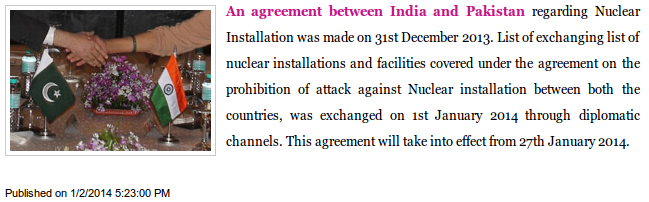
Breaking -India and Pakistan promise not to nuke each others nukes when they get angry!
http://www.sakshieducation.com/%28S%282yvntu45qvv0tpjnqik3bwnp%29%29/Story.aspx?nid=64645
A Japanese Director Takes on the ‘Nuclear Lobby’
Japanese film director Takafumi Ota needed financing for a film that was critical of the Japanese nuclear industry but found no one was interested in funding his project so he turned to the general public.

See link for video
http://www.wusa9.com/video/3001057539001/A-Japanese-Director-Takes-on-the-Nuclear-Lobby
SCRIPT: This Japanese film almost never saw the light of day. “The House of the Rising Sun” tells the story of a family torn apart by a nuclear disaster. A subject so sensitive in Japan that the director found it impossible to finance his project through conventional means. But the groundswell of anti-nuclear feeling following the Fukushima disaster persuaded Takafumi Ota to turn to the public. He raised 100,000 dollars through crowd-sourcing – and the film’s now being screened in independent cinemas.
SOUNDBITE 1 – Takafumi Ota (man), Director of “The house of the rising sun” (Japanese, 16 sec): “The media talks less and less about the problem of nuclear refugees. I asked myself what I could do as a director. I decided to make a film to voice the message that newspapers and televisions don’t.” Three years after the Fukushima disaster and the anti-nuclear demonstrations are waning. The Japanese media barely give them any airtime – even if surveys show most people are still against the industry.
SOUNDBITE 2 -Kazuo (woman), Demonstrator (Japanese, 14 sec): “Japanese people have a tendency to be quite passive. And it’s such a tough fight that many have given up. But we have to keep going!” The pro-nuclear lobby is an impressive foe, whose reach spans many sectors .
SOUNDBITE 3 – Professor Jeff Kingston (man), Temple University (English, 39 sec): “Japanese companies sit at the nexus of the global nuclear industry. Toshiba, Hitachi, Mitsubishi. They are part of what Japan calls the nuclear village. Pronuclear advocates in industry, finance, in politics, in academia, in mass media, bureaucracy. These people control the commanding heights of national energy policy and they are not prepared to let the public decide something that important.” Despite the lobby’s power, the government still hasn’t restarted the country’s 50 nuclear reactors, taken offline for safety checks. Japan is one of the only countries in the world to have completely shut down its nuclear energy industry, but many expect it’ll rise up again before too long.
Japan director turns to crowdfunding for anti-nuclear film / Tokyo (Japan) – 30 November 2013 11:19 – AFP / FEATURE Japanese film director Takafumi Ota had a problem. He needed studio financing for a film that was harshly critical of the nuclear industry in the aftermath of Fukushima, but no one was interested in funding his project the traditional way. Large sections of Japan’s movie industry wanted nothing to do with it, and he was told that influential sponsors did not want to be associated with anything that criticised the powerful atomic sector. “It wasn’t only major film distribution companies but also DVD companies — who usually get interested in investing in films to share copyright — who showed no interest in my plan,” said the 52-year-old Ota, whose previous work includes the critically acclaimed 2006 film “Strawberry fields”, which screened at the Cannes International Film Festival. “A senior film director told me ‘Don’t do this. You’ll never be able to make commercial films.'” With few options to make the film, but a groundswell of anti-nuclear feeling in post-Fukushima Japan, Ota turned to the public to make his film in another example of how crowdfunding is changing the face of traditional financing.
The practice sees individuals or firms raise micro-donations from small investors over the Internet. While still small, the market has been booming, with companies such as the pioneering KickStarter offering donation-based funding for creative projects. Globally, the crowdfunding market grew 81 percent last year and was on track to raise $5.1 billion in 2013, with investments in everything from business startups and philanthropic projects to films and music, according to research firm Massolution.
Photographing Hiroshima, Fukushima and Everything in Between By HIROYUKI ITO
“Are you asking the 92-year-old grandfather to keep fighting? That’s impossible,” he said. “While I was in Fukushima, I couldn’t walk for long, I fell and couldn’t stand up by myself. How can I photograph with such a frail body?”
But without missing a beat he asked me a final question.
“By the way, do you happen to know a good tiny point-and-shoot camera?”
Hiroyuki Ito Kikujiro Fukushima in Yanai, Yamaguchi, Japan. Dec. 2, 2013.

Kikujiro Fukushima’s life in photography took off when he promised to avenge the Hiroshima bombing. It was 1952, and Mr. Fukushima — a watchmaker, volunteer social worker and photographer — met Sugimatsu Nakamura, a 43-year-old fisherman, who was gravely ill from the atomic bomb’s effects.
“For the first two years I was too timid to photograph him,” Mr. Fukushima told me a few weeks ago. “But one day, he got on his knees, crying, and begged me.”
“Fukushima, can you please take revenge on the atomic bomb?”
“Yes, but how?”
“Take pictures of my pain and let the world know how terrible it is.”
Mr. Nakamura was not only angry about the bombing, but also with the Japanese government, which refused to provide proper care for its victims. Mr. Fukushima understood this well — he had been in the Japanese military, stationed in Hiroshima until one week before the bombing, when he was transferred to prepare for a suicide mission. Most of his comrades who stayed behind were killed.
Mr. Nakamura died in 1967, but the documentary filmmaker Saburo Hasegawa believes that the vow Mr. Fukushima made to the ailing fisherman guided his subsequent career, in which he photographed individuals fighting social injustice. During the social upheaval of the 1960s and ’70s, Mr. Fukushima photographed student and feminist movements, antiwar protests and industrial pollution. He even infiltrated Japan’s Self-Defense Forces by telling the head of public affairs that he would gladly give it free pictures if it gave him access.
He had other plans.
“If the government or corporations knowingly deceived the public by breaking the law, it’s O.K. for photographers to break the law in order to uncover the truth they are hiding,” Mr. Fukushima explained in “Japan Lies,” the documentary Mr. Hasegawa made about him.
For three years, he photographed the Navy, Army and military academy, giving them photographs to use for publicity. All the while, he was photographing military secrets, like machine guns and missiles made inside factories. Without permission, he published the exposé, “A Farewell to Arms,” in a magazine. Soon after its publication, he was punched and kicked by a stranger who was lurking outside his house in Tokyo. A few weeks later, another stranger slashed his face. An arsonist torched his house while he was away, but his daughter Noriko carried his negatives to safety.
This was not the first time Mr. Fukushima’s photography took a personal toll. The decade he spent photographing Mr. Nakamura overwhelmed him and led to a nervous breakdown that put him in an asylum for three months. In 1960, he divorced his wife and moved to Tokyo to become a professional photojournalist.
 Photographer Unknown Kikujiro Fukushima, the 20-year-old imperialist. He said that when he was young, he and his classmates were led to believe that killing as many enemies and dying for the emperor was the highest honor.
He worked mostly on personal projects, telling me that he was never a good photographer on assignment.
“Professional photographers go to newsy events, take beautiful pictures, publish nice spreads in magazines and move on,” he said. “I was very slow and shy. But once I throw myself into something, nobody could get me out of it. I simply get deeper and deeper. As a result, I ended up with the pictures nobody has.”
But when the Japanese economy prospered in 1980s and people willed themselves to forget the hard times of the postwar years, Mr. Fukushima’s politically charged photographs fell out of fashion. Instead, he designed jewelry to pay the bills. This was not too far from his roots: after the war — then married and with three children — he supported his family as a watchmaker. That was how he ended up in Hiroshima, which he visited several times a month to buy parts.
He first photographed the city’s ruins in 1946, after reading a newspaper article about how grass had begun to grow on the spot where the bomb was dropped. While also working as a volunteer social worker, he photographed orphans, widows and the elderly who were left alone after the bombing, giving the pictures to local authorities so they could raise money to help them.
BRIEF-Fortum says equipment renewal to boost Loviisa nuclear plant capacity
HELSINKI
http://www.reuters.com/article/2014/01/02/fortumoyj-results-idUSWEB00GBP20140102
Jan 2 (Reuters) – Fortum Oyj : * Loviisa nuclear power plant produced 8.04 terawatt hours of electricity in 2013. * Estimates renewal of turbines and reheaters to increase production
capacity by 29 MW (Reporting by Helsinki Newsroom)
Determination of radioactive cesium isotope ratios by triple quadrupole ICP-MS and its application to rainwater following the Fukushima Daiichi Nuclear Power Plant accident
DOI: 10.1039/C3JA50291K
Received 10 Sep 2013, Accepted 10 Dec 2013
First published online 02 Jan 2014

Study: Dead sea creatures cover 98 percent of ocean floor off California coast; up from 1 percent before Fukushima
Though the most significant increases were observed roughly a year after the incident, the study makes mention of the fact that the problems first began in 2011.
Thursday, January 02, 2014 by: Ethan A. Huff, staff writer
The global menace of uranium
Uranium – the ‘demon metal’ that threatens us all, Ecologist, Chris Busby, 1st January 2014 Ingested Uranium is linked with health impacts far greater than is explained by orthodox risk models. Chris Busby explains how the ‘demon metal’ does its damage – and why the nuclear industry is desperate to hide the truth. I am going to ramble about a bit here, but it’s a bit of a rambling tale, which I hope will come together at the end………
Fallujah – shake, bake, irradiate In 2009 I helped organize the first study of cancer and infant mortality in Fallujah Iraq – a paper which has now had 27,000 accesses and 18,000 downloads from the journal website and has been something of a phenomenon in the media (though not of course the BBC).
 The results showed an enormous increase in cancer, and this was most clear for in children (0-14) where the rate was 12.6 times the expected and in leukemia in young adults 0-34 where the rate was 38 times the expected.
Now these are pretty astonishing findings. The biggest leukemia increase in Hiroshima was about 17-fold, and this was ascribed to radiation exposures. But whatever caused this in Fallujah, also increased rates of congenital defects in the newborn and altered the sex ratio at birth.
 The sex ratio, the number of boys born per 1000 girls, fell from 1050 to about 800, a signal of genetic damage. We looked for the cause of this genetic damage in the hair of the mothers of the birth defect children and found a huge excess of Uranium. This result also caused a splash, with 16,000 accesses to the paper since its publication in 2011.
 Uranium weapons cause genetic damage Of course, these Fallujah studies just confirmed what the Iraqi doctors had been saying ever since Gulf War 1 when the US vapourised about 350 tons of the stuff over the Iraqi population. Uranium weapons were causing the genetic damage.
There were reports of similar effects in the Balkans and in Gulf war veterans and their children. Discussion can be found in these papers and the third one, where the congenital malformation rates are calculated.
The UK Gulf veterans are now in their 40s and are beginning to develop cancer. There are studies showing that US veterans have had children with birth defects. I have been involved in a number of Gulf war cancer cases in Ministry of Defence Pensions appeals, and notably in a coroner inquest in 2009 into the death of Gulf Veteran Stuart Dyson.
He died from colon cancer at the young age (for that disease) of 40, and the jury concluded that his cancer was caused by Depleted Uranium exposure, a finding that caused severe headaches for the Secretary of State for Defence.
 Bomb test veterans It is not only the Gulf veterans that were exposed to Uranium. The atmospheric nuclear tests involved huge bombs that were constructed entirely of Uranium.
The UK Grapple Y 3 megaton test on Christmas Island in 1958 (video here ~ 1 minute) involved a 4 ton lump of the stuff that was atomized by the explosion and created a black rain of Uranium oxide nanoparticles that fell from the sky (along with fish that had been sucked from the sea into the cloud).
The nuclear test veterans have suffered all the same effects: cancers and a whole range of health problems. And birth defects in the children. I know about the birth defects as a result of an epidemiological study I carried out with Mireille de Messieres in 2007. This showed a 9-fold excess risk of a congenital defect in the children and an 8- fold excess in the grandchildren.
And I know about the Uranium in the bombs and the black rain as it is evidence in the case I am currently fighting in the Royal Courts of Justice in a nuclear test veteran Pensions Appeal……..http://www.theecologist.org/News/news_analysis/2205213/uranium_the_demon_metal_that_threatens_us_all.html
A number of earthquakes near Fukushima prefecture
9 quakes hit same area near Fukushima border in past few hours — New island along ‘Ring of Fire’ south of Tokyo now over 15 times initial size in a month — Professor: “Massive volcanic eruption… We should pay close attention” (VIDEOS) http://enenews.com/9-quakes-hit-same-area-near-fukushima-border-in-past-few-hours-new-island-along-ring-of-fire-south-of-tokyo-now-15-times-larger-than-last-month-professor-massive-volcanic-eruption-we-s
Japan Meteorological Agency, Jan. 1, 2014:
02:35 JST 01 Jan 2014 Ibaraki-ken Hokubu M3.0 1
17:18 JST 31 Dec 2013 Ibaraki-ken Hokubu M3.4 2
15:17 JST 31 Dec 2013 Ibaraki-ken Hokubu M2.9 1
13:23 JST 31 Dec 2013 Ibaraki-ken Hokubu M2.7 1
11:37 JST 31 Dec 2013 Ibaraki-ken Hokubu M3.4 2
10:58 JST 31 Dec 2013 Ibaraki-ken Hokubu M3.3 2
10:22 JST 31 Dec 2013 Ibaraki-ken Hokubu M2.8 1
10:08 JST 31 Dec 2013 Ibaraki-ken Hokubu M3.6 2
10:03 JST 31 Dec 2013 Ibaraki-ken Hokubu M5.4 5-
NBC Dec. 26, 2013: Video over 2 islands in the seas south of Tokyo where lava from a volcano made 2 islands 1. […] It’s part of the Pacific ring of fire. >> Watch the broadcast here
NHK, , Dec. 20, 2013: Professor Kenji Nogami, Tokyo Institute of Technology: […] says more lava may have been drawn up than in other massive volcanic eruptions in the past in Japan. “The volcanic activity on the new island has been considerable. I assume that magma has been rising to the surface for a month now. We should pay close attention to the volcano and its eruptions.” >> Watch the broadcast hereAerial footage of the eruption filmed Thursday here
USA REPUBLICAN group leading the push for clean renewable energy
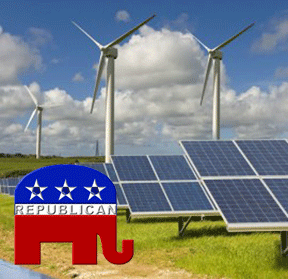 Conservatives Form Group Favoring Renewable Energy http://detroit.cbslocal.com/2014/01/01/conservatives-form-group-favoring-renewable-energy/January 1, 2014 LANSING (AP) – Conservative leaders and activists in Michigan have formed a group to support basing energy policy on the use of renewable resources and energy-efficiency programs.
The recent launch of the Michigan Conservative Energy Forum comes as Gov. Rick Snyder and legislators consider updating Michigan’s electricity law in 2014 or 2015.
Group executive director Larry Ward says the organization supports an “all-of-the-above” energy policy. He says it’s time for Republicans to lead on energy policy.
Michigan law sets a 10 percent renewable power standard that must be met by the end of 2015. A recent report to Snyder says 15 percent renewable electricity in 2020 and 30 percent in 2035 are achievable.
The forum says Michigan gets more than half its electricity from other states’ coal.
Japan relying on criminal gangs to save the situation at Fukushima
Mystery of steam rising from Fukushima nuclear reactor No 3
Mystery Steam Over Fukushima Could Be Sign Of Another Meltdown http://www.gizmodo.com.au/2014/01/radioactive-mystery-steam-over-fukushima-could-mean-another-meltdown/ ASHLEY FEINBERG 2 Jan 14, The newest update in the highly disconcerting series of devastating failures that is the Fukushima cleanup effort is troubling to say the least. Tepco has confirmed that (unexplained) plumes of steam have been rising from the mangled remains of Reactor Building 3. In other words, there’s a chance Fukushima could be in the middle of another meltdown.
The thing is no one has been able to find out the exact cause of the rising, mysterious radioactive steam because the combination of physical damage and, more importantly, lethal radiation levels have made investigating the reactor impossible. Tepco has known that a followup meltdown was a severe possibility though. The Reactor 3 fuel storage pond is still home to about 80 tonnes of plutonium-based mixed-oxide fuel according to the The Ecologist, and should that fuel storage pond dry out, the highly radioactive rods will melt down with devastating results.
Still, there are two other slightly less severe possibilities outlined by The Ecologist. First, the molten fuel could have burnt its way through the base and into the soil below, producing steam as it comes into contact with groundwater (while simultaneously releasing radioactive contaminants into the ocean). Second, reactor rod fragments could have come into contact with rainwater, producing extreme amounts of heat and, consequently, steam. As The Ecologist notes, “Of the three choices this is probably the least serious.”
While some of the possible outcomes might be better than others, nothing we’re facing is exactly ideal. But of course, that seems to be the recurring theme for Tepco’s efforts at containing the Fukushima disaster. Why change now. [Tepco viaThe Ecologist via Fark]
1 This Month

of the week – Shut Down Drone Warfare!


Tell the Ukrainian Government to Drop Prosecution of Peace Activist Yurii Sheliazhenko

Petition to revoke the licensing of the Near Surface Nuclear Disposal Facility (NSDF) at Chalk River. https://www.ourcommons.ca/petitions/en/Petition/Details?Petition=e-7247
To see nuclear-related stories in greater depth and intensity – go to https://nuclearinformation.wordpress.com
-
Archives
- April 2026 (103)
- March 2026 (251)
- February 2026 (268)
- January 2026 (308)
- December 2025 (358)
- November 2025 (359)
- October 2025 (376)
- September 2025 (257)
- August 2025 (319)
- July 2025 (230)
- June 2025 (348)
- May 2025 (261)
-
Categories
- 1
- 1 NUCLEAR ISSUES
- business and costs
- climate change
- culture and arts
- ENERGY
- environment
- health
- history
- indigenous issues
- Legal
- marketing of nuclear
- media
- opposition to nuclear
- PERSONAL STORIES
- politics
- politics international
- Religion and ethics
- safety
- secrets,lies and civil liberties
- spinbuster
- technology
- Uranium
- wastes
- weapons and war
- Women
- 2 WORLD
- ACTION
- AFRICA
- Atrocities
- AUSTRALIA
- Christina's notes
- Christina's themes
- culture and arts
- Events
- Fuk 2022
- Fuk 2023
- Fukushima 2017
- Fukushima 2018
- fukushima 2019
- Fukushima 2020
- Fukushima 2021
- general
- global warming
- Humour (God we need it)
- Nuclear
- RARE EARTHS
- Reference
- resources – print
- Resources -audiovicual
- Weekly Newsletter
- World
- World Nuclear
- YouTube
-
RSS
Entries RSS
Comments RSS
 nuclear-news