It looks as if the nuclear lobby’s trolls have a grip on Reddit
The /Energy subreddit isn’t the only one where the prejudice seems to be widespread. I’ve noticed it on the /Technology subreddit (to a lesser extent), and elsewhere.
 Why Are So Many Redditors Obsessed With Uncompetitive Nuclear Energy? http://cleantechnica.com/2013/12/27/many-redditors-obsessed-uncompetitive-nuclear-energy/ 27 Dec 13
I’m not a big reddit user, but I like the site and find it quite useful at times. Of course, reddit is humongous and the users span the social spectrum. Furthermore, there are hundreds if not thousands of subreddits, each with their own unique subculture. However, time and time again, I see a highly unrepresentative sample of nuclear enthusiasts over there, or in the comments of our posts when someone submits one of our stories to reddit and it does quite well there.
Nuclear supporters are far outnumbered by solar power supporters amongst the general population. Within the overall energy world, the general consensus is that solar power will grow tremendously around the world; nuclear power… not so much. Yet, on the /Energy subreddit, a popular solar or wind power story is sure to get swarmed by nuclear enthusiasts. Actually, it’s rare to even see a solar or wind story do well there despite the massive growth of these industries around the world. Renewable energy stories submitted there have a history of being immediately downvoted by redditors who simply don’t want to hear any positive news about renewable energy. Continue reading
USA’s nuclear weapons cost is $355 billion, not the planned $214 billion!
 Obama Administration Underestimated Cost of Maintaining Nuclear Weapons by $140 Billion, AllGov, 27 Dec 13 Defense officials in the Obama administration were more than a little off when they told Congress the cost of maintaining the nation’s nuclear weapons arsenal over the next 10 years.
They missed the mark by at least $140 billion.
Two years ago, the Pentagon informed lawmakers that they would need to allocate $214 billion over the coming decade to operate and upgrade the stockpile of nuclear warheads and delivery systems.
But the Congressional Budget Office (CBO) looked at the Defense Department’s future plans and found that nuclear weapons-related costs were more likely to reach $355 billion by 2023.
That’s 66% higher than the 2011 estimate.
The $355 billion includes $136 billion to modernize and operate submarines, bombers and missiles that deliver warheads, $105 billion to run weapons labs, weapons and naval reactors, $56 billion for command and control systems, and $59 billion for unforeseen technical problems or mismanagement.
And that’s just the direct costs related to the nuclear arsenal.
CBO officials point out there are other, very costly programs that exist because of the nuclear weapons program, such as cleaning up shuttered nuclear fuel facilities or the nation’s missile defense systems for shooting down other nation’s nuclear missiles.
These other costs will likely cost the government another $215 billion over the next decade…..http://www.allgov.com/news/where-is-the-money-going/obama-administration-underestimated-cost-of-maintaining-nuclear-weapons-by-140-billion-dollars?news=852020
Iran to seek direct nuclear talks with USA?

 Advisor to Iran supreme leader urges direct nuclear talks with U.S. LA Times, By Ramin Mostaghim and Carol J. Williams December 27, 2013, TEHRAN — The chief foreign policy advisor to Iran’s Ayatollah Ali Khamenei has called for direct talks with the United States on nuclear issues, a possible sign from the supreme leader that he is amenable to ending the animosity that has defined relations with Washington for 34 years.
Iranian President Hassan Rouhani has been the target of fierce criticism by political and religious hard-liners since he helped broker a deal with the United States and five other Western powers last month that will put Iranian high-level enrichment of uranium on hold for at least six months…….
The next round of talks between Iran and the six powers is to begin Monday in Geneva, and Velayati’s appeal for addressing each nation’s particular concerns individually could clear away obstacles to a permanent agreement imposed by some of the ideologically diverse P5-plus-1 members. http://www.latimes.com/world/worldnow/la-fg-wn-iran-us-nuclear-talks-20131227,0,592216.story#ixzz2onYWZ5xt
Uranium mining in Tanzania to destroy environment, health and tourism
poaching, which has been rampant in the Selous and government is doing little to stop it because word has it senior people are benefiting from the trade in blood ivory……
So perhaps, cynical as we know them to be, they let the reserve be poached empty and then shrug and tell us that is is no longer suitable for tourism and did they not always say mining is the future for the country?
No one will dare to really expose the dangers of uranium mining to the Tanzanian public and so most people will only get the uptalk of government and not the downside of the environmental fallout’.
Tanzania conservationists reject uranium mining approvals BY PROF. DR. WOLFGANG H. THOME, ETN AFRICA CORRESPONDENT | DEC 27, 2013 Reactions to media reports in Tanzania, publishing details of approvals for uranium mining given by the country’s Atomic Energy Commission, were swift and harsh, and predicatably given on condition of anonymity, no wonder considering Tanzania’s record of often brutal suppression of dissent, especially when big commercial interests are at stake……
Uranium mining in the Selous has led to world wide protests and led to the government putting a mechanism into place to carve out over 200 square kilometres of the Selous territory to evade sanctions by UNESCO, which had made the Selous Game Reserve a World Heritage Site – for the Tanzanian government not an issue it seems as they habitually ignore that status in favour of ‘development’ Continue reading
5,000 children at grave risk of cancer from Fukushima radiation
Impact of Fukushima radiation disaster: 5,000 kids could be diagnosed with cancer – scientist http://voiceofrussia.com/2013_12_26/Impact-of-Fukushima-radiation-disaster-5-000-kids-could-be-diagnosed-with-cancer-scientist-1163/ Slowly, the world is waking up to the realities of Japan’s nuclear catastrophe: this disaster is real. USS Reagan and Fukushima cancer levels are miles above comparative levels. Anna Sablina, cancer researcher, Assistant Professor of the University of Leuven and group leader of Flanders Institute of Biotechnology, discussed the impact of Fukushima disaster in an interview with the VoR. Continue reading
UK’s Hinkley nuclear reactor design failed the Generic Design Assessment

 Hinkley C: the Generic Design Assessment has failed Ecologist, Peter Lux 26th December 2013 The safety assessment for the Hinkley C reactor design has failed, reports Peter Lux. Faced with 724 unresolved concerns about the EPR design, the UK regulator went ahead and issued the licence anyway.The Generic Design Assessment (GDA) is a process which was set up in order to examine the designs for new power stations and iron out any flaws in them before the power stations are constructed. Continue reading
USA’s 70,000 metric tons of radioactive trash

they sould stop making the stuff!
Highly reactive nuclear waste seeks permanent home ORANGE COUNTY REGISTER, December 27th, 2013, By TERI SFORZA “………; two things happened last month that give hope to those who want Yucca to open for business: The U.S. Nuclear Regulatory Commission ordered its staff to finish a safety evaluation report for Yucca Mountain, and it will spend $11 million from the Nuclear Waste Fund to do it, and, a federal appeals court told the government to quit collecting $750 million a year from consumers for said Nuclear Waste Fund, since, you know, the federal government has failed to permanently dispose of a single gram of nuclear waste for more than 50 years.
This all comes as the city of San Clemente officially implores the federal government to create some sort of safe repository for nuclear waste, and to give first priority to the stuff stored at San Onofre Nuclear Generating Station because of our area’s “unique circumstances” (read: vulnerability to earthquakes and dense population).
“I’ll take any sign of forward momentum on Yucca Mountain as positive, including this one,” said San Clemente City Councilwoman Lori Donchak by email shortly after the news broke. “The immediate need is for a safety-evaluation report to see if the site can do its job. It’s not clear that the money available is enough to get that done and unfortunately no indicators that renewed funding is in the works in Washington…..
the importance of some sort of answer to the nation’s acute nuclear-waste-disposal-question grows more pressing every day: Some 70,000 metric tons of the poisonous stuff have piled up in pools and dry casks all across America, and more than 116 million people live within the 10-mile evacuation zone around the nuclear power plants that have created it.
That’s more than one of every three people in the United States.
And the financial cost of paralysis is high: About 80 lawsuits have been filed against the feds over broken promises to start accepting spent nuclear fuel by 1998, theDepartment of Energy had paid out $2.6 billion in damages to utility companies as of 2012, and it faces another $19.7 billion in liabilities through 2020, according to the General Accounting Office……
Possible Nazi nuclear research done in underground tunnels
 Nazi nuclear bomb project may have taken place in 15 miles of tunnels beneath concentration camp http://www.mirror.co.uk/news/world-news/nazi-nuclear-bomb-project-taken-2965371 28 Dec13, by Allan Hall Readings at the site of the Gusen camp at Mauthausen, northern Austria, show raised levels of uranium – hinting at underground explosions 70 years ago
A network of secret tunnels beneath a former concentration camp is to be explored for evidence that Nazi scientists were working on a nuclear bomb.
The probe was triggered by a TV documentary featuring blueprints and witness accounts of efforts to create the first A-bomb.
Fifteen miles of tunnels lie under the site of the Gusen camp at Mauthausen, northern Austria, and readings show raised levels of uranium – hinting at underground explosions 70 years ago.
Documentary maker Andreas Sulzer searched archives and found 272 inmates were taken from the camp to nearby St Georgen in January 1944 to start building secret galleries.
Japan – Freelance journalist sued over nuclear industry article

Minoru Tanaka, a 52-year-old Japanese freelancer who has written many investigative pieces about the nuclear power industry, is being sued for 67 million yen (600,000 euros) – an enormous sum he would never be able to pay – over a story that looked at the connections between nuclear industry figures, investors and politicians.
Published in the 16 December 2011 issue of the weekly Shukan Kinyobi and indiscreetly headlined “The last big fixer, Shiro Shirakawa, gets his share of the TEPCO nuclear cake,” the article tried to shed light on Japan’s opaque nuclear industrial complex, known as the “nuclear village,” and in particular, the activities of Shiro Shirakawa, the head of a company the provides security systems for power stations owned by the electricity utility TEPCO.
The article accused Shirakawa of taking advantage of his connections with key nuclear industry figures, including TEPCO’s former chairman, and politicians such as the parliamentarian Kamei Shizuka to obtain unjustified profits since the Fukushima Daiichi nuclear disaster in March 2011.
Most freelance and foreign journalists regard the libel suit that Shirakawa brought against Tanaka (but not against Shukan Kinyobi) as a bid to deter all journalists from doing investigative reporting about the nuclear industry and, in particular, about the way that the Fukushima Daiichi accident was handled.
When the Foreign Correspondents’ Club of Japan organized a news conference in Tokyo on 31 August 2012 to give Tanaka a chance to talk about the lawsuit, not a single journalist from Japan’s official Kisha press clubs attended. Freelancers are discriminated against in Japan and excluded from the Kisha clubs. As a result, Tanaka’s freelance status prevents him from receiving the support of his colleagues and increases his vulnerability.
Freelance and independent journalists such as Yu Terasawa, Michiyoshi Hatakeyama, Yuichi Sato and Ryuichi Hirokawa are often harassed over their nuclear industry reporting. Like TEPCO and the nuclear industry in general, the government seems to fear that coverage of the Fukushima aftermath and public discontent could result in their being blamed and lead to a national debate about energy issues in Japan.
Before a Tokyo court began hearing the lawsuit on 7 May 2012, Shirakawa sent Tanaka a letter warning that he would be rendered insolvent if the court rules against him. Several hearings have been heard since then and they are steadily wearing Tanaka down.
In Tanaka’s view, the case has all the hallmarks of what is often called a Strategic Lawsuit Against Public Participation (SLAPP) or “gag suit,” with a powerful plaintiff who has many political and business connections, on the one hand, and an isolated journalist, on the other.

The last big fixer, Shiro Shirakawa, gets his share of the TEPCO nuclear cake published in the 16 December 2011 issue of the weekly Shukan Kinyobi. Download the full article (pdf).
The Last Fixer
A mystery letter (怪文書) was distributed at the House of Representative Building 1 towards the end of May in 2011. It was titled, “WANTED: The Transporter of Nuclear Industry Bribes” and printed on A4 sized paper. Who the heck is the person it was written about? Under the headline of the mystery letter was a copy of the ID badge of the deceased 三塚博衆院議員(Mitsuka Hiroshi-LDP)’s personal secretary, in a collage. The person being criticized in the letter was a man called “The Last Big Fixer” aka Shirakawa Shiro.
“Ishihara Bank” also involved in huge loans
2013 nuclear spin failed: get ready for 2014 nuclear spin
In 2013 the pro nuclear spin was all about how “low dose” ionising radiation is OK – “don’t worry about it”. Despite the money spent propagating this lie, – it failed. Fukushima radiation is a greater worry than ever, along with all nuclear industry radiation, and overuse of medical radiation. In February 2013, the Symposium – Medical and Ecological Consequences of the Fukushima Nuclear Accident, at the New York Academy of Medicine. set the scientific facts clearly,and exposed the nuclear lobby’s lies.
In 2014 the spin is about “new generation” reactors, and how they will “fix climate change”. The opening salvo in this propaganda war is the glossy advertising film, Pandora’s Promise. You wouldn’t know, from this film, how divided and conflicted the nuclear lobby actually is. The “older style”Generation II reactors are still promoted, Gen’s III and IV (none built yet) are pushed as safer, while Small Modular (Nuclear) Reactors (SMRs) are touted as The Answer. None of them are affordable, but SMRs are the most wildly expensive.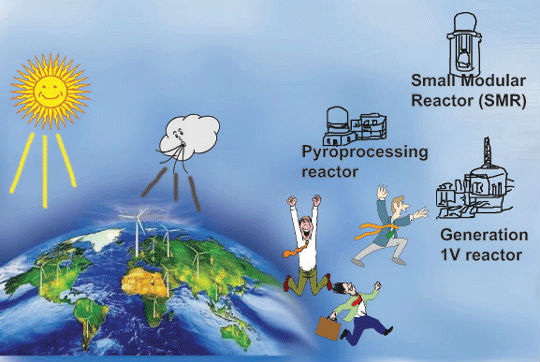
2014 will be all about global spin for tax-payers to buy these small, or large, nuclear white elephants. And yes, an accompanying spin will be the continued attack on renewable energy. Well – it is free fuel – an intolerable idea! As Dr Helen Caldicott said long ago – “If they could put a blanket around the sun and sell holes, they’d be happy”.
1 This Month


Tell the Ukrainian Government to Drop Prosecution of Peace Activist Yurii Sheliazhenko

Petition to revoke the licensing of the Near Surface Nuclear Disposal Facility (NSDF) at Chalk River. https://www.ourcommons.ca/petitions/en/Petition/Details?Petition=e-7247


of the week – STOP SMALL MODULAR REACTORS IN CANADA
To see nuclear-related stories in greater depth and intensity – go to https://nuclearinformation.wordpress.com
-
Archives
- March 2026 (193)
- February 2026 (268)
- January 2026 (308)
- December 2025 (358)
- November 2025 (359)
- October 2025 (376)
- September 2025 (258)
- August 2025 (319)
- July 2025 (230)
- June 2025 (348)
- May 2025 (261)
- April 2025 (305)
-
Categories
- 1
- 1 NUCLEAR ISSUES
- business and costs
- climate change
- culture and arts
- ENERGY
- environment
- health
- history
- indigenous issues
- Legal
- marketing of nuclear
- media
- opposition to nuclear
- PERSONAL STORIES
- politics
- politics international
- Religion and ethics
- safety
- secrets,lies and civil liberties
- spinbuster
- technology
- Uranium
- wastes
- weapons and war
- Women
- 2 WORLD
- ACTION
- AFRICA
- Atrocities
- AUSTRALIA
- Christina's notes
- Christina's themes
- culture and arts
- Events
- Fuk 2022
- Fuk 2023
- Fukushima 2017
- Fukushima 2018
- fukushima 2019
- Fukushima 2020
- Fukushima 2021
- general
- global warming
- Humour (God we need it)
- Nuclear
- RARE EARTHS
- Reference
- resources – print
- Resources -audiovicual
- Weekly Newsletter
- World
- World Nuclear
- YouTube
-
RSS
Entries RSS
Comments RSS
 nuclear-news