Surge in cancers among young in Fukushima, but experts divided on cause
… but it remained to be proven that the radioactive iodine came from the nuclear disaster instead of the normal environment…
Monday, 23 December, 2013
Fifty-nine young people in Fukushima prefecture have been diagnosed with or are suspected of having thyroid cancer, but experts are divided about whether their illness is caused by nuclear radiation.
All of them were younger than 18 at the time of the nuclear meltdown in the area in March 2011. They were identified in tests by the prefectural government, which covered 239,000 people by the end of September.
At a meeting hosted by Japan’s Environmental Ministry and the prefectural government on Saturday, most experts were not convinced radiation leaks from the Fukushima nuclear plant could trigger thyroid cancer in children so soon, the Asahi Shimbun reported yesterday.
Among those who voiced alarm was Toshihide Tsuda, a professor of epidemiology at Okayama University. He called upon the government to prepare for a possible increase in cases in the future.
“The rate at which children in Fukushima prefecture have developed thyroid cancer can be called frequent, because it is several times to several tens of times higher,” the newspaper quoted him as saying.
He compared the figures in Fukushima with cancer registration statistics throughout Japan from 1975 to 2008 that showed an annual average of five to 11 people in their late teens to early 20s developing cancer for every 1 million people.
Tetsuya Ohira, a professor of epidemiology at Fukushima Medical University, disagreed. It was not scientific to compare the Fukushima tests with cancer registry statistics, he argued.
In November, prefectural officials deemed it unlikely that the increase in suspected and confirmed cases of cancer was linked to radiation exposure.
In the Chernobyl disaster of 1986, it was not until four or five years after the accident that thyroid cancer cases surged.
“It is known that radioactive iodine is linked to thyroid cancer. Through the intake of food, people may absorb and accumulate it inside glands,” said Dr Choi Kin, a former president of the Hong Kong Medical Association.
Why you shouldn’t care if the IAEA praises Fukushima decommissioning efforts

On Friday the International Atomic Energy Agency (IAEA) sent a cohort to the destroyed Fukushima nuclear plant, and headlines trumpeted what seemed to be the first good news emerging from the smoldering wreck since the crisis began: praise for the decommissioning efforts.
But everyone missed the big question: When it comes to issues of nuclear safety, who cares what the IAEA has to say?
It’s about as disingenuous as hearing Smith & Wesson argue that gun manufacturing is inherently safe because none of the assault weapons used in (insert the last American school-yard massacre or shopping mall shoot-out) jammed or misfired.
The IAEA is the world’s biggest pro-bono shill operation for the nuclear industry. It is no more in the business of protecting the public from radiation and reactor meltdowns than the Missouri Bullet Company is in the business of protecting innocent bystanders from a drive-by shooting.
On the contrary, the IAEA has a vested PR interest in standing behind the mistakes, lies, venality, and incompetence ground out by Fukushima’s operator, the Tokyo Electric Power Co (Tepco), something that plays well with the passage of Japan’s new official secrecy laws.
The IAEA’s praise that “Japan has achieved good progress in improving its strategy and in allocating necessary resources to conduct a safe decommissioning of the Fukushima nuclear power station” did come with some predictable caveats that the situation remains “complex” and that there are “very challenging issues that must be solved for the plant’s long-term stability,” as Juan Carlos Lentijo, leader of the IAEA team, was quoted as saying by the BBC and everyone else.
But the issue remains that the IAEA is, despite popular opinion, and by its own adminssion, one of the least qualified organizations in the world to ensure nuclear power plant safety, and, thus, to draw any conclusions about the progress that Tepco is making toward safely decommissioning Fukushima.
The perception of the IAEA, and its affiliations with the United Nations, is that of the world’s nuclear regulator, the biggest stick on the block, created with the intention of keeping errant nuclear power operators in line.
The IAEA is not here for your safety
IAEA Director General and Japanese national Yukiya Amano – in the direct aftermath of the triple meltdown at Fukushima, occasioned by March 11, 2011’s 11-meter tsunami and 9.0 magnitude earthquake – immediately laid that perception to rest.
“Since the accident, I have tried to address some widespread misconceptions in the media about the IAEA’s role in nuclear safety,” he told his anxious countrymen 10 days after the catastrophe.
“I explained that we are not a ‘nuclear safety watchdog’ and that responsibility for nuclear safety lies with our Member States,” Amano said. And aside from sending a few expert contingents to review progress on cleaning up the world’s most impossible mess, Amano has stuck to his guns.
That’s a tough line for Amano to toe when over 200,00 people from his native country are on the run from radioactive fallout in Fukushima, and another 15,000 lie dead as a result of the tsunami and earthquake.
But given the statutes of the IAEA, it’s also a fair enough dose of tough love to dole out.
The statutes, adopted in New York on October 26, 1956, clearly define the mandate of the IAEA as the world’s official cheerleader for nuclear power.
According to the statutes: “The Agency shall seek to accelerate and enlarge the contribution of atomic energy to peace, health and prosperity throughout the world.”
So, what credibility does the IAEA have to say anything about “progress” in the decommissioning process at Fukushima?
Costs and Consequences of the Fukushima Daiichi Disaster
….Most have received only a small compensation to cover their costs of living as evacuees. Many are forced to make mortgage payments on the homes they left inside the exclusion zones. They have not been told that their homes will never again be habitable…
22 December 2013
The destruction of the Fukushima Daiichi nuclear power plant in March 2011, caused by an earthquake and subsequent tsunami, resulted in massive radioactive contamination of the Japanese mainland. In November 2011, the Japanese Science Ministry reported that long-lived radioactive cesium had contaminated 11,580 square miles (30,000 sq km) of the land surface of Japan.[i] Some 4,500 square miles – an area almost the size of Connecticut – was found to have radiation levels that exceeded Japan’s allowable exposure rate of 1 mSV (millisievert) per year.
About a month after the disaster, on April 19, 2011, Japan chose to drastically increase its official “safe” radiation exposure levels[ii] from 1 mSv to 20 mSv per year – 20 times higher than the US exposure limit. This allowed the Japanese government to downplay the dangers of the fallout and avoid evacuation of many badly contaminated areas.
However, all of the land within 12 miles (20 km) of the destroyed nuclear power plant, encompassing an area of about 230 square miles (600 sq km), and an additional 80 square miles (200 sq km) located northwest of the plant, were declared too radioactive for human habitation.[iii] All persons living in these areas were evacuated and the regions were declared to be permanent “exclusion” zones.
The precise value of the abandoned cities, towns, agricultural lands, businesses, homes and property located within the roughly 310 sq miles (800 sq km) of the exclusion zones has not been established.
Estimates of the total economic loss range from $250[iv]-$500[v] billion US. As for the human costs, in September 2012, Fukushima officials stated that 159,128 people had been evicted from the exclusion zones, losing their homes and virtually all their possessions.
Most have received only a small compensation to cover their costs of living as evacuees. Many are forced to make mortgage payments on the homes they left inside the exclusion zones. They have not been told that their homes will never again be habitable.
More psr.org
U.S. nuclear weapon plans to cost $355 billion over a decade: CBO report
….He said while it is true U.S. nuclear forces require some modernization, the current size of the U.S. arsenal is a Cold War holdover “that is increasingly irrelevant to today’s security threats, costs billions of dollars to maintain and sucks funding from higher priority programs.”The Union of Concerned Scientists said in a report in October that some of administration’s plans to modernize the weapons were misguided and violated the spirit of its pledge not to develop new nuclear arms…..
Sunday 22 December 2013
(Reporting by David Alexander; Editing by Leslie Adler)
(Reuters) – The Obama administration’s plans for the U.S. nuclear weapons complex, including modernization of bombs, delivery systems and laboratories, will cost the country about $355 billion over the next decade, the Congressional Budget Office said on Friday.
That is nearly $150 billion more than administration’s $208.5 billion estimate in a report to Congress last year, an analyst at an arms control group said, and since the modernization effort is just beginning, costs are expected to greatly increase after 2023.
The budget office said President Barack Obama had requested $23.1 billion for U.S. nuclear forces in the 2014 fiscal year, including $18 billion to maintain the weapons and supporting laboratories as well as the submarines, bombers and missiles to deliver the weapons.
In the decade to 2013, the administration’s plans to modernize and maintain submarines, bombers and missiles will cost about $136 billion, the CBO said in a 25-page report.
Weapons labs, weapons and naval reactors will cost $105 billion, and the United States will spend another $56 billion on command and control systems. Adding expected cost growth of $59 billion raises the total to $355 billion over a decade.
The estimates come as the United States is at the start of what Air Force General Robert Kehler, the head of U.S. Strategic Command, has called a “multi-decade effort to recapitalize our nuclear deterrent force and its supporting infrastructure.”
In addition to modernizing 1970s-era weapons, in some case replacing 1960s-model vacuum tubes with current-day electronics, the Pentagon will soon need to replace much of the triad of delivery systems, including a new class of ballistic missile submarines and a new type of long-range bomber.
U.S. nuclear missiles are a force in much distress
December 22, 2013
WASHINGTON — The hundreds of nuclear missiles that have stood war-ready for decades in underground silos along remote stretches of America, silent and unseen, packed with almost unimaginable destructive power, are a force in distress, if not in decline.
The number of intercontinental ballistic missiles is dwindling, their future defense role is in doubt, and missteps and leadership lapses this year have raised questions about how the force is managed.
One missile officer lamented about “rot” inside the force, and an independent assessment for the Air Force found signs of “burnout” among missile launch crews.
Also, four ICBM launch officers were disciplined this year for violating security rules by opening the blast door to their underground command post while one crew member was asleep.
Once called America’s “ace in the hole,” the ICBM is the card never played. None has ever been fired in anger.
Some say that proves its enduring value as a deterrent to war. To others it suggests the weapon is a relic.
Its potential for mass destruction nonetheless demands that it be handled and maintained with enormous care and strict discipline for as long as U.S. leaders keep it on launch-ready status.
Today it is the topic of a debate engaged in by relatively few Americans: What role should ICBMs play in U.S. defense, and at what financial cost, given a security scene dominated by terrorism, cyberthreats and the spread of nuclear technologies to Iran and North Korea?
The Congressional Budget Office on Friday estimated strategic nuclear forces would cost the Pentagon $132 billion over the next 10 years, based on current plans. That would include $20 billion for the ICBM force alone. It does not include an estimated $56 billion for the 10-year cost of communications and other systems needed to command and control the nuclear force.
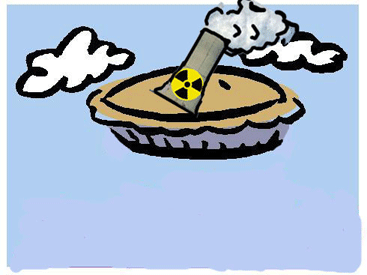
Pie in the sky? – The UK Government is considering to 75 Gigawatts of nuclear power by 2050
http://nextbigfuture.com/2013/12/the-uk-government-is-considering.html
22 December 2013
The current programme announced by ministers is to build 12 reactors to supply 16 gigawatts at five sites. The higher figure equates to more than 50 new large-scale modern reactors. The committee has been given the task of assessing the number of disposal facilities that might be required for the waste that will be produced by new nuclear power stations. It notes that the 16-gigawatt programme is only the “first tranche” and is “substantially below the 75 gigawatts upper limit being examined in [the Department of Energy and Climate Change]”.
The upper limit echoes a scenario outlined by the energy department in a 2011 report, outlining its vision for a low-carbon future. It suggested 75 gigawatts of nuclear power – enough to provide 86% of UK electricity – could be brought on line by 2050. “Nuclear energy is vital for our energy security and we want it to be part of the energy mix in the future, alongside renewables and clean coal and gas,” a department spokeswoman said. “It’s important to model potential scenarios to plan for our future energy needs, but we haven’t set any targets for the amount of new nuclear to be developed.”
Nuclear survival saga to film in New Zealand
http://www.nzherald.co.nz/nz/news/article.cfm?c_id=1&objectid=11176825&ref=rss
Pictures on link
Monday Dec 23, 2013
A star-studded film set in a remote valley which survives a nuclear holocaust will be shot in New Zealand early next year.
Film New Zealand confirmed yesterday that filming on Z for Zachariah – based on the 1974 science fiction children’s novel by Robert O’Brien – would begin in Canterbury late next month.
The movie will be produced by Hollywood star Tobey Maguire’s company and will star Chris Pine, Amanda Seyfried and 2014 Golden Globe nominee Chiwetel Ejiofor.
The filmmakers decided to use New Zealand after scouting for locations last month.
Japan to Extend Fukushima Radiation Cleanup work by up to Three Years
http://www.fananews.com/en/?p=191376
2013.12.22
0050 General
Tokyo, December 22 (QNA) – The Japanese government will have to extend its decontamination work following the 2011 crisis at the Fukushima Daiichi nuclear power plant by a maximum of three years, government officials said Sunday.
The Environment Ministry will shortly release a new schedule for radiation cleanup work, which was scheduled to be completed by the March 31 end of fiscal 2013 under the initial plan, Japanese news agency (Kyodo) quoted officials as saying.
The government will try to complete the work before reorganizing in fiscal 2017 areas around the crippled plant, currently divided into three zones based on radiation levels.(QNA)
QNA 1651 GMT 2013/12/22
Fukushima I NPP: Radioactive Cesium, All-Beta Detected from Groundwater Sample 25 Meters from the Ground Surface
Saturday, December 21, 2013
http://ex-skf.blogspot.co.uk/2013/12/fukushima-i-npp-radioactive-cesium-all.html
The groundwater sample from the observation hole dug 25 meters from the ground surface in between the turbine buildings for Reactor 3 and Reactor 4 (No. H25J7) was found with:
- Cesium-134: 1.6 Bq/Liter
- Cesium-137: 2.8 Bq/L
- All-beta: 67 Bq/L
after dirt particles were filtered out.
So far, radioactive materials (cesium, all-beta, tritium) have been detected from groundwater samples from the shallower, upper permeable layer. This is the first detection of radioactive materials from the groundwater below the level of the in-the-ground impermeable wall made of waterglass that is still being built closer to the plant harbor.
TEPCO says (handout for the press, 12/20/2013) they don’t know whether that means:
- The lower permeable layer (25 meters from the ground surface) is contaminated; or
- Radioactive materials entered the groundwater when the observation hole was dug; or
- The water from the upper permeable layer somehow entered the lower permeable layer; or
- The water got contaminated when it was being sampled.
The handout shows the particular location (observation hole No. H25J7) to be close to the turbine buildings of Reactor 3 and Reactor 4:
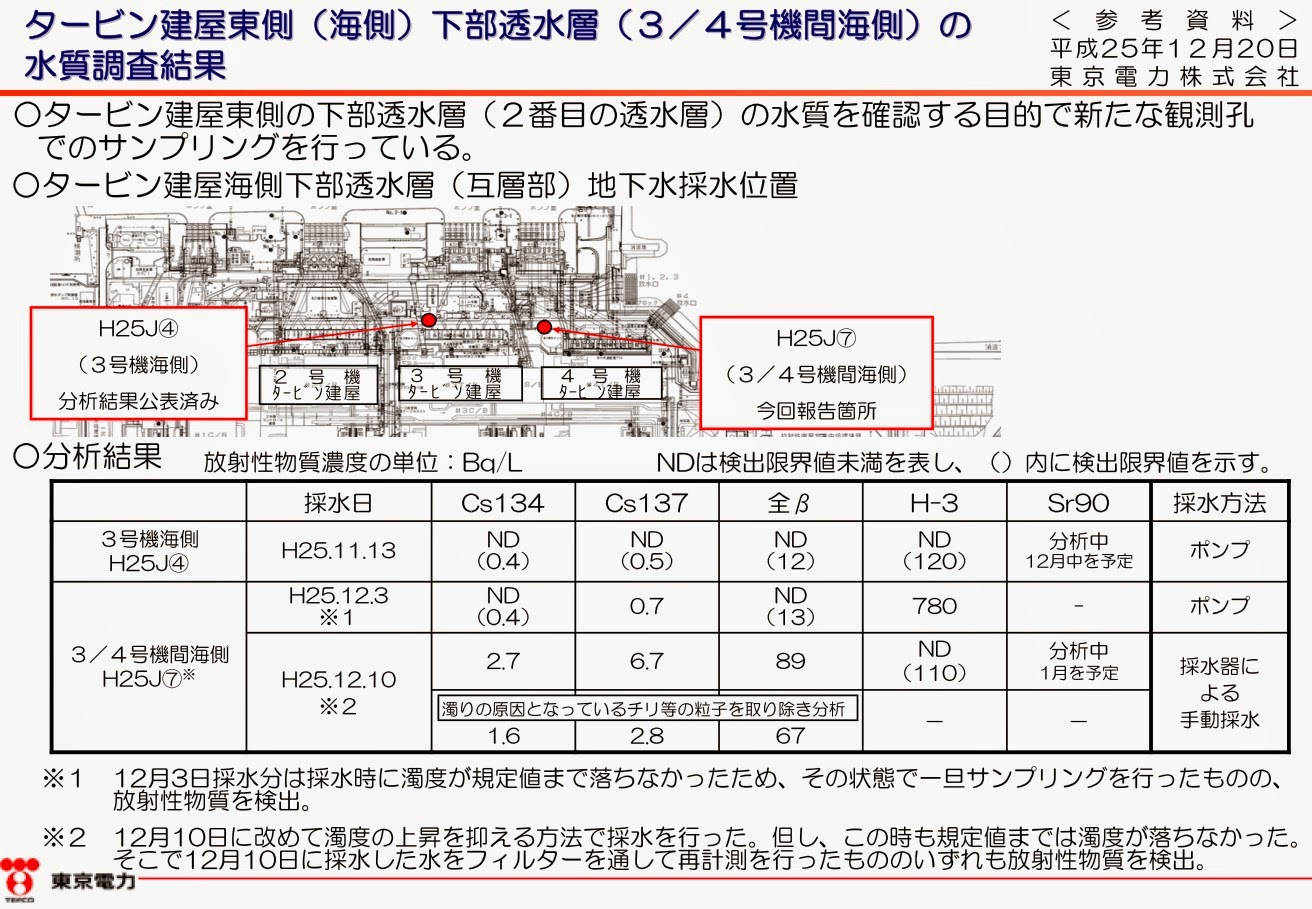
As far as I’m aware, it is only TV Asahi who covered this news on December 20:
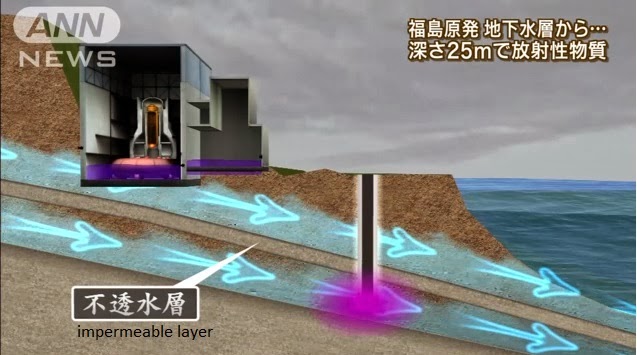
Japanese net citizens on Twitter and message boards who heard about the news (it doesn’t look to be many) are all doom and gloom, having already come to the conclusion that the lower permeable layer is contaminated (TEPCO’s hypothesis No.1).
1 This Month


Tell the Ukrainian Government to Drop Prosecution of Peace Activist Yurii Sheliazhenko

Petition to revoke the licensing of the Near Surface Nuclear Disposal Facility (NSDF) at Chalk River. https://www.ourcommons.ca/petitions/en/Petition/Details?Petition=e-7247


of the week – STOP SMALL MODULAR REACTORS IN CANADA
To see nuclear-related stories in greater depth and intensity – go to https://nuclearinformation.wordpress.com
-
Archives
- March 2026 (204)
- February 2026 (268)
- January 2026 (308)
- December 2025 (358)
- November 2025 (359)
- October 2025 (376)
- September 2025 (258)
- August 2025 (319)
- July 2025 (230)
- June 2025 (348)
- May 2025 (261)
- April 2025 (305)
-
Categories
- 1
- 1 NUCLEAR ISSUES
- business and costs
- climate change
- culture and arts
- ENERGY
- environment
- health
- history
- indigenous issues
- Legal
- marketing of nuclear
- media
- opposition to nuclear
- PERSONAL STORIES
- politics
- politics international
- Religion and ethics
- safety
- secrets,lies and civil liberties
- spinbuster
- technology
- Uranium
- wastes
- weapons and war
- Women
- 2 WORLD
- ACTION
- AFRICA
- Atrocities
- AUSTRALIA
- Christina's notes
- Christina's themes
- culture and arts
- Events
- Fuk 2022
- Fuk 2023
- Fukushima 2017
- Fukushima 2018
- fukushima 2019
- Fukushima 2020
- Fukushima 2021
- general
- global warming
- Humour (God we need it)
- Nuclear
- RARE EARTHS
- Reference
- resources – print
- Resources -audiovicual
- Weekly Newsletter
- World
- World Nuclear
- YouTube
-
RSS
Entries RSS
Comments RSS
 nuclear-news