By JIN NISHIKAWA/ Staff Writer
http://ajw.asahi.com/article/0311disaster/fukushima/AJ201312100010
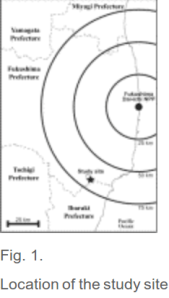
Most of the radioactive cesium that spewed from the Fukushima No. 1 nuclear plant and fell in broad-leaf forests remained near the surface and likely did not spread to groundwater, researchers said.
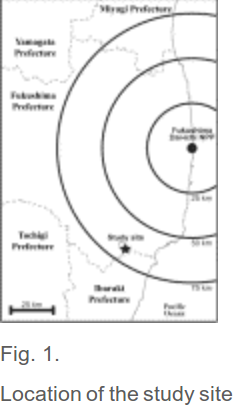
The researchers at the government-affiliated Japan Atomic Energy Agency began a study in May 2011 to monitor how cesium migrates in the ground below deciduous forests in Ibaraki Prefecture.
The forests were about 65 kilometers southwest from the crippled plant, which sits on the Pacific Coast.
When the disaster unfolded at the nuclear plant in March 2011, huge amounts of radioactive cesium landed on woodlands in a vast area around the plant.
Early readings in the study showed an average of 20 kilobecquerels of cesium per square meter in the surveyed area. About 70 percent of the cesium was present in a layer of fallen leaves.
Seven months later, the research team found that readings were down to one-fourth of the initial level.
In contrast, cesium levels tripled in the soil up to 5 centimeters deep after most of the cesium on the leaves seeped into the earth.
When the researchers measured cesium levels in the same soil in August 2012, they discovered that most of the cesium had remained there.
They also monitored how much of cesium had descended to 10 cm from 5 cm in the soil. The results showed only about 0.2 percent of the cesium moved in fiscal 2011, while the figure for fiscal 2012 was about 0.1 percent.
By autumn 2011, most of the cesium on the leaves had been washed into the soil by rainfall. The researchers also believe that rising temperatures accelerated the decomposition of the fallen leaves, resulting in more cesium sinking into the soil.
But after that, there was little movement in the cesium.
“In a future study, we want to look at cesium in the soil of needleleaf forests and forecast the impact on the nearby environment after monitoring the cesium’s movements to forestry products and areas beyond woodlands,” said Takahiro Nakanishi, a specialist of geoenviro
137Cs vertical migration in a deciduous forest soil following the Fukushima Dai-ichi Nuclear Power Plant accident
- Research Group for Environmental Science, Nuclear Science and Engineering Directorate, Japan Atomic Energy Agency, Ibaraki 319-1195, Japan
nmental science at the agency.
Link to Abstract and to purchase PDF
December 9, 2013
Posted by arclight2011part2 |
Uncategorized |
Leave a comment
….I believe this is a truth that cannot be concealed. Even if the village is decontaminated, the young people will not return, and if they cannot come back then the village will naturally perish, and it will be reported around the world as a ruined village. Rather than trying to protect the village, should not more attention be paid to the health of its people?,,,
[…]
…no more than 1% of the land of Iitate has been decontaminated so far. That was what the government claimed in March 2013. Accessing the relevant page in December 2013 shows that the government is now claiming about 2%. The government also claims to have decontaminated 110 houses, or 6% of the housing stock of Iitate. But who would return to a house surrounded by land and forests not yet decontaminated?….
ttp://rinf.com/alt-news/latest-news/fukushima-testimony-we-are-being-used-as-the-worlds-first-human-guinea-pigs/
Dec 09, 2013
The Rage of Exile: In the Wake of Fukushima
Shoji Masahiko; translated and introduced by Tom Gill
A Statement by one of those who lost their homeland to the Fukushima nuclear disaster
Translator’s foreword:
For the last two and a half years, I have been studying the inhabitants of Nagadoro, one of the twenty small hamlets in Iitate village, which has been evacuated and barricaded due to particularly high levels of radiation. Present government policy is to maintain the status of Nagadoro as a no-go zone for at least another four years. Among the 250 inhabitants is Shoji Masahiko, who until the nuclear disaster supported his wife and four children as a part-time farmer and part-time carpenter. In March of this year, Masahiko handed me the document which, after an inexcusable delay, I have now translated below. The Japanese original follows. TG
Recently I have started to take a first, tentative look into the things being said [about the situation in Fukushima] by university professors, world opinion, the specialist media, and experts from various foreign countries, and I feel moved to set down on paper my own thoughts and ideas, before it is too late, about how things are, what should be done, and to give my opinion and an appeal on what should be done internationally, socially, humanly and humanitarianly, regarding this important and weighty issue.
Shoji Masahiko, 2013.3.10 (Sunday)
All of a sudden two years have passed since that once-in-a-thousand-years calamity, the Great East Japan Earthquake, and the explosions that followed at the Fukushima No. 1 nuclear power plant – and nothing has changed. All that has happened is that our houses are crumbling, our fields are running to weeds, and our village is drifting back to a primitive state. Today I am thinking, I am worrying, and I am starting to feel resentment. “For us, in this reality, in this situation, what really matters? The village we were living in? To defend, to inherit, and to pass on to generations the home-place we were living in, the land our forefathers built upon, our property? Ah, but now what really matters is human health. That’s where it all starts” – with such words I question myself, then question once again. The national government and the village mayor insist now as ever that they will decontaminate the village, that they will enable us to go home, to return to the village as soon as humanly possible, that their plans will be executed swiftly, that the living environment will be getting the top priority as they open up the road to recovery, and no-one wants to abandon their homeland. But why, when human life and health should be the top priority, should that be reason to choose return, return to the village, as a higher priority than the people’s health, our children’s health, our grandchildren’s health? – That is something I cannot fathom.
A cherry blossom party at Nagadoro in the days before the disaster [photo: Shigihara Yoshitomo]
For my part I have actually started to think that we are being used as the world’s first human guinea-pigs, in an experiment to demonstrate to the world that “here in Japan, in the prefecture of Fukushima, in the village of Iitate, in an area of particularly high radiation, the people have come home, the village has been repopulated, and we have succeeded in restoring life as it was before the Great East Japan Disaster, and before the nuclear accident.” The youngsters, the young couples bringing up children, have been forced into activities and a living environment of extremely exaggerated caution, in which information on radiation and on health is zealously collected and shared. I think that is only natural for parents, for mothers. As such, these young people, these households with children, will not contemplate going home, they think not of returning to the village, nor will they until the radiation level is below world standards, and it is possible to live safely, with a sense of security, living off the fruits of the land – until that happens, I think it is only natural to stay away from the village, and as a parent of children myself that is the best I can hope for. To avoid having to shut up our children and grandchildren indoors. That seems to be something that the officials, cabinet ministers and bureaucrats in the capital cannot apprehend.
The only way for the officials, cabinet ministers and bureaucrats to convince and persuade the local people that it is safe to return is for them to come and experience life in the village for themselves, to prove by experiment with their own bodies that one can live in safety and peace of mind in our village; unless they turn their own experience into data, we will not be able to believe anything they tell us – this is the minimal responsibility of the nation that promoted nuclear energy and the Tokyo Electric Power Company. Electricity from the Fukushima nuclear power plant was electricity for Tokyo; we villagers of Iitate saw no benefit from it but only suffered the consequences – we could not see the radiation, we were told there was no immediate threat to health, even as hydrogen explosions burst out one after the other at the plant after March 12, 2011; only on April 22 were we told by the authorities – as a means to evade responsibility – to prepare for planned evacuation about a month later. And as a matter of fact, although our village was a high-level radiation zone, we accepted evacuees from Minami-Soma and some of those from Namie whose escape had been delayed, and in each of the village’s twenty hamlets, we prepared food for those evacuees, thinking it was aid, but we fed them irradiated food, and unnecessarily increased their dose of internal radiation.
The possibility of internal radiation poisoning implies heavy responsibility. We meant well, and can but pass on the responsibility for the deed to the government and Tokyo Electric Power, but if my memory serves me, we accepted some 2,000 evacuees. The national government should take absolute responsibility for any harm to health that emerges from internal or external radiation absorbed by those people. We who gave them the emergency supplies are full of remorse that we knew not of the danger in what we were doing, and we pray from the bottom of our hearts that no harm to health will result.
Shoji Masahiko, photographed on 24 April 2011 with two baskets full of home-grown shiitake mushrooms that had to be destroyed because of their radiation level [photo: Tom Gill]
Only a tiny part of the decontamination plan drawn up by the government for FY2012 (April 1, 2012~March 31, 2013) has been implemented, and no site has been s
ecured for storing the radioactive materials to be removed after decontamination. At present the information I have says that only 1% of the area slated for decontamination has actually been treated. Moreover, as the work of decontamination has commenced, it has proved difficult to secure workers with the right technical expertise to do the work, even in the numerous areas with low levels of radioactivity, where the forests are far from the houses, where there is plenty of space around the living quarters and where there are plenty of forests to serve as windbreaks [factors considered to help decontamination work]. This makes it highly questionable whether the decontamination plan can be carried out, and even if it were, I believe it would only be for the sake of being able to say they gave it a try, though without succeeding in reducing the radiation to a level where people could actually live there again. It is totally incomprehensible to me why vast amounts of the taxpayers’ money is being invested in this, even though it is unclear whether a safe and reassuring environment will result; nor can I understand why they are once again planning to put the local people’s lives at risk by making them go back before it is safe. Goodness knows how many billions of yen the work will cost, but the village office’s estimate for Iitate village alone is 322 billion yen (over $3 billion).
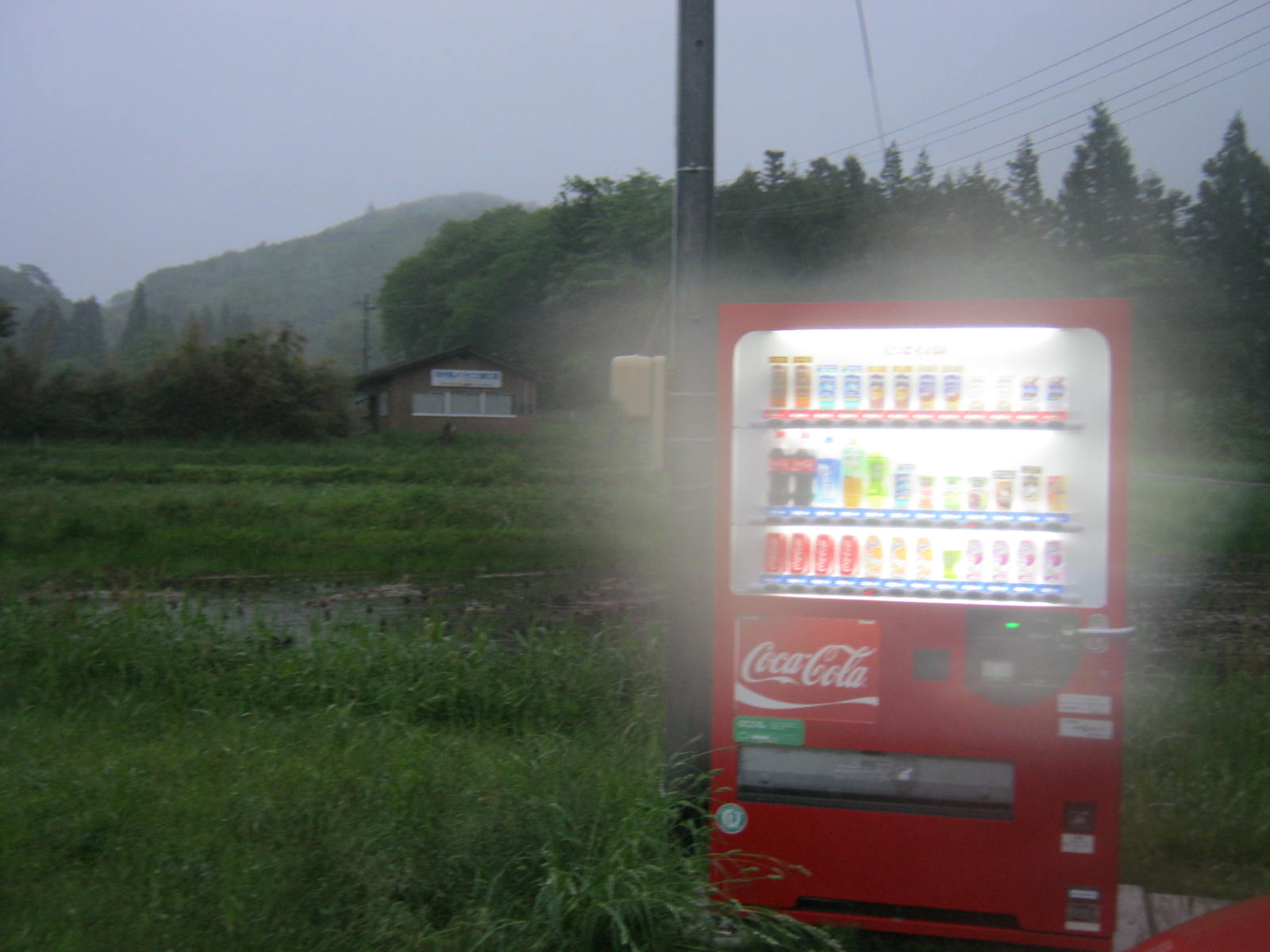
 A single Coca-cola vending machine in a field in the evacuated hamlet of Nagadoro on 30 May 2011 [photo: Tom Gill] A single Coca-cola vending machine in a field in the evacuated hamlet of Nagadoro on 30 May 2011 [photo: Tom Gill] |
Continue reading →
December 9, 2013
Posted by arclight2011part2 |
Uncategorized |
Leave a comment
http://www.reuters.com/article/2013/12/09/idUSL4N0JL1EV20131209
9 December 2013
…Sensing an interest in alternative power providers, close to 120 companies have registered with the government to become licensed power producers and suppliers….
[…]
…“(Nuclear restarts) look to take a long time so companies are diligently studying other options (for electricity),” Inoue said….
* 22 pct of Japan firms in poll say they will look at using new power firm
* That is 17 pct points higher than response to similar question in Sept poll
* Firms explore options amid uncertainty on nuclear restarts, future reforms
By James Topham
TOKYO, Dec 10 (Reuters) – The number of Japanese companies willing to consider buying electricity from new providers has jumped from three months ago, a Reuters poll showed, amid uncertainty on the restarting of nuclear energy and after power-sector reforms were approved.
The rising corporate interest in non-traditional power sellers such as Toyota Motor Corp and Panasonic Corp could further hurt Japan’s regional power monopolies already reeling from increased thermal fuel costs and the costs of refitting or decommissioning nuclear power plants.
It comes after the government passed legislation last month that includes the creation of a national grid operator by 2015 and the liberalisation of the power market for homes soon after, moves that could lead to a break up of the regional power monopolies.
Twenty-two percent of 255 big Japanese companies said they would consider using a new power provider in a question asked during the monthly Reuters Corporate Survey taken by Nikkei Research between Nov 22 and Dec 4.
That is 17 percentage points higher than when a similar question was asked in the September poll of Japanese companies.
“Many Japanese citizens are strongly against the restart of nuclear power, and earlier there was some hope that it would change, but it hasn’t, rather (anti-nuclear sentiment) might actually be getting stronger,” said Tetsuya Inoue, a senior researcher at Nomura Research Institute, who reviewed the survey results.
Japan is currently nuclear free for just the third time in more than four decades, following the massive March 2011 earthquake and tsunami that triggered reactor meltdowns and radiation leaks at the Fukushima Daiichi facility and caused the country to rethink its atomic energy use.
Continue reading →
December 9, 2013
Posted by arclight2011part2 |
Uncategorized |
Leave a comment






 nuclear-news