 |
| Photo Credit: SATOKO KAWASAKI, Japan Times |
Dec 6, 2013 | Washington’s Blog
December 9, 2013
http://www.smh.com.au/national/radioactive-spill-in-kakadu-stirs-rage-20131208-2yzee.html
It began as a 10-centimetre tear in a leach tank at Ranger uranium mine, in Kakadu National Park. Within an hour it turned into what some are calling one of the worst radioactive accidents in Australia’s history.
”It’s a massive failure,” said Justin O’Brien, chief executive of the Gundjeihmi Aboriginal Corporation, which represents the local Mirarr people. ”It’s hillbilly mining, and it’s not good enough.”
About 12.30am on Saturday morning, mine staff noticed liquid squirting from a crack in Leach Tank 1, a large above-ground tank containing more than 1.4 million litres of highly acidic radioactive slurry. Using a crane, they attempted to cover the crack with a steel plate, before noticing a second hole.
…People had to evacuate from their homes in Fukushima because there was a nuclear accident. The act of locating a nuclear power plant is like a domestic colonization, which marginalized communities have to accept…
http://globalvoicesonline.org/2013/12/08/japan-nuclear-disaster-radio-refugees/
8 December 2013
“You see, it’s different here. It’s much safer and more peaceful in Japan,” said my friend. I was introducing her to the idea of Global Voices: hearing stories from other side of the world, because “the world is talking”.
She continued: “There’s almost no need for people here to voice any kind of opinion or point of view, especially when your life is secured by following the norm.”
In a way she’s right. People living in Japan don’t always have to be concerned to what’s going on elsewhere. News headlines reflect this: in the public evening news broadcast, international news makes up only 7% of the total coverage. A researcher who monitored the broadcast [ja] over a period of three months found that a total of only two minutes, or 0.7 % of overall, were dedicated to reporting anything related to the African continent.
What’s going on outside the island usually doesn’t matter to Japanese, unless it’s North Korea conducting nuclear tests, or something significant related to the superpower, the United States. And ignorance is bliss, as they say.
One Japanese citizen who disagrees is Katsuya Soda, who believes that the public’s indifference to world affairs is ruining things in Japan. In February 2004, Katsuya started Nanmin Now! [ja], a radio program about refugee issues that airs on a community radio station in Kyoto. The show begins with an introduction by Katsuya in Kyoto-flavored dialect: “It’s time for Nanmin Now! A program that reports refugee information like a weather report.”
Before the Internet and social media became a space for popular expression, low-power FM, or community, radio was the only medium available to those who wanted to get an issue like the plight of refugees on the airwaves in a traditional city like Kyoto.
“At that time, information from the Internet had even less credibility than it does now,” says Katsuya. “I thought it was important to provide information via a medium that was familiar to everyone. Community radio is small in terms of reach, but it’s a trusted medium, as the airwaves are mandated by law to transmit information.”
With Nammin Now!, Katsuya’s ambition was to report news about refugees in such a way as to make refugee issues an item of concern in the minds of fellow Japanese. He was inspired to start the show after reading a book by Sadako Ogata, former United Nations High Commissioner for Refugees (UNHCR). “It taught the importance of the role of media and sustainable relationships, and the idea of a weather forecast came to my mind,” Katsuya says. “I decided to start a radio program that continuously reports on refugee issues just like the weather.”
Since launching the show, Katsuya has interviewed more than 500 people on the topic of refugees. The six-minute broadcast airs on a Saturday.
The word refugee—“nanmin” in Japanese — doesn’t appear very frequently in the Japanese news headlines. Japan accepts fewer than 50 refugees per year (in 2010 it accepted 39), even though it makes the world’s second largest financial contribution to the UNHCR. This is a surprisingly small number for a secure and peaceful island country. Some of these asylum-seekers even experience difficulties in Japan, such as deportation and detention. For the Japanese, the refugee problem is something going on the other, poorer side of the world. “It’s like a distant sorrow,” Katsuya says, “not just in terms of physical distance but also mentally. People believe they could never be a refugee.”
The mission of Nanmin Now! Is to ensure that “all the children of the world can sleep at home safely,” referring chiefly to places like certain countries in Africa, Afghanistan, and Myanmar, major sources of refugees. In the aftermath of Japan’s March 2011 earthquake, however, and accident at the Fukushima Daiichi nuclear power plant that followed, Katsuya became concerned about children in Japan.
|
| Photo Credit: SATOKO KAWASAKI, Japan Times |
Dec 6, 2013 | Washington’s Blog
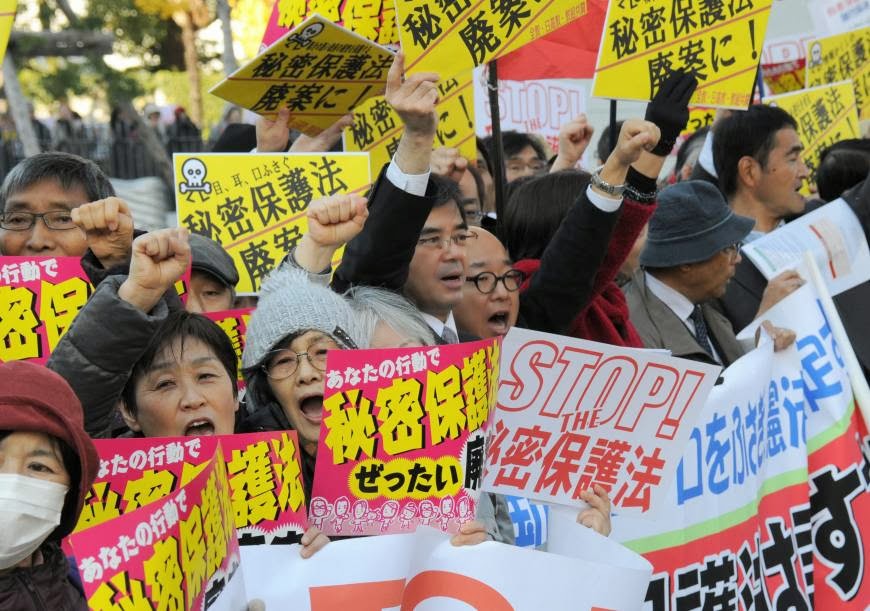
Japan Falls Back Into Fascism
The Empire of Japan surrendered on September 2, 1945.
68 years later, Japan has fallen back into fascism.
Despite large protests outside of the Japanese Senate:
Xinua reports:
Meanwhile, protests comprising more than 7,000 demonstrators continued around the Diet building, mobilized by civic groups, unions and concerned individuals, following similar scenes Wednesday that saw more than 6,000 anti-secrecy law opponents march around the Diet building hand-in-hand.
And the impassioned pleas of Japanese Senators (via Xinhua):
So outraged was opposition lawmaker Hirokazu Shiba in the committee meeting Thursday, that he rose from his seat and shouted “This is the way the reign of terror begins!” His fervor led to his fellow lawmakers having to physically restrain Shiba, as tensions in the meeting reached fever pitch.
The secrecy bill is headed for passage Friday. Indeed, the bill has likely already passed by the time you read this. (Update: it passed.)
Another Japanese Senator said:
 OP – ED Arclight2011 Nuclear-news.net 8 December 2013
The UK has decided to take the cheapest option for decommissioning according to a recent report by the badly named Department of the Environment and Climate Change (DECC), as 65 percent of their annual budget goes just on the costs of decommissioning it should be named British Nuclear Fools.
The processes involved with “decommissioning” are a “corporate secret” but a quick google says that the cheapest option is dissolution that involves melting everything in Nitric acid (or similar) and this has been the cause of high NO2 levels in the UK that are regularly blamed on other industries or countries. Though La Hague in France does contribute.
The UK has been reprimanded by the EU for the deaths caused by this NO2. And in the UK parliament we hear calls to cut the pollution detection monitors as they give the nuclear hazard away and threaten profits. These NO gases and particulates make it to even the arctic region of Russia (as Bellona has reported on many occasion whilst defending Norway from unjust blame)
As EDF and the French government begin the plans to reduce French nuclear and the shutting down of La Hague, they plan to increase use of Sellafield and other sites in the UK for these environmentally polluting nuclear processes.
The Irish Government has not been involved in the decisions for Hinckley, so An Taisce has formally lodged an appeal to the EU. The reaction of the UK and Ed Davey are well documented here… https://nuclear-news.net/2013/12/06/no-objection-by-ireland-uk-nuclear-hearing-told/
And as DECC were threatened with non co-operation if they asked for certain technical details or even the names of people involved, the Irish were likely not to be aware of the processes that the UK was planning to expand nor has their been a proper discussion concerning radionuclide’s and air quality issues being released due to these nuclear processes.
In fact not even the British public could be expected to know. In fact the UK NGO steering group who was supposed to be discussing this very issue over the past two years were not even allowed to know.
Who needs Leveson inquiry to silence information when the corporations and governments are doing the job so well anyway, I find myself asking.
I might point out that DECC also masterminded the Science Media Centre UK (SMC) to cover up or “manage” the Fukushima incident press coverage in 2011, which they then did and were rewarded by their sponsors (The big corporations and nuclear interests).
Bloggers and free press elements in Japan got too much truth out and the Japanese nuclear family had to close ranks with the USA and the Olympic Committee and have came up with the new “Secrets Act” , a shocking attack on free speech from a supposedly western country. It is now up to the Japanese Press to mobilize the people to reject this new Law, there are some signs of dissent in the media. We wish them well!
DECC has contracts of understanding with ROSATOM as well as some dubious eastern nuclear states. China, an authoritarian and pushy country will have the same leverage over DECC as the French and USA partners and therefore the Chinese communist (mostly)will have control of the information we hear on the news etc.. Have you heard the one about the Dalai lama recently? No? And you probably never will again!
Elements of the UK Media have had enough and are beginning to look a little harder at the Pro nuclear spin and analyse the sources of this drive for nuclear. The UK media is beginning to wake up to the deception but how deep will they dig?
It began after the crash of 2008 and 200 billion Euro moved directly into nuclear investments (A Norwegian insurance investment company has just sold its stocks in TEPCO at a massiviely reduced price and has beeen left licking its wounds). The Insurance and banking industry saw this as a safe bet for three more years and are heavily invested, in fact, the UK insurance industry will be proping up this PONZI scheme with a staggering 25 billion investment that is a curiously small amount considering the Total investment accrued in the Nuclear Industry by now. Just the normal monthly “Top Up” perhaps?
And if you dont think the Insurance Corporations view this as their own private nuclear “gravy train” why was the liability capped in Canada to only 1 billion? when the Japanese have paid TEPCO 50 billion in just the first year after the disaster. It seems it is the beleaguered Tax Payer is always the end recipient of this PONZI shaped dept burden.
Finally, the UK corporations have been supporting the Pro nuclear Corporations in Japan from the start and are still supporting Japan as it becomes a fascist state to protect their investments. These investments are very long term, measured in decades, and any country with nuclear power could be facing the same control of the population and of information.
Orwell would be not surprised perhaps at technology being used to enslave people by reducing their knowledge and controlling them totally.. No dissent, no illegal thoughts or 5 years in prison and a criminal history to stop you getting work for the rest of your life. Poor Japan! Poor UK!
Ms Hodge said: “It is a very serious thing to mislead a select committee. I’m going to have to take a look at this and we will then decide what action needs to taken if he did mislead the committee.”
A powerful committee of MPs will investigate whether they were given misleading evidence by the boss of Sellafield nuclear facility during a probe into the £70bn-plus cost of cleaning up the hazardous site.
Margaret Hodge, the chairwoman of the Public Accounts Committee, pledged last night to re-examine information given to her inquiry by Sellafield managing director Tony Price, after learning his claims conflicted with what is actually happening on site.
At a hearing on Wednesday, Mr Price hailed the vitrification plant, which turns deadly radioactive waste into glass for safer storage, as one of the “successes” of the much criticised way that Sellafield has been run.
When quizzed by Labour MP Meg Hillier over whether there were problems with the plant, he insisted it was running as usual and that staff were able to work there as normal. Mr Price said it was “not correct” that the plant’s ventilation system was not working properly.
However, other sources at the nuclear plant said that at that very moment, up to 40 staff were unable to get to their workplaces because of dangerous levels of radiation in part of the plant.
A power cut the previous Wednesday caused ventilation fans to fail and, as a result, an area known as Line 3 was heavily contaminated. The level of radiation is understood to have been 400 times the amount that, if found on a worker’s clothes, would prevent them from entering Sellafield’s offices or canteens.
A Sellafield spokesman confirmed “cross contamination in operational areas” of Line 3 and admitted that it is “undetermined” when workers will be able to return there. A board of inquiry has been set up to investigate the cause of the power fault.
Since receiving the report we have updated our position paper. We continue to oppose the construction of new nuclear power stations, promote the rapid introduction of renewable energy – particularly offshore wind – and oppose the provision of subsidies to nuclear power as they are reducing the amount of money available to more sustainable energy saving and renewable energy technologies.
[…]
After receiving the Tyndall Report, and after considering it properly, we are of the view that continued opposition to new nuclear power stations in the UK is still a credible position.
[…]
http://www.foe.co.uk/news/nuclear_40884?gclid=CPuqzOO4n7sCFYbHtAod_1UArw
02 August 2013
All the evidence is that we are facing a planetary emergency, especially with rapidly rising greenhouse gases and warnings from scientists of the potential breaching of tipping points. This isn’t a reason to panic but it is a reason to take a hard-headed approach in assessing and reassessing positions on technologies and practices. It also requires an ability to think out of the box and imagine a different future; or as Friends of the Earth’s strap-line says, see things differently.
It was with this hard-headed, seeing things differently, approach that we embarked on a review of the evidence for and against new nuclear power stations in the UK. The review could have thrown up information or evidence that would require us to change our current opposition to new nuclear power, but we undertook this review because we consider, objectively and without prejudice, the facts on the issues we work on. This is an important guiding principle given the planetary emergency context we are operating in.
To help us in our reassessment of the evidence we commissioned the Tyndall Centre at Manchester University to carry out a review. We commissioned them because they do not have a position for or against new nuclear power, they have expertise in nuclear power, and they are leading academics on climate change, especially carbon budgets. Their review was peer reviewed by academics in favour of nuclear power and against.
After receiving the Tyndall Report, and after considering it properly, we are of the view that continued opposition to new nuclear power stations in the UK is still a credible position.
The Tyndall Report found:
Source:Penn Energy
Country:JAPAN 
State:
City:
Date:12/7/2013
http://www.environmentguru.com/pages/elements/element.aspx?id=1426953
Westinghouse sees promising future for nuclear energy development in Brazil. Says AP1000 reactor design ‘the right fit’ for country’s needs. READ MORE
“The fundamental problem of the nuclear industry is not reactor safety, not waste disposal, not the dangers of nuclear proliferation, real though all these problems are.The fundamental problem of the industry is that nobody any longer has any fun building reactors. Sometime between 1960 and 1970 the fun went out of the business. The adventurers, the experimenters, the inventors, were driven out, and the accountants and managers took control. The accountants and managers decided that it was not cost effective to let bright people play with weird reactors.”
BBC Tokyo correspondent Rupert Wingfield-Hayes, Dec. 6, 2013 (at 2:30 in): They’re doing this work because that’s the easy bit. Reactor 4 was not badly damaged compared to the other reactors. There was no core meltdown, so that is the one that they can sort of get to grips with […] Reactor buildings 1, 2, and 3 where there were core meltdowns, the radiation levels there are still way too high for anyone to go in those buildings. So I think Reactors 1, 2, and 3, the reactors that had core meltdowns, are the real long-term problem, and a very difficult problem to deal with. Reactor 4 is a bit of a distraction. It’s important to get the fuel out, but it is the easy bit. […] the really big headache [is] to keep those melted reactors cool, which they have to do for many years to come. They have to pump water into the damaged reactor cores […] It’s a real nightmare to manage this ever-growing amount of water.
Full interview with Hayes here
New York Times reporter Matthew Wald* (at 46:30 in): The water, about a thousand tons a day, comes through the site and some of it goes into the basements of these ruined reactors, and these basements now have radioactive material in them. And the basements, the whole building is being cooled to keep the debris cool […] The water when it reaches the ocean just about meets international standards for drinking water, it’s barely polluted […] but it just looks awful that two and a half years after this accident, you have not contained the radioactive debris. […] [The fuel] is not molten anymore. Of course it’s kind of like candle wax that solidified, but it’s all over the place and getting it out is going to be a challenge. […] The vessel was over pressurized, the seals failed, little bits of fuel got out on to the space around the vessel into the basement, etc., etc. It’s dangerous, it’s highly radioactive. On the other hand it’s not really in a public place. […] But probably the first goal is simply to stop uncontrolled releases of radioactive material, and they haven’t quite reached that yet.
* A pro-nuclear blogger discussed Wald earlier this year: Matt Wald of the New York Times recently reviewed a new book on America’s nuclear waste storage saga […] Aside: Sadly, Matt’s post was one of the last posts ever published on Green, which just announced its demise due to budget constraints. It’s a crying shame; Green provided excellent coverage […]
See also: John Large
h/t http://robinwestenra.blogspot.co.uk/
Published on 6 Dec 2013
Since our friends in the US are blocked from viewing, I re uploaded it. ALL CREDIT TO AL JAZEERA ENGLISH and subMedia.tv. This upload is not for profit or any other reason other than to ensure that everyone can watch it. #ElsipogtogSolidarity


10 March A LIVE WEBINAR THE REAL EFFECTS OF NUCLEAR POWER
What the Industry Isn’t Telling Us
1:00 PM Mountain, 2 pm Central, 3 pm Eastern. Live on the Keepers of the Water Facebook page


18 March Webinar @ 1 PM EST: An Assessment of SMR Projects: The Case of Canada
register for the zoom:
https://us02web.zoom.us/webinar/register/WN_o8BIIOUvQ2ONJR1nta65DQ#/registration


of the week – STOP SMALL MODULAR REACTORS IN CANADA
To see nuclear-related stories in greater depth and intensity – go to https://nuclearinformation.wordpress.com
 nuclear-news