Right after the Fukushima disaster, Japan set about to market nuclear power
Japan “will resuscitate nuclear energy, and rebuild the basis for promoting exports of infrastructure facilities,” indicating that the ministry would continue to advance nuclear power generation and further expand nuclear facilities exports.
Because the pro-nuclear Abe administration has said, “We will share our experience of the accident and lessons learned from the disaster with countries of the world,” the ministry’s report can be regarded as a prototype for Prime Minister Shinzo Abe’s nuclear policy.
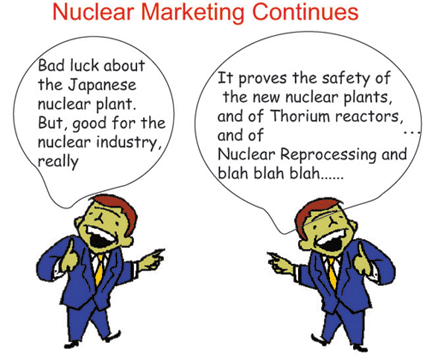
Ministry continued promoting nuclear power right after Fukushima accident December 02, 2013 THE ASAHI SHIMBUN The industry ministry began working to continue promoting nuclear power even immediately following the disastrous meltdowns at the Fukushima No. 1 nuclear power plant in March 2011, sources said.
The Asahi Shimbun has obtained a copy of the ministry’s confidential internal document titled, “Toward the Renaissance of Nuclear Energy,” which was compiled in late March 2011.
The report was written by a senior ministry official familiar with nuclear power facilities and distributed to its executives involved in designing the country’s energy policy, according to the sources.
The in-house document was used as a basis to determine the nation’s future nuclear policy in the aftermath of the disaster triggered by the Great East Japan Earthquake and tsunami on March 11, 2011, the sources said. Continue reading
Japan marketing nuclear technology to India
 Nuclear deal with Japan on the anvil THE HNDU, SANDEEP DIKSHIT , 2 Dec 13 At meeting with Emperor, Manmohan prefers to focus on economic aspects of relationship
Japan has said the main purpose of Emperor Akihito’s ongoing visit to India was to add more ballast to the bilateral relationship.
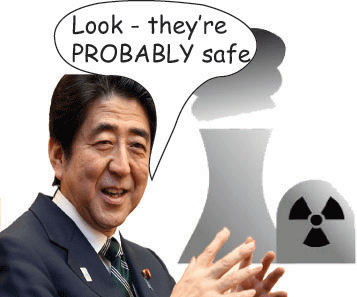 One of the elements that would add greater depth to the ties would be a civil nuclear agreement. “We are close to a bilateral deal on the peaceful use of nuclear energy,’’ said senior Japanese diplomats accompanying the Emperor, who is on a six-day visit to India……http://www.thehindu.com/news/national/nuclear-deal-with-japan-on-the-anvil/article5415157.ece
China marketing nuclear technology to Pakistan
How Pakistan and China Are Strengthening Nuclear Ties http://world.time.com/2013/12/02/how-pakistan-and-china-are-strengthening-nuclear-ties/?iid=gs-main-lead
The reactors are expected to start supplying 2,200 megawatts to the grid by 2019. The complex is not the first energy investment or nuclear project in Pakistan that China has been involved with, but it will be by far the largest.
 The nuclear power relationship between Pakistan and China is widely seen as a continuing effort to respond to the India-U.S. civilian nuclear deal, which, among other things, ended a decades-long moratorium on U.S. companies selling nuclear technology to India, despite India not being a signatory to the Nuclear Non-Proliferation Treaty. The move rankled Pakistan, which has also not signed the treaty and worries about a nuclear buildup by a country it considers its archenemy. China, too, criticized the deal for, it asserted, undermining nonproliferation. That the U.S. was building ties with India to counterbalance China’s growing power in Asia was probably not lost on Beijing either.
Time for UK government to be honest about its subsidy to nuclear power
biggest criticism is over ministers’ insistence that the deal agreed by the Treasury and EDF to fund the construction of a new nuclear power plant at Hinkley Point in Somerset is not a subsidy.
 “New nuclear is being subsidised and the coalition should come clean and admit it,” said Walley. “The government cannot escape that clear fact by talking about ‘support mechanisms’ and ‘insurance policies’ instead of ‘subsidies’.”
 be honest about oil, gas and nuclear subsidies and restate commitment to end fuel poverty Terry Macalister The Guardian, Monday 2 December 2013 The government has been urged to be more honest about the levels of subsidies given to oil and gas producers and the companies who will build a new nuclear power station at Hinkley Point.
A parliamentary watchdog argued on Monday that ministers should admit they are already providing £12bn of annual subsidies to fossil fuel operations and windfarms while lining up more support for shale gas and nuclear.
The environmental audit committee (EAC) said subsidies to oil and other carbon fuels should be scaled back because of the impact on global warming, and also urged ministers to restate a previous commitment to ending fuel poverty.
A report on energy subsidies just published by the committee says the chancellor’s autumn statement later this week is an ideal chance to provide a “clear and comprehensive analysis of energy subsidies in the UK”. Continue reading
EU probe into Britain’s nuclear subsidy could take until 2020
 EU state aid probe likely over British plan for EDF nuclear plant 7 News, December 3, 2013, By Barbara Lewis and Foo Yun Chee BRUSSELS (Reuters) – EU regulators are likely to open a formal investigation into whether Britain’s offer of state guarantees, to help finance a nuclear plant to be built by France’s EDF , conform with the bloc’s rules, its competition commissioner said on Monday.
Britain in October signed a deal with EDF to build a nuclear plant at Hinkley Point in southwest England and became the first European country to offer a guaranteed power price over 35 years for a new nuclear project.
“Two to three weeks ago we received notification from the UK,” EU Competition Commissioner Joaquin Almunia told a Brussels conference organised by Eurelectric, which represents the EU electricity industry.
“We are starting to analyse what is in the British proposal. Probably we will open a formal investigation because many people are asking the same question as you do,” he said when asked whether the British proposal for 35 years of a guaranteed energy price was too long under the terms of EU rules on state aid………The Commission is revising its state aid guidelines and is expected to finalise the rules for 2014-2020 next year.
It has said they will not specifically include nuclear energy, dealing another blow to Britain’s hopes of early certainty. Instead, each project will be assessed on its own merits………http://au.news.yahoo.com/world/a/20120325/eu-state-aid-probe-likely-over-british-plan-for-edf-nuclear-plant/
Israel developing a new super computer worm against Iran’s nukes?
 ‘Saudis, Israelis developing new ‘super Stuxnet’ against Iran nuclear program’ Rt.com, 2 Dec 13 Saudi Arabia and Israel’s Mossad intelligence division are co-conspiring to produce a computer worm “more destructive” than the Stuxnet malware to sabotage Iran’s nuclear program, according to a report from the semi-official Iranian Fars news agency.
“Saudi spy chief Prince Bandar bin Sultan bin Abdulaziz Al Saud and director of Israel’s Mossad intelligence agency Tamir Bardo sent their representatives to a meeting in Vienna on November 24 to increase the two sides’ cooperation in intelligence and sabotage operations against Iran’s nuclear program,” an anonymous source close to the Saudi secret services told Fars over the weekend.
The source noted that one of the major methods discussed was “the production of a malware worse than…Stuxnet.”
Stuxnet, a computer worm discovered in 2010, formed the basis of a cyberattack that sabotaged Iran’s uranium enrichment program. Its complexity prompted researchers to claim that it could only have been developed by a nation state.
It was generally believed to have been developed by the US and Israel, with former NSA contractor and whistleblower Edward Snowden only confirming their covert roles in an interview this July.
The intention behind the development of the new malware would be “to spy on and destroy the software structure of Iran’s nuclear program.” The source expressed a desire to remain anonymous on account of the sensitivity of information being shared. The plan would need a great deal of time and funding, with a rough figure of US $1 million being given as an estimate. It was apparently welcomed by Saudi Arabia with open arms……http://rt.com/news/stuxnet-iran-nuclear-mossad-565/
Inconvenient questions in Parliament about Sellafield’s £70bn clean-up costs
 Talk of building a new mixed-oxide (Mox) fuel reprocessing plant has been undermined by a report out this summer that concluded a previous Mox facility, which closed two years ago, had left taxpayers with a £2.2bn bill rather than the healthy profit that had been promised when it was first constructed.
Sellafield executives to face MPs as nuclear clean-up bill rises over £70bn http://www.theguardian.com/environment/2013/dec/01/sellafield-nuclear-clean-up-cost-rises Public accounts committee to scrutinise private consortium accused of spending cash ‘like confetti’ Terry Macalister The Guardian, Monday 2 December 2013 The bill for cleaning up the huge Sellafield nuclear plant in Cumbria will rise even higher than its current estimated level of £70bn as operators struggle to assess the full scale of the task, according to sources close to the project.
The warning comes just days before private sector managers face a grilling from the public accounts committee, which is investigating activities at the facility.
It was hoped that the huge bill – eight times the cost of staging the London Olympics – would be capped at £70bn, but well-placed sources have told the Guardian that the operators are convinced they are still “not at the top” of the cost curve.
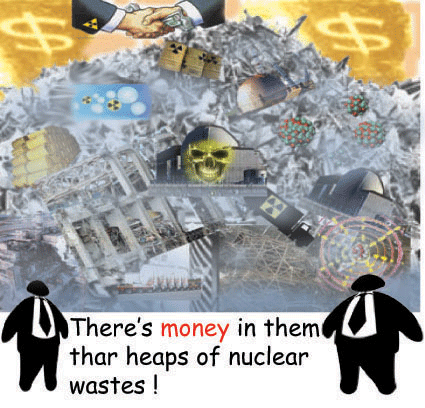
Sellafield is regarded as the most dangerous and polluted industrial site in western Europe, not least because it houses 120 tonnes of plutonium, the largest civilian stockpile in the world.
The cost of decommissioning the Calder Hall reactor plus a magnox fuel reprocessing plant at Sellafield has been rising steeply, but the biggest task comes from “ponds” and “silos” filled with old equipment and deteriorating, highly toxic waste. Continue reading
Thorough examination by European Commission nto UK’s nuclear subsidy plan
analysts at Liberum Capital argued that the guarantees offered to EDF could prove to be “economically insane”. They said by agreeing an inflation-linked price Davey had made a huge bet the cost of fossil fuels would rocket by the time Hinkley Point starts operating in 2023.
The House of Commons’ environmental audit committee has also criticised the government for refusing to admit that the Hinkley Point deal had subsidised EDF and its consortium partners.
“The government cannot escape that clear fact by talking about ‘support mechanisms’ and ‘insurance policies’ instead of ‘subsidies’,” the committee said in a report.
European commission inquiry into Hinkley Point deal could delay project Brussels to look at UK state aid for nuclear power plant after government offers EDF Energy a set price for 35 years The Guardian, Tuesday 3 December 2013 The government’s deal to underwrite the £16bn Hinkley Point nuclear power station plan faces delay and possible rejection after the European commission said it was ready to launch an in-depth inquiry into the agreement.
The EU competition commissioner said Brussels was likely to investigate the deal, which guarantees a minimum power price for 35 years, to make sure it conformed with state aid rules. The commission frowns on national governments offering deals to companies that stifle competition and distort the market.
Joaquín Almunia said: “We are starting to analyse what is in the British proposal. Probably we will open a formal investigation because many people are asking the same question [whether the UK’s agreement was too long].”
Energy secretary Ed Davey gave the go-ahead in October for a consortium led by France’s EDF Energy to build the Hinkley Point C plant in Somerset. Its two reactors will cost £8bn each and will provide enough power to supply 7% of Britain’s homes for 60 years.
Davey agreed a minimum price of £92.50 for every megawatt hour (MWh) of energy that Hinkley Point generates – almost twice the current wholesale cost of electricity. The deal with EDF was unprecedented and made the UK the first European country to offer a set price over 35 years for a new nuclear project……..
- Almunia gave no indication of how long an investigation might take but the commission sees the government’s deal with EDF, Areva and China’s General Nuclear Power as complex and highly novel. An investigation is therefore likely to be in-depth to investigate all aspects of the proposals……..
- The government’s proposals were always likely to receive attention from the commission but Almunia’s comments suggest they will be subjected to intense scrutiny.
The UK wants the EU to accept that nuclear power should be given special status like renewable energy but Germany and Austria oppose such a move and Hinkley Point is likely to be considered like any other state aid case.
Moves by the commission to block or radically alter the nuclear deal could spark a major dispute between London and Brussels. Many Conservative MPs and constituency parties are virulently opposed toEurope‘s influence over UK policy and David Cameron has pledged a referendum on UK membership of the EU if the Tories win the 2015 election……
- The government’s case was dealt a blow a month ago when analysts at Liberum Capital argued that the guarantees offered to EDF could prove to be “economically insane”. They said by agreeing an inflation-linked price Davey had made a huge bet the cost of fossil fuels would rocket by the time Hinkley Point starts operating in 2023.
The House of Commons’ environmental audit committee has also criticised the government for refusing to admit that the Hinkley Point deal had subsidised EDF and its consortium partners.
“The government cannot escape that clear fact by talking about ‘support mechanisms’ and ‘insurance policies’ instead of ‘subsidies’,” the committee said in a report.
EDF declined to comment.http://www.theguardian.com/business/2013/dec/02/european-commission-inquiry-hinkley-point-deal
Israel’s nuclear weapons-GOOD. Iran’s nuclear power- BAD. Why so?
“At some point, for its own security, Israel will have to take the bombs out of the basement and put them on the negotiating table.”.
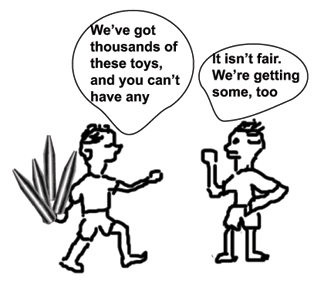 Why is the U.S. okay with Israel having nuclear weapons but not Iran? WP BY MAX FISHER December 2 Iranian officials sometimes respond to accusations that Tehran is seeking a nuclear weapons capability by replying that, not only do they not want a bomb, they’d actuallylike to see a nuclear-weapons-free Middle East. Yes, this is surely in part a deflection, meant to shift attention away from concerns about Iran’s nuclear activities by not-so-subtly nodding to the one country in the region that does have nuclear weapons: Israel.
But could Iran have a point? Is there something hypocritical about the world tolerating Israel’s nuclear arsenal, which the country does not officially acknowledge but has been publicly known for decades, and yet punishing Iran with severe economic sanctions just for its suspected steps toward a weapons program? Even Saudi Arabia, which sees Iran as its implacable enemy and made its accommodations with Israel long ago, often joins Tehran’s calls for a “nuclear-free region.” And anyone not closely versed in Middle East issues might naturally wonder why the United States would accept Israeli warheads but not an Iranian program.
- This issue comes up in every lecture I give,” Joe Cirincione, president of the nuclear nonproliferation-focused Ploughshares Fund, told me. The suspicions that Israel gets special treatment because it’s Israel, and that Western countries are unfairly hard on Israel’s neighbors, tend to inform how many in the Middle East see the ongoing nuclear disputes. “It is impossible to give a nuclear policy talk in the Middle East without having the questions focus almost entirely on Israel,” Cirincione said…….. Continue reading
Germany’s profitable agriculture – farming the sun and the wind
 German farmers reap benefits of harvesting renewable energy Ft.com By Jeevan Vasagar in Reussenköge , 2 Dec 13, Dirk Ketelsen is a farmer but these days most of his income comes from harvesting the wind. On Germany’s North Sea coast, where a fierce sea breeze blasts in across the polders, the generous financial support the government has poured into renewable energy has reared a crop of wind turbines as far as the eye can see.
 Mr Ketelsen began using wind to generate electricity on his organic farm in 1990. The next year, Germany adopted legislation that set guaranteed tariffs for power generated from renewables as part of an effort to encourage less polluting forms of energy.
Such policies have unleashed a boom for wind, sun and other sources of renewable energy, which now account for 23 per cent of the electricity consumption of Europe’s biggest economy.
They have also proved highly lucrative for farmers like Mr Ketelsen. The tariffs set by the Renewable Energy Act, known as the EEG, not only give renewables priority access to the electricity grid – ahead of the electricity produced by traditional power plants – they ensure their owners a guaranteed return over 20 years.
“Before the EEG, we said we’ll do this for ecological reasons. Even if there’s just a little bit of profit. Then came the EEG, and it worked out very well financially,” Mr Ketelsen said.
Navajo gather for uranium film event
 Livestream Navajo Window Rock Uranium Film Fest Grassroots Gathering (includs video) http://bsnorrell.blogspot.com.au/2013/12/livestream-navajo-window-rock-uranium.html Live from Navajo Nation: International Uranium Film Festival, with grassroots talks and workshops Dec 2 — 4, 2013. By Brenda Norrell Censored News NAVAJO NATION — The grassroots gathering at the International Uranium Film Festival on the Navajo Nation began this morning, with talks by Native Americans battling uranium mining in their homelands. The festival will also feature 21 films, many focused on the poisoning and disease by Navajoland Cold War uranium mining, on Monday, Tuesday and Wednesday.
Navajo President Ben Shelly spoke during the opening of the three day event.
President Shelly said he is still “talking” with the US about cleaning up the Church Rock, N.M., uranium tailings spill that happened in 1979. Shelly said he is still “talking” about cleaning up the Tuba City dump site too.
The Church Rock spill poisoned the region, and then flowed down the Rio Puerco toward Flagstaff, Arizona, poisoning more land and water on the Navajo Nation and causing cancer and disease. Continue reading
Storage solution for wind and solar energy, from Hitachi
Hitachi Announces Storage Technology for Renewable Energy Bloomberg, By Brian Wingfield – Dec 2, 2013 Hitachi Ltd. (6501) unveiled an energy-storage system that the company said will support wind and solar power and allow users to sell electricity into deregulated markets such as California.
The units can be installed on high-voltage power lines, and will be able to capture excess energy produced by wind and solar sources so it can be sold back into the network when the demand for power exceeds the supply. The systems, which include telecommunications and lithium-ion battery technologies developed by Tokyo-based Hitachi, will also minimize volatility on the power grid, company officials said today at a press conference in Washington.
“As the use of renewable energy expands, stabilization has become a very important priority,” Masaaki Nomoto, general manager for the company’s transmission and distribution systems division, said through a translator. He said the potential customers for the technology will include anyone who wants to sell power into the market, not just utilities……http://www.bloomberg.com/news/2013-12-02/hitachi-announces-storage-technology-for-renewable-energy.html
Limited Internal Radiation Exposure Associated with Resettlements to a Radiation-Contaminated Homeland after the Fukushima Daiichi Nuclear Disaster
….There are a few limitations to this study. Firstly, subject screening was conducted soon after the villagers’ return; therefore, more time may have been needed for radionuclides to accumulate in the body. Secondly, there is a high probability of sample selection bias because the sample size was small, mainly owing to the small size of the whole village population, and it is possible that individuals more concerned with the radiation contamination came to the screening program.
Conclusion
The present study concludes that the risks for internal radiation exposure could be limited after the resettlement of the villagers to their village with a strict food control intervention…..
- Published: Dec 02, 2013
- DOI: 10.1371/journal.pone.0081909
[ABSTRACT]
Resettlement to their radiation-contaminated hometown could be an option for people displaced at the time of a nuclear disaster; however, little information is available on the safety implications of these resettlement programs. Kawauchi village, located 12–30 km southwest of the Fukushima Daiichi nuclear power plant, was one of the 11 municipalities where mandatory evacuation was ordered by the central government. This village was also the first municipality to organize the return of the villagers. To assess the validity of the Kawauchi villagers’ resettlement program, the levels of internal Cesium (Cs) exposures were comparatively measured in returnees, commuters, and non-returnees among the Kawauchi villagers using a whole body counter. Of 149 individuals, 5 villagers had traceable levels of Cs exposure; the median detected level was 333 Bq/body (range, 309–1050 Bq/kg), and 5.3 Bq/kg (range, 5.1–18.2 Bq/kg). Median annual effective doses of villagers with traceable Cs were 1.1 x 10⁻² mSv/y (range, 1.0 x 10⁻²-4.1 x 10⁻² mSv/y). Although returnees had higher chances of consuming locally produced vegetables, Cochran-Mantel-Haenszel test showed that their level of internal radiation exposure was not significantly higher than that in the other 2 groups (p=0.643). The present findings in Kawauchi village imply that it is possible to maintain internal radiation exposure at very low levels even in a highly radiation-contaminated region at the time of a nuclear disaster. Moreover, the risks for internal radiation exposure could be limited with a strict food control intervention after resettlement to the radiation-contaminated village. It is crucial to establish an adequate number of radio-contaminated testing sites within the village, to provide immediate test result feedback to the villagers, and to provide education regarding the importance of re-testing in reducing the risk of high internal radiation exposure.
Citation: Tsubokura M, Kato S, Nihei M, Sakuma Y, Furutani T, et al. (2013) Limited Internal Radiation Exposure Associated with Resettlements to a Radiation-Contaminated Homeland after the Fukushima Daiichi Nuclear Disaster. PLoS ONE 8(12): e81909. doi:10.1371/journal.pone.0081909
Editor: Suminori Akiba, Kagoshima University Graduate School of Medical and Dental Sciences, Japan
Received: July 30, 2013; Accepted: October 17, 2013; Published: December 2, 2013
Copyright: © 2013 Tsubokura et al. This is an open-access article distributed under the terms of the Creative Commons Attribution License, which permits unrestricted use, distribution, and reproduction in any medium, provided the original author and source are credited.
Funding: The authors have no support or funding to report.
Competing interests: The authors have declared that no competing interests exist.
Introduction
Radiation exposure can generate long-term risks for disorders such as tumors depending on personal exposure doses[1]. Health threats have emerged in radiation-contaminated areas. Cumulative radiation exposure is a serious public concern in Fukushima, particularly among children, who face greater health risks than adults.
Evacuation from radiation-contaminated areas at the time of a nuclear disaster is an effective strategy to reduce the risks of radiation exposure[2], although there is a risk-benefit trade-off between the long-term effects of low-dose radiation and the serious short-term health effects an evacuation may cause[3]. For instance, the blanket evacuation technique caused a dramatically acute increase in mortality among residents of elderly nursing homes in the Fukushima area[4]. Moreover, evacuation could have long-term adverse health effects; prolonged life as evacuees could represent physical, mental and socioeconomic burdens[5].
Thus, an option for displaced people, who generally have strong affective ties with their place of birth, is resettlement to their radiation-contaminated hometown, as was the case after the Chernobyl disaster[6]. However, little information is available regarding the safety of such resettlement programs to the radiation-contaminated hometowns.
Under such circumstances, the case of Kawauchi village, Fukushima Prefecture, provides useful information concerning the validity of the resettlement program. Kawauchi village is located 12–30 km southwest of the Fukushima Daiichi nuclear power plant. This village was one of the 11 municipalities that were evacuated by central government mandate on March 15, 2011, and it was the first municipality to issue the return of its villagers after the Fukushima Daiichi nuclear power plant disaster[7]. The deposition density of Cesium (Cs)-137 was 43-860 kBq/m2 on November 11, 2011 in the Kawauchi area (Figure 1), which was comparable to zone II (555 kBq/m2) as of 1988 after the Chernobyl disaster[8,9]. Approximately half a year after the disaster, the central government lifted the emergency evacuation preparation zone in a 20-30 km radius from the Fukushima Daiichi nuclear power plant on September 30, 2011. Taken toghether with the low risk of hydrogen explosion and failure of the cooling system, and the low levels of external radiation exposure measured among the Fukushima residents, the mayor of Kawauchi village issued a declaration for all the former villagers to return home on January 31, 2012[10].
Figure 1. Cesium-137 deposition of soil around Fukushima Daiichi nuclear power plant as of November 5, 2011.
doi:10.1371/journal.pone.0081909.g001
However, many people hesitated to return home, partly owing to the lack of the information on the safety after the resettlement. Elevated air dose levels evoked a feeling of fear of potential irradiation. In addition, primarily because of consumption of potentially radiation-contaminated locally grown food products, a higher level of internal radiation exposure was expected among returnees after their resettlement to Kawauchi village. While the main industry of the region was agriculture, which had a working population share of 55%, the estimated annual effective doses from internal radiation exposure among returnees to the Kawauchi village using the results of the radio-contaminant food testing ranged between 0.37–7.0 mSv/y.[11] High doses from internal radiation exposure happened to be estimated in case of continuous ingestion of highly radio-contaminant food such as mushrooms.
To assess the validity of the Kawauchi villagers’ resettlement program, the levels of internal Cs-137 exposure, known to be representative of total internal radiation exposure[12], were comparatively measured in the returnees and non-returnees among the Kawauchi villagers. In this report, we started off with the presumption that the risk for internal radiation exposure would be limited to returnees. While returnees had higher chances of consuming locally produced vegetables, their level of internal radiation exposure was not significantly higher than that of non-returnees. Based on our findings, we also present and discuss the effective countermeasures to avoid internal contamination among residents after the resettlement, which could be useful for nuclear incidents in the future.
Study: Those lacking wisdom expected Fukushima plume to disperse before hitting West Coast — In reality “sharp features” were detected even after several days travel (PHOTO)
Published: December 2nd, 2013 at 7:06 pm ET
By ENENews
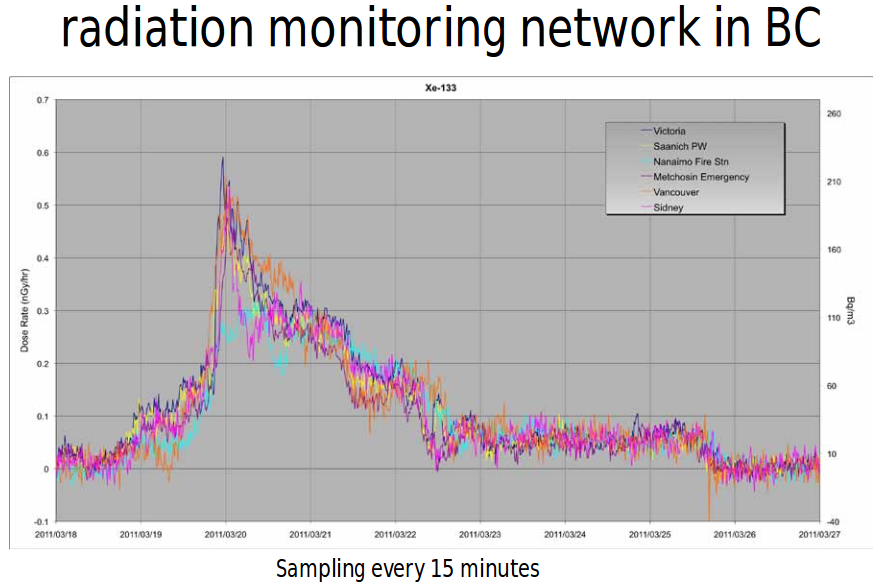
Evidence of sharp features in the Fukushima plume over Southwestern British Columbia, by Health Canada and Canadian Association of Management Consultants (Undated):
Evidence of sharp features in the Fukushima plume over Southwestern British Columbia […]
Naively [naive: deficient in worldly wisdom or informed judgment] one could expect a diffuse and well-mixed plume reaching the West Coast, especially in the boundary layer – – Nevertheless important small scale features are observed in the plume […]
Dispersion modelling indicates that there are indeed small scale / sharp features in the plume even after several days travel times […]
Horizontal diffusion does not play a major role in the horizontal spread of the plume […]
Voices of outrage from Fukushima!
http://globalvoicesonline.org/2013/12/02/20-bitter-voices-rise-from-fukushima-after-japans-2011-nuclear-disaster/

南相馬市60代男性「自宅一軒、竹中工務店に560万円で除染を依頼し、現場の
下請けはピンハネされまくって、70万円で
作業をする。末端の作業員は日当約8千円。除染が終了したら仕事がなくなるから、皆、
いい加減な仕事しかしない。それで雇用が確保され、経済が回る。それ
が除染ビジネスの実態」
A man in his 60s, Minamisoma city:
“A request for decontamination of one home with the Takenaka
Firm will cost 5,600,000 JPY. At the actual scene the
subcontractor has lots of bribes and kickbacks pilfered
from him and it costs 700,000 JPY to do the job.
It’s about 8,000 JPY per day for the final workers.
Because the jobs disappear when the decontamination is finished,
 everyone’s doing real sloppy work. By doing that, they’re
guaranteed long-term employment, and the economy turns. That’s
the real state of the decontamination business.”

福島の仮設・20代女性「子どもがいるので被ばくについて勉強したいと思い、県内の講演会等に
行くようにしている。しかし
偉い先生の講演会は、「放射線量はほとんどゼロ」「内部被ばくなどない」「福島は大丈夫」ばかり。
正確な情報が、手に入らない。それを声に出すと、さらに
非難される」
A woman in her 20s, Fukushima provisional housing:
“Because I have children I think I’d like to learn about
radiation exposure, so I’m making a point of going to
lectures within the prefecture.
However, a lecture of an esteemed professor was all ‘The
radiation level is nearly zero,’ ‘there is no such internal
radiation exposure,’ and ‘Fukushima is perfectly
fine.’
I can’t get any accurate information. If you raise your
voice about that, you’ll get criticized all the more.”
1 This Month


Tell the Ukrainian Government to Drop Prosecution of Peace Activist Yurii Sheliazhenko

Petition to revoke the licensing of the Near Surface Nuclear Disposal Facility (NSDF) at Chalk River. https://www.ourcommons.ca/petitions/en/Petition/Details?Petition=e-7247


of the week – STOP SMALL MODULAR REACTORS IN CANADA
To see nuclear-related stories in greater depth and intensity – go to https://nuclearinformation.wordpress.com
-
Archives
- March 2026 (204)
- February 2026 (268)
- January 2026 (308)
- December 2025 (358)
- November 2025 (359)
- October 2025 (376)
- September 2025 (258)
- August 2025 (319)
- July 2025 (230)
- June 2025 (348)
- May 2025 (261)
- April 2025 (305)
-
Categories
- 1
- 1 NUCLEAR ISSUES
- business and costs
- climate change
- culture and arts
- ENERGY
- environment
- health
- history
- indigenous issues
- Legal
- marketing of nuclear
- media
- opposition to nuclear
- PERSONAL STORIES
- politics
- politics international
- Religion and ethics
- safety
- secrets,lies and civil liberties
- spinbuster
- technology
- Uranium
- wastes
- weapons and war
- Women
- 2 WORLD
- ACTION
- AFRICA
- Atrocities
- AUSTRALIA
- Christina's notes
- Christina's themes
- culture and arts
- Events
- Fuk 2022
- Fuk 2023
- Fukushima 2017
- Fukushima 2018
- fukushima 2019
- Fukushima 2020
- Fukushima 2021
- general
- global warming
- Humour (God we need it)
- Nuclear
- RARE EARTHS
- Reference
- resources – print
- Resources -audiovicual
- Weekly Newsletter
- World
- World Nuclear
- YouTube
-
RSS
Entries RSS
Comments RSS
 nuclear-news