Japan tries to plug leaks about leaks, donning Russia’s mantle of nuclear and Olympic explosions
…If Japan’s secrecy law goes through, there could well be a proliferation of Nikitins, this time along the Pacific Rim as those who would dare to leak as much as Fukushima attempt to bear witness to one of the world’s greatest ongoing nuclear catastrophes….
http://www.bellona.org/articles/articles_2013/japan_leak_law
The Japanese government’s powerful lower house of Parliament passed a stiff new secrecy bill that would visit harsh penalties on bureaucrats who leak information, and reporters who seek it – a move environmentalists fear would allow official collusion and corruption of the kind unearthed during the Fukushima Daiichi nuclear disaster to flourish.
The ruling block and its supporters hope the weaker upper house will pass the legislation next month, the Associated Press reported.
According to the Asashi Shimbun newspaper, the government of heavily pro-nuclear Prime Minister Shizo Abe seeks information restrictions in four basic areas: defense, diplomacy, counter-terrorism and counter-espionage.
This, according to the Japanese press, will likely include information on the vulnerability of nuclear power plants – a keen area of interest to most Japanese and countries that surround it after the March 2011 Fukushima-Daiichi nuclear disaster which forced some 160,000 from their homes, and from which radioactive water continues to leak.
Apparently, frustrated that it can’t stop the leaks at Fukushima Daiichi, the Japanese government is taking a crack at stopping the leaks about the leaks. And officials caught leaking, stipulates the new law, could face as many as 10 years in prison.
Putting a tight lid on these kinds of unseemly radioactive emissions is especially important in light of the recent awarding by the International Olympic Committee of the 2020 Summer Games to Japan – a sort of pity plug for the situation the country has been plunged into by the nuclear disaster the government worked so hard to obscure.
Olympic pressures to shut up are not just Japan’s problem, and are something that bring it closer in spirit to its neighbor, Russia – an irony not lost on Nils Bøhmer, Bellona’s general director and nuclear physicist. He noted that Japan’s potential new law smacked of that not so post-Soviet sensibility in Russia of “dictating the truth and by making it illegal to tell the truth.”
The screws being put to Russian civil society activists and journalists in the run up to Sochi’s 2014 Winter Games to gouge out their eyes (or have them gouged out) over the massive environmental and social ruin Russia’s Olympic preparations have entailed and the massive corruption it has enabled is, according to international rights activists, unprecedented.
Add that the Russo-Soviet phobia to the truth about to nuclear disasters from accidental nuclear submarine sinkings, fires at ship repair yards, temperamental nuclear power reactors, a massive explosion at Chernobyl, the jailing of activists who draw attention to environmental and rights problems and the gagging of NGOs with President Vladimir Putin’s “foreign agent” law, and Tokyo and Moscow could become kissing cousins by the candle light of an Olympic torch.
Fukushima: Condition unknown
The current condition of the Fukushima Daiichi plant is precarious – arguably worse off than it was directly following the initial catastrophe, during which the plant lost all primary and back up cooling, leading to three reactor meltdowns, hydrogen explosions, vulnerability of spent nuclear fuel pools and a seemingly continuous leaks of highly radioactive water after it was hit by an 11-meter tsunami.
The disposition of the fuel in the melted down reactors is unknown. Efforts to extract spent nuclear fuel from a pool balanced 30 meters above the ground at the No 4 reactor building, which was heavily damaged by a hydrogen explosion, remain piecemeal, and there is as yet no real consensus on what on what might stop or at least diminish the leaks of some 400 metric tons a day of radioactive water into the Pacific.
On top of that, extremely inconvenient reports about worker radiation exposure and rock bottom wages for performing lethal work at the plant keep emerging from the lips of poorly paid subcontractors.
Gag on Fukushima essential to Japanese nuke renaissance
As plant owner Tokyo Electric Power Co. (Tepco) proceeds with its spit and string efforts to bring this ongoing catastrophe under control, it’s understandable that Abe would like to stuff a sock in the bad news bullhorn from Fukushima.
At the moment, all of Japan’s 50 nuclear reactors are shut down as they undergo stringent safety tests by the country’s new regulatory agency, which may result in many of them being chucked as unfit for operation.
Yet, Abe has promised a bright, safe nuclear future to a Japanese public that could largely care less about that, and, in fact, opposes it.
Tepco and several echelons of the Japanese government have, meanwhile, over the last two years and eight months, distinguished themselves as some of the most unreliable organizations in the world, most significantly in their connivance to withhold radiation data from the public and the world in the disaster’s immediate aftermath. The lie by omission sent thousands fleeing Fukushima’s fallout directly into its path.
Taro Yamamoto, a lawmaker in Japan’s upper hose of parliament told a Tokyo news conference Wednesday that the government’s role in hiding radiation information showed it was predisposed to hiding information from its citizens and this law would only make things worse, according to the newspaper, The Australian.
Meanwhile Tepco’s continuing post-Chernobyl Soviet-style campaign of disinformation, misinformation, incompetence, and secrets kept that have later been blown by the press has put its credibility under serious attack, if not destroyed it altogether.
News > UK In pictures: Hunterston B nuclear power station will operate until 2023
Hunterston B nuclear power station in Ayrshire has been given an extension after EDF Energy evaluated the plant.The operating extension was announced by company’s chief executive Vincent de Rivaz.
Japan’s Nuclear Regulation Authority Reports IAEA on Fukushima Nuclear Power Station
29 November 2013
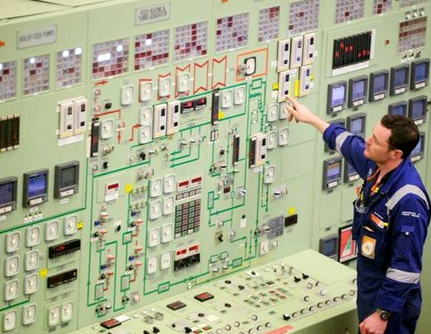
Geneva (ABC Live): The Nuclear Regulation Authority (NRA) of Japan provided the IAEA an update on radioactivity in seawater at TEPCO’s Fukushima Daiichi Nuclear Power Station (NPS).
http://www.iaea.org/newscenter/news/2013/f1issues271113.pdf
This update states that the concentrations of Cs-134, Cs-137, total Beta and H-3 were relatively stable from 18 to 24 November 2013 at the nuclear power station.
In addition, the NRA provided an update on the monitoring report of sea area radioactivity obtained from samples taken in the vicinity of TEPCO’s Fukushima Daiichi NPS and in the open sea.
http://radioactivity.nsr.go.jp/en/contents/8000/7651/24/Sea-monitoring%2820131126%29.pdf
To provide and track specific details on the transfer of fuel from the spent fuel from Unit 4 of the Fukushima Daiichi NPS that commenced on 18 November 2013, a new section on the TEPCO website is now available.
TEPCO has also provided information on the review that was undertaken following the operation of fuel removal from the Unit 4 spent fuel pool in a document dated 25 November 2013 titled Work Procedure Review Following Unused Fuel Removal at Fukushima Daiichi NPS Unit 4. Details are availablehere.
A series of photos and videos of the transfer process of the unused fuel removal at the Fukushima Daiichi NPS Unit 4 can be accessed at the following links:
- http://photo.tepco.co.jp/en/date/2013/201311-e/131120-01e.html
- http://photo.tepco.co.jp/en/date/2013/201311-e/131121-01e.html
- http://photo.tepco.co.jp/en/date/2013/201311-e/131122-01e.html
- http://photo.tepco.co.jp/en/date/2013/201311-e/131126-01e.html
- http://photo.tepco.co.jp/en/date/2013/201311-e/131127-01e.html
The above PDF`s show low levels of contamination so why do the fish have high levels? -Arclight2011
Repost
Fukushima marine contamination update
「汚染水はアンダーコントロール」とは、とても言えない状況。
■魚介類の核種分析結果<福島第一原子力発電所港湾内>平成25年11月20日 http://www.tepco.co.jp/nu/fukushima-np/f1/smp/2013/images/fish01_131120-j.pdf
≪放射性セシウム Cs134+Cs137 1000Bq/kg以上≫(単位Bq/kg)
クロソイ(筋肉) 1F港湾内(物揚場付近) 平成25年10月18日 3,800
ヒラメ(筋肉) 1F港湾内(東波除堤付近) 平成25年10月4日 1,110
カサゴ(筋肉) 1F港湾内(東波除堤付近) 平成25年10月29日 101,000
シロメバル(筋肉) 1F港湾内(東波除堤付近) 平成25年10月29日 3,900
ムラソイ(筋肉) 1F港湾内(北防波堤付近) 平成25年10月10日 110,000
ムラソイ(筋肉) 1F港湾内(北防波堤付近) 平成25年10月31日 73,000
アカエイ(筋肉) 1F港湾内(港湾口付近) 平成25年10月3日 3,100
ヒラメ(筋肉) 1F港湾内(港湾口付近) 平成25年10月7日 1,370
マコガレイ(筋肉) 1F港湾内(港湾口付近) 平成25年10月7日 2,550
クロダイ(筋肉) 1F港湾内(港湾口付近) 平成25年10月17日 2,870
アカエイ(筋肉) 1F港湾内(港湾口付近) 平成25年10月19日 10,800
マコガレイ(筋肉) 1F港湾内(港湾口付近) 平成25年10月19日 18,800
タケノコメバル(筋肉) 1F港湾内(港湾口付近) 平成25年10月29日 84,000
マコガレイ(筋肉) 1F港湾内(港湾口付近) 平成25年10月29日 1,270
ヒラメ(筋肉) 1F港湾内(港湾中央付近) 平成25年10月9日 3,270
クロソイ(筋肉) 1F港湾内(港湾中央付近) 平成25年10月22日 34,000
H/t https://www.facebook.com/kodomo.zenkokunet?ref=stream
Bing translate
Chikuwa, kamaboko and hanpen processed food also needs attention.
Situation not so water pollution is under control. ■ seafood radionuclide analysis results [Fukushima first nuclear power plant Harbor in] 11/20/2013 http://www.tepco.co.jp/nu/fukushima-np/f1/smp/2013/images/fish01_131120-j.pdf «radioactive caesium
Cs 134 Cs137 1000Bq/kg +» (units Bq/kg)
Fingerling (muscle) 1 F port in (ones lighters near) 10/18/2013 3,800
soleus (muscle) 1 F in the port (Near East Bank except wave) 10/4/2013 1,110
Scorpion ( muscle) 1 F in the port (Near East Bank except wave) 10/29/2013 101,000
シロメバル (muscle) 1 F in the port (Near East Bank except wave) 10/29/2013 3,900
Murthy (muscle) 1 F in the port (near the North breakwater) 10/10/2013 110,000
Murthy (muscle) 1 F in the port (near the North breakwater) 10/31/2013 73,000
Stingray (muscle) 1 F in the port (near the harbour mouth) 10/3/2013 3,100
harbors in the soleus (muscle) 1 F ( Near the harbour mouth) 10/7/2013 1,370
marbled sole pleuronectes yokohamae (muscle) 1 F in the port (near the harbour mouth) 10/7/2013 2,550
black sea bream (muscle) 1 F in the port (near the harbour mouth) 10/17/2013 2,870
Stingray (muscle) 1 F in the port (near the harbour mouth) 10/19/2013 10,800 marbled sole pleuronectes yokohamae (muscle) 1 F in the port (near the harbour mouth) 10/19/2013 18,800
タケノコメバル (muscle) 1 F in the port (near the harbour mouth) 10/29/2013 84,000
marbled sole pleuronectes yokohamae (muscle) 1 F in the port (near the harbour mouth) 10/29/2013 1,270
soleus (muscle) 1 F in the port (port near the middle) 10/9/2013 3,270 Fingerling (muscle) 1 F in the port (port near the middle) 10/22/2013 34,000 (Translated by Bing)
http://www.tepco.co.jp/nu/fukushima-np/f1/smp/2013/images/fish01_131120-j.pdf
Electricity: Ethiopia mulls 1,200MW from nuclear energy
Published: Nov 29, 2013
The Ethiopian government says it would target generating up to 1,200 Megawatts (MW) of electricity from nuclear energy as part of the objectives under its national energy expansion master plan.
This was disclosed on Tuesday by a consulting firm hired by the state-run Ethiopian Electric Power Corporation (EEPCo) as it presented its report to donors, financiers and academics.
The horn of Africa country needs to consider generating between 300-1,200 MW of power from nuclear energy to meet its total power demand of 37,000 MW by 2037, consulting outfit Parsons Brinckerhoff said.
Out of this total power to be generated after 25 years, some 4,000 MW will be exported.
“We need to broaden our options; that is why we are considering energy sources such as nuclear,” EEPCo chief executive Mihret Debebe later told reporters.
Media reports say that uranium deposits were found six years ago in Bale zone in the country’s Oromia Region.
Currently Russian Geological Survey firm Zaru Bezggeologia and its Ethiopian counterpart are analysing it.
The country’s 25 years power system master plan shows that $156 billion is required for about 550 projects that would be implemented to meet the demand by 2037.
Hydropower covers some 80 per cent of total energy the country plans to generate, followed by geothermal sources.
“Investment in power is the least risky and sustainable investment. I am sure the banks will get their money back on time when we link to the anticipated regional power market where power price is regulated under the East African Power Pool,” Mr Mihret said.
Currently the country generates around 2,270 MW of electricity mainly from hydropower and 170 MW from two wind farms – Adama I and Ashegoda projects.
Source: africareview.com
Graffiti maestro 281 Antinuke covers Tokyo walls with Fukushima message
…Many of his bold designs depict children threatened by nuclear power, with the atomic symbol taking the place of flower petals, a biscuit or an inflatable swimming ring….
South China Morning Post 2013-11-29


Graffiti maestro’s sticker illustrations provide a grim reminder of Japan’s nuclear nightmare
With his face hidden behind sunglasses and a white surgical mask, the artist is almost as invisible as the radioactive contamination he is protesting against.
Yet his stickers are graphic reminders of the Fukushima nuclear disaster.
Known as 281 Antinuke, Japan’s answer to Banksy has covered Tokyo streets in images depicting politicians as vampires and children being shielded from radioactive rain.
They are designed to highlight the consequences of the meltdown at Fukushima after the earthquake and tsunami in March, 2011. The disaster and the response by plant operator Tokyo Electric Power stoked anti-nuclear sentiment and the biggest public protests in Japan since the 1960s.
But the movement has since lost momentum.
“Perhaps because everyone believes people telling them on television that everything is fine, they don’t seem so worried,” 281 Antinuke said.
“I hope by leaving my art I can remind people we’re not safe at all … and that they will do something to protect themselves.”
Cardiac arrests rise after 2011 Fukushima quake
….Drs. Kitamura and Iwami said in their email that they are not sure what effect the nuclear meltdown might have had on the higher rates of cardiac arrest, if any. “The news might be a stress and affect the occurrence of sudden cardiac arrest, but in this study we did not aim to evaluate the impact of the nuclear accident.”….
29 November 2013,
http://voiceofrussia.com/news/2013_11_29/Cardiac-arrests-rise-after-2011-Fukushima-quake-3938/
Japan’s 2011 Fukushima earthquake, the most powerful ever recorded in that country, generated a killer tsunami, a nuclear power plant disaster and aftershocks of another sort – a 70 percent rise in cardiac arrests, particularly among people age 75 and older, according to a new study.
Kitamura and coauthor Dr. Taku Iwami of Kyoto University Health Service said in a joint email to Reuters Health that, based on past experience, the increase was not surprising.
“Earthquake was well-known to be one of the risk factors for sudden cardiac arrest and acute coronary syndrome (heart attack),” they said. “However, little is known about the impact of earthquake on these diseases by age and sex, and in this study, showing the differences provides new insights on disaster medicine.”
Using an ambulance-based registry, they looked at weekly counts of cardiac arrest cases that occurred outside a hospital from four weeks before and eight weeks after the date March 11 in the years 2005 to 2011.
Cardiac arrest is when the heart stops beating entirely, often due to an electrical problem that causes abnormal rhythms – which in turn can be brought on by anxiety or stress or by defects in the heart. Once it stops, unless the heart is restarted within minutes, cardiac arrest is usually fatal.
Normally, roughly 75 cardiac arrests would have been expected each week during the period researchers examined. But the week after the quake itself, the number of cases jumped 70 percent compared to that week in the previous years. The number was 48 percent higher the following week.
The risk kept declining gradually – it was 47 percent higher than in pre-quake years the third week, 26 percent higher the fourth week and 25 percent higher the fifth week. In the sixth week after the disaster, the rate was close to the same as that of previous years, despite two strong aftershocks above 7.0 magnitude on April 7 and April 11.
The researchers found that not all groups were affected equally. Residents age 75 and older faced a much greater risk than younger residents, probably because of age-related risk factors, they said.
Drs. Kitamura and Iwami said in their email that they are not sure what effect the nuclear meltdown might have had on the higher rates of cardiac arrest, if any. “The news might be a stress and affect the occurrence of sudden cardiac arrest, but in this study we did not aim to evaluate the impact of the nuclear accident.”
Voice of Russia, solarnews.ph, Reuters
Read more: http://voiceofrussia.com/news/2013_11_29/Cardiac-arrests-rise-after-2011-Fukushima-quake-3938/
Naoto Kan – Fukushima Lessons for California – Excerpt 1
Published on 27 Nov 2013
This is the first of 6 excerpts from the webcast ‘The Fukushima Nuclear Accident –
Lessons for California from then Prime Minister Kan and other distinguished speakers.’
In this segment, Mr. Kan relates his experiences and conclusions regarding the on-going Fukushima disaster and shares his views on the dangers of nuclear power.
The public forum, held June 4, 2013 in the San Diego City Council
Marketing nuclear power to Egypt – what a lovely, safe, idea!
Egypt moves ahead with nuclear plant to address electricity crisis ALMONITOR, Egypt Pulse Ayah Aman 29 Nov 13, CAIRO — The Egyptian government is taking new steps to implement its ambitious program to use nuclear energy for the generation of electricity. This comes after the project had been halted due to security, political and economic reasons as well as popular opposition…….
A source at the EAEA told Al-Monitor that the government expected to receive offers from 30 international companies for the execution of the project. The actual competition has been limited to 10 companies from six countries: Russia, China, Japan, South Korea, the United States and France…….

“The government will meet the $4 billion financing through grants from companies that it will pay back in installments,” the same source clarified. “However, the Egyptian government has yet to receive any offers for financing or assistance.” He brushed off criticism that external financing constituted a violation of sovereignty, “as it is the only option available to expedite the completion of the project.”
A delegation from the international consulting firm WorleyParsons visited Cairo in early November and met with experts on nuclear safety……… The Supreme Council of Energy is scheduled to hold a meeting next week, chaired by Mansour, to discuss the nuclear dossier and review the steps being considered to hold the tender to build nuclear power plants. Continue reading
Yes Virginia, UNSCEAR DOES say that radiation causes child cancers
“It is not recommended to use the same generalizations used for adults when considering the risks and effects of radiation exposure during childhood,”
infants and children have smaller body diameters, and their organs are less shielded by overlying tissues, with the same exposure the doses to their internal organs is higher than that to an adult.
 Effects of radiation exposure of children, relief web 25 Nov 13 Report from UN Scientific Committee on the Effects of Atomic Radiation Published on 25 Oct 2013 — View Original Publication of Volume II of the UNSCEAR 2013 Report Risk following exposure to radiation differs for adults and children, says UNSCEAR report Vienna 24 October 2013 (UN Information Service) – “Doses received by children and adults from the same source of ionizing radiation can have differing impacts, and therefore, should be considered separately in order to predict risk following exposure more accurately for children,” was the main thrust of the report “Effects of radiation exposure of children” presented today at the United Nations headquarters in New York.
The report, which has been prepared by the United Nations Scientific Committee on the Effects of Atomic Radiation (UNSCEAR), has been in preparation over the last two years (since 2011) and was presented today to the UN General Assembly as part of the Report of the 60th session of UNSCEAR to the General Assembly. “Because of their anatomical and physiological differences, radiation exposure has a different impact on children compared with adults,” said Dr. Fred Mettler, Chair of the Expert Group on the UNSCEAR Report on Effects of Radiation Exposure of Children.
He presented the report as a valuable resource for the international medical and scientific community, because as such, children are generally assessed along with adults in epidemiological studies and comprehensive overviews of the effect of radiation on children are generally unavailable. The report highlights some important issues. For instance, for a given radiation dose, infants and children are more at risk than adults of developing a variety of tumours. This risk is, generally, not always immediate but extends later into life. Continue reading
PRISM – Power Reactor Innovative Small Module new nuclear magic gimmick
The plutonium stockpile poses enormous problems for the government. Not only is it highly radioactive and an immense potential danger to health, it is also a target for terrorist attacks and for anyone interested in stealing nuclear weapons-grade material.
The NDA’s report to DECC is understood to conclude that the Prism fast reactor is as credible as the two other options based on Mox fuel, even though GE-Hitachi has not yet built a commercial-scale plant for burning plutonium waste. DECC, however, has refused to release the report under a Freedom of Information request
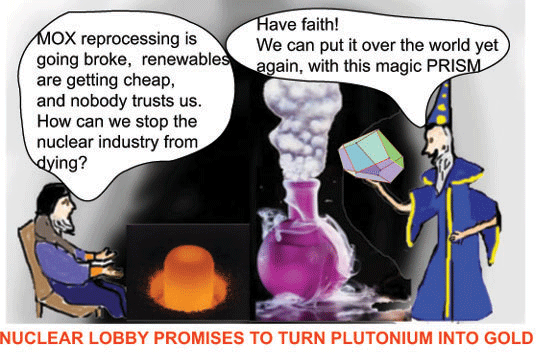
It is understood that the NDA has been impressed by proposals from GE-Hitachi to build a pair of its Prism fast reactors on the Sellafield site,
Revealed: UK Government’s radical plan to ‘burn up’ UK’s mountain of plutonium http://www.independent.co.uk/news/science/revealed-uk-governments-radical-plan-to-burn-up-uks-mountain-of-plutonium-8967535.html 28 Nove 13 A radical plan to dispose of Britain’s huge store of civil plutonium – the biggest in the world – by “burning” it in a new type of fast reactor is now officially one of three “credible options” being considered by the Government, The Independent understands. However, further delays have hit attempts to make a final decision on what to do with the growing plutonium stockpile which has been a recurring headache for successive governments over the past three decades.
The stock of plutonium, one of the most dangerous radioactive substances and the element of nuclear bombs, has already exceeded 100 tonnes and is likely to grow to as much as 140 tonnes by 2020, bolstered by a recent decision to include foreign plutonium from imported nuclear waste.
Ministers had pledged to resolve the plutonium problem in a public consultation but are sitting on a secret report by the Nuclear Decommissioning Authority (NDA) which is believed to confirm that there are now three “credible options” for dealing with the plutonium stored at the Sellafield nuclear reprocessing plant in Cumbria. Continue reading
Vested interests busy “spinning” the Iran nuclear deal
Iran’s Nuclear Deal Triggers Spin War By Pepe Escobar Global Research, November 27, 2013 Iran’s nuclear deal with the P5+1 group of world powers in Geneva has triggered a spin war which will last for the next 6 months, as many of the parties involved will pursue their own business interests in this situation, journalist Pepe Escobar told RT.
RT: As we see, US Secretary of State John Kerry and Iran’s Foreign Minister Mohammed Zarif came out of the talks with different views. Why’s there such diversity in the interpretation of the deal?
Pepe Escobar: Because the spin war started at 3am in Geneva. It’s going to go on for another six months, until May 2014, that’s the duration of this “first step” deal. [It’s] very important: Kerry had to say [this] so that he could appease the Israel lobby, the US Congress and the Wahhabi petrodollar lobby in the US, not to mention some neocons in the US as well, [who are] still very powerful.
Follow the Money: How Lobby Interests are Spinning Iran Nuclear Deal
In Iran it’s different. They are saying, “We still have our right to enrich uranium,” and this is correct, because they will keep enriching uranium to 5 percent for the next six months, [while] 20 percent [enrichment] is frozen. They will discuss… the next deal, which will be the definitive deal, starting from May 2014.
And all the 20 percent enriched uranium that they have is going to be diluted, so it cannot be used later on for weapons-grade material………
For the moment we have a breakthrough – it’s going to last for six months. There will be all sorts of interests that will try to bombard this deal; I’m saying especially about Wahhabi petrodollar monarchy interests and the Israeli lobby as well.
But for the moment we have diplomacy in action, something that we haven’t seen, especially between Iran and the US, for 34 years. This is the major breakthrough at the moment. But we have to be vigilant.http://www.globalresearch.ca/irans-nuclear-deal-triggers-spin-war/5359638
Popularity of new Iran nuclear deal is making critics think twice
 Iran nuclear deal foes rein in criticism LA Times, The deal’s backers and opponents are recalibrating strategies in light of war-weary Americans’ conflicted views of Iran and strong support for the accord. By Paul Richter November 27, 2013, WASHINGTON — As they prepare for battle over the new deal to limit Iran’s nuclear program, the accord’s supporters and foes are calibrating strategies based on their reading of Americans’ conflicted views about the
  Islamic Republic.
American war-weariness forms a big part of the Obama administration’s campaign for the accord, a preliminary agreement to curb Iran’s disputed nuclear program. Administration officials have said that without a diplomatic deal, the country would be on a “march to war.”
For now, the administration appears to have the upper hand. Many skeptics of the deal, who issued sharp criticism shortly after its announcement, have since muted their words.
Instead of attacking the agreement directly, opponents have pinned their hopes on continued American suspicion of Iran and its leaders. They expect the government in Tehran to fail to meet its obligations under the agreement and are poised to go on the offensive if that happens.
“Critics of the deal are reluctant to attack it too frontally because they realize how popular it is,” said Dylan Williams, legislative director for J Street, a liberal pro-Israel group that supports the deal……
a Reuters-Ipsos survey released Tuesday showed 44% of respondents supported the new accord; 22% opposed it. If the deal failed, 49% would favor more sanctions, 31% wanted more diplomacy, and 20% wanted to turn to military force.
“The appetite for military engagement anywhere is very low,” said pollster Julia Clark of Ipsos. After two wars that were far longer and costlier than expected, “we in the public feel burned.”……….
The preliminary agreement between Iran and six world powers, including the U.S., was announced Sunday in Geneva. It would temporarily ease some of the sanctions that have crippled Iran’s economy in return for a halt to key aspects of the country’s nuclear program.
The deal is intended to allow time to negotiate a comprehensive agreement on the nuclear program…….
Israeli officials have strenuously opposed the accord, and lawmakers who support Israel have been prominent among the deal’s critics. But statements from major pro-Israel organizations in the United States have been relatively mild………http://www.latimes.com/world/la-fg-iran-deal-20131128,0,7605298.story#axzz2m40yK2dZ
Renewable energy – the way to empower women in Southern Africa
In Southern Africa, women led cooperatives could become part of a decentralised renewable energy  revolution. For instance, solar roof top energy systems generate energy at the place it is needed, increasing efficiency while allowing it to remain under the control of the people who use it.
Renewable energy is never just about energy, but rather about all the opportunities it creates. If society committed to this sustainable option, we would literally and figuratively be putting power in women’s hands.
The benefits extend far beyond environmental preservation, to a society where women are less burdened and abused, but instead empowered, independent and equal.
Southern Africa: Renewable Energy Can Give Women Power http://allafrica.com/stories/201311281197.html BY GLEN TYLER, 27 NOVEMBER 2013 Johannesburg — Climate change is happening fast. Africa is already feeling the negative effects, yet this continent is the least responsible for it.
While Greenpeace continues to campaign and lobby for climate justice and environmental sustainability, corporations and government continue to drag us into climate chaos. However, it is seldom acknowledged that women bear the brunt of this chaos and that climate justice is linked to gender justice. Continue reading
Bomb explosion near Kudankulam nuclear reactor – 6 killed
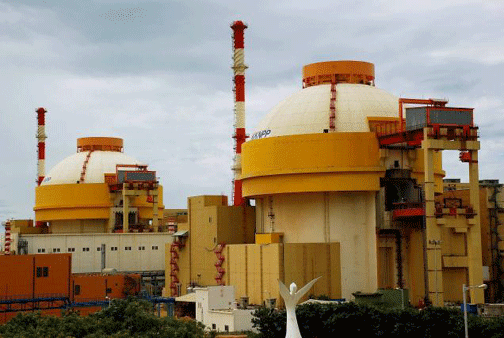 Bomb explodes near Indian nuclear reactor,THE AUSTRALIAN, ROBIN PAGNAMENTA THE TIMES NOVEMBER 29, 2013 A BOMB has exploded close to India’s biggest nuclear power station, killing six people and prompting a police investigation into whether it was linked with anti-nuclear protests in the area. The device exploded in a village close to Kudankulam in the southern state of Tamil Nadu, destroying at least two houses and seriously injuring three people. Among the six killed were a woman and three young children.
Vijayendra Bidari, a police spokesman, said the house in which it exploded was being used as a “bomb-making facility” in a village where anti-nuclear activists had been operating. He said the bomb apparently detonated accidentally as the suspected activists were building it. Two unexploded bombs were recovered from the site. The blast occurred about 1km from the Russian-built plant, which started operating last month – six years later than was planned – despite protests from locals who fear a nuclear accident.
Kudankulam lies in a seismically active area and the coastal zone was affected by the 2004 tsunami. Activists fear there could be a repeat of the 2011 Fukushima nuclear disaster in Japan.
SP Udayakumar, the founder of the People’s Movement Against Nuclear Energy, the main anti-nuclear group in the region, denied involvement in the bomb-making. “We made it clear immediately that we have nothing to do with the bomb blasts,” he said.
- Mr Udayakumar said he believed gangs associated with illegal mining were behind the blasts. – ………:
- –
6 Nuclear reactors now shut down in South Korea
 S.Korea nuclear reactor hit by automatic shutdown; six units now off First Post World, 29 Nov 13, SEOUL (Reuters) – A “safety-related action” automatically shut down one of its 23 nuclear reactors on Thursday, South Korea’s nuclear operator said, bringing the tally of those closed to six and hiking chances of possible power blackouts this winter……. “We are now looking into the cause of the shutdown and it is not yet clear when the reactor will restart,” said a spokesman at operator Korea Hydro & Nuclear Power. Operation of the 587-megawatt Kori No. 1 reactor, over 300 km southeast of Seoul, was suspended early on Thursday morning. The reactor, which started operation in 1978, had recently returned from nearly 180 days of scheduled maintenance through October 5, according to KHNP’s website. (www.khnp.co.kr). The unit’s license to operate was extended another 10 years in end-2007, another KHNP spokesman noted……
1 This Month


Tell the Ukrainian Government to Drop Prosecution of Peace Activist Yurii Sheliazhenko

Petition to revoke the licensing of the Near Surface Nuclear Disposal Facility (NSDF) at Chalk River. https://www.ourcommons.ca/petitions/en/Petition/Details?Petition=e-7247


of the week – STOP SMALL MODULAR REACTORS IN CANADA
To see nuclear-related stories in greater depth and intensity – go to https://nuclearinformation.wordpress.com
-
Archives
- March 2026 (204)
- February 2026 (268)
- January 2026 (308)
- December 2025 (358)
- November 2025 (359)
- October 2025 (376)
- September 2025 (258)
- August 2025 (319)
- July 2025 (230)
- June 2025 (348)
- May 2025 (261)
- April 2025 (305)
-
Categories
- 1
- 1 NUCLEAR ISSUES
- business and costs
- climate change
- culture and arts
- ENERGY
- environment
- health
- history
- indigenous issues
- Legal
- marketing of nuclear
- media
- opposition to nuclear
- PERSONAL STORIES
- politics
- politics international
- Religion and ethics
- safety
- secrets,lies and civil liberties
- spinbuster
- technology
- Uranium
- wastes
- weapons and war
- Women
- 2 WORLD
- ACTION
- AFRICA
- Atrocities
- AUSTRALIA
- Christina's notes
- Christina's themes
- culture and arts
- Events
- Fuk 2022
- Fuk 2023
- Fukushima 2017
- Fukushima 2018
- fukushima 2019
- Fukushima 2020
- Fukushima 2021
- general
- global warming
- Humour (God we need it)
- Nuclear
- RARE EARTHS
- Reference
- resources – print
- Resources -audiovicual
- Weekly Newsletter
- World
- World Nuclear
- YouTube
-
RSS
Entries RSS
Comments RSS
 nuclear-news