Federal plans to truck radioactive material from a World War II-era plant in Tennessee to Nevada for burial in the desert are rekindling a long-running battle to prevent the Silver State from becoming the nation’s nuclear dumping ground.
U.S. Department of Energy officials told residents at a town hall meeting Wednesday in Las Vegas that the state doesn’t have authority to prevent shipments of uranium waste from Oak Ridge, Tenn., to the Nevada National Security Site north of Las Vegas.
A similar meeting was scheduled late Thursday in rural Pahrump.
Nevada Gov. Brian Sandoval, who protested the waste transport and burial plan when it became public last summer, issued a statement Thursday calling it premature to say whether the state will seek a federal court order to block the shipments.
Sandoval aide Mary-Sarah Kinner pointed to continuing talks between state and Energy Department to address concerns about the plan.
Energy Department administrators said they’ve revised transportation plans, agreed to bury the waste deeper than initially planned, and performed evaluations “above and beyond regulatory requirements” to address state concerns, including the safety of the waste for 10,000 years.
A truck was loaded at Oak Ridge in June, and officials told residents in Las Vegas they want to begin shipments under armed guard in January, before the trip certification expires. Up to 100 shipments would follow before 2017. Shipping times and routes would be kept secret.
The delay is costing $2.5 million a month, department spokeswoman Aoife McCarthy said.
Tracy Mustin, a deputy to Energy Secretary Ernest Moniz, declared Wednesday that moving the potentially deadly material some 2,000 miles was “necessary and in the interest of national security.”
“We’re confident that we can execute the program safely and securely,” Mustin said.
The assurances brought criticism from several of the 80 or so people who attended Wednesday’s town hall meeting, including veterans of the decades-long battle that has so far blocked a plan to entomb waste from nuclear plants in tunnels at Yucca Mountain, about 90 miles northwest of Las Vegas.
…With uranium prices low after the 2011 accident at Japan’s Fukushima Daiichi atomic power plant, Russia has “no need” now to blend down more highly enriched uranium for fuel, said Sergei Novikov, spokesman for state nuclear corporation Rosatom….
MOSCOW (Reuters) – A 20-year-old deal that has powered American homes while reducing the risk of Russian nuclear material falling into the wrong hands approached its end on Thursday when the final shipment of uranium left St Petersburg for Baltimore.
Under the 1993 HEU Purchase Agreement, Russia downblended 500 metric tons of highly enriched uranium (HEU) from nuclear weapons into low-enriched uranium and sent it to the United States, where it was made into fuel for nuclear power plants.
Over much of the life of the deal, it was used to generate roughly half of all commercial nuclear energy produced in the United States, or nearly 10 percent of all U.S. electricity, according to the U.S. Energy Department.
“For two decades, one in 10 light bulbs in America has been powered by nuclear material from Russian nuclear warheads,” Energy Secretary Ernest Moniz said of the agreement, commonly known as Megatons for Megawatts.
It provided cash and jobs in Russia’s nuclear industry at a time, after the 1991 Soviet collapse, when fears ran high that impoverished scientists would sell secrets or “dirty bomb” ingredients.
It was “crucial for stabilising the Russian nuclear complex at a critical time in the 1990s,” said Matthew Bunn, a Harvard University professor and expert on nuclear security and proliferation.
He called it “perhaps the most successful U.S.-Russian cooperative effort to reduce nuclear dangers”.
But times have changed. A richer Russia, while seeking to expand its nuclear energy industry, has resisted U.S. efforts to extend the agreement or come up with another one to continue blending down HEU, Bunn said.
The deal was done when Russia wanted financial aid from the West. President Vladimir Putin, in power since 2000, has made a point of rejecting handouts and demanded that the United States treat Russia as an equal.
“It is too bad … that Russia has not decided to blend down substantial additional quantities of highly enriched uranium,” Bunn said. “They still have far more than is plausibly needed for their military programmes.”
The following brief was just published by the Institute for Science and International Security (ISIS) on the current state of Iran’s nuclear program:
Key Findings from the IAEA Iran Safeguards Report
David Albright, Christina Walrond, and Andrea Stricker
November 14, 2013
The International Atomic Energy Agency (IAEA) released on November 14, 2013 its report on the implementation of NPT safeguards in Iran and the status of Iran’s compliance with Security Council resolutions. Below are the key findings from the report. A complete ISIS analysis will follow later today.
Key Findings:
1) Iran has continued to produce near 20 and 3.5 percent low enriched uranium (LEU) at the same rate as the last reporting period. Its centrifuge capability at the Natanz and Fordow enrichment facilities remains essentially the same as the last reporting period.
2) Number of installed IR-1 centrifuges at the Natanz Fuel Enrichment Plant (FEP) increases by only 4 machines; number of enriching centrifuges decreases by two cascades.
3) No new IR-2m machines installed and no enrichment in IR-2m cascades in the FEP.
4) No new centrifuges enriching at the Fordow Fuel Enrichment Plant, and no increase in the number of installed centrifuges at the plant.
5) Iran continues to convert its 19.75 percent uranium hexafluoride into uranium oxide, but it has increased its stockpile of near 20 percent low enriched uranium hexafluoride by 10 kg to 196 kg total.
6) Critical components of the IR-40 Reactor at Arak remain uninstalled.
7) No new fuel assemblies completed for the IR-40 reactor; number of fuel assemblies remains consistent at 10; Iran in the process of completing an eleventh assembly. A full core would hold 150 fuel assemblies
8) Iran takes positive step in concluding initial cooperation agreement with IAEA; much more is required to satisfy IAEA’s concerns about past or possibly ongoing nuclear weapons related work. Iran also did not agree to provide updated, detailed design information on the Arak Heavy Water Reactor.
Published: November 14th, 2013 at 1:22 am ET
By ENENews
Amchitka Island, Alaska, Biological Monitoring Report 2011 Sampling Results, September 2013: To determine what [Fukushima Dai-ichi’s] direct release of radioactive materials into the atmosphere might have contributed to the background radiation on Amchitka and Adak Islands, semiquantitative gamma spectrometry measurements were made […] The results imply that Dolly Varden [a type of fish], rockweed, and to a lesser extent, Irish lord [a type of fish] appear to contain a significant cesium isotope signature from Fukushima Dai-ichi. The estimated 134Cs/137Cs activity ratios in pooled fauna samples at the time sampled ranged from <30 to about 60 percent. Observations of Fukushima-derived fallout impacting on this region are supported by findings of elevated levels of 134Cs (and 137Cs) in lichen and soil collected from both the Adak and Amchitka regions. […]
Lichen sample from mid-2011 expressed in picocuries/kilogram — Lichen on the island had less than 70 pCi/kg of Cs-137 in 1997.
Department of Energy: Biological Monitoring at Amchitka Appears to Show Impacts from Fukushima Dai-ichi Incident […] The U.S. Department of Energy Office Legacy Management (LM) has a long-term stewardship mission to protect human health and the environment from the legacy of underground nuclear testing conducted at Amchitka Island, Alaska, from 1965 to 1971. […] Atmospheric monitoring in the United States showed elevated cesium activities shortly after the [Fukushima] nuclear incident. LM scientists anticipated that atmospheric transport of cesium would potentially increase the cesium activities in the 2011 biological samples collected near Amchitka. Because cesium-134 has a relatively short half-life of 2 years and indicates leakage from a nuclear reactor, it is a clear indicator of a recent nuclear accident […] Because the Amchitka 2011 sampling event occurred soon after the Fukushima nuclear accident, the biota impacted by atmospheric precipitation showed the greatest impact (e.g., species that live in freshwater or shallow ocean waters) when compared to marine biota living in deeper water. This is because ocean currents are a slower transport process than wind currents. LM scientists anticipate that the marine biota will show the impacts of Fukushima during the next sampling event, currently scheduled to occur in 2016. […]
They also found Uranium-235, 236 and 238 in these items. Starts on Page 247.
>> You can see how these radioisotopes can add up very quickly if you’re eating the fish.
……………………………………………………………………………………
And from Mary M….
In this report, it appears that the Plutonium detected was actually NOT more in 2011 compared to their testing in 2004.
Cesium 137, Uranium 234 and Uranium 236 levels were higher/more in 2011 (pg55).
Maybe there’s something I’m missing, but this area was definitely a hot spot before, so it is not all related to Fukushima. Does anyone read the Plutonium part differently?
For a long time now there has been concern about the Trans Pacific Partnership Agreement and what it might mean for intellectual property laws and online rights but little is known about the negotiations for the treaty because talks are being held in secret. However, WikiLeaks managed to obtain and release the chapter of the agreement concerning IP and people who’ve been following the talks are more worried than ever. We spoke to journalist, writer and author of Rebel Code, Glyn Moody about just what the TPP is and the potential consequences of it being signed.
…..The deal, worth over $10 billion, is seen as a pivotal test of the technology’s future on the continent, and Rosatom’s marketing and engineering subsidiaries abroad, Rusatom Overseas and Astomstroyexport, are competing against Westinghouse, a U.S. unit of Japan’s Toshiba.
The rules could also make it difficult for Rosatom to license its VVER reactor in Britain with a view to build it at a British site, Laaksonen said.
“It is not enough to have the world’s best plants, if you cannot tell how good you are and how are your plants,” he said…..
Published: Friday November 15, 2013 MYT 12:10:02 AM
MOSCOW (Reuters) – An ambitious export drive by Russia’s nuclear reactor corporation is being hamstrung by dated Soviet-style secrecy rules, foreign executives at the company say.
Rosatom has hired a former Finnish nuclear regulator, Jukka Laaksonen, to be the face of Russian nuclear energy abroad and a guarantor of safety.
But in a throwback to Soviet secrecy rules, Laaksonen and two other new foreign vice presidents are barred from working out of its Moscow headquarters, a hulking colonnaded building that housed the Soviet Union’s atomic ministry in the 1950s.
Before Rosatom’s export branch, Rusatom Overseas, moved to its own offices, its Czech vice president, Leos Tomicek, often worked out a cafe across the street, a company spokesman said.
Tomicek and Laaksonen say strict internal commercial secrecy rules prevent the Russian state firm from advertising its latest technology and are the biggest obstacle to Russia’s ambitions to triple sales by 2030.
“You cannot sell something in a black box,” said Laaksonen, who joined Rusatom Overseas almost two years ago.
“The legislation is old, and the culture is old. This is very helpful for all our competitors.”
The Russian nuclear industry has won recent sales by offering full-package deals for nuclear newcomers such as Vietnam, Turkey, China and Bangladesh.
This was made possible by a consolidation of the industry under Rosatom’s chief Sergei Kiriyenko, who was Russia’s youngest-ever prime minister under President Boris Yeltsin.
Rosatom now controls all facets of the business from uranium mining to fuel enrichment and grid development.
Backed by President Vladimir Putin, it is now building more nuclear plants worldwide than any other vendor, bidding for most major tenders and plans to open 20 marketing offices.
The nuclear giant, which is building 19 reactors outside of Russia, this month said its foreign orders portfolio was worth $66.5 billion in 2012, up 30 percent from a year earlier. It aims to have orders for 30 reactors abroad by 2030.
But Russia will fail to sell reactors to the European Union and other markets with nuclear know-how, unless it scraps rules preventing it from supplying the level of details on its reactor designs that such clients and regulators demand, Laaksonen said.
How to Get Censored on China’s TwitterProPublica, Nov. 14, 2013, 11:19 a.m.“Author Name, ProPublica.” not to be resold, reposted or changed without Authors Accreditation 中文版:新浪微博:遭遇中国式审查
Air Force Chief of Staff Gen. Mark Welsh says the change was initiated as the Air Force searched for a successor to Maj. Gen. Michael Carey. He was fired in October for misbehavior as commander of 20th Air Force, which is responsible for all 450 of the Air Force’s Minuteman 3 nuclear missiles.
The removal of Carey came amid a series of disclosures by The Associated Press about security and leadership lapses, morale problems, training flaws, and an assertion by one midlevel nuclear officer that he had found ”rot” inside his unit at Minot Air Force Base.
….In August, the number of people in Fukushima who have died since the accident from illnesses related to prolonged evacuation rose to 1,539, nearing the prefecture’s tsunami death toll of 1,599….
By Mia 14/11/13
The government said they are going to support the evacuees with a new proposal. I am concerned because:
Those residents in the area more than 50mSv/y will get sufficient financial help from the government, but those in the remaining area are not going to be financially supported.
Where are those residents in 50mSv/y going be housed? They could be offered to live in 20mSv/y zone in Fukushima prefecture as the government considers it safe.
Maybe people outside Japan think that those 160,000 evacuees from the Fukushima nuclear accident, earthquake and tsunami were evacuated into a safe area from the Fukushima prefecture, but the most of the evacuees had been evacuated just outside 20km radius of the crippled plant where radiation level is anywhere between up to 20mSv/y. Those husbands among the evacuees who had lost jobs from the earthquake, tsunami and Fukushima nuclear accident have ended up working as Tepco clean-up workers and have been even more exposed to radiation. Other help offered by the Japanese government was announced for pregnant women and children to be provided free accommodation if they decide to come back to Fukushima prefecture. In my opinion, this is a disgrace. Also, they would advise the residents to use dosimeters because it reads even lower than the public monitoring posts.
[Mia`s note – Correction to main stream media published figures] The number 160,000 is reported as a number of evacuees in the most of Japanese and English news except for a few reports, but I think it is figure of total evacuees who were affected by Earthquake, Tsunami and Fukushima accident in Tohoku region. After searching the regional information concerning refugees, I think seems 86,000 is about right for the Fukushima disaster evacuees. The Japanese government evacuated only the residents in the areas 20km radius of the Fukushima Nuclear power plant and also from Iidate village, Kawauchi village and some from Minami-soma city. Total population in those areas was about 86,000.)
————————————————-
“For many Fukushima evacuees, the truth is they won’t be going home” by Sophie Knight and Antoni Slodkowski Iwaki, Japan Mon Nov 11, 2013 (Reuters)
“The government is also considering a proposal floated earlier this month to offer new compensation to residents in the areas of highest radiation who have no prospect of returning home, officials involved have said.”
For many of Japan’s oldest nuclear refugees, all they want is to be allowed back to the homes they were forced to abandon. Others are ready to move away, severing ties to the ghost towns that remain in the shadow of the wrecked Fukushima nuclear plant.
But among the thousands of evacuees stuck in temporary housing more than two and a half years after the worst nuclear accident since Chernobyl, there is a shared understanding on one point – Japan’s government is unable to deliver on its ambitious initial goals for cleaning up the areas that had to be evacuated after the March 2011 earthquake and tsunami disaster……
…..Lawmakers from Prime Minister Shinzo Abe’s coalition parties on Monday recommended the government step back from the most ambitious Fukushima clean-up goals, and begin telling evacuees that a $30 billion clean-up will not achieve the long-term radiation reduction goal set by the previous administration. “The government and ruling party will act as one and deal with this firmly,” said Chief Cabinet Secretary Yoshihide Suga, adding that Abe would consider the proposal seriously.
The government is also considering a proposal floated earlier this month to offer new compensation to residents in the areas of highest radiation who have no prospect of returning home, officials involved have said.
FRUSTRATION, RESIGNATION 福島原発避難者:不満とあきらめ
……. Social workers report an increase in domestic strife, alcoholism and illnesses such as deep vein thrombosis from lack of exercise. In August, the number of people in Fukushima who have died since the accident from illnesses related to prolonged evacuation rose to 1,539, nearing the prefecture’s tsunami death toll of 1,599.
Among those who remain, there is frustration, resignation and a sense that the hardest decisions remain ahead……… No matter how hard they try to decontaminate, radiation isn’t going down. So even though we have decided to go back, we can’t,” said Keiko Shioi, a 59-year-old housewife from Naraha, near the nuclear plant. …..“No matter how much they decontaminate I’m not going back because I have children and it is my responsibility to protect them,” said Yumi Ide, a mother of two teenage boys from Tomioka……
…Westinghouse is also optimistic about opportunities in Eastern Europe – including in Bulgaria and Ukraine – and in South East Asian countries such as Vietnam….
“We see [Saudi Arabia] as a good market for us to not only grow our technology, but as a very fertile market as supply chain development,” said Danny Roderick, the chief executive of the United States-based firm owned by Toshiba.
Saudi Arabia, the world’s biggest oil exporter, plans to seek preliminary bids for its first nuclear reactor next year.
The request for proposals could be for more than one reactor, the first of which would start construction in 2017 for completion in 2022, said Muhammad Garwan, the atomic energy team leader of the King Abdullah City for Atomic and Renewable Energy (Ka-Care), the government’s energy diversification planner.
Over a decade-long construction period, the country plans to add 18 gigawatts of nuclear power, which combined with 54GW of renewable energy, would represent half of the kingdom’s soaring power demand.
It would have to finalise a “123” cooperation pact with the US to enable it to buy nuclear technology from Westinghouse or other US firms.
Section 123 of the US Atomic Energy Act requires a specific agreement for significant transfers of nuclear material, equipment or components from the US to another nation.
“I still have high optimism that the 123 agreement will get made, but it is a very complex set of discussions right now, and both parties are going to have to come to the table and talk,” said Mr Roderick.
Westinghouse is supplying technology to the nuclear power plants being built in the UAE, which has a 123 agreement with the US.
…It was not immediately clear how Egypt would finance the plant, but since Mursi’s removal it has been offered $12 billion in aid from Kuwait, Saudi Arabia and the United Arab Emirates….
CAIRO (Reuters) – Egypt will launch an international tender in January to build its first nuclear power station, an Electricity Ministry spokesman said on Thursday before talks with Russian officials on cooperation between the two countries.
Egypt froze its nuclear programme after the 1986 nuclear disaster at Chernobyl, but announced in 2006 it planned to revive it. Plans for a tender were being prepared when President Hosni Mubarak was deposed in February 2011.
Aktham Abouelela, spokesman for the Electricity Ministry said: “The Nuclear Power Plants Authority plans to launch the first international tender in January to build a nuclear station in Dabaa,” near the Mediterranean coast.
“It will be a pressurised water reactor with a capacity of 950 to 1650 megawatts. The station will have two units,” Abouelela added.
Egypt’s economic outlook has been clouded by political uncertainty since Mubarak’s downfall, which set off turbulence that has chased away foreign investors and tourists. Islamist President Mohamed Mursi was ousted by the army in July in response to massive street protests against his rule.
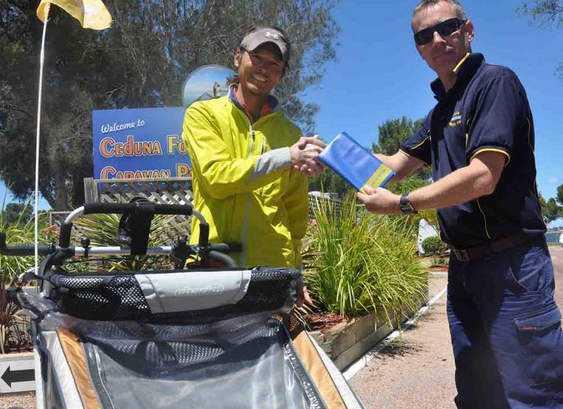
Mr Takashige is undertaking his ‘Peace Run’, which will see him run 40,000 kilometres across five continents, and is currently on the leg that takes him across Australia and New Zealand.
This run will have two purposes, to continue his peace run and to raise money for the victims of the Fukushima tsunami.
Mr Takashige said it was important to help the young people living in Fukushima.
“Two years ago there was a big earthquake and tsunami, and I decided to donate to the victims, especially the kids of Fukushima,” he said.
“I want the kids to move from their home town to somewhere safer as soon as possible.”
The run began two years ago with his run across the USA from Los Angeles to New York, which took him over 5800 kilometres and 138 days to complete as he travelled across the prairies and Rocky Mountains.
Mr Takashige said he used to be a cyclist, and decided to cycle across several countries in 1994.
“I’m an ex-English teacher and I made up my mind to travel around the world by bike,” he said.
“I cycled across the United States, Canada, New Zealand and Australia, and I’m taking the same route again.”
In 1995 Mr Takashige cycled from Perth to Sydney, taking 85 days and 5500 kilometres to complete.
This included riding through the Nullarbor and Ceduna, which he said he felt a special connection with.
He said he likes to enjoy the great nature of Australia.
“Last time I crossed the Nullarbor Plain I was surprised to see the longest stretch of nothing but desert,” he said.
“We don’t see such an isolated place in Japan.”
After having a hard time in the Nullarbor during his first journey, he went into the region with a plan, including shopping for supplies in Esperance and Norseman.
He was also fortunate to be paid a visit by some of his friends from Japan while he was in Madura, who provided him with some of his favourite foods including rice and cookies.
Mr Takashige said while on the road he also received donations from people passing by.
“Many caravan drivers stopped to ask questions, and also offered canned food, frozen vegetables and water,” he said.
“I couldn’t imagine how kind the local people were, every day I received a lot of food and water, and have received around $600 in donations so far.”
While in Ceduna Mr Takashige stayed at the Ceduna Foreshore Caravan Park, which provided him with donations of water and money, as well as a pass to other caravan parks on Eyre Peninsula.
Some of the visitors who saw him on the road also provided him with donations for his cause.
Mr Takashige said he hoped to arrive in Sydney by the end of January, where he will fly to Aukland to begin his New Zealand leg.
From there he will depart back to Japan, and plans to continue the peace run next year through Europe, Africa and South America.
He said he hopes to meet as many people as possible in his journey around the world.
“When I first travelled to Australia I didn’t notice how beautiful the coast is and how nice the people are,” he said.
“I’m enjoying everything I see and the people I meet.”
“I’m happy to run across Australia on my own two legs, but next time I visit I will be driving.”
For more information or to make a donation email to kaytaka@hotmail.com
Mice fed an experimental anti-inflammatory drug three days before exposure to space-like radiation developed half as many carcinomas as mice that did not get the compound, a finding that has implications for astronauts on long-duration missions, as well as people on Earth receiving radiation treatments for therapeutic reasons, new research shows.
We expect our drinking water to be germ free, but what about drug free? You probably haven’t given it much thought … but new research is showing our water is teeming with all kinds of drugs!
DNews Video
The compound, which is derived from plant moss, belongs to a family of drugs called synthetic triterpenoids, which in addition to easing inflammation appear have powerful antioxidant properties.
Synthetic triterpenoids already are in clinical trials and appear to be useful in treating kidney disease, diabetes, age-related macular degeneration, pulmonary diseases, Alzheimer’s, Parkinson’s and various cancers.
The idea to give irradiated mice food laced with a dose of the synthetic triterpenoid CDDO-Me stemmed from a previous series of experiments.
Researchers discovered that mice irradiated over several days developed more cancerous tumors than mice receiving a single hit of radiation, even though the total dosages were identical, Jerry Shaw, with the University of Texas Southwestern Medical Center in Dallas said at the American Society for Gravitational and Space Research conference in Orlando last week.
The mice had been genetically modified to be susceptible to either lung cancer or colon cancer — the first and second leading causes of cancer deaths in the United States.
Cells in the lungs tend to be replaced only when damaged, while colon cells turn over about every seven days, giving researchers two different processes to study.
Splitting up the radiation dose had similar effects on both groups. So did varying the type of radiation.
“This suggested that there was something about the fractioned dose of radiation that was leading to more invasive cancers,” Shaw said.
Since 2011, the Mita clinic in the city of Kodaira, near Tokyo, conducted blood tests and thyroid scans on 1,500 patients, including children.These tests are to be brought to completion and Dr. Shigeru Mita, director of the clinic, the health of the inhabitants of the capital deteriorated sharply after the catastrophe of Fukushima.
In an interview with the website Save children from radiation , Dr. Shigeru Mita said that “the rate of neutrophils (the most abundant type of white blood cells, an essential part of the immune system) in healthy children aged 6to 12 years is 4000, but the patients tested, it is 2500, well below the minimum value allowed so-called “threshold” level which is 3000. I think it shows a serious problem. “
This is of course due to the catastrophe of Fukushima.
“During the summer of 2011, there have been many cases of children with the bloodshot eyes, and found in most cases large circles. (…) We see now more cases of sinusitis accompanied by asthma. (…) And when these children spend some time in western Japan, their health improves. If it were possible, it would have to move away from the east of Japan. “
“Radioactive substances from Fukushima Daiichi reached Tokyo, and huge amounts of contaminated waste is burned and there is no denying the fact that we inhale radioactive substances in the air. Again, after the nuclear accident, a huge amount of radioactive material was released into the environment. Therefore, if we see an increase in symptoms that are different from those we observed previously, physicians should first take into account the effects of radioactivity. “
“I really hope that not only the children leave Tokyo, but also adults,” “Older people need more time to heal asthma, but medication is not working. There is also more patients with diseases that were once rare “






 nuclear-news