The latest-generation French nuclear reactor known as the EPR will be tested for the first time in China in 2014, according to Trade Minister Nicole Bricq.
“The Chinese have said this, they have promised me,” Bricq said in an interview in Paris. “The Chinese have told us that it’s their ambition.”
Areva SA (AREVA) and Electricite de France SA are developing EPRs in China at Taishan, Finland, France and under the latest plan in the U.K. following a deal last month to build a $26 billion plant at Hinkley Point in England. The projects at Flamanville in Normandy and Finland for the as-yet unproven EPR reactor have been plagued by delays and billions in budget overruns.
Bricq made her comments on the Chinese project yesterday following a press conference to publicize a nuclear trade fair next October in Paris as well as the importance of the atomic industry for French exports and jobs.
EDF Chief Executive Officer Henri Proglio declined to give a date for when the EPR at Taishan will be completed, saying that it’s China’s role to name the time.
“Taishan is progressing well,” he said.
The first EPR project in Finland, led by Areva, the French company that designed the technology, is seven years behind schedule and won’t be completed until 2016. The second, an EDF project at Flamanville in northwest France, will cost more than twice as much as expected.
EDF has said the lessons learned in these countries as well as China mean Hinkley Point will go more smoothly.
Delayed Start
The Taishan plant, built in partnership with China General Nuclear Power Corp., will start commercial operation in 2015, EDF said last month. That’s about a year later than originally planned. China General and China National Nuclear Corp. will hold minority stakes in the U.K. project.
At Flamanville in Normandy, EDF has pushed back the commercial start of the generator numerous times and revised cost estimates three years in a row. In December, the state-controlled utility raised the estimate to 8.5 billion euros ($11.4 billion).
Key milestones for developing the EPR were reached two years faster in China than in Finland, according to Areva.
WASHINGTON — Over the resistance of state officials, the Department of Energy is moving forward with plans to ship highly radioactive uranium waste to the Nevada National Security Site for burial in a government landfill, federal leaders said Tuesday.
DOE officials insisted the strategy will be safe despite questions about the suitability of disposing potent and long-lived nuclear material in trenches that would be dug deeper than 40 feet into the desert.
Kevin Knobloch, chief of staff to Energy Secretary Ernest Moniz, said Nevada cannot veto the disposal plan at the government’s self-regulated site about 65 miles north of Las Vegas.
In the face of opposition from Nevada Gov. Brian Sandoval, Knoblach said DOE has pledged to “work very closely with state and local authorities to make sure we are listening to concerns, answering questions, sharing information.”
Knobloch and other DOE officials spoke to reporters as DOE prepares for public meetings in Las Vegas on Wednesday and in Pahrump on Thursday on the plan, which was delayed earlier this year after it was publicized and began to draw further scrutiny.
Starting early next year, 403 canisters containing a ceramic mixture of uranium-233, uranium-235 and uranium-232 will be transported to Nevada from the Oak Ridge National Laboratory as part of an environmental cleanup of the Tennessee site.
This is a developing story. Check back for updates.
Birol pointed out that imported natural gas prices in Japan are five times higher than in the USA. He said that it is important for the country “to think carefully whether or not to go back to the use of nuclear while it has to keep electricity prices down.”
The export markets of Europe and Japan will decline as a result of higher electricity prices, according to the International Energy Agency’s 2013 edition of its World Energy Outlook (WEO).
Currently, electricity prices for industrial consumers in Europe and Japan are more than double those in the USA. This large gap in prices is projected to be maintained through to 2035 in the latest WEO annual report, affecting company strategies and investment decisions in energy-intensive industries. While America sees its share of global exports of energy-intensive goods slightly increase to 2035, Europe and Japan would see their shares of global exports decline by 10% and 3% respectively from today’s levels – representing a combined loss of around one-third of their current share.
Speaking at the launch of the report in London today, IEA chief economist and WEO Editor Fatih Birol said, “Lower energy prices in the USA mean that it is well-placed to reap an economic advantage, while higher costs for energy-intensive industries in Europe and Japan are set to be a heavy burden.”
“It didn’t spread via the internet. It spread outside of its target due to a bug and so it started traveling via USB. Given the community targeted, I would not be surprised if other countries had nuclear plants with infected PCs,” he said.
The virus appears to have spread to other countries.
One of the world’s top computer security experts – Eugene Kaspersky – said this week that the virus has attacked a Russian nuclear reactor. As The Register notes:
The infamous Stuxnet malware thought to have been developed by the US and Israel to disrupt Iran’s nuclear facilities, also managed to cause chaos at a Russian nuclear plant, according to Eugene Kaspersky.
The revelation came during a Q&A session after a speech at Australia’s National Press Club last week, in which he argued that those spooks responsible for “offensive technologies” don’t realise the unintended consequences of releasing malware into the wild.
“Everything you do is a boomerang,” he added. “It will get back to you.”
***
“Unfortunately, it’s very possible that other nations which are not in a conflict will be victims of cyber attacks on critical infrastructure,” said Kaspersky.
“It’s cyber space. [There are] no borders, [and many facilities share the] same systems.”
Not finished there, Kaspersky also claimed to have heard from “Russian space guys” in the know that even machines on the International Space Station had been infected “from time to time” after scientists arrived aboard with infected USBs.
Watch for yourself:
As British security website V3 – in an article entitled “Stuxnet: UK and US nuclear plants at risk as malware spreads outside Russia” – reports:
Experts from FireEye [background] and F-Secure [background] told V3 the nature of Stuxnet means it is likely many power plants have fallen victim to the malware ….
F-Secure security analyst Sean Sullivan told V3 Stuxnet’s unpredictable nature means it has likely spread to other facilities outside of the plant mentioned by Kaspersky.
TORONTO Already increasing electricity bills will soar even higher if Ontario Power Generation gets approval for a 30 per cent increase in the rate it is paid for electricity generated by nuclear power, the New Democrats warned Tuesday.
“You’re seeing rates go up faster than they should,” said NDP energy critic Peter Tabuns. “As long as the Liberals see a blank cheque as a parachute to get out of any tough spots, our bills are going to go up.”
OPG said the rate increase, if approved by the Ontario Energy Board, would add about $5.36 each month to the bill for typical residential customers.
The reasons for the requested hike “include ensuring obligations for used nuclear fuel management and decommissioning costs are met,” the government-owned utility said in a statement.
L’UNSCEAR (Comité scientifique des Nations Unies sur l’effet du rayonnement atomique) a récemment publié un rapport intitulé « Sources, effets et dangers des rayonnements ionisants” avec un accent particulier mis sur les niveaux et les effets de l’exposition aux radiations dues à l’accident nucléaire de Fukushima au Japon.
Ce rapport a été critiqué par des experts médicaux. Dans cette vidéo, le Dr Alex Rosen, un pédiatre allemand membre d’IPPNW (Association Internationale des Médecins pour la Prévention de la Guerre Nucléaire), fustige la minimisation de l’impact de la radoactivité par l’UNSCEAR et le lobby nucléaire.
Le Dr. Keith Baverstock, un ancien chercheur à l’OMS, parle, lui, du manque d’indépendance de l’OMS dans ses recherches sur l’ impact sur la santé de la radioativité, précisément, ce que dans le cadre des activités d’IndependentWHO nous ne cessons de dénoncer.
Dr. Alex Rosen from Düsseldorf, Germany is a member of the International Physicians for the Prevention of Nuclear War and sends his personal message on the health risks of nuclear energy
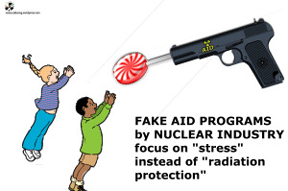
The nuclear industry helps irradiating and murdering Children, assisted by IAEA, WHO, ICRP, BEIR, UNSCEAR and local and national health authorities. With Cover Up, Dose Limits and Do not evacuate Policy.
Here is a belarusian Example: CORE / ETHOS Program:
= learn how to live in irradiated areas (no word about evacuation) & avoid stress (instead of radiation protection) & build industry, infra structure, accept the radiation, resettlement of people in contaminated areas <- instead of evacuation!
“Even in the present, over one year after the Fukushima Daiichi nuclear disaster, there are restrictions on children playing outside in areas of Fukushima”
Of course it is. Children still live in irradiated areas and are massively more vunerable to it, than their parents. Children = Mitosis = faster cell division = FAST CANCER GROWTH & silent death
“their physical strength has declined greatly due to insufficient exercise and they are also experiencing mental stress.”
Is stress the problem? Or is a Cesium 137 radionuclide in their heart tissue the problem? A plutonium atom in the lungs? Strontium 90 in bones and teeth? Is stress really the problem? Continue reading →
How the Nuclear Industry first kills the Children and then the Parents April 14, 2013 by Mikkai妊娠中の日本人女性の避難すぐ translated by Jan Hemmer, NGO “For the Children of Chernobyl”
There is statistical health damage caused by the so-called low-level radiation (above ZERO up to 500mSv.) That is not assigned to any particular people, but occur in a defined population. This issue is the subject of thousands of studies all over the world since the Chernobyl nuclear disaster, and I will discuss in detail below with reference to examples. Factors such as age, gender, health, immune system, nutrition, social situation and the duration of exposure of the radioactivity influence the onset of cancer and other diseases.Until the Chernobyl disaster, the biological effects in the body of the radioactive isotopes have been undervalued.
It is now clear: Any radiation poses a risk especially for children who are extremely radiosensitive.
1) A child is constantly increasing in weight and size, it grows from the intrauterine embryo to adult, the younger, the faster.Therefore, the cells divide much more frequently than an adult.Cells in the division phase (mitosis) are more vulnerable to radiation than cells in the resting phase.
2) The ability of the body to recognize “defective” cells and to eliminate them develops during childhood. An embryo has not yet this ability. Therefore “defective” cells can multiply unimpeded and later lead to cancer or heritable diseases.
The Mainichi, Nov. 11, 2013: NRA chairman blocks interviews with Fukushima residents over exposure doses […] NRA Chairman Shunichi Tanaka intervened to limit such interviews to friendly local government leaders, the Mainichi Shimbun has learned. Tanaka’s action is igniting a chorus of protests from members of the NRA’s expert panel […] The panel under NRA Commissioner Kayoko Nakamura’s leadership started deliberations in September by inviting five outside experts, including those in charge of emergency radiation medicine. […] However, when NRA Chairman Tanaka learned of the proposal in late October he rejected it […] Masafumi Yokemoto, professor of environmental policy at Osaka City University […] criticizes NRA Chairman Tanaka for meddling in the expert panel’s deliberations and blocking interviews with evacuees to draw a foregone conclusion that the repatriation of evacuees is the only viable option. […]
Reuters, , Nov. 11, 2013: […] Some had hoped the decontamination project employing thousands of temporary workers to strip trees, spray roads and remove topsoil would be enough […] 90 percent of the projected reduction in radiation comes from natural decay of radioactive particles over time.[…] “No matter how hard they try to decontaminate, radiation isn’t going down. So even though we have decided to go back, we can’t,” said Keiko Shioi, a 59-year-old housewife from Naraha, near the nuclear plant. […]
NHK WORLD, Nov. 11, 2013: Experts call for change in radiation measuring […] A panel of experts is urging the Japanese government to change the way it measures radiation exposure for evacuees from the Fukushima nuclear accident when they return home. […] To date, officials have estimated exposure based on radiation levels in the environment. But the panel says they should measures exposure by equipping individuals with radiation monitors called dosimeters. Radiation measurements made by dosimeters tend to be one-third to one-seventh of readings estimated through environmental monitoring. […] The panel also calls for assigning local government officials and health nurses as advisors in each community. […] NHK Newsline, Nov. 11, 2013 (h/t Anonymous tip): […] The proposal comes at a time when the government is aiming to lift the evacuation advisory for areas where annual radiation doses are estimated at 20 millisieverts or lower. […] The new method is expected to help promote returns of evacuees as well as reduce costs for decontaminating areas tainted by radioactive fallout.
NHK Newsline, Nov. 11, 2013 (at 0:45 in): Readings on such devices [personal dosimeters] tend to be one-third to one-seventh lower than estimates based on environmental monitoring. […] Radiation measurements made by dosimeters tend to be one-third to one-seventh of readings estimated through environmental monitoring. […] “Individual monitor readings don’t necessarily reflect different radiation levels in a household.” -Fukushima evacuee Watch NHK’s broadcast here
Chernobyl Birds Have Smaller Brains PLOS 1 Anders Pape Møller mail, Andea Bonisoli-Alquati, Geir Rudolfsen, Timothy A. Mousseau Abstract
Background
Animals living in areas contaminated by radioactive material from Chernobyl suffer from increased oxidative stress and low levels of antioxidants. Therefore, normal development of the nervous system is jeopardized as reflected by high frequencies of developmental errors, reduced brain size and impaired cognitive abilities in humans. Alternatively, associations between psychological effects and radiation have been attributed to post-traumatic stress in humans.
Methodology/Principal Finding
Here we used an extensive sample of 550 birds belonging to 48 species to test the prediction that even in the absence of post-traumatic stress, there is a negative association between relative brain size and level of background radiation. We found a negative association between brain size as reflected by external head volume and level of background radiation, independent of structural body size and body mass. The observed reduction in brain size in relation to background radiation amounted to 5% across the range of almost a factor 5,000 in radiation level. Species differed significantly in reduction in brain size with increasing background radiation, and brain size was the only morphological character that showed a negative relationship with radiation. Brain size was significantly smaller in yearlings than in older individuals.
Conclusions/Significance
Low dose radiation can have significant effects on normal brain development as reflected by brain size and therefore potentially cognitive ability. The fact that brain size was smaller in yearlings than in older individuals implies that there was significant directional selection on brain size with individuals with larger brains experiencing a viability advantage……..http://www.plosone.org/article/info:doi/10.1371/journal.pone.0016862
Russia’s floating nuclear plants to power remote Arctic regions, The Conversation, Tony Roulstone, 12 Nov 13 “…..Russia is embarking on an ambitious and somewhat imaginative programme of building floating nuclear power stations…… These reactors, mounted on huge, 140m by 30m barges, are being built in the Baltic shipyard in St Petersburg and will be floated through the Norwegian and Barents Seas to where they will generate heat and electrical power in the Arctic.
The first, Academician Lomonosov, has been built and its two 35MWe KLT-40S reactors are now being installed. Lomonosovis destined for Vilyuchinsk, on the Kamchatka Peninsula in the Russian Far East where she will be operating by 2016. Up to ten similar plants are destined for similarly remote and unpopulated areas……. The KLT-40S reactor is fuelled by 30-40% enriched uranium, which falls outside what would be allowed for civil use (concern about weapons proliferation limits enrichment to very low levels). The reactors are built in factories and assembled in shipyards, where productivity is much higher and quality standards easier to police than on construction sites. But military reactors are designed with little thought for costs and because of their small power output it’s very likely that their lifetime generating costs will be several times that of large, grid-connected reactors, and many more times higher that of a gas power station…….
Just how safe Russian military reactors are is clouded in secrecy; we just don’t know how safe the KLT-40S is. Russia has successfully operated nine nuclear icebreakers over the past 50 years. On the other hand we know that seven Russian nuclear submarines have sunk, some due to reactor problems and others due to weapons explosion onboard, and a further ten reported reactor accidents. So this reactor’s pedigree is not unblemished.
Cooling systems for civil reactors have become very complex and this is a prime cause of soaring construction costs. It is difficult to install in a naval vessel the number of systems and separate them so that they provide redundancy should one fail. …..
As with many other aspects, we do not know whether the containment structure of the Russian reactors will be effective. Though the Russians are being imaginative in developing barge-mounted reactors to address a problem specific to their geography and their needs, the lack of openness makes it hard to see how useful their nuclear technology can be in the West……. http://theconversation.com/russias-floating-nuclear-plants-to-power-remote-arctic-regions-19994
If this seems too big to comprehend, let’s look at the state level. Jacobson has worked with research teams to develop plans for New York and California, and he hopes to do one for each state in the country.
The California plan aims for “all new energy powered with WWS by 2020, 80-85 percent of existing energy replaced by 2030, and 100 percent replaced by 2050.”
When it comes to New York, the biggest difference from California is a little less concentrated solar and much more offshore wind. This is their New York plan:……..
We Have the Renewable Energy We Need to Power the World—So What’s Stopping Us?A leading researcher says we have enough wind and solar to power the world. Are we willing to do what’s necessary to transform our society Alter Net, Tara LohanNovember 8, 2013 |The environment is one bad news story after another The Pacific Ocean is warming at a rate faster than anything seen in the last 10,000 years and we may have the warmest Arctic in the last 120,000 years. We’re told to brace for more and worse droughts, floods, heat waves, and storms. Coastal communities may disappear from rising seas, entire island nations are going under. If that all weren’t bad enough, there is a global wine shortage.
The bright side is that we aren’t being blindsided by an unknown enemy: Our relentless burning of fossil fuels is the big thing pushing us toward the brink. So it would figure that a solution to get us out of this mess would be pretty obvious.
That’s why it’s great that there are people like Mark Z. Jacobson, a professor of civil and environmental engineering at Stanford University. While it is one thing to say we want to stop burning fossil fuels, Jacobson (and a team of researchers) are telling us how to do it.
Jacobson was recently on the “David Letterman Show,” where he proclaimed that we have enough wind and solar to power the world…… Continue reading →
The Next Big Innovation in Renewable Energy Won’t Be Technological It will be financial. The Atlantic,TODD WOODY NOV 11 2013,Silicon Valley solar company SolarCity last week quietly did something that could revolutionize renewable energy in the United States. No, the company did not invent a radically more efficient or cheaper photovoltaic panel. Rather, it announced it plans to sell $54 million in asset-backed securities.
And that is a very big deal, even if the dollar amount of the notes on offer is rather small. That’s because the assets backing the securities are leases for some of the rooftop solar systems it has installed on homes across the country. Hundreds of millions of dollars in solar leases have been signed in the U.S. in recent years. If those leases can be bundled and sold to pension funds and other investors, “solar securitization” could open up a potentially huge new pool of capital that could be tapped to finance the expansion of renewable energy as federal and state tax breaks for renewable energy begin to expire. For homeowners and businesses, solar securitization could translate into cheaper electricity. A SolarCity spokesman declined to comment on the securities offering.
Much of the innovation responsible for the solar industry’s explosive growth has been financial rather than technological. Half the U.S.’s solar capacity, for instance, was installed just in 2012. Driving those sales was the ability of homeowners to avoid the five-figure cost of a photovoltaic system by leasing it for a monthly payment that often is lower than what they’d pay their local utility. Anywhere between 75 and 90 percent of all solar systems are now leased as a result……..HTTP://WWW.THEATLANTIC.COM/TECHNOLOGY/ARCHIVE/2013/11/THE-NEXT-BIG-INNOVATION-IN-RENEWABLE-ENERGY-WONT-BE-TECHNOLOGICAL/281345/
Kerry sees nuclear deal with Iran as diplomacy warms BY LESLEY WROUGHTON AND ANDREW OSBORN ABU DHABI/LONDON Mon Nov 11, 2013 (Reuters) – U.S. Secretary of State John Kerry said on Monday he hoped an agreement on Iran’s disputed nuclear program would be signed within months and London and Tehran revived diplomatic ties, signs of a warmer atmosphere between the Islamic Republic and the West.
In a further indication of cooperation, the United Nations nuclear watchdog reached an agreement under which Iran will grant U.N. inspectors access to more nuclear facilities.
Iran and six world powers – the United States, Britain, Russia, France, China and Germany – came close to a preliminary nuclear agreement at the weekend during talks in Geneva and decided to resume negotiations on November 20 in their attempt to defuse a decade-old standoff……. http://www.reuters.com/article/2013/11/11/us-iran-nuclear-idUSBRE9A804X20131111








 nuclear-news