Eastern European scientists’ studiesshed new light on Chernobyl nuclear radiation
 Perspectives on Chernobyl and Fukushima Health Effects: Journal of Health and Pollution, Vol 3 June 2013 What Can Be Learned From Eastern European Research?
Timothy Mousseau, PhD1
UK’s new nuclear obsolete before it’s ever switched on ?
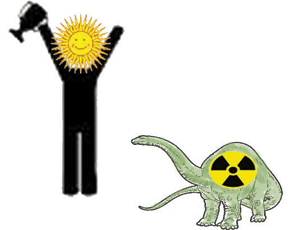
 Nuclear may become obsolete warns US solar energy chief The UK risks missing out on the benefits of solar power by focusing on sources such as nuclear, according to the Scottish entrepreneur behind one of America’s fastest growing retail solar panel companies. Telegraph UK By Louise Armitstead25 Aug 2013
“Given the proven cost curve in solar, that nuclear plant could be obsolete before it’s even switched on. Politicians must be careful not to lock Britons into 20th century energy prices…….http://www.telegraph.co.uk/finance/newsbysector/energy/10265065/Nuclear-may-become-obsolete-warns-US-solar-energy-chief.html
Japan’s taxpayers to cop huge expense in fukushima radiation clean-up
 State to spend over ¥1 trillion of taxpayer money for Fukushima decontamination work http://www.japantimes.co.jp/news/2013/11/02/national/state-to-spend-over-%C2%A51-trillion-of-taxpayer-money-for-fukushima-decontamination-work/?utm_source=rss&utm_medium=rss&utm_campaign=state-to-spend-over-%25c2%25a51-trillion-of-taxpayer-money-for-fukushima-decontamination-work#.Unli23Bwo7o KYODO NOV 2, 2013
In a major policy shift, the government will use more than ¥1 trillion in public funds to clean up contaminated areas around the Fukushima No. 1 plant, according to sources.
The plan revealed Friday to alleviate the financial burden Tokyo Electric Power Co. was supposed to shoulder is in line with a ruling Liberal Democratic Party proposal compiled Thursday on ways to accelerate the sluggish recovery from one of the world’s worst nuclear crises.
Tepco is still expected to stump up to some ¥3 trillion because the government has no intention of exempting it from decontamination payments that have already been planned by the state and local governments.
The central government, for its part, plans to use taxpayers’ money to respond to additional decontamination needs for infrastructure restoration, such as cleaning schools, parks and other public facilities that have been left to go to seed after residents fled from their homes. It will also use public funds to build interim storage facilities to keep radioactive soil and other waste from the cleanup efforts.
The Environment Ministry has earmarked a total of ¥1.5 trillion for radioactive decontamination through fiscal 2013, ending next March, and has asked Tepco to pay back ¥40 billion of the funds it has so far used. But the utility has only returned ¥6.7 billion, citing delays in clerical work and tough business conditions.
Tepco is struggling amid soaring costs for fuel imports to boost thermal power generation to cover the loss of all its nuclear plants. It also needs funds to compensate people and companies affected by the nuclear crisis and to decommission the crippled reactors of the Fukushima No. 1 plant.
TEPCO struggles with plans to avoid bankruptcy
Japan’s Fukushima operator mulls overhaul to counter break-up plans http://in.reuters.com/article/2013/11/04/japan-fukushima-tepco-reorganisation-idINL2N0IP09C20131104 By Yoshifumi Takemoto and Kentaro Hamada TOKYO | Mon Nov 4, 2013 (Reuters) – The operator of Japan’s wrecked Fukushima nuclear plant is working on a reorganization plan to fend off more drastic proposals, including possibly dragging the company through bankruptcy in return for a publicly funded clean-up and shutdown of the reactors. Continue reading
India’s nuclear industry not really safe – new book
In recent years, some of the crucial Russian suppliers of components to the plant have been detained in Russia and indicted for shoddy business practices.
 A new book, The Power of Promise: Examining Nuclear Energy in India by Princeton University physicist M.V. Ramana, takes a sober—and sobering—look at the fantasies and perils attached to this mirage, and finds the promise of nuclear energy empty in every way: environmental, economic and technological.
The more disturbing parts of Ramana’s book deal with the neglect of safety by the nuclear establishment. Recounting various alarming “incidents” in recent decades, he inspires little confidence in India’s ability to avoid a major disaster such as Chernobyl or Fukushima.
 India shouldn’t buy what Japan is selling, Live Mint, 4 Nov 13, Materials of substandard quality have already been installed in Kudankulam plant, says former chairman of AERB Pankaj Mishra
  An obsession with nuclear power makes many political elites secretive, ruthless and delusional, even as their cherished projects threaten millions of people with disaster. But the egregious examples I have in mind here aren’t Iran, Pakistan and North Korea. They are Japan and India, two countries with democratic institutions.
Hungary the 12th country to have highly enriched uranium HEU converted to LEU
UNITED STATES, INTERNATIONAL PARTNERS REMOVE LAST REMAINING WEAPONS-USABLE HIGHLY ENRICHED URANIUM FROM HUNGARY, SET NUCLEAR SECURITY MILESTONE EIN News Desk 4 Nov 13,WASHINGTON – The U.S. Department of Energy today announced under a multi-year international effort coordinated between Hungary, the United States, the Russian Federation, and the International Atomic Energy Agency (IAEA), the successful removal of all remaining highly enriched uranium (HEU) from Hungary. This makes Hungary the twelfth country to completely eliminate HEU from its borders since President Obama’s 2009 announcement of an international effort to secure all vulnerable nuclear material around the world……..
The final 49.2 kilograms of remaining HEU in Hungary were removed over a series of three secure air shipments during the past six weeks and transported to Russia. Previously, the four participants returned 190 kilograms of HEU from Hungary to Russia via three shipments – in 2008, 2009, and 2012. The material will be transported to Russia where it will be downblended into low enriched uranium (LEU) for use in nuclear power reactors.
The other eleven countries and locations that have completely removed HEU under this effort are Austria, Chile, Czech Republic, Libya, Mexico, Romania, Serbia, Taiwan, Turkey, Ukraine, and Vietnam. To date, the Department has removed or dispositioned more than 5,000 kilograms of HEU and plutonium from more than 40 countries around the world and has removed all HEU from 25 countries. A fact sheet on the Department’s efforts to prevent nuclear terrorism is available here…….. http://www.einnews.com/pr_news/174969858/united-states-international-partners-remove-last-remaining-weapons-usable-highly-enriched-uranium-from-hungary-set-nuclear-security-milestone
Japanese government lags on developing renewable energy
Viewpoint: Japan dawdles on a clear energy policy, The Spec.com Viewpoint: The Japan Times (excerpt), 4 Nov 13 Uncertainties hang over Japan’s energy policy 40 years after the global panic over oil supplies shocked the nation and prodded it to diversify into nuclear power. This reliance on nuclear power came to a halt following the March 2011 triple meltdowns at Tokyo Electric Power Co.’s Fukushima No. 1 nuclear power plant. The government has yet to set a new direction.
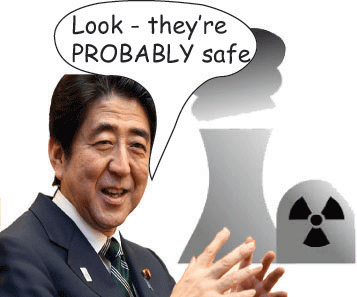
While dismissing the idea of nuclear power phase-out as unrealistic and “irresponsible,” Prime Minister Shinzo Abe has said his administration will try to “reduce as much as possible” Japan’s reliance on nuclear power. But little progress has been made toward this goal and the prime minister appears to consider nuclear energy to be a key part of his administration’s economic growth strategy.
The government is in the process of crafting a new medium- to long-term energy plan by the end of this year. In working out the plan, it should set a clear timeline to end Japan’s reliance on nuclear power while making serious efforts to expand renewable energy resources as much as possible……..
Diversification of energy supply remains a major challenge. Japan still relies on imports from the Middle East for more than 80 per cent of its oil. Renewable energy sources such as wind and solar power still account for only a tiny portion of Japan’s power needs. Japanese companies must make strenuous efforts to further improve energy-saving technologies and the government should vigorously promote renewable energy sources. These efforts will help create the basis for building a stable economy. http://www.thespec.com/opinion-story/4190255-viewpoint-japan-dawdles-on-a-clear-energy-policy/
Radiation exposure to endovascular procedure operators
Endovascular interventions exposed operators to more radiation than coronary Healio, Ingwersen M. J Am Coll Cardiol Intv. 2013;6:1095-1102. November 4, 2013
Operators who performed endovascular procedures for pelvic, upper limb and below-the-knee disease experienced increased radiation exposure in the cath lab compared with those who performed coronary procedures…….Although recommended dose limits were not exceeded in our study, radiation exposure may have biological effects depending on the type and frequency of procedures performed, the time lag between the procedures, the fluoroscopy time and a patient’s BMI,” the researchers wrote. “Therefore, protection devices, spectral filtration, pulsed fluoroscopy and low frame rates should be used whenever possible.” http://www.healio.com/cardiology/intervention/news/online/%7B5a58b7e0-ecc4-4957-847a-8f67c3b8edf0%7D/endovascular-interventions-exposed-operators-to-more-radiation-than-coronary
Big corporations increasingly investing in renewable energy
 Why corporations like Microsoft are investing in renewable energy Microsoft joins the growing ranks of firms – including Walmart, Google and Ikea – that are investing in renewable energy. Do these deals make good business sense? Ucilia Wang theguardian.com, Tuesday 5 November 2013 In a move that underlines the growing appeal of corporate investment in renewable energy, Microsoft announced Monday that it will power one of its data centers with electricity from a Texas wind farm.
The software giant has agreed to buy all of the output from the 110MW wind farm for 20 years. The project, to be built by RES Americas, will send electricity into a local grid that serves a Microsoft data center in San Antonio. Construction is set to start next year and be completed in 2015……..
as the wind and solar markets grow, thanks in large part to federal and state tax breaks and other subsidies, the cost of building and owning renewable-energy projects – along with the price of renewable energy – has steeply declined. The average long-term price for wind power to US utilities plummeted to $40 per megawatt-hour, in 2012 contracts, from $70 per megawatt-hour in 2009, according to Lawrence Berkeley National Laboratory report.
Meanwhile, the marketing benefit of investing in renewables remains strong. Buying wind power or owning wind farms, for example, represents a deeper commitment to fighting climate change than simply buying credits. ….. Continue reading
Point Lepreau nuclear power plant leaks toxic chemical into Bay of Fundy again!
NB Power says levels of hydrazine low; will investigate to prevent future releases
CBC News
Posted:Nov 04, 2013
http://www.cbc.ca/m/touch/canada/story/1.2356261
Water laced with low levels of the toxic chemical hydrazine has spilled from the Point Lepreau nuclear power plant into the Bay of Fundy, according to NB Power.
The release happened Sunday when light water leaked from a valve on the non-nuclear side of the Point Lepreau Generating Station, according to the company. The release is contained, it said.
NB Power said samples taken Sunday along the shoreline of the Bay of Fundy contained 0.009 parts per million of hydrazine.
In a statement, the company said the concentration is “less than federally recommended guidelines that determine impacts on marine life or ecological systems.” Testing Monday found levels below detection, the company said.
“NB Power will continue to monitor the area and take additional samples,” Claire Harris, a manager at the generating station, said in an statement.
“Following a thorough investigation, NB Power will determine the appropriate measures to implement and prevent recurrence.”
Hydrazine is used to strip oxygen from water in steam generators. It protects the generators from corrosion and keeps the proper water chemistry.
It’s not the first time hydrazine from Point Lepreau has been released. Two years ago, 23 barrels of water mixed with the chemical leaked into the Bay of Fundy.
Three weeks later, there was a radioactive spill in the plant when six litres of heavy water splashed to the floor.
At the time, the head of Canada’s Nuclear Safety Commission called the events “unsettling.”
The Nuclear Meltdown at Fukushima: Danger, Deception and Betrayal
We are grateful to Ian Thomas Ash for sparking a badly needed debate. His documentary is powerful and personal. The mothers and the radiation-badges wearing children of Fukushima speak the tragic voice of truth.
Evaggelos Vallianatos
Last month I watched a documentary on the March 11, 2011 nuclear disaster in Fukushima prefecture, Japan. The showing of the 2013 documentary, A2-B-C, took place in a cafeteria of Pomona College where students gather at tables and speak foreign languages. I am a guest at the Greek table.
The American producer, Ian Thomas Ash, introduced his film and answered questions. He is young and unusually virtuous and talented. He sees himself as a witness of a tragedy he has to report to the world.
He said he felt morally obliged to document the effects of the horrific nuclear accident. That is the reason he is not married and without children. For the duration of filming he lived in the contaminated Fukushima prefecture with the affected local people. He ate the food they ate and drank the same water. In addition, he speaks Japanese and has lived in Japan for several years.
He admitted the focus of his documentary was not the actual disaster or the lethal nature of the nuclear power plants. Rather, he felt compelled to bring to life the nuclear meltdown through the eyes and feelings of mothers and children near the damaged Fukushima nuclear factories.
The story opens a few days after the disaster when Ian questions a government official about safety. The official reluctantly puts all the blame on science: that this is an enterprise beyond human control. “Nothing is certain,” the official says, “but I am telling you to feel safe.”
Then Ian returns to Fukushima eighteen months after the nuclear explosion. He talks and has dinner with mothers still living with their families in the radiation-contaminated zone.
The Fukushima mothers are angry. They speak of deception and betrayal. They resent
they have become the guinea pigs of the unholy alliance of the nuclear company and the state, which keep telling the mothers everything is under control.
The mothers see workers “decontaminating” radiation hot spots near their homes, but no one can guarantee their children will not get cancer. All the officials say is, “it’s safe, it’s safe.”
Meanwhile, we see Fukushima children on hospital beds being checked for thyroid cysts. Forty-four percent of the children are afflicted with thyroid cysts. Those children also suffer from severe nosebleeds and skin rashes. Each child carries a shining glass radiation badge hanging from his or her book bag.
Ian talked to some of those young children. They cheerfully explained the purpose of their radiation badges. “To warn us about the radiation in the playground,” they said. “Will we get leukemia and die?” they asked.
Ian also talked to a 17-year-old girl planning to study engineering. “I panicked when they found thyroid cysts on me,” she said.
Post-Fukushima costs hitting Florida Power & Light Co. customers
Monday, Nov. 4, 2013
Palm Beach Post Staff Writer
This story continues the new premium website for subscribers only
http://www.palmbeachpost.com/news/business/post-fukushima-costs-hitting-fpl-customers/nbhPX/
NRC Proposed a $3,500 Fine for a Michigan Cardiology Practice Over Willful Violations of Regulations for Employee Radiation Dose Monitoring
“We cannot tolerate willful violations of NRC requirements nor lying to NRC inspectors,”
3,500 Dollars Fine (Proposed)
No: III-13-040 November 4, 2013
CONTACT: Viktoria Mitlyng 630-829-9662
Prema Chandrathil 630-829-9663
http://www.noodls.com/view/D770D7E7F4FE1D805EF9AA03517679091F01801C?rh=
The Nuclear Regulatory Commission has proposed a fine of $3,500 for Jackson Cardiology Associates of Jackson, Mich. after finding a nuclear medicine technologist employed by the practice willfully violated NRC regulations by not wearing the required radiation dose monitoring badges and lying to an NRC inspector about it.
During a routine inspection on Aug. 20, 2012, an NRC inspector found the technologist without the required monitoring badges to measure occupational radiation dose. The technologist initially told the inspector she had left the badges at home. But during a follow-up inspection on Nov. 7, 2012, the technologist admitted she had lied to the inspector and said she lost the badges in February 2012.
The NRC’s Office of Investigations in a follow-up investigation found the technologist did not have her monitoring badges analyzed or replaced between the latter half of 2010 and June 2012. The investigation also found the technologist stopped wearing her monitoring badges in late June 2012, and she had not made payments to the vendor who analyzed Jackson Cardiology’s monitoring badges.
The first violation is for the technologist’s willful failure to wear the required badges; the second is for the technologist willfully providing the NRC with incomplete and inaccurate information about
her badges. The proposed fine is the base civil penalty for Severity Level III violations, the second to lowest of the NRC’s four severity levels. Jackson Cardiology has taken several corrective actions, including changing procedures for radiation monitoring reports and payments, retraining the technologist and increasing oversight and supervision.
“We cannot tolerate willful violations of NRC requirements nor lying to NRC inspectors,” said Cynthia Pederson, NRC Region III Administrator. “While the actual safety significance in this case was limited because of the low dose rates, the technologist’s actions kept Jackson Cardiology from following radiation exposure monitoring requirements and impacted the NRC’s regulatory inspection process.”
Jackson Cardiology has the option to deny the violations or request alternative dispute resolution with the NRC to resolve the issue.
– See more at: http://www.noodls.com/view/D770D7E7F4FE1D805EF9AA03517679091F01801C?rh=#sthash.UC7NnDgH.dpuf
1 This Month

of the week – Shut Down Drone Warfare!


Tell the Ukrainian Government to Drop Prosecution of Peace Activist Yurii Sheliazhenko

Petition to revoke the licensing of the Near Surface Nuclear Disposal Facility (NSDF) at Chalk River. https://www.ourcommons.ca/petitions/en/Petition/Details?Petition=e-7247
To see nuclear-related stories in greater depth and intensity – go to https://nuclearinformation.wordpress.com
-
Archives
- April 2026 (103)
- March 2026 (251)
- February 2026 (268)
- January 2026 (308)
- December 2025 (358)
- November 2025 (359)
- October 2025 (376)
- September 2025 (257)
- August 2025 (319)
- July 2025 (230)
- June 2025 (348)
- May 2025 (261)
-
Categories
- 1
- 1 NUCLEAR ISSUES
- business and costs
- climate change
- culture and arts
- ENERGY
- environment
- health
- history
- indigenous issues
- Legal
- marketing of nuclear
- media
- opposition to nuclear
- PERSONAL STORIES
- politics
- politics international
- Religion and ethics
- safety
- secrets,lies and civil liberties
- spinbuster
- technology
- Uranium
- wastes
- weapons and war
- Women
- 2 WORLD
- ACTION
- AFRICA
- Atrocities
- AUSTRALIA
- Christina's notes
- Christina's themes
- culture and arts
- Events
- Fuk 2022
- Fuk 2023
- Fukushima 2017
- Fukushima 2018
- fukushima 2019
- Fukushima 2020
- Fukushima 2021
- general
- global warming
- Humour (God we need it)
- Nuclear
- RARE EARTHS
- Reference
- resources – print
- Resources -audiovicual
- Weekly Newsletter
- World
- World Nuclear
- YouTube
-
RSS
Entries RSS
Comments RSS
 nuclear-news