Hero rescues pets from Fukushima nuclear wasteland
Published on 5 Nov 2013
Subscribe to ITN News: http://bit.ly/itnytsub
A man who refused to leave when Japan’s Fukushima nuclear plants melted down is now caring for hundreds of abandoned animals in a wasteland. As fears of radiation grew following the meltdowns of March 2011, tens of thousands of people fled their homes, and the area was put into lock-down. Even now, more than two-and-a-half years after the disaster, those who enter must leave again before nightfall. But one man never left.
Keigo Sakamoto, 58, started an animal sanctuary over a decade ago in Naraha, fewer than 12-and-a-half miles from the Fukushima plant. After the disaster, he was ordered to evacuate, which would have meant abandoning some 500 animals including chickens, dogs, rabbits, geese, goats and guinea pigs. Sakamoto refused to leave. The government blocked access roads with concrete blocks and he was trapped inside, cut off from supplies. For months he and his animals ate anything they could find, explaining here that he feeds cat food to his dogs.
Twice a week, on Mondays and Fridays, Sakamoto makes the one-and-a-half-hour supply run to the nearby town of Iwaki. He receives some monetary support and bags of animal feed from his supporters, who send it to a pet shop in town. A supermarket provides him with discarded vegetables. Sakamoto says he is not scared, because he is protecting hundreds of lives, and plans to continue doing what he is doing. Report by Mark Morris.
China on Tuesday demanded that Japan provide “accurate” information on how it is handling new fallout from the Fukushima nuclear disaster.
06 Nov 2013
http://www.channelnewsasia.com/news/asiapacific/china-demands-accurate/875468.html
UNITED NATIONS: China on Tuesday demanded that Japan provide “accurate” information on how it is handling new fallout from the Fukushima nuclear disaster.
China told the UN General Assembly it was worried about radioactive water leaks from the Japanese plant that went into meltdown after being hit by a tsunami in March 2011.
“China follows closely the countermeasures to be adopted by Japan,” China’s deputy UN ambassador Wang Min told a debate on the International Atomic Energy Agency (IAEA), the UN nuclear watchdog.
“We urge the Japanese side to spare no effort in minimising the subsequent impact of the accident and provide timely, comprehensive and accurate information to the international community,” Wang added.
China and Japan have a series of bilateral disputes, and the new comments are certain to annoy the Japanese government, which is already under major domestic pressure over Fukushima, diplomats said.
Wang said the 2011 disaster had “sounded the alarm bell for nuclear safety” even though China “firmly” supports the use of nuclear power.
South Korea also said it was worried about the radioactive leaks but gave more support to Japan.
Fukushima “continues to be a source of serious concern, especially to adjacent countries, because of the spillage of contaminated water into the sea,” said South Korea’s deputy UN ambassador Sul Kyung-Hoon.
South Korea “appreciates the Japanese government’s efforts to share relevant information with the international community,” Sul added, while calling on the IAEA to strengthen assistance to Japan.
IAEA director general Yukiya Amano said the UN atomic watchdog “has recommended that Japan establish an effective plan and mechanisms for the long-term management of contaminated water.
“The announcement by the Japanese government of a basic policy for addressing this issue was an important step forward.” Amano added, saying that an IAEA team will visit Japan this year.
Fukushima and Iwaki reconstruction: eyewitness report
There is very little reconstruction along the Fukushima coastline: a sea wall, a few railway bridges on the East JR railway, but no housing development, no new city development. A local property agent working from Tokyo tells me: “I can’t sell houses, as banks won’t lend in this area.”

05 November 2013
http://www.channel4.com/news/fukushima-and-iwaki-reconstruction-eyewitness-report
British architect Garry Thomas visited Iwaki, near the damaged Fukushima Dai-ichi nuclear plant, recently. He found a place barely reconstructed, and residents losing hope.
During my visit to Iwaki, I stayed with two Japanese families, and got to see how little reconstruction there is, and how 25,000 people in the area have been displaced by tsunami damage or radiation contamination, writes Garry Thomas, a British architect.
The reason I visited the Fukushima area is that I have friends there, and I worked there as a student of architecture 19 years ago.
I worked with a Japanese architect in Iwaki – Yanai San. Whilst there as part of the Japan Home Stay programme, I lived with another architect – Yoshida San, also in Iwaki.
I was motivated to revisit the area to meet my old friends and to see for myself how the area and architects are coping with tsunami damage, earthquake damage and radiation contamination.
I found the situation far from positive and in crisis.
In spite of the huge reconstruction effort I was shocked to find out that there is very little work for architects in the Fukushima area. The situation is bogged down by the slow city planning process, bank funding and lending problems and an economy that is depressed by radiation and young people leaving the area.
The only real economy is services that provide for refugees, and radiation gang workers.
I found the situation far from positive and in crisis.
Yoshida San who used to employ a few people and his son, also an architect, has had to rent out his office space and part of his home to refugees because of a lack of work. He does what little work he has from a desk in his living room. His son has left the area and moved to Sendai to work in a practice with his old university professor.
nd Yanai San fears it is the yakuza [mafia] that now controls gangs of workers at the Daichii plant, an allegation which has been made before.
“It is the yakuza and their companies that are controlling the radiation gang workers,” he told me.
“Iwaki people stay at home more now, they fear the refugee population and the gang workers who drink in bars at night – they are too rustic for Iwaki city people.”
I get to meet some of the Iwaki refugee population and discover it is made up of those forced out by official radiation contamination, who receive government payouts; those who are forced out voluntarily from undefined radiation contamination, who receive no funding and have lost everything; and refugees made up of radiation gang workers, who are bussed to Daichii every day.
During my stay at the home of Yoshida San I get to meet Hiroaki San, a 10-year-old boy and his parents – voluntary refugees forced out of their hometown of Hisanohamma by tsunami damage and radiation fear.
U.N. cover-up of Fukushima exposed on TV — Medical Doctor: There’s now many more cancer cases than we expected from Fukushima, UNSCEAR report has falsified estimations (VIDEO)
Published: November 5th, 2013 at 4:01 pm ET
By ENENews
Title: Medical experts criticize UNSCEAR report for playing down consequences of Fukushima nuclear accident
Source: 3sat (German language public TV network)
Captions: World Network For Saving Children From Radiation
Date Published: Nov. 5, 2013
At 1:30 in
Dr. Alex Rosen, Medical Doctor and radiation specialist: There is now a much higher number of thyroid cancer cases than we expected. […]
Narrator: According to Dr. Alex Rosen, there are various falsified estimations in the UNSCEAR [United Nations Scientific Committee on the Effects of Atomic Radiation] report. […]
Professor Wolfgang Hoffman, professor of epidemiology at Geifswald University: It is certain that we will have an elevated level of cancer. […]
Marc Molitor, journalist with Belgisher TV (Belgium): A certain member within UNSCEAR told me that the report was written to play down the consequences of the Fukushima nuclear accident. Moreover, he also said that the members pretend not to learn the lesson from Chernobyl. There was seemingly a discussion on it.
[UNSCEAR Report: “No discernible increased incidence of radiation-related health effects are expected among exposed members of the public or their descendants. The most important health effect is on mental and social well-being”]
IAEA to gauge radioactivity in Fukushima seawater with limited testing, limited manpower and limited time!
6 November 2013, 01:36

According to the Japanese Foreign Ministry, two experts of the International Atomic Energy Agency, ecologist David Osborn and radiometrics engineer Hartmut Nies, will be in Japan next Thursday and Friday on a mission to sample seawater off Fukushima for gauging its radioactivity levels.
On March 11, 2011 four of the reactors of the Fukushima nuclear power plant were badly crippled by a series of accidents following a powerful earthquake and a subsequent tsunami.
Fukushima is now rated as the world’s worst nuclear disaster after Chernobyl.
Voice of Russia, RIA
Read more: http://voiceofrussia.com/news/2013_11_06/IAEA-to-gauge-radioactivity-in-Fukushima-seawater-1584/
Steering away from nuclear power following the 2011 Fukushima disaster, Japan on Monday opened its biggest solar plant.
5 november 2013
Japan’s Kyocera Corp. built the 70-megawatt Kagoshima Nanatsujima Mega Solar Plant in the country’s southwest region. The plant will produce enough electricity to power about 22,000 homes, according to xinhuanet.com.
“We would like to contribute to new development and improvement for human societies through a new type of energy production from Kagoshima, the place where many courageous samurai challenged the ancient political and social regime in the 1860s to reform the country,” Nobuo Kitamura, the plant’s president, said at the plant’s opening ceremony.
Japan aims to diversify its energy mix by developing its renewable energy sector, and it’s pushing solar by giving incentives to homeowners and businesses that use it. Previously, Japan’s energy policy favored nuclear power.
To date, Japan is one of only five countries to have achieved 10-gigawatts of cumulative solar capacity, according to recent research released by NPD Solarbuzz. The four other countries are Germany, Italy, China and the U.S.
According to an independent equity broker and financial services group, Japan’s solar energy will increase to 19-gigawatts by 2016. One gigawatt of solar power is enough to power 139,000 homes, according to the Solar Energy Industries Association.
By the end of August, rooftop solar panel installations made up 89 percent of Japan’s solar market, and the remaining 11 percent comprised installations on the ground and off-grid segments.
Japan’s evolving solar strategy includes efforts to diversify its energy portfolio, reduce its Mideast energy dependence and avoid related import disruptions.
Nuclear accident may force lockdown
The seven existing nuclear power plants in the UK are to be shut down by 2023
Irish homes could be forced into lockdown in the event of a major meltdown at a nuclear power plant in the UK, experts have warned.
The Radiological Protection Institute of Ireland (RPII) predicted people could be forced to stay indoors for days were an accident to occur at any of the eight plants dotted along the west coast of Britain.
Chief executive Dr Ann McGarry said while a potential accident would result in “no observable health impacts”, the socio-economic consequences would be much worse.
“People might be advised to stay in doors for a period of time. It could be from hours to possibly a day or two,” Dr McGarry said.
“For most of the accident scenarios that we looked at, some food controls would be necessary.
“The amount of radioactivity reaching Ireland wouldn’t be enough to directly impact the health of people, but if food contaminated wasn’t taken off shelves and people ate it, it would have some impact.”
Dr McGarry said radiation from a leak, spill or explosion would travel from the UK to Ireland by sea and air.
But what might initially be large amounts would be diluted in water or fail to travel the distance across the Irish Sea to be high enough to pose a serious risk.
The seven existing nuclear power plants in the UK are to be shut down by 2023.
It is proposed the plants will be replaced and eight new sites have been identified for construction.
Dr McGarry, during a grilling by members of the Oireachtas environment committee, played down any potential risks to Ireland that would result from their build.
She said one accident scenario had been identified in which cancer results could increase.
“From day-to-day operations, we do not believe there is a health risk, but we did look at one accident scenario where there would be an increase in cancer rates if things went badly wrong,” Dr McGarry said.
Responding to concerns about old tanks used at the Sellafield power station in Cumbria, the RPII chief insisted they posed no real danger to Ireland.
She likened the tanks to swimming pools above ground, saying if there were an explosion similar to that at Chernobyl in the 1980s, there would not be the same level of power to lift the radioactivity into the air for it to travel to Ireland.
The only way this could be achieved, she said, would be with a meteorite.
“If a meteorite were to hit a tank and release radioactivity into the air, then in that sort of scenario we could have some impact in Ireland.”
Japan, USA, France, (not India) gain from nuclear sales to India
India shouldn’t buy what Japan is selling, Live Mint, 4 Nov 13, Materials of substandard quality have already been installed in Kudankulam plant, says former chairman of AERB Pankaj Mishra ……… there are also broader political and economic compulsions behind the new proliferation of nuclear technologies.Japan’s conservative leaders want to preserve their nuclear option, even if that risks provoking South Korea and a devastating arms race in north Asia. Worried by Japan’s unused plutonium supply, the US, as the Wall Street Journal reported in May, is pushing to restart nuclear reactors in Japan.

With Fukushima’s emergency cleanup – it’s no time to be advocating new nuclear power!
nothing short of a full-on global presence will do. The bring-down of the fuel rods from Unit Four is a terrifying unknown. There’s no precedent for an operation of this scope, precision or potential fallout.
At very least it demands fullest possible attention from all the world’s best scientists and engineers. The global media must power through the Abe Administration’s crack-down on the flow of information. And we must all direct our full awareness to what is about to happen at Fukushima.
before anyone advocates MORE nuclear power, they should take a good long look at what’s going at Fukushima. And if they are claiming atomic expertise, maybe they should jump in to help.
 Global Warming vs Global Nuclear Radiation: Climate Scientists Dismiss Fukushima, Lobby for Nuclear Energy Global Research 4 Nov 13 Four climate scientists have made a public statement claiming nuclear power is an answer to global warming. Before they proceed, they should visit Fukushima, where the Tokyo Electric Power Company has moved definitively toward bringing down the some 1300 hot fuel rods from a pool at Unit Four.
Which makes this a time of global terror.
In response more than 150,000 petition signatures from www.nukefree.org and others will be delivered at the United Nations this Thursday, November 7, asking for a global response to this disaster.
Since March 11, 2011, fuel assemblies weighing some 400 tons, containing more than 1500 extremely radioactive fuel rods, have been suspended 100 feet in the air above Fukushima Daiichi’s Unit Four. “If you calculate the amount of cesium 137 in the pool, the amount is equivalent to 14,000 Hiroshima atomic bombs,” says Hiroaki Koide, assistant professor at Kyoto University Research Reactor Institute. Former US Department of Energy official Robert Alvarez, an expert on fuel pool fires, calculates potential fallout from Unit Four at ten times greater than what came from Chernobyl.
Tokyo Electric Power says it may start moving these fuel rods as early as November 8. Continue reading
For USA help, Japan must first sign up to free USA nuclear equipment providers from accident liabilty

 U.S. Says Japan Signing Liability Pact Would Aid Nuclear Cleanup Bloomberg, By Jacob Adelman – Nov 3, 2013 Japan will receive international help with the cleanup at the Fukushima atomic station once it
  joins an existing treaty that defines liability for accidents at nuclear plants, U.S. Energy Secretary Ernest Moniz said.
The treaty, known as the Convention on Supplementary Compensation for Nuclear Damage,assigns accident liability to plant operators rather than equipment and technology vendors,Moniz said in a Nov. 2 interview in Tokyo. Continue reading
Fukushima clean-up an “unprecedented challenge” says shocked USA Energy Secretary Moniz
 US Energy Secretary “shocked” and “stunned” after being at Fukushima plant — “Unprecedented” and “daunting” task ahead for Japan — America has “direct interest” in Tepco doing things safely (VIDEO) http://enenews.com/energy-secretary-shocked-stunned-after-being-fukushima-plant-unprecedented-daunting-task-ahead-japan-america-direct-interest-tepco-doing-safely-video
Statement from U.S. Secretary of Energy Ernest Moniz Regarding Fukushima, Nov. 1, 2013 “On Friday, I made my first visit to the Fukushima Daiichi Nuclear Power Station. It is stunning that one can see firsthand the destructive force of the tsunami even more than two and a half years after the tragic events.[…] TEPCO President Hirose, and his dedicated staff […] face a dauntingtask in the cleanup and decommissioning of Fukushima Daiichi, one that will take decades and is being carried out under very challenging conditions. The TEPCO workforce is facing unprecedented challenges and is clearly focused on devising and implementing solutions. […] It appears that spent nuclear fuel will begin to be removed from Unit 4 as scheduled in mid-November. […] As Japan continues […] the cleanup at the Fukushima site […] the United States stands ready to continue assisting our partners in this daunting yet indispensable task […]“
NHK WORLD, (removed from Internet) Oct. 31, 2013: Ernest Moniz […] in his speech in Tokyo on Thursday […] said the success of the cleanup of areas around the Fukushima plant and decommissioning of reactors have global significance. Moniz said the US has a direct interest in seeing the next steps are done efficiently and safely.
Fukushima to Remove Tritium, IAEA To Send “Help” Update 11/2/13
AP, Nov. 2, 2013: In a speech Thursday in Tokyo, [Moniz] said “the success of the cleanup also has global significance. So we all have a direct interest in seeing that the next steps are taken well, efficiently and safely.”
NHK,, Nov. 2, 2013: Ernest Moniz spoke to NHK on Saturday in Tokyo, one day after visiting the Fukushima Daiichi plant. Moniz said he was shocked to see the scale of the damage that remains more than 2 and half years after the tsunami disaster and the nuclear accident. He said he also sensed how difficult work at the plant is with workers required to wear full face masks and other protective gear.
Watch the NHK interview here (removed from Internet
Fukushima area gets another earthquake
Another earthquake: New 4.9 tremor near Fukushima Rt.com : November 04, 2013 A 4.9 magnitude earthquake with an epicenter close to Fukushima Prefecture has struck the eastern coast of Japan, the Japan Meteorological Agency said.
The tremor was registered at a depth of 20 km. There have not been immediate reports of damage or injuries. No tsunami warning has been issued.
It is the second earthquake to hit Fukushima neighboring prefecture in the past two days. A 5.0earthquake was registered on Japan’s east coast, with Sunday’s tremors felt as far away as Tokyo.
The news comes amid preparations for a tough and dangerous cleanup operation to remove fuel rods from Unit 4 at Fukushima Daiichi plant. ……http://rt.com/news/fukushima-japan-earthquake-nuclear-194/
28 reasons to worry about Fukushima radiation reaching USA West Coast
 28 facts that prove Fukushima’s nuclear disaster has put the West Coast in danger http://www.dose.ca/2013/11/04/28-facts-prove-fukushimas-nuclear-disaster-has-put-west-coast-danger Dose.caWeb stuff November 4, 2013 – New reports are showing that the infamous Fukushima Daiichi nuclear disaster that happened on March 11, 2011 has been more harmful than anyone could have ever predicted. Why? Because it turns out that radiation levels are constantly getting worse, especially on the West Coast, as 300 tons of radioactive water enter the Pacific Ocean every day.
Public and scientists do not believe Shinzo Abe’s statement that Fukushima nuclear radiation is controlled
For former nuclear engineer Michael Friedlander, who describes himself as “an avid supporter of responsible nuclear power,” these comments are damaging to the atomic industry.
“It’s a very Japanese way of handling the situation, the authorities telling everybody that everything’s OK, don’t worry, we’re in control,” Friedlander said in an interview from Hong Kong.
Abe’s comments haven’t persuaded the Japanese public. A Kyodo News poll conducted Oct. 26 and Oct. 27 found that 83 percent of respondents said they didn’t believe his “under control” statement.
The residents of Namie, a town 8 kilometers from the Fukushima nuclear station that was evacuated, said that Abe is making “irresponsible comments.
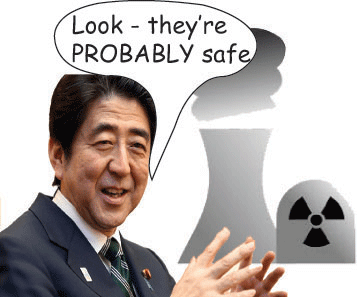 Abe’s stance on Fukushima water fuels skepticism Claim radioactivity contained scoffed at by public, scientists The Columbian, By Tsuyoshi Inajima and Yuriy Humber, Bloomberg News November 2, 2013, TOKYO — Japan’s Prime Minister Shinzo Abe says radioactive water flowing into the sea from the crippled Fukushima atomic station is being contained within the plant’s harbor, a view maintained by operator Tokyo Electric Power Co.
Marine scientists, Fukushima residents and Japan’s general public don’t agree. Continue reading
EDF has passed UK nuclear costs on to the British taxpayer

 Deutsche Bank notes that EdF has effectively handballed the risk of new nuclear to consumer and the UK government. The consumer is picking up the tab through higher electricity bills, and the UK government is using taxpayers money to guarantee 65 per cent of the project cost. With the involvement of Chinese nuclear interests, that leaves EdF with an exposure of just £3.5 billion. http://reneweconomy.com.au/2013/nuclear-part-2-36006

1 This Month

of the week – Shut Down Drone Warfare!


Tell the Ukrainian Government to Drop Prosecution of Peace Activist Yurii Sheliazhenko

Petition to revoke the licensing of the Near Surface Nuclear Disposal Facility (NSDF) at Chalk River. https://www.ourcommons.ca/petitions/en/Petition/Details?Petition=e-7247
To see nuclear-related stories in greater depth and intensity – go to https://nuclearinformation.wordpress.com
-
Archives
- April 2026 (91)
- March 2026 (251)
- February 2026 (268)
- January 2026 (308)
- December 2025 (358)
- November 2025 (359)
- October 2025 (376)
- September 2025 (257)
- August 2025 (319)
- July 2025 (230)
- June 2025 (348)
- May 2025 (261)
-
Categories
- 1
- 1 NUCLEAR ISSUES
- business and costs
- climate change
- culture and arts
- ENERGY
- environment
- health
- history
- indigenous issues
- Legal
- marketing of nuclear
- media
- opposition to nuclear
- PERSONAL STORIES
- politics
- politics international
- Religion and ethics
- safety
- secrets,lies and civil liberties
- spinbuster
- technology
- Uranium
- wastes
- weapons and war
- Women
- 2 WORLD
- ACTION
- AFRICA
- Atrocities
- AUSTRALIA
- Christina's notes
- Christina's themes
- culture and arts
- Events
- Fuk 2022
- Fuk 2023
- Fukushima 2017
- Fukushima 2018
- fukushima 2019
- Fukushima 2020
- Fukushima 2021
- general
- global warming
- Humour (God we need it)
- Nuclear
- RARE EARTHS
- Reference
- resources – print
- Resources -audiovicual
- Weekly Newsletter
- World
- World Nuclear
- YouTube
-
RSS
Entries RSS
Comments RSS
 nuclear-news