“Can Anyone Recall What We Put In Our Nuclear Dump?” Or Where Our Missing Radioactive Materials Are?
A good read

 1916 by Mabel Hill
Although the articles found in this post are not brand new, they, along with Fukushima (and Chernobyl), are useful reminders as the UK proceeds with its New Nuclear projects; the US Energy Secretary, a nuclear physicist, stated on Friday from Japan that nuclear is still in the proposed US energy mix; Japan is trying to peddle nuclear reactors to Asia and the Middle East, and Russia’s state owned Rosatom is selling Jordan a nuclear power plant. http://jordantimes.com/article/green-party-calls-for-consensus-among-parties-against-nuclear-project http://www.democracynow.org/2013/3/26/energy_nominee_ernest_moniz_criticized_for
In the above context, the topic of both uranium mining waste and nuclear waste, which no one still knows what to do with, must be more urgently held up for examination. The question must be asked: If we have so many troubles with old waste and radioactive materials are getting lost, why are we considering new nuclear to generate more problems? Fukushima is still leaking and countries…
View original post 977 more words
Chinese nuclear disaster ‘highly probable’ by 2030
He Zuoxiu
25th October 2013
As the UK prepares to build a fleet of new nuclear power stations with Chinese capital and expertise, a former state nuclear expert warns: China itself is heading for nuclear catastrophe.
Some members of the nuclear power industry rely too much on theoretical calculations, when only experience can provide real accuracy.
The lifetime of nuclear reactors is calculated in “reactor-years”. One reactor year means one reactor operating for one year. The world’s 443 nuclear power plants have been running for a total of 14,767 reactor-years, during which time there have been 23 accidents involving a reactor core melting. That’s one major accident every 642 reactor years.
But according to the design requirements, an accident of that scale should only happen once every 20,000 reactor years. The actual incidence is 32 times higher than the theory allows.
Some argue this criticism is unfair. After all, 17 of those 23 accidents were caused by human error – something hard to account for in calculations. But human error is impossible to eliminate, and cannot be ignored when making major policy decisions.
Even if we set aside the accidents attributed to human error, technical failings have caused core melting once every 2,461 reactor-years. That’s still more than eight times the theoretical calculation.
Lessons from the US, Russia and Japan
The US and former Soviet Union had been operating nuclear power for 267 and 162 reactor-years respectively before a major accident occurred. Japan managed to get to 1,442 reactor-years before Fukushima struck.
At the time of the Three Mile Island accident in 1979, the US had 52 nuclear power stations, which had been operating for 267 reactor years, or an average of 5.1 years per reactor. At the time of the Chernobyl disaster in 1986, the Soviet Union’s power plants had been running for an average of just 3.5 reactor years.
Why did the US and Soviet Union experience accidents so quickly? First, the US rapidly built more than 50 nuclear power stations, and the larger the sample the larger the chances of an incident.
Second, as the first country to experience a major nuclear accident, the US was operating with little experience. In the Soviet Union, another factor was also at play – major design failings in the technology used.
After these events, improvements in nuclear safety were made worldwide. The biggest advances came in the US. First, the rate of expansion was slowed, with a complete halt to new plants during president Carter’s administration. Second, technological improvements greatly reduced the chances of an accident. Third, there was a strong focus on developing new types of nuclear power stations. Fourth, the US continued actively to export nuclear technology, allowing it to observe nuclear safety at a safe distance. Fifth, safety management was strengthened.
Thanks to these important measures, there has been no major accident in either the US or the former Soviet Union since 1986.
But other countries have suffered. Despite drawing on the lessons of the past and enjoying a late start, Japan was still hit by a major accident after 1,442 reactor years.
The only country with more than 50 nuclear power plants not to have suffered a major accident is France, with 58 nuclear power stations and a total of 1,519 reactor-years.
Dear Climate Scientists, Please Note the Global Terror at Fukushima Four
Four climate scientists have made a public statement claiming nuclear power is an answer to global warming.
http://www.commondreams.org/view/2013/11/03-7
Published on Sunday, November 3, 2013 by Common Dreams
Before they proceed, they should visit Fukushima, where the Tokyo Electric Power Company has moved definitively toward bringing down the some 1300 hot fuel rods from a pool at Unit Four.
Which makes this a time of global terror.
Since March 11, 2011, fuel assemblies weighing some 400 tons, containing more than 1500 extremely radioactive fuel rods, have been suspended 100 feet in the air above Fukushima Daiichi’s Unit Four. “If you calculate the amount of cesium 137 in the pool, the amount is equivalent to 14,000 Hiroshima atomic bombs,” says Hiroaki Koide, assistant professor at Kyoto University Research Reactor Institute. Former US Department of Energy official Robert Alvarez, an expert on fuel pool fires, calculates potential fallout from Unit Four at ten times greater than what came from Chernobyl.
Tokyo Electric Power says it may start moving these fuel rods as early as November 8. Using computerized controls, such an operation might take take about 100 days. But because of the damage done to the assemblies, the fuel pool and the supporting building, the job must be coordinated manually. Tepco says it could take a year, but that requires an optimism the company’s track record doesn’t warrant.
The assemblies were pulled from Unit Four’s core for routine maintenance just prior to the disaster. When the quake and tsunami hit, the pool lost coolant.
Reactor fuel pellets are encased in long tubes made of zirconium alloy, which is extremely flammable when exposed to air.
The United Nation’s International Atomic Energy Agency has confirmed that at least some of the rods caught fire. There’s no hardened containment over the Fukushima fuel pools, so substantial quantities of radiation were spewed directly into the atmosphere.
Fully aware of its corrosive effects, Tepco had little choice but to pour in seawater. The fuel rods are almost certainly embrittled and crumbling. Random debris has been seen in the pool.
Unit Four’s structure is buckling from the quake and from an explosion possibly linked to hydrogen. The building is tipping and sinking into the sea of mud created by massive quantities of water which has been flowing down from the mountains and carrying contamination into the ocean. A typhoon has just dumped ten more inches of rain onto the site. Yet another is apparently on its way.
The site has been thankfully spared another massive quake since the big one thirty-two months ago. But should the Unit Four pool crash to the ground, or an assembly be dropped, or a fuel rod crumble or break in transit, the ensuing releases could cripple critical electronic equipment and require evacuation of all workers. Humankind could be left standing helpless, as almost happened when Tepco contemplated abandoning the site altogether as the disaster began.
There are some 11,000 fuel rods now scattered around the Fukushima site. More than 6,000 sit in a pool just 50 meters from the base of Unit Four.
The exact location and status of the melted cores from Units One, Two and Three remain uncertain. Millions of tons of water have been poured into their proximate location to keep them cool. Much of that contaminated water is being stored in more than a thousand leaky tanks that could not withstand a strong earthquake.
This coming Thursday, Moveon.org and affiliated organizations will present more than 150,000 signatures asking for global intervention at Fukushima. Thankfully, Japan’s Prime Minister Abe has finally asked for global help in dealing with Fukushima’s water problems. US Energy Secretary Ernest Moniz has offered America’s help.
But nothing short of a full-on global presence will do. The bring-down of the fuel rods from Unit Four is a terrifying unknown. There’s no precedent for an operation of this scope, precision or potential fallout.
At very least it demands fullest possible attention from all the world’s best scientists and engineers. The global media must power through the Abe Administration’s crack-down on the flow of information. And we must all direct our full awareness to what is about to happen at Fukushima.
Unfortunately, it’s no exaggeration to say that our survival may depend on it.
It’s also clear that before anyone advocates MORE nuclear power, they should take a good long look at what’s going at Fukushima. And if they are claiming atomic expertise, maybe they should jump in to help.

Physicist Claims No Nuclear Disaster at Fukushima
Some other reading
https://nuclear-news.net/2013/08/12/south-africa-kemms-pro-nuke-puff-and-the-africans-reaction/
Melissa Melton
The Daily Sheeple
November 2nd, 2013 –
http://www.thedailysheeple.com/physicist-on-fukushima-there-was-no-nuclear-disaster_112013
According to Dr. Kelvin Kemm, nuclear physicist and CEO of Nuclear Africa, Fukushima is not a nuclear disaster and all the fear surrounding potential negative impact on the biosphere and everything living in it boils down to little more than media-driven hype.

From Dr. Kemm’s recent article on CFACT.org:
Firstly let us get something clear. There was no Fukushima nuclear disaster. Total number of people killed by nuclear radiation at Fukushima was zero. Total injured by radiation was zero. Total private property damaged by radiation….zero. There was no nuclear disaster. What there was, was a major media feeding frenzy fuelled by the rather remote possibility that there may have been a major radiation leak.
At the time, there was media frenzy that “reactors at Fukushima may suffer a core meltdown.” Dire warnings were issued. Well the reactors did suffer a core meltdown. What happened? Nothing.
Kemm also asserts that none of the leaks that have happened at Daiichi since then have really amounted to much of anything either.
So, recent reports coming out of TEPCO that 400 tons of contaminated water are emptying into the Pacific Ocean daily from the damaged Fukushima No. 1 nuclear plant (see The Japan Times) are apparently nothing to be concerned about. In fact, Kemm says TEPCO should just dump more radioactive water into the ocean:
Quite frankly, scientifically speaking, the best thing to do with the mildly radioactive waste water would be to intentionally pour it into the sea. The water which is currently in the new Fukushima storage tanks has already been filtered to remove radioactive Caesium.
Kemm goes on to explain that the tritium isn’t harmful:
All that is left is a bit of radioactive Tritium. Tritium is actually part of the water molecule anyway…so what we really have is…well, water in water…The Tritium heavy water is very mildly radioactive and is found normally in the sea all over the world all of the time. This Tritium concentration in the one thousand storage tanks at Fukushima is higher than that found naturally in the sea, but is still so low as to pose no real danger at all.
No doubt the Japanese government is too scared to release this water into the sea because of the howl of criticism which would no doubt follow.
Kemm did not mention anything about the other materials being discharged into the atmosphere and the water. Presenting at a September International Atomic Energy Agency meeting, Michio Aoyama, senior researcher at the geochemical research department of the Meteorological Research Institute at the Japan Meteorological Agency, some 60 billion becquerels of cesium-137 and strontium-90 are being discharged daily into the Pacific from the ditch at the north end of the reactors. Strontium-90 alone has a half-life of nearly 30 years.
Kemm also did not address fish levels in the Pacific now reported at historic lows or studies of fish tainted with Fukushima radiation finding their way across the Pacific Ocean to North America and what effect those fish could have on the people who have unknowingly eaten (and are still eating) them. Yachtsman Ivan MacFadyen, who recently sailed from Melbourne to Osaka to San Francisco, came back and straight-up said the ocean is broken.
A study released in the peer-reviewed International Journal of Health Services claims 14,000 Americans, mostly infants under the age of one, have already died due to Fukushima radiation. The International Physicians for the Prevention of Nuclear War has estimated that over 136,000 cases of Fukushima-induced cancer and other serious illnesses will likely occur in the future (and this does not include precancerous tumors on children). Stories continue to come out that Fukushima children are being diagnosed with thyroid cancer at an alarming rate. Breaking protocol, a lawmaker recently handed a letter directly to the Japanese Emperor, warning him about the sick children and clean-up workers being diagnosed with cancer in and around Fukushima.
Apparently though, none of this is any cause for concern, as Dr. Kemm goes on to conclude:
The Fukushima incident will continue to attract media attention for some time to come, I imagine. It has become such a good story to roll with that it will not just go away. However, in sober reflection and retrospection one has to come to the conclusion that far from being a nuclear disaster the Fukushima incident was actually a wonderful illustration of the safety of nuclear power.
Japan ruling party questions plan to let Fukushima evacuees go home
….Ishiba also said authorities might have to relax limits for radiation exposure if anything was ever going to be done in terms of re-building the area…
TOKYO |
http://www.reuters.com/article/2013/11/03/us-japan-nuclear-ldp-idUSBRE9A201U20131103
(Reuters) – A Japanese ruling party official has called into question a government plan to let people who fled from the Fukushima nuclear disaster go home, saying the government should identify areas that will never be habitable.
The Fukushima plant north of Tokyo was battered by an earthquake and tsunami in March 2011, leading to meltdowns and explosions that sent plumes of radiation into the air and sea.
About 150,000 people were evacuated. A large area of surrounding land is off-limits because of radiation but the government is hoping to eventually allow everyone to go home.
But Shigeru Ishiba, secretary general of the ruling Liberal Democratic Party (LDP), said it was inevitable that some people would never go back.
“The time will definitely come that someone must say ‘they cannot live in this area but they would be compensated’,” Ishiba was quoted as saying in the Asahi Shimbun newspaper.
The question of letting people go home is politically sensitive for the government and it would not want to have to tell thousands of residents that cannot go back.
The plant’s operator, Tokyo Electric Power Co, has been struggling to stop radiation leaks from the wrecked plant.
It is now preparing to remove 400 tonnes of highly irradiated spent fuel from a damaged reactor building, a very dangerous operation that has never been attempted before on this scale.
Ishiba also said authorities might have to relax limits for radiation exposure if anything was ever going to be done in terms of re-building the area.
“Unless we come up with answer as to what to do with a measure for decontamination, reconstruction of Fukushima won’t ever make progress,” Ishiba was quoted as saying.
(Reporting by Tetsushi Kajimoto; Editing by Robert Birsel)
Fukushima Nuclear Worker Pens Manga About Experience

http://www.animenewsnetwork.com/news/2013-11-03/fukushima-nuclear-worker-pens-manga-about-experience
Kazuto Takita, a former laborer at the Fukushima Daiichi Nuclear Power Plant after the March 2011 earthquake and tsunami, debuted a manga series about his experiences in the 48th issue of Kodansha‘s Morning magazine on Thursday. The manga also debuted on the same day in Kodansha‘s digital magazine D Morning.
The manga Ryūta is writing is titled 1F: Fukushima Daiichi Genshiryoku Hatsudenjo Rōdōki (1F: Fukushima Daiichi Nuclear Power Plant Work Log). The 1F in the title stands for the numerical designation for the Fukushima plant. After the earlier “1F” one-shot was published on October 3 and caused a huge stir among the public, the decision was quickly made to turn the story into a full series.
48-year old Kazuto Takita was a laborer at the powerplant after the 2011 earthquake and tsunami, and he received the grand prize in “34th Manga Open,” a competition that Morning organized to find new talent.
Source: Mainichi Shimbun’s Mantan Web
TV: “A new and disturbing development” around Fukushima — Worrying claims of ‘cancer cluster’ emerging — Specialists deeply concerned (VIDEO)
Published: November 3rd, 2013 at 2:42 pm ET
By ENENews

ABC’s Foreign Correspondent Homepage (Australia), Nov. 3, 2013: Earthquakes. Tsunami. Nuclear Emergency. The chilling set of dominoes that dropped in March 2011 and devastated northern Japan have now largely coalesced into one word – Fukushima. […] For North Asia Correspondent Mark Willacy it’s been a dominant and defining story. Now – as he visits the hot-zone one last time – a new and disturbing development.
Japan: The Next Wave — ABC’s Foreign Correspondent, Nov. 3, 2013: […] In a private children’s hospital well away from the no-go-zone, parents are holding on tight to their little sons and daughters […] Tests commissioned by the local authorities have discerned an alarming spike in the incidence of thyroid cancer in Fukushima children and while specialists and experts are reluctant to draw a definitive link between the tumours and the nuclear radiation […] they’re nonetheless deeply concerned. “The doctors in Fukushima say that it shouldn’t be coming out so soon, so it can’t be related to the nuclear accident. But that’s very unscientific, and it’s not a reason we can accept.” -AKIRA SUGENOYA Former Thyroid Surgeon & Chernobyl Volunteer. […] Now [North Asia Correspondent Mark Willacy] returns a final time to investigate worrying new claims a cancer cluster has developed around the radiation zone and the victims are children.
Watch a preview of ‘Foreign Correspondent’ airing Tuesday Nov. 5 at 8:00p on ABC
China and nuclear power – theme for November 2013
The global nuclear lobby looks to China as its saviour. The World Nuclear Association(WNA) boasts that China has 17 working nuclear power reactors and 30 under construction, They are less enthusiastic about the safety concerns about China’s nuclear reactors, nuclear wastes, and growing nuclear arsenal – as well as about the increasing popular resistance to nuclear power. See the sidebar at right, for the negative side of China’s nuclear power – and reasons why China might not fulfil the nuclear lobby’s dream.
While the Chinese government is trying to crack down on corruption , in fact, corruption is entrenched in both public and private businesses – graft, bribery, embezzlement, backdoor deals, nepotism, patronage, and statistical falsification. No surprise that this goes on on the very secretive operations of nuclear power and nuclear waste management. And the world does not get to hear of any nuclear whistleblowers in the closed totalitarian State of China.
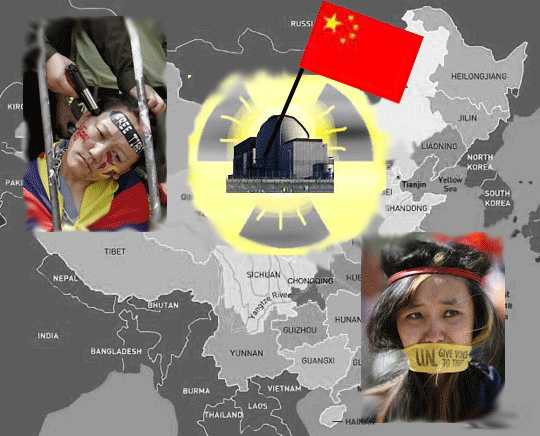
The danger and security issues of nuclear power make China deal more forcefully and secretly with nuclear power. For China, as with its neighbour, India, nuclear power leads to suppression of civil liberties.
As China has in fact slowed down its nuclear power programme, it has, like Japan, looked to export nuclear technology, as a way to make the industry financially viable.
Support Taro Yamamoto with this petition – Support the Fukushima victims
Date: 11/2/2013

To the Japanese Diet, Taro Yamamoto’s action, breaking customary protocol to remit a letter to the Emperor of Japan, was to call the Emperor of Japan’s attention on the plight, living conditions of the people of Fukushima, children obliged to live in contaminated environment beyond acceptable level. Taro Yamamoto’s sincere and devoted action, highly concerned for the people welfare, deserves respect and does not deserve a punishment nor a destitution. It is the duty of an elected official to mind foremost of anything else the welfare of the people. Safety of children being utmost important, lives of children threatened taking precedence before protocol.. In that action, Taro Yamamoto acted in the purest form of Yamato damashii, the honorable Japan that we citizens of the world have learned to love and respect. We humbly submit this petition, to voice our full support and high respect to Mr Taro Yamamoto.
SIGN THE PETITION
Nov 2, 2013
Scandal of top Japanese hotels’ misleading menus leaves bad taste
…This is at a time when Tokyo is attempting to convince other nations – notably South Korea – that fish and other produce from northeast Japan is safe to consume and has not been affected by the ongoing crisis at the Fukushima nuclear plant….
High-end establishments admit lying about ingredients, as UNESCO honours nation’s food

Julian Ryall in Tokyo
PUBLISHED : Sunday, 03 November, 2013,
Hankyu Hanshin Hotels chain admitted that its restaurants deliberately mislabelled 47 ingredients on its menus over a period of seven years.
Japanese cuisine was given a firm seal of approval when Unesco announced plans to list the country’s traditional food as an intangible cultural heritage asset as early as next month.
However, Japan’s commitment to quality and safety has since been called into question by a scandal that is enveloping restaurants and hotels around the country.
Long-running deception on a massive scale in the industry came to light on Monday when the Hankyu Hanshin Hotels chain admitted that its restaurants deliberately mislabelled 47 ingredients on its menus over a period of seven years.
Dishes described as containing “shiba” shrimp, which retail for around 2,500 yen (HK$196) per kilo, actually contained a far more run-of-the-mill variety that sell for just 1,400 yen per kilo. Similarly, sought-after onions from the Kujo district of Kyoto prefecture which sell for 2,000 yen per kilo were replaced by cheaper, ordinary leeks.
The fraud was detected during an internal investigation by the hotel chain, prompted by another chain, Prince Hotels, admitting that its expensive “domestically produced beef” had in fact come from Chile.
Since the admission by Hankyu Hanshin Hotels, a number of other establishments have also come clean on the ingredients in their meals. The Ritz-Carlton in Osaka and the Renaissance Sapporo Hotel in Hokkaido have both confirmed that they used cheaper, basic foodstuffs in their premium plates.
Admitting his company’s actions and paying more than 20 million yen to 10,000 customers as compensation was not enough to save Hiroshi Desaki, president of Hankyu Hanshin Hotels, from resigning over the scandal.
“It’s all just about greed, but this sort of thing affects the entire food industry,” said Sean Brophy, managing director of Tokyo-based specialist importer I Love Cheese.
“Provenance of a product is very important, but it can be difficult to disprove. It can be a nightmare for other companies such as ours, because it undermines our credibility and all the hard work we have put in,” he said.
1 This Month


18 March Webinar @ 1 PM EST: An Assessment of SMR Projects: The Case of Canada
register for the zoom:
https://us02web.zoom.us/webinar/register/WN_o8BIIOUvQ2ONJR1nta65DQ#/registration


of the week – STOP SMALL MODULAR REACTORS IN CANADA
To see nuclear-related stories in greater depth and intensity – go to https://nuclearinformation.wordpress.com
-
Archives
- March 2026 (141)
- February 2026 (268)
- January 2026 (308)
- December 2025 (358)
- November 2025 (359)
- October 2025 (376)
- September 2025 (258)
- August 2025 (319)
- July 2025 (230)
- June 2025 (348)
- May 2025 (261)
- April 2025 (305)
-
Categories
- 1
- 1 NUCLEAR ISSUES
- business and costs
- climate change
- culture and arts
- ENERGY
- environment
- health
- history
- indigenous issues
- Legal
- marketing of nuclear
- media
- opposition to nuclear
- PERSONAL STORIES
- politics
- politics international
- Religion and ethics
- safety
- secrets,lies and civil liberties
- spinbuster
- technology
- Uranium
- wastes
- weapons and war
- Women
- 2 WORLD
- ACTION
- AFRICA
- Atrocities
- AUSTRALIA
- Christina's notes
- Christina's themes
- culture and arts
- Events
- Fuk 2022
- Fuk 2023
- Fukushima 2017
- Fukushima 2018
- fukushima 2019
- Fukushima 2020
- Fukushima 2021
- general
- global warming
- Humour (God we need it)
- Nuclear
- RARE EARTHS
- Reference
- resources – print
- Resources -audiovicual
- Weekly Newsletter
- World
- World Nuclear
- YouTube
-
RSS
Entries RSS
Comments RSS
 nuclear-news