Solar set to beat nuclear on headline strike price by 2018 never mind 2023
| 24 October 2013,
Just two weeks ago, energy minster Greg Barker laid down a crystal clear challenge to the solar PV sector. The only way to maximise solar’s contribution to the 2020 renewables target would be to “squeeze out subsidy” and to “compete like-for-like with fossil fuels”, he said. That’s some challenge, but it is one that is not being extended to any other low carbon technology. Certainly not to nuclear. The contrast between the minister’s uncompromising message to our industry on 8 October and the Hinkley Point C deal announced by DECC this week could not be any clearer.
The very suggestion from energy secretary Ed Davey in the House of Commons on Monday, that the nuclear price “is competitive with projected costs for other plants commissioning in the 2020s”, is frankly absurd. Indeed it is so absurd that I had to check and double-check Hansard to make sure that that was really what his speech writers at DECC had written for him. Nuclear industry claims that this deal makes its technology the “cheapest” low carbon energy technology are even more outrageous, confusing, as they do, the headline £92.50/MWh CPI-linked 2023 nuclear strike price with next year’s draft renewables strike prices. The correct comparison is with projected costs for renewables projects completing in 2023 and beyond not in just six months’ time.
The nuclear lobby and its supporters also assume incorrectly that the renewables strike prices proposed by DECC are those that will actually be set. In fact, such is the projected pace of cost reduction in the solar PV sector that the Solar Trade Association (STA) has been able to ask for a strike price of £91 in 2018. It is inconceivable in my view that DECC will now set a higher solar strike price than £91 in 2018. If they were to do so, it would be the first time to my knowledge that the energy department had ever told a main trade body, “Thank you so very much for asking for a lower level of support than we proposed but we insist that you have more”.
So even if we were to leave out the multi-billion loan guarantees and the other sweeteners required for new nuclear, solar PV will be beating nuclear on strike price alone by 2018, some five years before Hinkley Point C is due to be completed. By 2019, the Solar Trade Association predicts that the industry will require a strike price of £86, falling year on year thereafter, paid over 15 not 35 years and with no nuclear-style small print permitting a possible increase in strike price once those terms are set.
For those who say that none of this matters, there’s plenty of funding room for both nuclear and renewables, it’s important to sound a serious note of caution. We do not yet know what will replace the current Levy Control Framework funding envelope for low carbon generation that runs to 2019, but the Treasury will be examining very closely the implications for bill payers of the nuclear deal. This process will have profound implications for renewables support into the 2020s, now that the government has locked us into a more expensive form of low carbon generation from 2023.
Solar and nuclear: some facts
When the government announced the strike price for Hinkley Point C on Monday, it also published an infographic comparing the amount of land required by solar and wind farms to generate the same amount of electricity as the proposed Somerset nuclear power station. Although DECC said the graphic was only intended to be illustrative, it was seized upon by certain parts of the press as evidence of the “blight” of renewable energy. In our own graphic we present some other facts and figures about nuclear and how it compares with solar. Illustration by Viki Hämmerle.

Japan secrecy act stirs fears about press freedom, right to know
…”There is a demand by the established political forces for greater control over the people,” said Lawrence Repeta, a law professor at Meiji University. “This fits with the notion that the state should have broad authority to act in secret.”…
….”This may very well be Abe’s true intention – cover-up of mistaken state actions regarding the Fukushima disaster and/or the necessity of nuclear power,” said Sophia University political science professor Koichi Nakano…..
…”As things stand, the state gets a more or less free hand in deciding what constitutes a state secret and it can potentially keep things secret forever,” Nakano said….
hursday Oct 24, 2013 | Linda Sieg, Kiyoshi Takenaka for Reuters
TOKYO (Reuters) – Japanese Prime Minister Shinzo Abe’s government is planning a state secrets act that critics say could curtail public access to information on a wide range of issues, including tensions with China and the Fukushima nuclear crisis.
The new law would dramatically expand the definition of official secrets and journalists convicted under it could be jailed for up to five years.
Japan’s harsh state secrecy regime before and during World War Two has long made such legislation taboo, but the new law looks certain to be enacted since Abe’s Liberal Democratic Party-led bloc has a comfortable majority in both houses of parliament and the opposition has been in disarray since he came to power last December.
Critics see parallels between the new law and Abe’s drive to revise Japan’s U.S.-drafted, post-war constitution to stress citizen’s duties over civil rights, part of a conservative agenda that includes a stronger military and recasting Japan’s wartime history with a less apologetic tone.
AREVA to acquire a ten percent stake at Hinckley because the British Government has bailed them out of a dark nuclear hole!
Thu Oct 24, 2013 1:57pm EDT
AREVA: At September 30, 2013: Backlog of €42bn
http://www.reuters.com/article/2013/10/24/areva-idUSnBw246420a+100+BSW20131024
Robust revenue growth to €6.847bn:
+4.7% vs. Sept. 2012 (+7.6% like for like)
Strong organic growth (+9.9%) in the nuclear operations
Regulatory News:
AREVA (Paris:AREVA):
Luc Oursel, Chief Executive Officer, offered the following comments on the group’s performance in the first nine months of 2013:
“After a remarkable first half and as anticipated, our third quarter revenue was stable in the nuclear operations compared with the third quarter of 2012. Globally, our nuclear operations generated organic growth of 10% in the first nine months of 2013. This performance demonstrates the strength of our commercial positions in the installed base market, where we continue to innovate while improving our competitiveness. The success of our integrated offers and of our Safety Alliance and Forward Alliance programs are perfect examples of this. Moreover, agreements signed for the EDF project at Hinkley Point strengthen our position in the new builds market and bolster the credibility of our EPR™ offers to other customers.
In the Renewable Energies BG, revenue is below our Action 2016 plan outlook, mainly due to the current indecisiveness in the renewable markets.
Based on our performance over the past nine months, we confirm our revenue outlook for our business as a whole in 2013.”
Fukushima water reaches new radiation high
Oct 24, 2013
http://japandailypress.com/fukushima-water-reaches-new-radiation-high-2438477/
Tokyo Electric Power Co (TEPCO), the utility operator that manages the damaged Fukushima Daiichi nuclear plant said on Thursday that the water they collected from the drainage ditch has double the radiation than from the previous week. This is a new record high for contaminated water in the plant, ever since the meltdown in 2011, the worst nuclear accident since Chernobyl.
TEPCO said that the readings they collected from the water sample in the drainage ditch on Wednesday sets it at 140,000 becquerels per liter of beta ray-emitting substances. It is 2.3 times more than the previous record of 59,000 becquerels seen last Tuesday in the same area and 11 times higher than the reading from the previous day. TEPCO theorizes that the heavy rains from the past few days may have carried the radioactive material to the areas surrounding the ditch.
Even though there were sandbags placed in anticipation of the rains from Typhoon Wipha last week, the heavier than expected rains may have caused the contaminated water to overflow into the Pacific Ocean. The location where they got the water samples is just 600 meters from the ocean and close to the storage tanks containing the contaminated water that TEPCO admitted had leaked almost 300 tons of radioactive water last August.
They also announced on Thursday that they have started transferring the contaminated water that have built up in the tank’s flood enclosures to a closed reservoir in preparation for Typhoon Francisco that is expected to hit Japan this weekend.
IAEA – “Great Progress in Fukushima Daiichi Nuclear Accident Remediation Efforts “
….The mission encouraged the Government to strengthen its efforts to explain to the public that an additional individual radiation dose of 1 millisievert per year (mSv/y), which it has announced as a long-term goal, cannot be achieved in a short time by decontamination work alone…
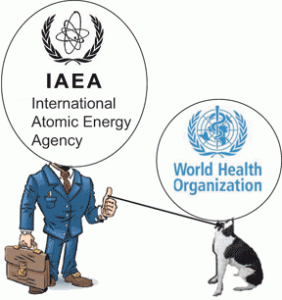
United Nation experts are encouraging the Japanese government to better communicate contamination goals with the public but are otherwise very positive about the progress that has been made in the Fukushima Daiichi nuclear accident remediation efforts in Japan. The experts are from the International Atomic Energy Agency (IAEA) a U.N. task force who oversees and reviews remediation efforts. They have been conducting ongoing reviews of the situation since the 2011 earthquake.
In March 2011, a 9.0-magnitude earthquake created a tsunami that in addition to killing 20,000 people, slammed into the power station, disabling cooling systems and leading to fuel meltdowns in three of the six units. The incident was reported to be the worst nuclear accident since the 1986 Chernobyl disaster.
The mission recognized the “huge effort and enormous resources” that Japan is devoting to its remediation strategies and activities, with the aim of improving living conditions for people affected by the nuclear accident and enabling evacuees to return home, the IAEA said in a news release.
“Japan has done an enormous amount to reduce people’s radiation exposure in the affected areas, to work towards enabling evacuees to go back to their homes and to support local communities in overcoming economic and social disruption,” said team leader Juan Carlos Lentijo, Director of the Division of Fuel Cycle and Waste Technology in the IAEA’s Department of Nuclear Energy.
He added that the team was really impressed by the involvement of a wide range of ministries, agencies and local authorities in driving these crucial remediation efforts.
The 14-21 October mission, which was requested by the Japanese Government, welcomed the extensive provision of individual dosimeters so that residents can monitor their own radiation dose rates, helping to boost public confidence.
“Good progress has been made in the remediation of affected farmland, and comprehensive implementation of food safety measures has protected consumers and improved consumer confidence in farm produce,” the press release noted, adding that a comprehensive programme to monitor fresh water sources such as rivers, lakes and ponds is ongoing, including extensive food monitoring of both wild and cultivated freshwater fish.
The mission encouraged the Government to strengthen its efforts to explain to the public that an additional individual radiation dose of 1 millisievert per year (mSv/y), which it has announced as a long-term goal, cannot be achieved in a short time by decontamination work alone.
Read more at the UN News Centre.
Article appearing courtesy Environmental News Network.
Is Japan Eyeing Nuclear Armament?
October 24, 2013
http://english.chosun.com/site/data/html_dir/2013/10/24/2013102400866.html
Japan is gearing up to build its own nuclear weapons as part of a wider rearmament drive that would allow it to send troops abroad, experts warn. Tokyo is believed to have the technology to build nuclear weapons anytime.
Two leading Japan experts in the U.S., Richard Samuels of the Center for International Studies at the MIT and James Schoff of the Carnegie Endowment for International Peace, sounded the warning in a recent report titled “Asia in the Second Nuclear Age.”
So far, they write, “memories of horrific nuclear attacks on Hiroshima and Nagasaki have sustained anti-nuclear sentiment and helped justify national policies championing nonproliferation and forgoing an indigenous nuclear arsenal.”
They warn that the view no longer holds true that “associated institutional and diplomatic constraints on nuclear breakout” mean that Japan “will find it virtually impossible” to build nuclear weapons.
Instead, they notice signs of a shift, caused by domestic and international factors in public attitudes and political calculation.
About one-third of candidates running in the Japanese general elections last year and this year supported nuclear armament, the report says. This is an all-time high.
Samuels and Schoff cite North Korea and China as external threats which Japan can use as a pretext to develop its own nuclear weapons. The North is the biggest headache to Japan. It could launch a nuclear attack on the island country if it faces regime collapse or an attack from outside, thinking that it has nothing more to lose, they speculated.
“With the U.S. nuclear umbrella shrinking and nuclear threats in Asia becoming greater and more complex, analysts cannot dismiss a nuclear-armed Japan as a purely academic exercise,” they said.
Mobile phone mast radiation, Sweden. Pr. Chris Busby
Published on 23 Oct 2013
Pr. Chris Busby and Ditta Rietuma inspecting the mobile mast radiation at 100 m distance 7th floor in Sweden, Some human experimentation.
IAEA comes to Murmansk to tote up nuclear safety roadblocks passed – and those to come
….“After the [spent nuclear fuel] has been moved into containers, which the British have supplied, it will stay in a storage facility renovated with British funds as well. According to our plans, the dismantlement will begin in late 2014,” Grigoriev said….
http://www.bellona.org/articles/articles_2013/Murmansk_IAEA
MURMANSK—Gathered for a meeting in the Russian polar city of Murmansk, experts from ten countries discussed efforts in assuring global nuclear safety in the past two years: international projects in the management of spent nuclear fuel and radioactive waste, work done in decommissioning nuclear submarines and service vessels, and the need for cross-border cooperation in clearing the Arctic seas from radiation hazards.
The 27th plenary meeting of the Contact Expert Group (CEG) – an international expert body created in 1996 under the auspices of the International Atomic Energy Agency (IAEA) to help safely and securely manage Russia’s Cold War nuclear legacy – was hosted this year in Murmansk, a far northern Russian city on the Kola Peninsula, home to Russia’s Northern Fleet.
The meeting, which took place on October 9 and 10, was gathered to discuss the results of Russia’s work with nuclear and radioactive waste and included a plenary session and visits to two sites of major significance for the international efforts to safeguard the Northern Fleet’s decommissioned nuclear vessels and stockpiles of spent nuclear fuel and radioactive waste: Sayda Bay and Andreyeva Bay.
Both former naval bases, Sayda Bay and Andreyeva Bay now serve as storage sites for the hulls and reactor compartments of old nuclear submarines, and the Russian Navy’s nuclear and radioactive waste, respectively.
Another nuclear legacy site – a former naval base called Gremikha – has been used to store spent nuclear fuel from naval reactors, and progress at this site was also discussed in Murmansk.
Bellona, which has for many years been working extensively with the issues of nuclear and radiation safety in Russia’s north, had been unsuccessful in securing permission to participate in the meeting, with the organizers routinely citing CEG provisions as reason to decline invitation to non-governmental ecological organizations.
Bellona, however, was given permission to be present in journalist capacity for part of the meeting of October 9 and the press conference given afterwards.
“We value greatly the work of the Contact Expert Group, which is a unique example of international partnership geared toward ensuring global nuclear safety. Including – and this is especially important for us – on the territory of Murmansk Region,” Murmansk Region Governor Marina Kovtun said in her welcome speech to the meeting’s participants.
According to Kovtun, the government of Murmansk Region places enormous significance on ensuring nuclear and radiation safety in the region – and save for the international assistance, these projects would be taking much longer to carry out.
“Today we are looking at nuclear safety projects in Russia’s Northwest, in particular, in Murmansk Region,” said Anatoly Zakharchev, who heads the project office for comprehensive decommissioning of nuclear submarines within the Nuclear and Radiation Safety Directorate of the State Atomic Energy Corporation Rosatom.
“Historically, it has come together so that it was in this region that the harnessing of the energy of the atomic nucleus was actively pursued in the last century. Andreyeva Bay and Sayda Bay are telling results of the progress and our joint efforts in [achieving nuclear safety],” Zakharchev said.
Remediating Gremikha
Gremikha – a restricted-access territory on the eastern shore of the Kola Peninsula, 350 kilometers off the entrance to Kola Bay – used to be home to the second largest onshore storage facility for the Northern Fleet’s spent nuclear fuel.
According to Zakharchev, the site is expected to be completely clear of spent nuclear fuel by 2020.
“In Gremikha, we will start dismantling nine more reactor cores and we think that by 2020, we will have completely cleared the base from [spent] nuclear fuel and will then begin creating a ‘brownfield’ [there] and then a ‘greenfield’ after that,” Zakharchev said.
The ‘brownfield’ concept implies cleanup of contaminated territories to a level suitable for reclaiming it for industrial uses, and a ‘greenfield’ site is one that allows the land to be used for agriculture or other non-industrial purposes.
Zakharchev said that the spent fuel from reactors of nuclear submarines laid up in Gremikha is sent to Murmansk for temporary storage at a collection site of Rosatom’s nuclear fleet operator organization, Atomflot. There, it awaits transportation to the Urals, to be reprocessed at the nuclear reprocessing facility Mayak.
Progress in Sayda Bay and Andreyeva Bay
Sayda Bay, which became the first site to accommodate reactor compartments of dismantled nuclear-powered submarines when Russia set about decommissioning its aging nuclear fleet, long remained a severe radiation hazard, with an increasing number of cut-out reactor sections collecting at the pontoon piers in the bay, where they were stored afloat.
In 2003, however, German funding and technology came to the site following an intergovernmental agreement that secured Germany’s cooperation in building an onshore storage facility in Sayda Bay.
Bellona files police report against Statoil over six years of chemicals leaked into Norwegian Sea
http://www.bellona.org/articles/articles_2013/Njord_leak
A disposal well in the Norwegian Sea owned by Norway’s state oil company Statoil leaked 3,428 tons of hazardous chemicals and oil based drilling fluids over six years at the Njord site, Bellona has learned.
Statoil further violated provisons stipulating that it disclose crucial information about the cause of the leak within two years of its discovery to Norwegian environmental authorities. Bellona alleges the oil giant delayed reporting to dodge penalites.
Statoil yesterday admitted to the leakage and issued an apology, but contested that it deliberately put off reporting the incident to Norway’s Environmental Agency.
Bellona has, nonetheless, filed a police report against the state oil company in the hope that corporate penalties will be levied against Statoil.
“We are looking very seriously at the issue and believes it is important that it be reviewed,” said Bellona adviser Karl Kristensen, who prepared the legal action (downloadable in Norwegian to right).
Leaks of so-called ‘black’ and ‘red’ chemicals and other oil-based ‘yellow’ discharges from the injection well located near Statoil’s floating Njord A platform in the Norwegian Sea off the country’s northwest coast are classified as illegal for release into the environment. Kristensen was quick to say that there is no danger that Norway’s northwest coast will be contaminated by the leaks.
The Njord A platform is attached to the injection well through a series of sub-sea pipes.
Kristensen explained that Norway’s color-based system of chemical classifications proceeds from green, which are mainly harmless. Yellow is the widest category, the majority of which constitutes chemicals that are harmful to the environment, such as oil-based drill mud, or slop.
 |
| Bellona’s Karl Kristensen |
| Bellona |
Red and black are chemicals that are highly toxic and can work their way into the food chain, causing cross-generational contamination.
According to Kristensen’s research, the leaks at the Njord injection well “are equal to or greater than the total emissions of hazardous chemicals and oil pollution from the Norwegian Continental Shelf over an entire year.”
Bellona’s police filing reports that “leaks from injection well A-14HX I the Njord Field [has] resulted in illegal discharges totaling 3,428 tons of chemicals.”
Njord production director Arve Rennemo wrote in a letter dated September 2 and quoted by Norwegian daily VG, that, “the guiding assumption is that virtually all the ‘slop’ injected into the well A-14 HX has leaked to the seabed.”
“This assumption is the basis for the estimate that a total of 3,428 tons of chemicals have leaked onto the seabed,” wrote Rennemo.
Two year reporting delay
Bellona maintains that Statoil also has violated the provisions concerning disclosure of the leakage to the pollution contorl supervisory oversight authorities with Norway’s Environmental Agency, and that it withheld crucial information about the cause of the leakage for two years, even thought the reasons were known to the company.
Australia’s nuclear policy is a complex challenge
Posted
http://www.abc.net.au/news/2013-10-23/rovere-nuclear-disarmament/5040484

Australia’s approach to nuclear non-proliferation may seem inconsistent at times, but this doesn’t mean that it’s wrong, writes Crispin Rovere.
Thom Woodroofe has accurately identified some apparent inconsistencies in Australia’s approach to nuclear non-proliferation and disarmament as revealed by the recent freedom of information disclosures made by the departments of foreign affairs and trade, and defence.
But the problem is not the policy, it is that successive governments have failed to communicate the complexity of the challenge to the Australian people.
On one level, there is some bureaucratic tension with regard to Australia’s policy on nuclear disarmament. Some in government, particularly in the diplomatic space, argue that Australia’s credentials on nuclear disarmament would be bolstered internationally if we weren’t viewed as piously lecturing others while being comfortably sheltered ourselves under the US nuclear umbrella.
Conversely, many in the defence and intelligence community emphasise the role of the US nuclear umbrella in not only protecting Australia, but also preventing the spread of nuclear weapons among US allies, many of whom would likely develop nuclear weapons if not for Americas assurances.
Few in government convincingly argue that Australia requires American nuclear assurances to preserve our own sovereignty – the overwhelming strength of America’s conventional military power is more than adequate for deterring threats from abroad. The reality is that Australia does not attach itself to America’s nuclear umbrella for our own sake, but rather to help out our American friends who are trying to keep anxious threshold states non-nuclear, such as Japan.
NZ’s nuclear-free legislation wins top disarmament award
New Zealand’s ground-breaking nuclear-free legislation wins top disarmament award
Hamburg/Geneva/New York – 23 October 2013: In 1987, against the backdrop of rising Cold War tensions between the United States and the Soviet Union, New Zealand passed its ground-breaking Nuclear-Free Act, which banned nuclear weapons and meant US nuclear-armed and nuclear-powered ships were no longer allowed in New Zealand ports.
Today, more than 25 years later, the policy has been announced by the World Future Council as winner of the Silver Future Policy Award. This year’s award seeks to highlight disarmament policies that contribute to the achievement of peace, sustainable development and human security. This evening, a formal awards ceremony will be convened at UN Headquarters.
The horrific health and environmental consequences of nuclear testing in the South Pacific, growing concern about the risks of nuclear war, and government plans to develop nuclear energy led to a surge in anti-nuclear sentiment in New Zealand in the 1970s. Among the campaigns employed by the anti-nuclear movement was the declaration of Nuclear Weapon-Free Zones (NWFZ) in classrooms, work places, towns and cities. By the 1984 general election, over 66 percent of New Zealanders lived in such NWFZs.
Although New Zealand had never possessed nuclear weapons or had an active nuclear weapons programme, it was a member of the ANZUS alliance that effectively provided New Zealand with US extended nuclear deterrence. In addition, until 1984, New Zealand welcomed the visit of nuclear-armed warships into its ports. A critical moment came in 1985, when the New Zealand Government refused a request from the United States to allow the visit of the non-nuclear destroyer USS Buchanan on the grounds that it was potentially capable of carrying nuclear weapons. The US subsequently suspended its obligations to New Zealand under the ANZUS Treaty.
In 1987 the nuclear-free policy was firmly cemented in the New Zealand Nuclear Free Zone, Arms Control, And Disarmament Act, which prohibits the emplacement or transport of nuclear-powered and armed vessels (including aircraft) from New Zealand territory and prohibits the manufacture, acquisition, possession or control over nuclear weapons as well as aiding and abetting any person in doing so by New Zealand citizens or residents.
The policy’s Silver win further reinforces the words of former New Zealand Prime Minister David Lange, who said: “Our nuclear free status is a statement of our belief that we and our fellow human beings can build the institutions which will one day allow us all to renounce the weapons of mass destruction. We are a small country and what we can do is limited. But in this as in every other great issue, we have to start somewhere.”
Former New Zealand Disarmament Minister, Matt Robson, commented on the policy’s win: “It is said that big things from little acorns grow. The former acorn of nuclear free New Zealand is now an oak as the Award recognises and will one day be part of the nuclear free oak forest across the world.”
“New Zealand’s policy started as a radical and utopian gesture, and has become part of our national identity – our DNA,” says New Zealander Alyn Ware, winner of the 2009 Right Livelihood Award for his work on nuclear disarmament, and a participant in the Future Policy Award ceremony at the United Nations on 23 October. “It inspires other countries, and empowers us kiwis to take nuclear abolition global.’
The Treaty for the Prohibition of Nuclear Weapons in Latin America and the Caribbean (Treaty of Tlatelolco) won the 2013 Future Policy Gold Award, while Argentina’s “National Programme for the Voluntary Surrender of Firearms” also received Silver. Four additional disarmament policies from Belgium, Costa Rica, Mongolia and Mozambique/South Africa were recognized as Honourable Mentions.
The Future Policy Award is the only award that honours policies rather than people on an international level. The World Future Council convened this year’s Award in partnership with the UN Office for Disarmament Affairs (UNODA) and the Inter-Parliamentary Union (IPU).
ends
Images show new work at NKorea’s nuclear test site
http://newsinfo.inquirer.net/513223/images-show-new-work-at-nkoreas-nuclear-test-site
Thursday, October 24th, 2013
AP
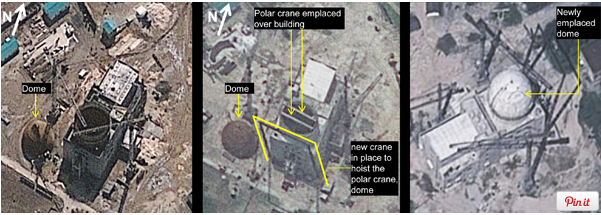
FILE – The combination of these three file satellite images taken, from left, March 20, June 24 and Aug. 6, 2012, by GeoEye-1 satellite, and released by IHS Jane’s Defence Weekly, shows development of a building construction at Yongbyon Nuclear Scientific Research Center in North Korea. AP Photo/GeoEye and IHS Jane’s Defence Weekly, File
WASHINGTON – Satellite imagery shows North Korea has made new tunnel entrances at its nuclear test site in a sign it is preparing to conduct more underground explosions there in the future, a U.S. research institute said Wednesday.
That’s the latest indication that Pyongyang is pressing on with its nuclear weapons program, although the U.S.-Korea Institute at Johns Hopkins School of Advanced International Studies says there’s no sign another test explosion is coming soon.
In February, North Korea conducted its third and most powerful nuclear test since 2006, drawing international condemnation — including from its benefactor China — and tighter U.N. sanctions. The North now says it is willing to resume aid-for-disarmament negotiations without preconditions, but the U.S. remains skeptical of Pyongyang’s intentions.
An analysis of recent commercial satellite imagery being published on the institute’s website, 38 North, concludes there are two new tunnel entrances at the Punggye-ri site in the country’s northeast, suggesting new tunnels are being constructed or new entrances for existing tunnels. There’s also enlarged heaps of soil from excavations and construction probably intended to upgrade support buildings. The latest image is from Sept. 27.
Where’s the Coverage? Many Countries Have Nuclear Power but No Enrichment
http://blog.camera.org/archives/2013/10/wheres_the_coverage_many_count.html
Posted by SC at October 23, 2013 07:47 PM
The “P5+1” talks proceed, meaning Iran is negotiating on the issue of its nuclear program with the five permanent members of the United Nations Security Council (the United States, Great Britain, France, China, Russia) plus Germany. The next round will take place early next month in Geneva and the media are tripping over themselves to cover differences between the United States and Israel on the matter. And there are differences. According to Bloomberg:
In Moscow yesterday, Russia’s chief negotiator at the talks said Iran and world powers may strike an accord allowing the Islamic republic to continue enriching uranium up to 5 percent purity. That level would require more time to turn into weapons-grade material than the 20 percent enriched uranium Iran is also producing.[…]
Netanyahu has urged the U.S. and five other powers taking part in talks with Iran in Geneva to reject any proposal that would not ensure a halt to all uranium enrichment. Iran must also stop building a plutonium-producing reactor and curtail other capabilities to make sure it can’t build a nuclear weapon, the Israeli leader says.
Iran is already in violation of a number of Security Council resolutions demanding it cease all uranium enrichment and heavy water activity – a process used to create weapons-grade plutonium. Furthermore, none of this activity is even remotely necessary if Iran, as it claims, only wants a peaceful nuclear program.
There are many countries that have nuclear power that do not have the capability to enrich their own fuel. They buy it from abroad and that’s what Iran could do. And that’s what the media are neglecting to tell you.
There are over thirty countries around the world that have nuclear power programs but according to the World Nuclear Association, only eleven have the capacity to enrich their own fuel.
Here are some of the countries that have nuclear energy but don’t enrich their own nuclear fuel:
• Argentina
• Armenia
• Belgium
• Bulgaria
• Canada
• Czech Rep
• Finland
• Hungary
• South Korea
• Lithuania
• Mexico
• Romania
• Slovakia
• Slovenia
• South Africa
• Spain
• Sweden
• Switzerland
• Ukraine
The fact is that, of countries that have enrichment capabilities, the majority also possess nuclear weapons. Countries that enrich nuclear materials but do not have nuclear weapons include Germany, Japan and the Netherlands. Countries that enrich and do have nuclear weapons include Pakistan, Russia and China.
When you think of Iran, do you think it fits in with Germany, Japan and the Netherlands? Or, does it fit better with Pakistan, Russia and China?
If that isn’t enough to make you uncomfortable, in a speech to the Supreme Cultural Revolutionary Council in 2005, Rouhani himself said:
A county that could enrich uranium to about 3.5 percent will also have the capability to enrich it to about 90 percent. Having fuel cycle capability virtually means that a country that possesses this capability is able to produce nuclear weapons.
Since Argentina, Armenia, Sweden and Spain can buy nuclear fuel from abroad, why can’t Iran? Since our neighbors Canada and Mexico can pursue this policy, why can’t Iran? And since numerous countries have nuclear energy without any enrichment capabilities, why don’t the media include this in their reporting? Where’s the context? Where’s the background? Where’s the coverage?
1 This Month


Tell the Ukrainian Government to Drop Prosecution of Peace Activist Yurii Sheliazhenko

Petition to revoke the licensing of the Near Surface Nuclear Disposal Facility (NSDF) at Chalk River. https://www.ourcommons.ca/petitions/en/Petition/Details?Petition=e-7247


of the week – STOP SMALL MODULAR REACTORS IN CANADA
To see nuclear-related stories in greater depth and intensity – go to https://nuclearinformation.wordpress.com
-
Archives
- March 2026 (193)
- February 2026 (268)
- January 2026 (308)
- December 2025 (358)
- November 2025 (359)
- October 2025 (376)
- September 2025 (258)
- August 2025 (319)
- July 2025 (230)
- June 2025 (348)
- May 2025 (261)
- April 2025 (305)
-
Categories
- 1
- 1 NUCLEAR ISSUES
- business and costs
- climate change
- culture and arts
- ENERGY
- environment
- health
- history
- indigenous issues
- Legal
- marketing of nuclear
- media
- opposition to nuclear
- PERSONAL STORIES
- politics
- politics international
- Religion and ethics
- safety
- secrets,lies and civil liberties
- spinbuster
- technology
- Uranium
- wastes
- weapons and war
- Women
- 2 WORLD
- ACTION
- AFRICA
- Atrocities
- AUSTRALIA
- Christina's notes
- Christina's themes
- culture and arts
- Events
- Fuk 2022
- Fuk 2023
- Fukushima 2017
- Fukushima 2018
- fukushima 2019
- Fukushima 2020
- Fukushima 2021
- general
- global warming
- Humour (God we need it)
- Nuclear
- RARE EARTHS
- Reference
- resources – print
- Resources -audiovicual
- Weekly Newsletter
- World
- World Nuclear
- YouTube
-
RSS
Entries RSS
Comments RSS
 nuclear-news