22 October 2013
Article posted by UKTI Digital, for UK Trade & Investment
http://opentoexport.com/article/civil-nuclear-energy-in-russia/
ROSATOM currently runs projects in 13 countries with a global pipeline of potential projects. There is a Memorandum of Understanding in place aiming to establish commercial cooperation between Rosatom and DECC UK.
Market overview
Russian nuclear industry is one of the world’s leaders in terms of level of scientific and technological developments in the area of reactor design, nuclear fuel, experience of nuclear power plant operation, NPP personnel qualification.
Its complex consists of over 250 enterprises and organizations employing over 250 thousand people.
Nuclear industry structure:
-
Companies in nuclear fuel cycle
-
Companies in nuclear power engineering
-
Companies in the sector of nuclear weapons application
-
Research institutes
State Atomic Energy Corporation Rosatom consolidates the enterprises mentioned above. It is the only company in the world that has a complete nuclear power cycle. Its daughter company – JSC Atomenergoprom consolidates the civilian part of the nuclear industry.
At present Russia operates 31 nuclear power reactors in 10 plants, which provide 16% of the country’s electricity and 17% of the world nuclear fuel.
As of beginning of 2013 Rosatom has orders for 80 units for the projects that include construction of nuclear plants in Armenia, Bangladesh, Belarus, Bulgaria, India, Iran, China, Kazakhstan, Russian Federation (10 units under construction , another 14 units operational by 2020), Slovakia, Turkey, Ukraine, Vietnam (source: (www.rosatom.ru).
Above all, there are 154 reactors with 173 GW ordered or planned (mostly expected in operation in 8-10 years) (source: www.rosatom.ru). Additional 341 reactors with 390 GW are proposed (expected operation in 15 years) (www.rosatom.ru)
Rosatom Reactors – distribution by geographical areas (source: www.rosatom.ru):
-
NAFTA: USA – 4 being built, 10 planned/ordered, 32 proposed
-
South America: 2 being built2 planned/ordered, 9proposed
-
Rest of Europe: 2 being built, 5 planned/ordered, 26 proposed
-
Eastern Europe: 2 being built, 17 planned/ordered, 28 proposed
-
Middle East: 12 planned/ordered, 17 proposed
-
Russia& non-EE CIS: 10 being built, 17 planned/ordered, 32 proposed
-
East Asia(excl. China): 7 being built, 16 planned/ordered, 6 proposed
-
China: 27 being built, 51planned/ordered, 120proposed
-
SE Asia: 2 being built, 2planned/ordered, 23proposed
-
Indian subcontinent: 7 being built, 20 planned/ordered, 42 proposed
-
RSA: South Africa – 6 proposed
Since a long time ago Rosatom has expressed particular interest in perspectives to build NPP in UK, where 8 sites have been finally approved as suitable for new build (www.world-nuclear-news.org).
In September 2013 a Memorandum of Understanding was signed between the Russian state atomic energy corporation Rosatom and DECC in the UK. This established a programme of commercial cooperation in civil nuclear energy and was signed by UK Energy Minister Michael Fallon and Rosatom Head Sergei Kiriyenko. It supports cooperation between Rosatom (Russia), Fortum (Finland) and Rolls-Royce (UK) in the process of investigation and implementation of projects to construct Russian-designed VVER pressurized water reactors in the UK. (source: www.gov.uk)
Moreover, in September 2013 Rolls-Royce (UK) signed a business contract with Rosatom to handle engineering and safety evaluation functions on Rosatom’s VVER technology ahead of its potential entry in the Generic Design Assessment process. (source: www.gov.uk)
As a result, UK became one of the most favourable markets for establishment of business relations and outsourcing of Russian nuclear sector.
There are several UK companies that are already active in the Russian Nuclear Energy Sector: Rolls-Royce, Doosan Babcock, ClydeUnion, Norton Rose, Sheffield Forgemasters and Worley Parsons.
Fuel Cycle and Regulatory sub-sector
Continue reading →
October 22, 2013
Posted by arclight2011part2 |
Uncategorized |
Leave a comment
COLUMBIA, Mo. (AP) – The University of Missouri is getting $1.8 million from the federal government to encourage nuclear energy development.
The grants announced Tuesday will help fund the development of a supply chain, logistics, and infrastructure needed to manufacture small modular nuclear reactors.
Modular reactors are smaller than large nuclear power plants. They can be built in factories and shipped where they are needed. The university in July announced a partnership with Westinghouse Electric Co. and Ameren Missouri to work on research related to modular nuclear reactors.
President Barack Obama’s administration said Tuesday that the project also will assess the education and training needed for a workforce to produce the reactors.
Sen. Claire McCaskill said the grant shows Missouri is well situated to lead the nation in developing small modular nuclear reactors.
(Copyright 2013 The Associated Press. All rights reserved. This material may not be published, broadcast, rewritten or redistributed.)
Associated Press
October 22, 2013
Posted by arclight2011part2 |
Uncategorized |
Leave a comment
Concerns to be Outlined in NYC About Conflicting United Nations Fukushima Reports and Their Global Implications
http://www.istockanalyst.com/business/news/6617925/doctors-to-say-un-science-report-systematically-underestimates-health-impact-of-fukushima-catastrophe
22 October2013
What:
Two conflicting reports on Fukushima – one by the U.N. Human Rights Council Special Rapporteur on the right to health and the other by the U.N. Scientific Committee on the Effects of Atomic Radiation (UNSCEAR) – will be discussed at a public meeting on October 24, prior to the presentation of the reports to the U.N. General Assembly on October 25 at the 3rd and 4th Committees, respectively. Speakers will include: the author of the Human Rights Council report, a co-author of an NGO critique of the UNSCEAR report, and a representative of a Japanese human rights organization.
Since the March 2011 nuclear disaster in Fukushima, individuals and communities in Japan continue to be exposed to dangerous levels of radioactivity. There are serious concerns about consequent health effects for citizens in contaminated areas. Residents have a right to live in a safe and healthy environment, however, sufficient protective measures and support are not being provided. The right of access to medical treatment and the medical data about one’s own body are being seriously denied. Experts will speak about how these two U.N. reports impact policy regarding the lives and health of citizens currently affected after the nuclear disaster, and what should be done to provide immediate relief to protect their fundamental right to health.
When:
Thurs., Oct. 24, 2013, 9:30 a.m.-Noon.
Where:
Baha’i International Community – 866 U.N. Plaza, Suite 120 – New York City. Free and open to public – no UN pass required – 48th Street & First Avenue. Due to limited space, please register (name, contact info, affiliation) by sending an email to HRNNY1024@gmail.com.
Speakers:
- Anand Grover, special rapporteur on the right to health, U.N. Human Rights Council, and visitor to Japan when writing the Human Rights Council report;
- Dr. John Rachow MD, Physicians for Social Responsibility (PSR), and a visitor to Fukushima in 2012; and
- Mari Inoue, Esq, Human Rights Now, a Japanese human rights organization.
Media Contacts:
Alfred Meyer, (202) 215-8208 or alfred.c.meyer@gmail.com (PSR USA); and alexrosen@gmx.net (IPPNW Germany).
Backgrounder:
As physicians concerned with the effects of radioactive fallout on human health and the ecosystem, Physicians for Social Responsibility-USA and International Physicians for the Prevention of Nuclear War-Germany have reviewed the upcoming United Nations Scientific Committee on the Effects of Atomic Radiation (UNSCEAR) report to the U.N. General Assembly. We appreciate the effort made by UNSCEAR committee members to evaluate the extensive and complex data concerning the Fukushima nuclear catastrophe. While parts of the UNSCEAR report will be useful in the future to assess the consequences of the nuclear meltdowns on public health and the environment, we believe the 2013 UNSCEAR report systematically underestimates the true extent of the catastrophe. Many of the assumptions are based on the two WHO/IAEA reports published in May 2012 and February 2013, which did not accurately portray the true extent of radiation exposure, followed faulty assumptions, ignored the ongoing radioactive emissions over the past 2½ years and excluded non-cancer effects of radiation.
HUMAN RIGHTS NOW: Human Rights Now (HRN), an international NGO in consultative status with the ECOSOC, is based in Tokyo with several hundreds of members composed of lawyers, scholars, journalists and concerned citizens. In July 2011, on behalf of a coalition of civil society groups in Japan, Human Rights Now requested the Office of United Nations High Commissioner for Human Rights (OHCHR) for a Special Rapporteur to investigate the human rights situation after the disaster. In response to the request, Anand Grover, the special rapporteur on the right to health, visited Japan in November 2012. In December 2012, HRN submitted a joint statement, endorsed by more than 70 civil societies in Japan and worldwide, urging the IAEA and the Japanese government to take a rights-based approach in response to the nuclear disaster based on the preliminary findings and recommendations issued by Grover in November. To raise awareness of the situation in Fukushima after the nuclear accident, HRN NY has organized human rights seminars and a press conference to inform the international community about the ongoing crisis. (http://hrn.or.jp/eng/)
PHYSICIANS FOR SOCIAL RESPONSIBILITY: Physicians for Social Responsibility (PSR), the U.S. affiliate of International Physicians for the Prevention of Nuclear War (IPPNW) advocates for sound public health policies regarding exposure to radioactive and other toxic materials. PSR is the medical and public health voice working to prevent the use of and to abolish nuclear weapons, to promote safe, non-nuclear energy, and to slow, stop and reverse global warming and the toxic degradation of the environment. Fukushima presents an immediate challenge to protect those individuals most endangered by exposure to dangerous levels of radioactivity, and to adequately and openly track the health consequences of the ongoing irradiation of populations. PSR was founded in 1961 and was instrumental in achieving the Limited Nuclear Test Ban Treaty that ended the global radioactive contamination produced by atmospheric nuclear bomb testing. PSR shared in the 1985 Nobel Peace Prize awarded to International Physicians for the Prevention of Nuclear War (IPPNW), for building public pressure to push their governments to end the nuclear arms race. (http://www.psr.org/)
/PRNewswire-USNewswire — Oct. 22, 2013/
SOURCE Physicians for Social Responsibility and Human Rights Now
 (Source: PR Newswire )
(Source: Quotemedia)
October 22, 2013
Posted by arclight2011part2 |
Uncategorized |
1 Comment
http://en.fujairahnews.net/News.aspx?id=5795&sid=3

Image source ; http://thewaterproject.org/water-in-crisis-middle-east.php
UAE has world’s best-regulated and safest nuclear programme, says radiation expert
Dr Claire Cousins delivering the keynote speech during the second international symposium on radiological protection in Abu Dhabi yesterday. She said it was particularly gratifying that the symposium was taking place in the capital.
Abu Dhabi: The UAE has the world’s safest and best regulated nuclear programme, a radiation protection expert said yesterday.
“The UAE has the world’s best regulated and safest nuclear programme and the chances that it might develop any complication in future is very low,” Dr Claire Cousins, Chair, International Commission on Radiological Protection, told Gulf News yesterday (Tuesday).
Dr Cousins was speaking on the sidelines of the 2nd International Symposium on Radiological Protection being held in Abu Dhabi.
Dr Cousins, who has also been a member of the British Institute of Radiology Radiation Protection Committee since 2006, said it was particularly gratifying that the three-day symposium was taking place in Abu Dhabi for the first time, expressing hope that it will find ways of establishing closer collaboration with the many people and organisations involved in radiological protection in the Gulf region.
Dr Cousins welcomed nominations from UAE organisations for Emirati members on the International Commission of Radiological Protection, an independent charity, established to advance for public benefit the science of radiological protection, in particular by providing recommendations and guidance on all aspects of protection against ionising radiation.
Dr William D. Travers, director general of the Federal Authority for Nuclear Regulation, said as the UAE’s foremost regulatory body on the safe and secure use and control of nuclear materials, they are committed to bringing the best practices of the global industry to the UAE.
“We are very pleased to be hosting the international radiation protection community for the ICRP summit as this event will provide the opportunity to showcase the UAE’s leadership as a respected member of the global nuclear energy community,” Dr Travers said.
He added when the prospect of becoming the prime sponsor for this event was raised, FANR’s staff and board as well as other UAE agencies represented on the National Radiation Protection Committee reacted enthusiastically. “We all saw this as an opportunity to reiterate the UAE’s commitment to a peaceful nuclear energy programme based on the highest international standards for nuclear safety, radiation protection, nuclear security and safeguards. This commitment extends throughout the nuclear sector, and includes all activities in which the UAE uses radiation,” Dr Travers said.
He added the symposium provides a platform for knowledge sharing and best practices which will help support national capacity building towards managing these activities safely for a sustainable future.
Split into six sessions taking place over three days, session topics include the safe use of radiation in the health-care industry, the safety of naturally occurring radioactive materials (NORM) in the environment and the challenges of clean-up of radioactive contamination following the events in Fukushima, Japan in 2011.
Gulf News
Date : 10/22/2013 10:35:37 PM – See more at: http://en.fujairahnews.net/News.aspx?id=5795&sid=3#sthash.O6apA6fF.dpuf
October 22, 2013
Posted by arclight2011part2 |
Uncategorized |
Leave a comment
Posted by Mia ; http://fukushimaappeal.blogspot.co.uk/2013/10/fukushima-watch-protest-filed-vs.html
In the latest chapter in the search for justice following the Fukushima nuclear disaster, one person filed a protest Wednesday against a decision by Tokyo prosecutors not to indict former executives of Tokyo Electric Power Co.9501.TO -2.83%, the operator of the Fukushima Daiichi nuclear plant.
In the filing to the Tokyo District Court, Ruiko Muto reiterated her claim that Tepco executives ignored research findings suggesting a tsunami more than 10 meters high could reach the plant, and didn’t take steps to prepare for such a scenario. The group Ms. Muto works with says the worst nuclear power accident since Chernobyl was caused by human error, and could have been prevented.
“If we don’t want to let it happen again, we must clarify who was responsible and what was wrong,” Ms. Muto told Japan Real Time on Thursday.
Ms. Muto is one of 14,716 people who first filed suit against the company with the Fukushima District Prosecutor’s Office in June 2012. The office took the unusual step of sending the suit to the Tokyo District Prosecutor’s Office without clearly explaining why. The Tokyo office decided in September not to indict any of the accused, saying tsunami waves of more than 10 meters were beyond expectations.
In Japanese criminal justice, claimants can protest a prosecutor’s decision not to indict anyone by asking for a review by a jury-like group of 11 citizens. Because the decision was made by Tokyo prosecutors, a jury-like group in Tokyo will conduct the review.
Ms. Muto said she has been in contact with other victims of the accident now living across the country, and plans to file another suit in late November along with anyone who responds by then.
“About 4,000 have already said yes. But not everyone, because some of them have died,” she said.
Ms. Muto herself lives in the mountains of Tamura City in Fukushima, about 40 kilometers from the Daiichi plant. Her cafe has had far fewer customers since the disaster, drastically reducing her income. She earns some money by helping deliver eggs, which don’t accumulate much radioactive cesium.
In the March 2011 disaster, a massive tsunami caused by a powerful earthquake hit the Daiichi plant, disrupting all back-up power, paralyzing cooling systems and causing three reactors to overheat and melt down. The plant was only prepared for waves of up to 6.5 meters. Hydrogen released as Tepco tried to cool the reactors with seawater caused the buildings housing the reactors to implode, scattered large amounts of radioactive materials into the environment.
“The damages have been multiplied here, as refugees who lost their jobs are now forced to work at the Daiichi site as cleaners to get by, exposing themselves to even more radiation,” Ms. Muto said. “We must stop this vicious cycle. I would really like considerate understanding from people in Tokyo.”
October 22, 2013
Posted by arclight2011part2 |
Uncategorized |
Leave a comment
….Stone said many people expected him to abandon his latest film after the Fukushima disaster, but he continued with it “to say what a lot of people believe but they haven’t stood up and said.” He now thinks that the Fukushima crisis even reinforces his case….
…”I suspect there are a lot of people in Japan who will quietly acknowledge that this is the way to go, but they are just waiting for somebody to stand up and say it. So I think we’ll get support,” he said….
Film director urges Japan to improve nuclear power
By MARI YAMAGUCHI | Associated Press | Oct 21, 2013
http://www.newser.com/article/da9ivfr80/director-of-pandoras-promise-urges-japan-to-retain-nuclear-power-despite-fukushima.html

Dressed in white hazmat coveralls and carrying a dosimeter, documentary film director Robert Stone ventured into the damaged Fukushima nuclear plant’s exclusion zone a year after a massive earthquake and tsunami triggered meltdowns in three reactors.
As he encountered abandoned homes, shops and toppled cars in the scene in his new film “Pandora’s Promise,” Stone asked a traveling companion, “So, are you still pro-nuclear?”
Stone, a British filmmaker based in New York, confronts viewers with the thorny question of whether nuclear energy should be abandoned because of the Fukushima disaster. His answer is no, because he believes nuclear energy can help solve climate change.
Stone was clear about that when he started making the film before the March 2011 meltdowns at Japan’s Fukushima Dai-ichi nuclear plant. He raises the question as he interviews respected environmentalists who are pro-nuclear, and visits Chernobyl and Fukushima himself to see the aftermath of their disasters. He also travels to major cities around the world, carrying his dosimeter and comparing radiation figures.
“As somebody who was making a documentary that is advocating for more nuclear power, going to Fukushima was deeply disturbing and very emotional,” Stone told The Associated Press in a recent interview during a visit to Japan to promote his film ahead of its Japanese opening in February.
Continue reading →
October 22, 2013
Posted by arclight2011part2 |
Uncategorized |
Leave a comment
….Sugenoya, a slightly built man with a gentle smile, said his offer is intended to help concerned families play it safe.
“Radiation doesn’t hurt. It doesn’t even itch,” he said. “A terrible thing has happened, but people don’t realize it at all.”….

Inage source ; http://www.nanaimodailynews.com/news/chornobyl-doctor-turned-mayor-offers-his-japanese-town-to-get-children-out-of-fukushima-1.667440
Tuesday, 10.22.13
http://www.miamiherald.com/2013/10/22/3703781/japan-mayor-offers-fukushima-kids.html
By YURI KAGEYAMA
Associated Press
MATSUMOTO, Japan — A generation ago, Dr. Akira Sugenoya performed lifesaving cancer surgery on more than 100 children after the 1986 Chernobyl catastrophe. Today, as mayor of a northeastern Japanese city, he’s trying to avoid a repeat of his own history.
Beginning in April, parents living in the shadow of the Fukushima nuclear disaster will be able to send their children about 300 kilometers (200 miles) away to his city, Matsumoto, to go to school. The city will pay 1.4 million yen ($140,000) a year for a six-bedroom house and caretakers; parents won’t pay tuition but will cover expenses such as utilities and meals.
“If my fears turn out to be unfounded, nothing would be better news,” Sugenoya said in a recent interview with The Associated Press at Matsumoto city hall. “But if they become reality, then there is little time before it’s too late.”
Sugenoya has been critical of the government’s response to the three meltdowns at the Fukushima Dai-ichi nuclear plant, which exploded after the March 2011 tsunami and is still releasing radiation into the air and sea. Decommissioning will take decades, and experts disagree over how much the disaster will affect the health of area residents.
The single sickness confirmed by the International Atomic Energy Agency to have been caused by low-dose radiation from Chernobyl is thyroid cancer, which if properly treated with surgery is rarely fatal. Sugenoya, a thyroid specialist, volunteered to work in Belarus, close to the Ukraine power plant, in 1991 after hearing about thousands of cases of thyroid cancer there.
Continue reading →
October 22, 2013
Posted by arclight2011part2 |
Uncategorized |
Leave a comment
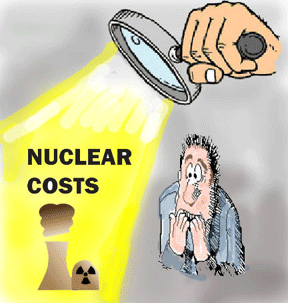
 The government has also already committed itself to providing financial guarantees of £10bn to cover the building of Hinkley Point, something not available to builders of solar or wind arrays.
Even Nick Butler, a former energy adviser to No 10 and a supporter of nuclear, believes the price is far too high. In a recent blog he warned: “Lower sources of power are available and have been rejected. When deals do not match the interests of both sides – producers and consumers – at a point of mutual advantage, they tend to unravel.”
 China’s need for nuclear power leads Britain to revive outdated technology , Terry Macalister, The Guardian, Sunday 20 October 2013 Critics say the new plant in Somerset will be heavily subsidised and cushioned from financial reality.
- The signing of a nuclear deal between EDF and the government is a landmark event for power generation. Today’s go-ahead for the Hinkley Point C plant shows ministers are prepared to commit Britain to provide decades of guaranteed financial returns (paid for by you and me as energy users) to companies in return for winning huge slugs of investment for new power stations…..
- Ministers insist that the commitment to provide Hinkley Point with a guaranteed price of around double the market rate is not a subsidy. The final figure of £92.50 is a considerable step up from the £80 per MWhr said to be on the table when negotiations began in earnest, and that figure is said by some calculations to be worth around £80bn in guaranteed revenues, the cost of nine Olympics.
- Critics will accuse the government of providing subsidies to an old technology that should not need handouts, while pointing out the safety dangers and the unsolved waste disposal problems raised by new nuclear. Questions will also be asked about the wisdom of providing a country alleged to be involved in cyber-spying, access to sensitive energy infrastructure via the involvement of a state-owned firm…….. Continue reading →
October 22, 2013
Posted by Christina Macpherson |
politics, UK |
Leave a comment







 nuclear-news