Britain has smarter, less costly energy options, than its new nuclear deal
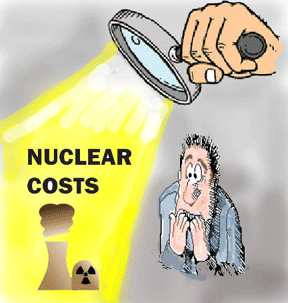
 COLUMN-British nuclear embrace fails to convince: Wynn By Gerard Wynn Oct 21 (Reuters) – Britain’s investment in new nuclear power is a result of a previous decision to limit the country’s options, and depends on an argument for energy security that fails to convince.
Britain has ruled out new coal power and adopted tough carbon emissions targets as well as a carbon tax on energy, given concerns about climate change.
In addition, European Union pollution curbs on sulphur and oxides of nitrogen require the imminent closure of several of the country’s existing coal-fired power plants.
That has created a dependence on gas and low-carbon power.
Britain’s Department of Energy and Climate Change (DECC) on Monday outlined the details of a commercial agreement with French state utility EDF to build the UK’s first new nuclear power plant since 1995, to be commissioned in 2023.
The agreed contract of about 90 pounds ($150) per megawatt-hour should not be compared with the wholesale power price, which records only operating costs including those from subsidised wind and solar power, which have zero fuel costs.
It should instead be compared with the calculated, full cost of power generation, including capital and operating costs.
In those terms, the contract appears competitive with renewable power but is more costly than gas.
Nuclear has the advantage over gas that it is less carbon-emitting, and over wind and solar power that it is baseload, available on demand rather than according to the weather.
But that is before taking into account the cost of radioactive waste, for which Britain still has not identified a long-term disposal site after a tentative agreement with a local council in northwest England recently collapsed.
And the government does not appear to account for the alternative of building sub-sea interconnectors, with which Britain could instead tap lower wholesale power prices in Germany and Scandinavia…….
COST
Monday’s announcement was thin on important details, such as the rate at which the operator will be compensated when its electricity is not required, for example when demand is weak…….
“The UK’s ‘energy island’ strategy for security of supply is not practical in light of excess power capacity across the EU,” argued the UK-based corporate advisory firm Alexa Capital in a report published on Monday, “UK energy in perspective: is there a better way forward?”.
“We ask whether British business and consumers would not be better off contracting for a greater proportion of electricity from interconnection.”
The cost of building an interconnector would add only a few euros per MWh to the cost of importing electricity.
The full cost of buying electricity from German gas plants would probably therefore be cheaper than the new nuclear deal, without the worries of radioactive waste disposal.
It may have been better for Britain to invest in new subsea cables and pick up the phone to E.ON and RWE , not EDF. ($1 = 0.6178 British pounds) ($1 = 0.7302 euros) (Editing by Dale Hudson) http://in.reuters.com/article/2013/10/21/column-wynn-nuclear-britain-idINL5N0IB0TV20131021

1 Comment »
Leave a reply to Schuyler Gould Cancel reply
1 This Month

of the week– Nuclear Reactor Information Task Force

14 May – online event From Bombs to Data Centres: the Face of Nuclear Colonialism
To see nuclear-related stories in greater depth and intensity – go to https://nuclearinformation.wordpress.com
-
Archives
- May 2026 (102)
- April 2026 (356)
- March 2026 (251)
- February 2026 (268)
- January 2026 (308)
- December 2025 (358)
- November 2025 (359)
- October 2025 (376)
- September 2025 (257)
- August 2025 (319)
- July 2025 (230)
- June 2025 (348)
-
Categories
- 1
- 1 NUCLEAR ISSUES
- business and costs
- climate change
- culture and arts
- ENERGY
- environment
- health
- history
- indigenous issues
- Legal
- marketing of nuclear
- media
- opposition to nuclear
- PERSONAL STORIES
- politics
- politics international
- Religion and ethics
- safety
- secrets,lies and civil liberties
- spinbuster
- technology
- Uranium
- wastes
- weapons and war
- Women
- 2 WORLD
- ACTION
- AFRICA
- Atrocities
- AUSTRALIA
- Christina's notes
- Christina's themes
- culture and arts
- Events
- Fuk 2022
- Fuk 2023
- Fukushima 2017
- Fukushima 2018
- fukushima 2019
- Fukushima 2020
- Fukushima 2021
- general
- global warming
- Humour (God we need it)
- Nuclear
- RARE EARTHS
- Reference
- resources – print
- Resources -audiovicual
- Weekly Newsletter
- World
- World Nuclear
- YouTube
-
RSS
Entries RSS
Comments RSS
 nuclear-news
Are the plant’s decommissioning costs included in its net operating costs?