Progress in talks between Iran and USA
Iran, world powers report progress in nuclear talks, agree to further meetings WP, By Joby Warrick, Published: October 16 E-mail the writer GENEVA — Iranian and U.S. officials cited significant progress Wednesday in international talks on Iran’s nuclear program, agreeing to hold further meetings in rapid succession with the aim of producing a deal inhibiting Tehran’s ability to acquire atomic weapons.
The two days of talks in a palace just above Lake Geneva yielded no specific agreements on curbing Iran’s nuclear activities. But they produced a rare, one-on-one meeting between U.S. and Iranian officials and pledges from both sides to work quickly to end what a top Iranian official called “an unnecessary crisis.”….http://www.washingtonpost.com/world/national-security/iran-nuclear-talks-enter-second-day-western-officials-call-tehrans-proposal-very-useful/2013/10/16/615815f4-364e-11e3-be86-6aeaa439845b_story.html
Confusion and deception over Fukushima radiation
Fukushima Farmer: Plutonium was detected “all over” village 25 miles from plant — Professor: “Something terrible, dreadful happening” — Mayor: Please don’t tell this to the residents (VIDEO) http://enenews.com/fukushima-farmer-plutonium-detected-all-village-professor-terrible-dreadful-happening-radiation-levels-high-mayor-please-dont-residents-video
Kenichi Hasegawa, Farmer from Iitate Village in Fukushima Prefecture, Canberra Forum, March 13, 2013 After the nuclear accident, all over Iitate village, plutonium and strontium were detected [40km from nuclear plant]. […] And then something unbelievable happened. Authorities started bringing many [hygienists or dentists?] to the village […] these doctors started doing this local safety campaign. They kept telling us, “It’s OK, it’s safe, there’s nothing to worry about.” […] The day before the evacuation order was announced, the professor from Kyoto University called Professor Imanaka came to the village and did a thorough research monitoring of the radiation levels.
And Professor Imanaka, he was just astonished, “Something terrible, dreadful is happening. The radiation level was so high; I can’t believe people are still living here.” […] So Professor Imanaka brought his data to the mayor and said, “You guys should evacuate immediately.” But the mayor’s response was, “Please do not disclose this data to the public.” Instead he said, “Is there any way to live with this radiation?” The village authorities only were interested in protecting the village itself, not the people.
We wanted to protect the children and we suggested to evacuate the children, but they didn’t listen. And the day before the evacuation order, exclusion zone, was announced, the day before, a different professor from ??? University visited the village and he called all the parents to the town hall, and then gave a safety lecture, “Your kids can go out and play, your kids don’t have to wear masks just to play outside.” But the very next day the evacuation order was announced.
Japan physician who volunteered at a Minamisoma evacuation center soon after 3/11Feb. 19, 2013 (at 54:00 in): What happened at that time was systematic effort by the prefecture government, […] as well as the Japanese central government, tried to minimize the amount of radiation. […] Primary concern […] for Fukushima Minpo [newspaper] was losing business […] For the prefecture government, losing the people means less revenue, less positions.
‘Emergency transfer’ of Fukushima radioactive water, following typhoon
‘Emergency measures’ used at Fukushima site during typhoon — Contaminated water dumped in ocean — 9 barriers were on verge of overflowing, then released into environment with NO radiation test — CNN: Workers were “on vigil” (VIDEO) http://enenews.com/emergency-measures-taken-at-fukushima-plant-during-typhoon-tv-contaminated-water-dumped-in-ocean-many-barriers-were-on-verge-of-overflowing-then-were-drained-into-environment-with-no-radia
Asahi, Oct. 16, 2013: Heavy rain from Typhoon No. 26 forced [TEPCO] to discharge rainwater Oct. 16 that was threatening to swamp the barriers that surround the radioactive water storage tanks […] According to the utility, workers drained about 40 tons of water from within barriers in areas called C-West and C-East at around 5:40 a.m. The water was transferred to a temporary storage tank to check its radiation levels before it was released, TEPCO officials said. But water levels continued to rise inside the barriers, threatening to spill over. Plant workers were eventually forced to open drainage valves on a total of nine storage areas starting around 7 a.m. to allow the water to escape, according to officials. Earlier, TEPCO had said it would discharge water that accumulated behind the barriers only after transferring it to a temporary storage tank where it would confirm it complied with safety standards. TEPCO officials said circumstances forced it to take “emergency measures” because the water rose at a faster rate than it could transfer to the holding tank.
NHK WORLD, Oct. 16, 2013: [TEPCO] has released rainwater that had accumulated in the compound from typhoon Wipha. The water has reportedly cleared tests for radioactivity. […] It began releasing the water from 9 locations on Wednesday morning. […] The level of tritium, which takes longer to measure, is also likely to be safe. In a separate move, TEPCO made an emergency transfer of highly radioactive water that had pooled at 2 other locations. The water was transferred to an adjacent underground storage pool. TEPCO had not stored water underground since a leak in April […] because rainwater from the typhoon was rising fast, the utility decided to store the radioactive water temporarily in an underground pool […] TEPCO has built additional storage tanks and increased personnel and patrols to control contaminated water after a storm earlier this month. Radioactive water flowed over barriers at that time, and seeped out of an overfilled tank. […] The authority asked TEPCO to tighten monitoring for possible leaks.
CNN,, Oct. 16, 2013: Typhoon Wipha hits Tokyo area, killing at least 17 […] TEPCO, which has been struggling to deal with a series of leaks at its Fukushima Daiichi nuclear plant, said workers at the plant were “on vigil” and accumulated rainwater had been released from storage tanks.
NHK Newsline, , Oct. 16, 2013: The water accumulated around the compound. Some of it became contaminated with radioactive substances. Managers at Fukushima Daiichi instructed workers to release it into the ocean after tetsts showed the radiation levels met safety standards. […] Workers made an ‘emergency transfer’ of rain water at two other locations because they suspected it was highly radioactive.
Watch the NHK broadcast here
Yassa Arafat murdered by radioactive polonium
Yasser Arafat: The Dark History of Polonium http://www.livescience.com/40448-history-of-polonium-yasser-arafat.html By Marc Lallanilla, Assistant Editor | October 15, 2013 Little did scientists Marie and Pierre Curie suspect, when they discovered polonium in 1898, that the radioactive element would go on to have one of the darkest and most intriguing histories of any known substance.
In 2004, Palestinian leader Yasser Arafat died of uncertain causes in Percy Hospital in Paris. He complained of nausea and stomach pain, suffered liver and kidney failure, and eventually lapsed into a coma before dying. In 2012, Arafat’s remains were exhumed because of persistent rumors that he was the victim of an assassination that used poloniumas a deadly weapon.
A report published last week in the medical journal The Lancet confirmed that traces of polonium were found on Arafat’s toothbrush, underwear and other personal items, fueling reports that he was assassinated. And Arafat isn’t the first person who’s believed to have been murdered by polonium.
Heating and air conditioning by solar panels
Solar Panels Can Be Used to Provide Heating and Air Conditioning Science daily Oct. 16, 2013 — The use of solar panels for hot water in the bathroom is standard practice, but researchers at the Madrid Universities Carlos III and Politécnica suggest that they may also be used to provide large offices with heating in the winter and air conditioning in the summer. Their proposal involves the incorporation of solar collectors into a gas-based co-generation system with an absorption machine, which would reduce both energy expenditure and CO2 emissions…….http://www.sciencedaily.com/releases/2013/10/131016112615.htm
Staff at Fukushima Daiichi demoralised and sick
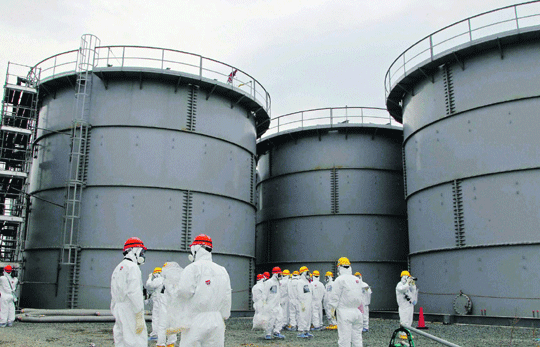 Plummeting morale at Fukushima Daiichi as nuclear cleanup takes its toll Staff on the frontline of operation plagued by health problems and fearful about the future, insiders say Justin McCurry in Fukushima The Guardian, Tuesday 15 October 2013 Dressed in a hazardous materials suit, full-face mask and hard hat,Japan‘s prime minister, Shinzo Abe, left his audience in no doubt: “The future of Japan,” he said, “rests on your shoulders. I am counting on you.”
Abe’s exhortation, delivered during a recent visit to the FukushimaDaiichi nuclear power plant, was only heard by a small group of men inside the plant’s emergency control room. But it was directed at almost 6,000 more: the technicians and engineers, truck drivers and builders who, almost three years after the plant suffered a triple meltdown, remain on the frontline of the world’s most dangerous industrial cleanup.
Yet as the scale of the challenge has become clearer with every new accident and radiation leak, the men working inside the plant are suffering from plummeting morale, health problems and anxiety about the future, according to insiders interviewed by the Guardian……..
Some workers have left because of exhaustion and stress, while others have decided to find work closer to their displaced wives and children.
“They are less motivated and are worried about continuing to work for a firm that might not exist in a decade from now,” Shigemura said………
Workers who have stayed on do so in the knowledge that they risk damaging their health through prolonged exposure to radiation and in accidents of the kind that occurred this week.
Earlier this year, Tepco said that 1,973 workers, including those employed by contractors and subcontractors, had estimated thyroid radiation doses in excess of 100 mSv, the level at which many physicians agree the risk of developing cancer begins to rise…….
While Thomas and other experts have cautioned against reaching hasty conclusions about a possible rise in thyroid cancer among Fukushima Daiichi workers, there is little doubt that their punishing work schedule, performed under the international spotlight, is taking a toll on their health.
“I’m particularly worried about depression and alcoholism,” said Takeshi Tanigawa, a professor in the department of public health at Ehime University in western Japan. “I’ve seen high levels of physical distress and symptoms of post-traumatic stress disorder.”……
For the thousands of non-Tepco employees hired across Japan to perform backbreaking, dangerous work for contractors and subcontractors, the lure of earning decent money in return for working close to lethal levels of radiation has proved an illusion.
Once money for accommodation has been subtracted from their wages, labourers are typically left with a few thousand yen at the end of each day. In some cases, smaller companies withhold danger money, which can amount to more than half of a worker’s daily wage because, they say, they need the extra cash to keep their business afloat.
The poor pay has forced growing numbers of men to quit and take up jobs decontaminating the area around the plant, for which they can earn similar money but with much less exposure to radiation…….
“Tepco workers worry about their health, but also about whether Tepco will take care of them if they fall ill in the future. They put their lives and their health on the line, but in the years to come, they wonder if they will just be discarded.”http://www.theguardian.com/environment/2013/oct/15/fukushima-nuclear-power-plant-cleanup
Censorship of radiation-caused illness in Fukushima
 “It’s Madness”: Doctors in Japan helping perpetuate Fukushima cover-up — Patients not being told their illnesses are from exposure to radioactive contamination — Scientific reports showing radiation health damage to humans are forbidden to be published (AUDIO) http://enenews.com/madness-doctors-japan-helping-perpetuate-fukushima-cover-patients-being-told-illnesses-exposure-radioactive-contamination-scientific-reports-show-radiation-health-damage-humans-forbidden-be-publ
Title: Arnie Gundersen Interview
Source: WBKM
Date: Oct. 2013
Arnie Gundersen, Fairewinds Chief Engineer: : We’re seeing scientist after scientist here at Fairewinds writing to us saying that they’ve got good science and they’re being ostracized in Japan and being forbidden for publishing scientific reports that show radiation health damage to Japanese people. So basically the government is sitting on the scientific community and preventing goods science from being done. Same as the doctors, the doctors have contacted us as well. They say they’ve been told not to tell their patients that their illness is radiation induced. So these guys have an oath as a doctor to be honest with their patients, and yet they’re basically ignoring their own oath and helping perpetuate a cover-up in the Japanese government. […]
Host: From where I sit, what you just described is madness essentially.
Gundersen: From where I sit it’s madness too. That’s the problem in Japan right now, is that nobody is willing to admit that the path they have chosen to take for the last two and a half years is crazy.
Full broadcast here
Thousands march in Niger to protest against AREVA
5,000 march against French uranium miner in Niger http://www.mining.com/5000-march-against-french-uranium-miner-in-niger-17954/Frik Els | October 12, 2013 Thousand of protestors marched against French uranium miner Areva (EPA:AREVA) in the remote town of Arlit in Niger on Saturday.
Areva has been operating in Niger for more than 50 years with two sites, Somair and Cominak, currently producing, and its long-term deal with the government of Niger is up for renegotiation at the end of 2013.
The roughly 5,000 protesters in Arlit were out in support of a Niger government audit to determine how to better distribute revenues from the two mines Reuters reports:
“We’re showing Areva that we are fed up and we’re demonstrating our support for the government in the contract renewal negotiations,” Azaoua Mamane, an Arlit civil society spokesman, said in an interview with a private radio station.
“We don’t have enough drinking water while the company pumps 20 million cubic meters of water each year for free. The government must negotiate a win-win partnership,” Mamane said.
The two mines together produce 4,500 tonnes of uranium for export to France and another project at Imouraren, which will be the largest uranium mine in Africa, is set to start operations in 2015.The Somair mine was back to full production in August, after a suicide attack in May killed one worker and injured 14 partially shutting down mining.
Prices for uranium are languishing at 8-year lows of $34 a pound and have not recovered since the Fukushima disaster in Japan in 2011
100% renewable energy powers Austrian town
Güssing, Austria Powered Entirely By Renewable Energy Clean Technica 16 Oct 13, A small town in Austria that had no significant industry or trade business is now thriving thanks to local renewable resources.Güssing (population: 4,000) sits in eastern Austria. In 1988 the region (population: 27,000) was one of the poorest districts in the country. It relied on agriculture, there was no transportation infrastructure, unemployment was high, and 70 percent of those who did have work were commuting to Vienna, 100 miles away. The town, where two-thirds of the working population was out of work and young people were moving away, was referred to as a dying town. Due to a lack of connections to the railway network and to the Austrian Autobahn (freeway) system, energy costs were extremely high. At the time the town of Güssing was said to be hardly able to afford its $8.1 million annual fossil fuel bill.
Several of the town leaders realized that $8 million dollars going to pay for fuel oil (mostly for heating) and other fossil fuels (such as coal for electricity) from outside the region could stay in the local economy if they could produce their own energy. However, they realized if they wanted to be energy self-sufficient the first step was reducing energy use. In 1990, the town implemented an energy efficiency program, retrofitting all public buildings with new insulation and replacing all streetlights with energy-efficient bulbs, reducing energy expenditure in buildings in the town center by almost 50 percent.
With greatly improved efficiency, the town then adopted a policy calling for the complete elimination of the use of fossil fuels in all public buildings, in an attempt to keep more money in the local economy……
The little town has become a net energy producer—generating more energy from renewables than it uses. Altogether, there are more than 30 power plants using renewable energy technologies within 10 kilometers of the village. Now the goal is to take the lessons from the small town of Güssing and make the entire 27,000-person district an energy-self-sufficient net producer……
The town now has 60 new companies, 1,500 new jobs, and annual revenues of $17 million due to energy sales, all resulting from the growth of the renewable energy sector. The downtown has been rebuilt and young people picture themselves staying there in the future. And other areas are following Gussing’s lead. More than 15 regions in Austria are now energy independent with regard to electricity, heating, and/or transportation. The town of Güssing has shown that not only is a high-renewables future possible, but also economically advantageous. Schwarzenegger must agree, because when he left he said, “I’ll be back.”
Read more at http://cleantechnica.com/2013/10/16/renewable-energy-powered-austrian-town-gussing/#FMpHPsrls8ze6ylD.99
1 This Month
Chernobyl: The Lost Tapes – A good documentary on Chernobyl on SBS available On Demand for the next 3 weeks– https://www.sbs.com.au/ondemand/tv-program/chernobyl-the-lost-tapes/2352741955560

of the week–London Campaign for Nuclear Disarmament

Tell the Ukrainian Government to Drop Prosecution of Peace Activist Yurii Sheliazhenko
To see nuclear-related stories in greater depth and intensity – go to https://nuclearinformation.wordpress.com
-
Archives
- April 2026 (114)
- March 2026 (251)
- February 2026 (268)
- January 2026 (308)
- December 2025 (358)
- November 2025 (359)
- October 2025 (376)
- September 2025 (257)
- August 2025 (319)
- July 2025 (230)
- June 2025 (348)
- May 2025 (261)
-
Categories
- 1
- 1 NUCLEAR ISSUES
- business and costs
- climate change
- culture and arts
- ENERGY
- environment
- health
- history
- indigenous issues
- Legal
- marketing of nuclear
- media
- opposition to nuclear
- PERSONAL STORIES
- politics
- politics international
- Religion and ethics
- safety
- secrets,lies and civil liberties
- spinbuster
- technology
- Uranium
- wastes
- weapons and war
- Women
- 2 WORLD
- ACTION
- AFRICA
- Atrocities
- AUSTRALIA
- Christina's notes
- Christina's themes
- culture and arts
- Events
- Fuk 2022
- Fuk 2023
- Fukushima 2017
- Fukushima 2018
- fukushima 2019
- Fukushima 2020
- Fukushima 2021
- general
- global warming
- Humour (God we need it)
- Nuclear
- RARE EARTHS
- Reference
- resources – print
- Resources -audiovicual
- Weekly Newsletter
- World
- World Nuclear
- YouTube
-
RSS
Entries RSS
Comments RSS
 nuclear-news