Dpt Física Aplicada I, ETSIA, Universidad de Sevilla, Ctra Utrera km 1, 41013 Sevilla, Spain
KAERI, Daedeok-Daero 989-111, Yuseong-Gu, Daejeon, Republic of Korea
Laboratory of Ion Beam Physics, ETH-Zurich, Schafmattstrasse 20, 8093 Zurich, Switzerland
Institut de Ciència i Tecnologia Ambientals and Departament de Física, Universitat Autònoma de Barcelona, 08193 Bellaterra, Spain
Environ. Sci. Technol., Article ASAP
DOI: 10.1021/es4031408
Publication Date (Web): September 30, 2013
Copyright © 2013 American Chemical Society
Abstract

A numerical model consisting of a 3D advection/diffusion equation, including uptake/release reactions between water and sediments described in a dynamic way, has been applied to simulate the marine releases of 90Sr from the Fukushima power plant after the March 2011 tsunami. This is a relevant issue since 90Sr releases are still occurring. The model used here had been successfully applied to simulate 137Cs releases. Assuming that the temporal trend of 90Sr releases was the same as for 137Cs during the four months after the accident simulated here, the source term could be evaluated, resulting in a total release of 80 TBq of 90Sr until the end of June, which is in the lower range of previous estimates. Computed vertical profiles of 90Sr in the water column have been compared with measured ones. The 90Sr inventories within the model domain have also been calculated for the water column and for bed sediments. Maximum dissolved inventory (obtained for April 10th, 2011) within the model domain results in about 58 TBq. Inventories in bed sediments are 3 orders of magnitude lower than in the water column due to the low reactivity of this radionuclide. 90Sr/137Cs ratios in the ocean have also been calculated and compared with measured values, showing both spatial and temporal variations.
October 16, 2013
Posted by arclight2011part2 |
Uncategorized |
Leave a comment
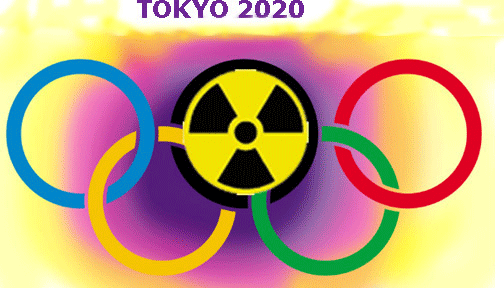
Berlin (dpa) – The International Olympic Committee (IOC) on Tuesday said it has no health-related concerns about Tokyo hosting the 2020 Olympics, despite the continued critical state of the damaged facilities at the Fukushima Daiichi Nuclear Power Station.

Image source ; http://rt.com/news/fukushima-children-thyroid-cancer-783/
“The IOC received assurances from the highest authority in Japan that the levels in Tokyo and surrounding area are safe, and there is no reason to believe that this will not be the case during the Games,” the IOC told the German press agency dpa, without answering further detailed questions.
However, problems at the plant continue to such an extent that the Japanese government has once again turned abroad for help on the question of the plant, since operator Tepco seems to be overextended.
Japanese Prime Minister Shinzo Abe in early October asked for international support during a Kyoto conference of researchers from abroad.
Shortly before the vote on the host of the 2020 Olympics, Abe reassured members of the IOC that life in Tokyo is normal and “everything is under control.” But bad news has not stopped since the earthquake and tsunami disaster on March 11, 2011, in Fukushima, 250 kilometres to the north of Tokyo.
Contaminated water has seeped from leaky cooling tanks into the Pacific Ocean. More leaks are feared.
The government is now planning to erect a 1.4 kilometre-long protective wall around the reactors. In addition, pipes with chemical cooling agents will be laid around the buildings that contain reactors 1 to 4.
The IOC awarded the 2020 Olympics to Tokyo last month, over Istanbul and Madrid.
October 16, 2013
Posted by arclight2011part2 |
Uncategorized |
Leave a comment
16 Oct 2013, 8:20pm AEDT
http://www.abc.net.au/news/2013-10-16/typhoon-wipha-tokyo-weather-fukushima-nuclear-hurricane-cyclone/5026396
A typhoon killed 17 people in Japan on Wednesday, most on an offshore island, but largely spared the capital and caused no new disaster as it brushed by the wrecked Fukushima nuclear power station.
Typhoon Wipha roared up Japan’s east coast, forcing the evacuation of about 20,000 people from their homes because of flooding and the cancellation of hundreds of flights.
Sixteen people were killed on Izu Oshima island about 120 kilometres south of Tokyo, as rivers burst their banks.
Meanwhile, the island’s local authority says it has not been able to confirm the whereabouts of 50 of Izu Oshima’s more than 8,300 residents.
The storm set off mudslides along a two-kilometre stretch of mountains.
Television footage showed roads clogged with wreckage and houses with gaping holes smashed into them.
“I heard a crackling sound and then the trees on the hillside all fell over,” a woman on Izu Oshima told NHK television.
The once-in-a-decade storm brought hurricane-force winds and drenching rain to the Tokyo metropolitan area of 30 million people at the peak of the morning rush hour.
A woman was swept away by a swollen river in the west of the capital, the government said, while about 20 people were hurt in falls or struck by flying debris.
More than 500 flights at Tokyo’s Haneda and Narita airports were cancelled, and thousands of schools closed. Bullet train services were halted but resumed by Wednesday afternoon.
The operator of the Fukushima nuclear plant, Tokyo Electric Power Corporation (TEPCO), cancelled all offshore work and secured machinery as the storm approached.
TEPCO has been struggling to contain radioactive leaks since a 2011 earthquake and tsunami caused extensive damage and triggered the world’s worst nuclear crisis since Chernobyl in 1986.
A TEPCO spokesman said the typhoon had caused no new problems at the plant, which is on the coast 220 kilometres north of Tokyo.
The storm dumped heavy rain which had to be pumped out of protective containers at the base of about 1,000 tanks storing radioactive water, the by-product of a jerry-rigged cooling system designed to control wrecked reactors.
The rainwater was checked for radioactivity and released into the sea, the company spokesman said.
Typhoon Wipha was downgraded to a tropical depression by 5:00pm AEST. It was off the coast of north-eastern Japan and moving northeast at 95 kph, according to the Japan Meteorological Agency.
At its height, Wipha had sustained winds at its centre of 126 kph and gusts of up to 180 kph.
It was the strongest storm to hit the region since October 2004.
That cyclone triggered floods and landslides that killed almost 100 people, forced thousands from their homes and caused billions of dollars in damage.
Reuters/AFP
October 16, 2013
Posted by arclight2011part2 |
Uncategorized |
Leave a comment
Even as a last-ditch effort, he said, nuclear weapons can’t work using existing warheads but only with new, even larger nuclear explosives than exist in any arsenal. “A lot more people have been recorded to have died from nuclear weapons than have been recorded to have died from asteroid impacts,” he warned.
Published: Wednesday, Oct. 16, 2013 – 3:00 am
Last Modified: Wednesday, Oct. 16, 2013 – 1:49 pm
WASHINGTON — When geophysicist H. Jay Melosh attended a meeting of U.S. and ex-Soviet nuclear weapons designers in May 1995, he was surprised by how eager the Cold Warriors were to work together against an unlikely but dangerous extraterrestrial threat: asteroids on a collision course with Earth.
After Edward Teller, the father of the hydrogen bomb, urged others meeting at the Lawrence Livermore National Laboratory in California to consider building and orbiting huge, new nuclear weapons for planetary protection, some top Russian weapons experts lent their support.
“It was a really bizarre thing to see that these weapons designers were willing to work together – to build the biggest bombs ever,” said Melosh, an expert in space impacts who has an asteroid named after him.
Ever since, he has been pushing back against scientists who still support the nuclear option, arguing that a non-nuclear solution – diverting asteroids by hitting them with battering rams – is both possible and far less dangerous.
But Melosh’s campaign suffered a setback last month when Energy Secretary Ernest Moniz signed an agreement with Russia that could open the door to new collaboration between nuclear weapons scientists in everything from plutonium-fueled reactors to lasers and explosives research. A Sept. 16 Department of Energy announcement cited “defense from asteroids” as one potential area of study.
President Barack Obama has committed the United States to seeking a world without nuclear weapons. But NASA is spending hundreds of thousands of dollars a year to study their use against asteroids, and the U.S. nuclear weapons labs appear to be itching to work with their Russian colleagues on the problem.
Moreover, weapons experts in both countries are citing the asteroid threat as a reason to hold onto – or to build – very large-yield nuclear explosives, which have declining terrestrial justification.
David Wright, co-director of the Union of Concerned Scientists’ Global Security Program, said he hoped any joint asteroid defense work would not become a “jobs program” for weapons scientists.
“When you’ve got the weapons labs sort of pushing for this in the various countries, it starts to make me feel a little uneasy,” he said. “Which doesn’t mean it’s not a legitimate thing to do, but you want to know it’s being done for legitimate reasons.”
To some critics, the idea smacks of bad science fiction, something out of the 1998 Bruce Willis action film “Armageddon,” which shows a team of deep-sea oil drillers landing on an Earth-bound asteroid, planting a nuclear warhead and neatly blowing the rock in halves that just miss Earth.
Critics also note that depending on the nature of the work, it could run afoul of several international pacts, including the 1967 Outer Space Treaty signed by 129 countries that prohibits deploying nuclear weapons in space.
Some experts worry that radioactive debris from blasting an asteroid could itself wreak havoc on Earth.
Bong Wie, the director of Iowa State University’s Asteroid Deflection Research Center, said he has a three-year, $600,000 grant from NASA to design a “hypervelocity nuclear interceptor system,” basically an ICBM-borne warhead fitted with a battering ram.
The ram would separate from the bomb before impact, gouging a crater in the asteroid so the bomb could then blast it to bits.
Keith Holsapple, an engineering professor at the University of Washington, said NASA has given him a five-year, $1.25 million research grant to study how either an impact device or a nuclear explosion could deflect an Earth-bound asteroid from its path.
Continue reading →
October 16, 2013
Posted by arclight2011part2 |
Uncategorized |
Leave a comment
PARIS (Reuters) – French nuclear group Areva is ready to join the EDF-led consortium that plans to build a nuclear plant at Hinkley Point in the UK, Bloomberg reported on Wednesday, quoting people with knowledge of the matter.
Bloomberg said China General Nuclear Power Corp. would also become a shareholder and that Areva and EDF’s boards would meet next week to approve the deal.
Areva and EDF declined to comment on the report.
Areva would take a stake in the project from French utility EDF, allowing EDF to share the cost of building two Areva-designed EPR reactors estimated at 14 billion pounds (16.5 billion euros).
On Sunday, British Energy Minister Ed Davey said Britain was “extremely close” to sealing a deal with EDF unit EDF Energy to build the country’s first new nuclear power station since 1995, adding there would also be Chinese involvement in the talks.
The British government and EDF have long been in talks over financial terms to build a new nuclear plant at Hinkley Point in Somerset, southwest England.
The Financial Times reported on Saturday that British Finance Minister George Osborne would sign a memorandum of understanding this week to back Chinese General Nuclear Power Group (CGNPG) entering a deal with EDF for the planned Hinkley Point plant.
(Reporting by Geert De Clercq; editing by David Evans)
October 16, 2013
Posted by arclight2011part2 |
Uncategorized |
1 Comment
George Osborne will hail a new dawn for Britain’s civil nuclear programme on Thursday as the chancellor announces a deal between Chinese investors and EDF Energy to build the first nuclear power station in the UK in a generation.
The Chinese General Nuclear Power Group and the French energy company are expected to sign a letter of intent as the two sides finally agree a deal for a planned new plant at Hinkley Point in Somerset. The main commercial details of the agreement will be announced on Monday by Ed Davey, energy secretary.
The first reactor to be built in Britain since Sizewell B began operating in 1995, ministers hope the deal will unlock the construction of several new nuclear power stations across the UK.
British officials have been travelling the world trying to entice investment in new nuclear, relying on French and Japanese technology and Chinese funding to fuel the renaissance of the British industry.
But Mr Osborne’s determination to announce the deal on his trip to China has infuriated Mr Davey, who has done much of the legwork. He travelled to China last month to meet officials ahead of the chancellor’s visit.
“Football fans might say he is the John Terry of government,” remarked one Liberal Democrat on Thursday, a reference to when the Chelsea captain changed into full kit to lift the Champions League trophy – despite having not played in the match. “He [Mr Osborne] was as close to the real negotiations and the work as Pluto is to the earth.”
Continue reading →
October 16, 2013
Posted by arclight2011part2 |
Uncategorized |
Leave a comment
 Report: Olympic athletes and tourists warned they will be in danger from Tokyo’s elevated radiation levels — Cesium found at almost every venue tested http://enenews.com/report-olympic-athletes-and-tourists-warned-they-will-be-in-danger-from-tokyos-elevated-radiation-levels-cesium-found-at-almost-every-venue-tested
Title: Elevated radiation claimed at Tokyo 2020 Olympic venues
Source: South China Morning Post
Author: Julian Ryall in Tokyo
Date: Oct. 12, 2013
A citizens’ group in Tokyo has found elevated levels of radioactivity at sporting facilities that will be used in the 2020 Olympic Games and is warning that competitors and the hundreds of thousands of people expected to flock to the city for the event will be putting themselves in danger.
The Citizens’ Group for Measuring Radioactive Environment at Facilities for the 2020 Tokyo Olympics claims wind-borne radiation from the four crippled reactors at the Fukushima nuclear plant has contaminated a number of future venues.
Measurements were taken at 39 sporting venues that have been earmarked to stage events in seven years’ time […]
“We found caesium-137 at almost every place we carried out tests, and there was no caesium here before the accident at Fukushima,” Mitsuo Tanaka, a member of the group, told the South China Morning Post. […]
See also: Study: Contamination in Tokyo suburb 3 times higher than area just 1 mile from Fukushima Daiichi — Nuclear Scientist: Significant contamination in Tokyo, a serious problem (AUDIO
October 16, 2013
Posted by Christina Macpherson |
environment, Japan |
Leave a comment
Fukushima Doctor: Cancer found in over 40 children… We believe it’s related to the nuclear disaster — Physician: Leukemia cases to increase in next few months?(AUDIO) http://enenews.com/fukushima-doctor-thyroid-cancer-found-in-over-40-children-this-is-related-to-the-nuclear-disaster-physician-leukemia-cases-to-increase-in-next-few-months-audio October 11th, 2013
 TVR, Oct. 10, 2013: Belarusian therapists help Japanese colleagues to fight radiation […] Japanese doctors continue to struggle with radiation and the consequences of the Fukushima accident with the help of their Belarusian colleagues. Brest endocrinologists are among the best diagnosticians in Belarus. The first and mobile laboratory for thyroid cancer detection appeared in this region. […] Yuko Yanagisawa, therapist, Fukushima Prefecture (Japan): “The Fukushima accident took place two and a half years ago. But we have found thyroid cancer in more than forty children. The official medical community believes that this situation is not related to the radiation effects from the accident, but we disagree with this. Therefore, we came to Belarus to consult local specialists”.
See also: Japan Professor: Fukushima crisis is leading to surge in thyroid cancers… First signs of health catastrophe — NHK: Trend seen in new cancer tests is ‘suspicious’ (VIDEO)
Journal Tribune,, Oct. 1, 2013: [Yuki N. Karakawa, International Association of Emergency Managers] said the disaster at Fukushima will be felt in Japan for a 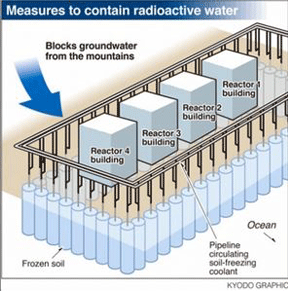 longtime, and that there will be long-term medical effects – something he claims the country hadn’t put into their planning systems.
October 16, 2013
Posted by Christina Macpherson |
Fukushima 2013, health, Japan |
Leave a comment
 If there are plenty of women working as correspondents and reporters, then relatively few female opinion writers and editors, then this indicates a problem in the industry
A study by Women in Journalism earlier this year found that across national newspapers, 78% of bylined front page stories were written by men, and of those quoted as experts or sources in lead stories, 84% were men. The Women’s Media Centre in the United States, on conducting similar research reported that during the 2012 presidential election, 75% of front page bylined articles at top newspapers were written by men and that women made up a mere 14% of Sunday TV talk show interviewees, and 29% of “roundtable” guests. Women in Journalism were quick to highlight one of the most worrying aspects of this imbalance: most stories involving women in the four week period surveyed, portrayed them as either victims or celebrities.
While the gender gap in print is insidious, in broadcast media it’s glaringly obvious
Women in journalism: not a trivial subject,Open Democracy, DAWN FOSTER 14 October 2013 The biggest newspapers in the United States, Britain and Europe still reserve pages of the most serious political and foreign policy analysis for older white men.
Can girls even find Syria on a map? Jill Filipovic’s (tongue in cheek) rejoinder on the Guardian website last month aimed to poke fun at the bias in commissioning opinion pieces on foreign policy issues, noting the heavy weighting towards male bylines on the pages of the New York Times and the Washington Post. Filipovic’s piece swiftly garnered a huge response online, and an article from Buzzfeed’s Sheera Frenkel, claiming that most correspondents covering the Syrian conflict were women. Filipovic’s central argument wasn’t disputed by Frenkel – the vast majority of opinion writers embraced across the global media continue to be male.
This matters, because it frames the national debate, and in the case of Syria, influences political decision on military intervention, purporting to be a bell-weather for public opinion at large. Continue reading →
October 16, 2013
Posted by Christina Macpherson |
media, women |
Leave a comment
Ten years of fast-rising electric rates reveal Duke Energy Florida is not competitive Tampa Bay Times, Robert Trigaux, 14 Oct 13 “……..Duke Energy, which last year bought Progress Energy Florida, has done a lousy job over the past decade running its power plants. This is the company that permanently closed the Crystal River 3 nuclear power plant after what should have been a routine maintenance upgrade.
This is the same company that said it would build a nuclear power plant in Levy County. It charged customers in advance to help start Levy, only to shelve the price-gone-wild project years later.
Customers were charged billions. No electricity was generated.
How did this mess happen? Where were the watchdogs? Why can’t Duke Energy Florida be held accountable for squandering ratepayer money and jacking up rates?……
On Wednesday, the Florida Public Service Commission — a puppet of the utilities it is supposed to regulate — will meet and probably rubber-stamp a proposed settlement.
If the PSC accepts this settlement, Duke will not have to defend its wasting nearly $3 billion forced upon customers to pay in return for delivering zero electricity. Nor will it have to justify why it should get to keep $250 million it made on its two defunct nuclear projects.
Nor is this the end. Higher rates await in the years ahead. If Duke really was Store One in a free market, its customers would flee elsewhere. Instead, they must stay and suffer. The business gods must be crazy.
October 16, 2013
Posted by Christina Macpherson |
business and costs, USA |
Leave a comment
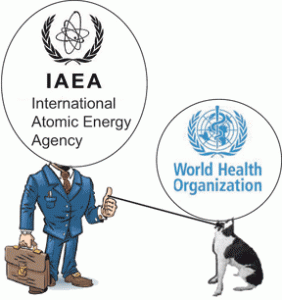 The publication of this ‘summary document’ on the World Health Organisation’s website has raised questions from independent experts and former United Nations and WHO officials, who question the validity of its findings and its anonymous authorship.
“There is definitive evidence of an alarming rise in birth defects, leukaemia, cancer and other carcinogenic diseases in Iraq after the war. Looking at the stark difference between previous descriptions of the WHO study’s findings and this new report, it seems that someone, somewhere clumsily decided that they would not release these damning findings, but instead obscure them.”
How the World Health Organisation covered up Iraq’s nuclear nightmare http://www.theguardian.com/environment/earth-insight/2013/oct/13/world-health-organisation-iraq-war-depleted-uranium by Nafeez Ahmed Ex-UN, WHO officials reveal political interference to suppress scientific evidence of postwar environmental health catastrophe
Last month, the World Health Organisation (WHO) published a long awaited document summarising the findings of an in-depth investigation into the prevalence of congenital birth defects (CBD) in Iraq, which many experts believe is linked to the use of depleted uranium (DU) munitions by Allied forces. According to the ‘summary report’:
“The rates for spontaneous abortion, stillbirths and congenital birth defects found in the study are consistent with or even lower than international estimates. The study provides no clear evidence to suggest an unusually high rate of congenital birth defects in Iraq.”
Jaffar Hussain, WHO’s Head of Mission in Iraq, said that the report is based on survey techniques that are “renowned worldwide” and that the study was peer reviewed “extensively” by international experts.
Backtrack
But the conclusions contrasted dramatically from previous statements about the research findings from Iraqi Ministry of Health (MOH) officials involved in the study. Earlier this year, BBC Newsspoke to MOH researchers who confirmed the joint report would furnish “damning evidence” that rates of birth defects are higher in areas experiencing heavy fighting in the 2003 war. In an earlypress release, WHO similarly acknowledged “existing MOH statistics showing high number of CBD cases” in the “high risk” areas selected for study. Continue reading →
October 16, 2013
Posted by Christina Macpherson |
Iraq, Reference, secrets,lies and civil liberties |
1 Comment
Top Nuke Commanders Terminated Following Missing Nuclear Warheads Report Top nuke commanders Navy Vice Adm. Tim Giardina and Maj. Gen. Michael Carey terminated following exclusive high level military intelligence over secret nuclear warheads transfer By Anthony Gucciardi, Global Research, October 13, 2013 Two of the top nuclear commanders within the United States have now been terminated following the exclusive high level military leak report by Alex Jones and myself regarding the secret and unsigned nuclear weapons transfer from Dyess Air Force base to South Carolina. Disturbingly, the high level suspensions from top generals within the military establishment are not the only red flags to follow the leaked report…………..
the nuke commanders were terminated behind the scenes in a move that was not meant to hit the public eye — especially not the fact that the second in command was fired on the same day of the leaked nuclear transfer. More importantly, shedding light on the secret transfer of nuclear weapons and the numerous red flags that prove its validity is key in stopping the psychopathic control freaks in government from going through with Graham’s ‘warnings’ of a nuclear explosion that would lead to a war with Syria.
The highest level generals have now installed a new commander, Pentagon Air Force Commander Jack Weinstein, who may be willing to do the bidding of higher ups that the previous two nuke commanders would not…….http://www.globalresearch.ca/top-nuke-commanders-terminated-following-missing-nuclear-warheads-report/5354182
October 16, 2013
Posted by Christina Macpherson |
secrets,lies and civil liberties, USA |
Leave a comment
Radiation estimates for No. 1 workers likely 20% too low: U.N .Japan Times 13 Oct 13 KYODO NEW YORK – THE RADIATION DOSES WORKERS RECEIVED IN THE INITIAL PHASE OF THE FUKUSHIMA DISASTER MAY HAVE UNDERESTIMATED BY 20 PERCENT, A REPORT BY A U.N. PANEL SAYS.
The U.N. Scientific Committee on the Effects of Atomic Radiation said in a summary report on its website that the Japanese government and Tokyo Electric Power Co., known as Tepco, used tests that failed to take into account some types of radiation released by the three meltdowns at the Fukushima No. 1 power plant in March 2011……http://www.japantimes.co.jp/news/2013/10/13/national/radiation-estimates-for-no-1-workers-likely-20-too-low-u-n/#.UlxMO9JJMgs
October 16, 2013
Posted by Christina Macpherson |
Fukushima 2013 |
Leave a comment
Reuters, 16/10 10:49 CET
By Elaine Lies
http://www.euronews.com/newswires/2162230-once-in-a-decade-typhoon-threatens-japanese-capital/
TOKYO (Reuters) – A typhoon killed 17 people in Japan on Wednesday, most on an offshore island, but largely spared the capital and caused no new disaster as it brushed by the wrecked Fukushima nuclear power station, the plant’s operator said.
More than 50 people were missing after the “once in a decade” Typhoon Wipha roared up Japan’s east coast. About 20,000 people were told to leave their homes because of the danger of flooding and hundreds of flights were cancelled.
Sixteen people were killed on Izu Oshima island, about 120 km (75 miles) south of Tokyo, as rivers burst their banks. The storm set off mudslides along a 2 km (1.2 mile) stretch of mountains.
Television footage showed roads clogged with wreckage and houses with gaping holes smashed into them.
“I heard a crackling sound and then the trees on the hillside all fell over,” a woman on Izu Oshima told NHK television.
The storm brought hurricane-force winds and drenching
rain to the Tokyo metropolitan area of 30 million people at the peak of the morning rush hour.
A woman was swept away by a swollen river in western Tokyo and more than 50 people were missing, the government said, including two schoolboys engulfed by waves on a beach.
About 20 people were hurt by falls or being struck by flying debris.
The operator of the Fukushima nuclear plant, Tokyo Electric Power Corp, cancelled all offshore work and secured machinery as the storm approached.
RAIN PUMPED OUT
The operator, known as Tepco, has been struggling to contain radioactive leaks since a 2011 earthquake and tsunami caused extensive damage and triggered the world’s worst nuclear crisis since Chernobyl in 1986.
A Tepco spokesman said Typhoon Wipha had caused no new problems at the plant, which is on the coast 220 km (130 miles) north of Tokyo.
The storm dumped heavy rain and it had to be pumped out of protective containers at the base of about 1,000 tanks storing radioactive water, the by-product of a jerry-rigged cooling system designed to control wrecked reactors.
The rainwater was checked for radioactivity and released into the sea, the company spokesman said.
Wipha was down-graded to a tropical depression by 0700 GMT. It was off the coast of northeastern Japan and moving northeast at 95 kph (59 mph), according to the Japan Meteorological Agency.
At its height, it had sustained winds at its centre of 126 kph (78 mph) and gusts of up to 180 kph (112 mph).
More than 500 flights at Tokyo’s Haneda and Narita airports were cancelled, and thousands of schools closed. Bullet train services were halted but resumed by Wednesday afternoon.
Typhoon Wipha was the strongest storm to hit the region since October 2004. That cyclone triggered floods and landslides that killed almost 100 people, forced thousands from their homes and caused billions of dollars in damage.
(Additional reporting by Chris Meyers, Billy Mallard and Antoni Slodkowski and Yuka Obayashi; Editing by Robert Birsel)
October 16, 2013
Posted by arclight2011part2 |
Uncategorized |
Leave a comment
http://www.wbir.com/story/news/local/2013/10/15/report-shows-tenn-nuclear-safety-violations/2991077/
The Associated Press, WBIR 8:26 p.m.
EDT October 15, 2013
NASHVILLE, Tenn. (AP) – A recent congressional study shows Tennessee’s nuclear plants had a total of 258 safety violations between 2000 and 2012.
The Associated Press obtained a copy of the Government Accountability Office report that’s awaiting release.
Nuclear Regulatory Commission figures cited in the report show the Sequoyah plant in Soddy-Daisy had 125 violations, of which all but two were lower-level violations. Watts Bar in Spring City had 133 violations. Only three were higher-level status.
According to the report, while the West has the fewest reactors, it had the most lower-level violations during that time period, more than two-and-a-half times the Southeast’s rate per reactor.
The Southeast, with the most reactors of the NRC’s four regions, had the fewest such violations.
October 16, 2013
Posted by arclight2011part2 |
Uncategorized |
Leave a comment




 nuclear-news