Charity appeals for support to help nuclear disaster children
Tuesday 8th October 2013

RESPITE VISIT: Northallerton car dealership boss and Friends of Chernobyl’s Children supporter Simon Bailes with children from Belarus this summer.
A CHARITY dedicated to providing an annual four-week respite holiday for children severely affected by a nuclear disaster is appealing for help to support the visits.
The Friends of Chernobyl’s Children said an open evening at Northallerton Town Hall, had been successful in attracting new families to host about 12 children and two interpreters from Belarus next summer, but it would need more support for its fundraising activities.
The Northallerton branch of the charity, which was established in the 1990s, organises a range of activities for the vulnerable youngsters from Mogilev, the area most severely affected by the 1987 disaster.
Mogilev will continue to be blighted by unsafe levels of radiation for the next 24,000 years leading to increased risk of thyroid cancer and other diseases.
Linda Spence, the charity’s co-ordinator, said a number of local businesses and organisations, including Bettys, had pledged to continue supporting the charity.
Its chairman, Suzanne Firth, said: “The charity has always been lucky to get such fantastic support from the Northallerton community and this is what makes the visits possible.
“But we are always on the look-out for more local people to get involved, particularly in our fundraising activities.”
For details, visit facebook.com/FOCCNorthallerton or call 01609-773708
Breaking!! EU energy guidelines leave out nuclear in mortal blow for UK nuclear!
(Reuters) –
BRUSSELS |
http://uk.reuters.com/article/2013/10/08/uk-wheu-nuclear-idUKBRE9970TM20131008
www.youtube.com/watch?v=ojNFvfaAMOs
Britain’s plans to use public money to subsidise a new generation of nuclear power suffered a setback on Tuesday when EU policy-makers decided to exclude atomic electricity from a list of funding guidelines.
An early draft raised expectations the Commission was preparing to sanction public support for nuclear power and whipped up a storm of protest, especially in the biggest EU economy Germany.
Germany is phasing out nuclear power and replacing it with renewable sources , such as wind and solar, whereas Britain wants to build new nuclear plants with the help of public funds.
Commission spokesman Antoine Colombani said EU Competition Commissioner Joaquin Almunia proposed that guidelines, expected to be published in November, should not include specific criteria on nuclear power. The other commissioners agreed with him at an internal meeting on Tuesday, he said.
Japan’s secrecy over health consequences of Fukushima radiation
International Scientists: Japan experts must be allowed to report health consequences of Fukushima — “The official data is all denial” — Pressured to downplay true impact of disaster http://enenews.com/international-scientists-japan-experts-must-be-allowed-to-report-health-consequences-of-fukushima-the-official-data-is-all-denial-pressured-to-downplay-true-impact-of-disaster October 6th, 2013
Georgia Straight (Canada), Oct. 2, 2013: “The official data is all denial,” [Eiichiro Ochiai, a retired chemistry professor in Vancouver who taught at University of British Columbia and the University of Tokyo] said. “The nuclear industry tries to suppress the truth.”
Fukushima News 10/1/13: Thousands in Japan Suffering Massive And Recurring Nosebleeds In Recent Days
Letter to United Nations Secretary-General Ban Ki-Moon from 17 international scientists and experts urging international action on Fukushima crisis, Sept. 13, 2013: […] it is clear that the situation at the Fukushima Daiichi reactor site is progressively deteriorating, not stabilizing. […] It is clear now that the Fukushima Daiichi nuclear disaster is far from over, and that there can be no credible estimate of total environmental or human health impacts because the radiological release has not ceased and the outcomes from exposing large populations to low doses over long time frames is unclear. A final estimation of the radiological release from the Fukushima Daiichi site, of necessity lies in the future; perhaps the distant future. […] Japanese physicians and scientists in Japan must be allowed and supported to treat and report Fukushima related health consequences. Nuclear calamities to date result in institutional pressure to under report and even distort patient health data and other evidence […] Such institutional pressure is now contributing to a downplaying of the true impact of the Fukushima accident.
Scientists don’t buy Japan’s claims that Fukushima radiation is “contained”
 ”Once strontium gets into fish, it stays in them for months and years and it’s going to be an additional reason why they won’t be able to open up their fisheries.”
“The credibility problem is as great as the engineering solution,”
Scientists dismiss claims that radiation in Japan is contained TEPCO’S radiation claims called ‘silly’ The Columbian, By Jonathan Tirone, Bloomberg News October 7, 2013, VIENNA — Tokyo Electric Power Co.’s claim that radioactive water leaking into the sea from the wrecked Fukushima nuclear plant is confined to the coast doesn’t make scientific sense, according to a U.S. researcher who surveyed waters off the site last month.
Japan’s government has supported the utility’s statement that the irradiated groundwater flowing into the Pacific Ocean at a rate of some 400 tons a day remains in an area of 0.3 square kilometers (0.12 square miles) within the bay fronting the atomic station. Continue reading
Safety worries about China’s new nuclear plant

 China nuclear plant delay raises safety concern South China Morning Post, 07 October, 2013, Eric Ngeric.mpng@scmp.com The world’s first AP1000 third-generation nuclear power plant being built in Sanmen, Zhejiang province, has fallen behind schedule, and questions are being raised over its safety standards.
Industry veteran Li Yulun said the plant’s developer, China National Nuclear Corp (CNNC), and its United States technology partner Westinghouse should be more transparent about how mainland reactors would be built according to the most advanced safety standards.
“Our state leaders have put a high priority on [nuclear safety] but companies executing projects do not seem to have the same level of understanding,” Li, a former vice-president of CNNC, said on the sidelines of a recent clean energy conference in Macau.
The State Council in October last year decided to resume “normal” construction of nuclear power plants, ending a 19-month suspension of new project approvals amid a thorough safety review of all operating projects and those under construction or being planned following the earthquake-nuclear disaster in Japan in March 2011.
Beijing also scaled back expansion of new plants before the end of 2015 and allowed only a small number of “well-proven” projects in coastal regions……..http://www.scmp.com/business/china-business/article/1325973/china-nuclear-plant-delay-raises-safety-concern
New nuclear information book – The Doomsday Machine
Apart from the apparent blind spot over two increasingly important and mainstream renewables, this book is an informative and convincing case against the nuclear industry.
It should be compulsory reading for the many politicians who still seem to be seduced by the nuclear dream without apparently ever having given the subject five minutes of proper scrutiny
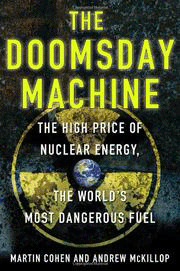 Nuclear power: The Doomsday Machine Independent Australia 6 Oct 13 The nuclear industry believes it will help stave off the threat of climate change, but a new book says that is a pipe dream. Paul Brown from the Climate News Network reports. A BOOK ENTITLED The Doomsday Machine leaves little room for doubt in readers’ minds about the two authors’ views on nuclear power.
But just in case you missed the point, social scientist Martin Cohen andAndrew McKillop, an energy economist, add in capital letters on the cover:
‘The high price of nuclear energy, the world’s most dangerous fuel.’
This well-written book is a comprehensive attack on an industry that, despite the Chernobyl and Fukushima accidents and an extraordinary history of cost overruns and delays, still has many supporters and continues to plan for worldwide expansion. Continue reading
Nuclear waste: urgent and unsolved danger for USA and Canada, as well as Japan
We must fix our own nuclear woes before criticizing others http://blogs.theprovince.com/2013/10/06/letter-of-the-week-we-must-fix-our-own-nuclear-woes-before-criticizing-others/ Jorgen Hansen, Kelowna It is very sad for Japan and the rest of the world that they had the Fukushima nuclear disaster in March 2011 as a result of an earthquake and the resulting tsunami and have nuclear waste going into the ocean.
Here at home in Canada and in the United States, we should be much more concerned about the nuclear waste storage at Hanford, Wash., nuclear waste disposal site.
There they have nuclear waste in old steel containers — huge containers — and the tanks are rusting away. What type of nuclear waste? Apparently it is a mixture of everything you can imagine, much of it waste that came from making nuclear bombs for the Cold War.
Now, we have hot stuff in our very own backyard. Concerned scientists are worried about the buildup of nuclear-waste hydrogen that could result in an explosion so large that we will have this mess drift up into our Canadian atmosphere, much the same way Mount St. Helen’s ash did when that exploded.
Scientists do not know how to get rid of this stuff or how to process it into distinct components and then deal with each of them. The U.S. is more concerned about waging war around the world to convert the Muslim heathens into good little Christians. Should the U.S. not clean up at home before they venture abroad? It could be that the waging of wars has left the U.S. so broke that it has no money left for clean up.
In the meantime, the news is all about Iran and its nuclear program. No one mentions the Israel’s nuclear program and where its waste goes. It is time to clean up at home before we concentrate on the nuclear problems of our neighbours.
Nuclear waste lasts for millions of years; at this rate, humans won’t.
Jorgen Hansen, Kelowna
Cancer causing radiation in fish must be increasing
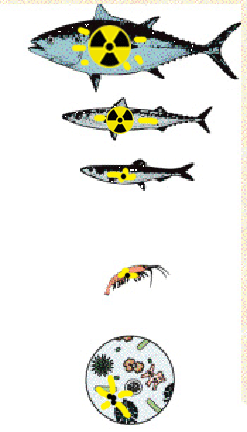 Report raises fresh concerns about radiation levels in Japanese fish Canada AM: Cancer-causing radiation in fish Gordon Edwards of the Canadian Coalition for Nuclear Responsibility discusses the danger, and whether the information will prompt changes. CTVNews.ca Staff
Monday, October 7, 2013
Two and a half years after the Fukushima nuclear plant disaster in Japan, concerns are again being raised about radiation levels in fish caught in the Pacific Ocean.
A report by the Vancouver weekly newspaper, The Georgia Straight, suggests at least 800 people worldwide could develop cancer from eating fish caught in Japan’s waters – and about half of those cases will be fatal.
About 500 of the cancers will occur in Japan, while 75 will be due to Japanese fish exports to other countries, including Canada, the newspaper estimates. It also quotes several nuclear experts who say that estimate is likely conservative and the real toll could be closer to 80,000 cancers.
Gordon Edwards, president of the Canadian Coalition for Nuclear Responsibility, notes that the estimate is based only on the fish that has been eaten up to now.
“People are going to continue to consume these fish and the toll could rise higher,” he told CTV’s Canada AM Monday from Montreal……..
Some fish samples tested to date have had very high levels of radiation: one sea bass sample collected in July, for example, had 1,000 becquerels per kilogram of cesium.While Canadians are exposed to radiation every day from the sun and the environment, Edwards notes that radioactive cesium doesn’t exist in nature at all and it’s not known if there is any safe level.
“The background level is zero. So this is all comes from the Fukushima disaster,” he said of the fish.The Canadian Food Inspection Agency tested fish exports from Japan for several months, but dropped the testing in June 2011, just three months after the disaster.
Edwards says he does not understand why the CFIA is not taking the issue more seriously.”Canadian authorities are really doing us all a disservice by not following and monitoring this much more closely. They’re treating it as though it’s a kind of ho-hum situation, but in fact, it was a major event worldwide,” he said.
“And it should be studied very more carefully because that’s the only way we’re going to learn what the effects of this may be for the future.” http://canadaam.ctvnews.ca/report-raises-fresh-concerns-about-radiation-levels-in-japanese-fish-1.1486514#ixzz2hAEyiUbR
African Americans’ proud history against nuclear weapons
 The Civil Rights Movement and Nuclear Test Ban Treaty HUFFINGTON POST, Vincent Intondi 10/07/2013“………..having the first African American president also advocate for nuclear disarmament should not come as a surprise. President Obama was simply following in the path of those before him. Indeed, since 1945, many in the African American community, including some of the most prominent black leaders in U.S. history, actively supported nuclear disarmament, often connecting the nuclear issue with the fight for racial equality and liberation movements around the world. And it was due, in part, to these black activists, including Dr. Martin Luther King Jr., and his wife, Coretta, that President Kennedy was able to pass the partial nuclear test ban treaty fifty years ago this week. Continue reading
1 This Month



Tell the Ukrainian Government to Drop Prosecution of Peace Activist Yurii Sheliazhenko

Petition to revoke the licensing of the Near Surface Nuclear Disposal Facility (NSDF) at Chalk River. https://www.ourcommons.ca/petitions/en/Petition/Details?Petition=e-7247


of the week – STOP SMALL MODULAR REACTORS IN CANADA
To see nuclear-related stories in greater depth and intensity – go to https://nuclearinformation.wordpress.com
-
Archives
- March 2026 (222)
- February 2026 (268)
- January 2026 (308)
- December 2025 (358)
- November 2025 (359)
- October 2025 (376)
- September 2025 (258)
- August 2025 (319)
- July 2025 (230)
- June 2025 (348)
- May 2025 (261)
- April 2025 (305)
-
Categories
- 1
- 1 NUCLEAR ISSUES
- business and costs
- climate change
- culture and arts
- ENERGY
- environment
- health
- history
- indigenous issues
- Legal
- marketing of nuclear
- media
- opposition to nuclear
- PERSONAL STORIES
- politics
- politics international
- Religion and ethics
- safety
- secrets,lies and civil liberties
- spinbuster
- technology
- Uranium
- wastes
- weapons and war
- Women
- 2 WORLD
- ACTION
- AFRICA
- Atrocities
- AUSTRALIA
- Christina's notes
- Christina's themes
- culture and arts
- Events
- Fuk 2022
- Fuk 2023
- Fukushima 2017
- Fukushima 2018
- fukushima 2019
- Fukushima 2020
- Fukushima 2021
- general
- global warming
- Humour (God we need it)
- Nuclear
- RARE EARTHS
- Reference
- resources – print
- Resources -audiovicual
- Weekly Newsletter
- World
- World Nuclear
- YouTube
-
RSS
Entries RSS
Comments RSS
 nuclear-news