World Action Now on Fukushima – Harvey Wasserman PlanetarianPerspectives.netOctober 5, 2013Still At It After All These Years Journalist, author, activist and historian Harvey Wasserman has been reporting on, and participating in, the nuclear free movement for decades.
In that time, by his judgment, only one other event matches the nuclear danger to the world posed by the Cuban Missile Crisis.
That event is the ongoing nuclear disaster at Fukushima.
Haven’t heard about it in the corporate media? That’s because the deadly and dying global nuclear industry and its allies don’t want you to know.
That’s why Wasserman, who edit sNukeFree.org, has organized a petition drive to the UN advocating international expert oversight of, and participation in, management of the Fukushima crisis.
World Action Now on Fukushima – Harvey Wasserman
In this EON interview, he explains why we must all be involved in this world-historical challenge to human and planetary survival.
Sign the petition HERE. [Production team: Morgan Peterson and Herb Peterson in LA; Mary Beth Brangan and Jim Heddle somewhere in Northern California.]…..http://www.planetarianperspectives.net/?p=1076
Iran foils nuclear plant sabotage plot http://www.skynews.com.au/world/article.aspx?id=912635 Sunday October 6, 2013 Iran has arrested four people suspected of attempting to sabotage one of its nuclear plants, Atomic Energy Organisation chief Ali Akbar Salehi says. ‘Some time ago, we uncovered sabotage activities by several people at a nuclear plant,’ Salehi said in comments carried by the Mehr news agency on Sunday.
‘We let them continue their activities so that we could gather more intelligence. ‘We arrested them at the appropriate moment and their interrogation is ongoing.’ Salehi did not specify which of Iran’s nuclear plants was targeted.
In August last year, saboteurs blew up power lines supplying Iran’s underground uranium enrichment plant at Fardo outside the central city of Qom.
In 2010, a US cyber-attack, reportedly carried out in collaboration with Israel, hit Iran’s nuclear facilities. The Stuxnet virus was tailored specifically to target uranium enrichment facilities. ‘There are still viruses out there but we have taken the necessary measures,’ Salehi said.
‘Since we uncovered the Stuxnet virus, we have reinforced our protection systems and a special unit has been set up.’ In recent years, Iran has detained a number of alleged US or Israeli agents accused of spying on, or attempting to sabotage, its nuclear program. Several Iranian nuclear engineers have also been killed in what Tehran says were assassinations by foreign intelligence services.
On Monday, state Sen. Hoon-Yung Hopgood, D-Taylor, and state Rep. Sarah Roberts, D-Taylor, traveled to a public hearing in Ontario to voice their concerns before a Joint Review Panel on the matter of the Deep Geologic Repository (DGR) on the shore of Lake Huron. Today, Hopgood and Roberts joined other prominent officials in submitting a formal written Request for Ruling regarding the plan, which appears to have a much larger scope than what is detailed in the project report.
In the request, the signatories demanded a suspension of the hearings if the Joint Review Panel and OPG cannot confirm that all highly radioactive wastes are prohibited in this or any future repository on the site. The facility would be located under the Bruce Nuclear Power Plant and about 440 yards below the Great Lakes basin.
“As if the proposal of this radioactive waste repository less than a mile from the shores of Lake Huron wasn’t threatening enough, it is now becoming clear that those fears are just the beginning,” said Sen. Hopgood. “With the hearings underway, information is coming out regarding the actual scope of the project and the potential to include highly radioactive wastes. This isn’t just for the mops and rags that OPG often speaks of, and could include everything short of spent nuclear fuel. If that is the intent, it is absolutely essential that we go back to the drawing board or, better yet, scrap the idea altogether.” Roberts concurred.
“The merits of this debate must be founded on the assumption that we have all of the correct information regarding this (DGR),” said Rep. Roberts. “Otherwise, the potential for negative impacts on our Great Lakes could be far worse than we ever imagined.”
Roberts and Hopgood attended day 12 of the hearings to be held through Oct. 12.
Timothy Mousseau,, Professor of Biological Sciences at University of South Carolina: We’re going to see leaks of this magnitude on a near daily basis. There’s going to be all sorts of leaks. We know they’re happening; they’re just not being documented for the most part. It’s an inherently unstable situation. […]
It’s a very unstable situation […]
The current situation in Fukushima is extremely unstable. There haven’t been the engineering developments needed to really solve the problem in the short or long-term. I think everybody’s just struggling to figure out how to deal with this.
Emanuel Pastreich, Professor at Kyung Hee University in South Korea and Director of The Asia Institute: The basic parameters of the ‘Fuksuhima Initiative’ — which is to say to create a truly global peer-to-peer collaborative effort to muster all the expertise in the world, all the goodwill in the world, and also a lot of man hours from creative and thoughtful people to come up with a real, long-term solution to this remarkable crisis. And to do it with the seriousness equivalent to say, putting a man on the moon, or if you want to reinterpret it, to say something the equivalent of a reverse Manhattan Project to deal with the extremely serious and totally unprecedented challenges.
Layne Hartsell, Asia Institute Fellow: The disaster has continued. When things like this leave the news, they seem to go away in the public psyche and public thought — but actually this is a lot worse right now, or building up to something much worse. Your thoughts?
Pastreich: Well, the news has not been good, as you know, in terms of the release of radioactive water, contamination and the amount of cesium and then strontium more recently. As we talked about in our paper this is really going to be a serious challenge for us. It’s something which the Japanese and others have floated ideas, but we’re really in uncharted territory. What we really want to do here at The Asia Institute is put together the most basic framework for how we would build such a global collaborative effort. […] There are many grim things I could talk about; actually I’d rather not stress the grimness of this. I hope the people out there understand just how serious this issue is and that really need to come together quickly. This is not something we can put off for another 6 months or a year. We really need it to come together. […]
Foreign Policy in Focus, Pastreich and Hartsell, Sept. 3, 2013: The Century-Long Challenge to Respond to Fukushima […] the worst case of nuclear contamination the world has ever seen. Radiation continues to leak from the crippled Fukushima Daiichi site into groundwater, threatening to contaminate the entire Pacific Ocean. The cleanup will require an unprecedented global effort. […] Solving the Fukushima Daiichi crisis needs to be considered a challenge akin to putting a person on the moon in the 1960s. […] the situation potentially puts the health of hundreds of millions at risk. […] To solve the Fukushima Daiichi problem will require enlisting the best and the brightest to come up with a long-term plan to be implemented over the next century. […] The Fukushima disaster is a crisis for all of humanity […]
Japan appeals for foreign help to stop leaks at crippled nuclear plant The Independent, MARI YAMAGUCHI TOKYO SUNDAY 06 OCTOBER 2013 Shinzo Abe, Japan’s Prime Minister, has appealed for overseas help to contain the ever-increasing leaks of radioactive water at the crippled nuclear plant in Fukushima.
“We are wide open to receive the most advanced knowledge from overseas to contain the problem,” Mr Abe said in his speech to open the conference on energy and environment in Kyoto yesterday. “My country needs your knowledge and expertise,” he said. Despite Mr Abe’s reassurances to the International Olympic Committee last month that the leaks were “under control”, many Japanese believe he was glossing over problems at the plant.
(Reuters) – Its stock price has nearly trebled this year, its near-term debt trades at par, banks have extended credit, and an enterprise value of $83 billion – a rough guide to how much it could cost to buy – makes it Asia’s biggest listed electricity utility.
Yet Tokyo Electric Power (9501.T), or Tepco, has lost $27 billion since the 2011 disaster at its Fukushima Daiichi nuclear plant, and faces massive liabilities as it decommissions the facility, compensates tens of thousands of residents forced to evacuate, and pays for decontamination of an area nearly the size of Connecticut.
Creditors, led by Japan’s top banks, have agreed to provide Tepco with $5.9 billion – rolling over existing loans and putting in new financing [ID:nT9N0GD01Q] – and the company has applied to restart its 7-reactor Kashiwazaki Kariwa facility, the world’s biggest nuclear plant, saying a restart would save it $1 billion a month in fuel costs.
All of which has prompted Tepco, which supplies electricity to 29 million homes and businesses in and around Tokyo, to say it could make a profit this financial year.
“It’s all kabuki,” said Tom O’Sullivan, founder of independent energy consultancy Mathyos Japan, using a Japanese term to portray political posturing. “Tepco still faces significant problems.”
“You have the trade minister … saying the utility is fine. You have Tepco’s president … applying for restarts, and you have banks falling in line to roll over loans. It’s very much an orchestrated presentation.”
“Due to the huge impact of reduced demand from Japan, the reactor-restart story is likely to continue to be the main factor affecting the spot uranium price over the coming few months,
No Nukes, No Uranium BARRON’s By RHIANNON HOYLE 6 Oct 13Japan’s 2011 disaster at Fukushima still weighs on national energy policies worldwide, as well as the commodity’s price. DJ-AIG Commodity IndexesUranium prices are edging higher after a recent plunge to nearly eight-year lows, but that’s no reason for investors to pile in.
Demand for the nuclear fuel isn’t ramping up as expected. Japan, a major uranium user, has been slow to restart nuclear operations after the 2011 earthquake and tsunami that devastated the Fukushima Daiichi power plant, and stockpiles of U3O8—the most actively traded compound of uranium—are growing.
Prices were down 22% when they hit their nadir last month. At $34 a pound, the commodity was worth just half what it had traded for prior to Fukushima.
Uranium is now trading at about $35 a pound as prices gravitate back toward the material’s production cost, which some analysts estimate to be $40 a pound. Continue reading →
Niger’s Hedges Bets on French Uranium Assets Oil Price.com. By Editorial Dept | Fri, 04 October 2013 Bottom Line: Under constant threat of terrorist attacks in the security nightmare of Niger, French nuclear group Areva will now face an audit of its uranium mines as the Nigerien government seeks a better deal.
Analysis: Areva has two mines in Niger: Somair and Cominak. Together these two facilities produce about one-third of France’s nuclear power. But the 10-year contract for these mines ends this year, and the government of Niger is planning to take advantage of that by auditing the company and determining how it can get a better deal. The plan will be to increase tax revenues from Areva and to force it into more significant investments in infrastructure. Areva was operating at a loss last year, but is eyeing over 1.1 billion euros in operating profits for this year—and Niger is hoping to get a bigger chunk of this through taxes and infrastructure deals. The government of Niger already owns a 36.4% stake in Somair and a 31% stake in Cominak. Areva will now be audited first based on claims from some groups that it is not transparently reporting its revenues and operating costs. A third mine that is under construction—Areva’s Imouraren uranium mine—is also under scrutiny. The government of Niger has warned that the company will face fines if there are any further delays to the opening of this mine, now slated for 2015.
A delegation of Japanese hibakusha (atomic bomb survivors) and several others affected by the more recent events at Fukushima from the World Friendship Center visited the Bainbridge Japanese American Exclusion Memorial on Saturday, Sept. 28, as part of a larger visit to the country including stops in Portland, Seattle and New Mexico.
— image credit: Luciano Marano | Bainbridge Island Review
….When at the end of the list, a moment of silence was called for, and the birds suddenly and uniformly became quiet. For the entire minute they did not make a sound. When the ceremony began again, they flew away……
These are the words on the Bainbridge Island Japanese American Exclusion Memorial. They echo the thoughts and memories of the citizens who were forced from their homes in 1942 by President Franklin D. Roosevelt’s Executive Order 9066 and Civilian Exclusion Order No. 1, and the regretful nation that let such a thing happen.
However, these words could just as easily apply to yet another historic tragedy of World War II: the only two nuclear attacks in the history of the world.
The stories of both regrettable episodes came together Saturday, Sept. 28, when a delegation of Japanese hibakusha (atomic bomb survivors) and several others affected by the more recent events at Fukushima from the World Friendship Center came to visit the Bainbridge memorial and met with local citizens who lived through the displacement. Though it is a unique group of representatives within the delegation, this is not the organization’s first such visit to the island.
“This is the third Peace Ambassador trip so far,” said Carol Stern, visit coordinator and delegation host. “It’s a unique group of people who have been involved with peace work for a long time.”
TEPCO must not only compensate the loss of its domestic victims, but also provide the international community with a clear commitment.
[…]
The Pacific Ocean doesn’t belong to Japan, but is commonly owned by the international community, the environmental protection of which is fundamental to the safety and reproduction of human beings.
[…]
radioactive sewage discharge results must be published. China and the international community should demand that Japan reveal the results of objective scientific monitoring of the 11,500 tons of radioactive discharge over the past two years, and publish its scale, damage level, as well as a prevention and cure strategy.
The devastating earthquake in northeastern Japan two years ago caused a nuclear leak at Fukushima Daiichi Nuclear Power Station. In July 2012, Alaskan seals exhibited inexplicable hemorrhage phenomena and signs of immunity deficiency. Scientists suspected the condition had something to do with Japan’s discharge of nuclear sewage, or radioactive water, into the Pacific Ocean. However, no evidence has yet confirmed that suspicion. The Japanese government has proposed to take measures to clean up the post-disaster nuclear waste by the end of March 2014. To this point, they have been simply dumping it into the sea.
On Aug 7, 2013, Japan’s Nuclear Disaster Countermeasures Headquarters said the daily discharge into the sea was nearly 300 tons. Research analysis shows that underground water is polluted and therefore radioactive discharge cannot be avoided. Currently, the Japanese government and Tokyo Electric Power Company (TEPCO) are considering pumping underground water into the area to reduce the discharge. By September 2014, the volume of pumped sewage will be 40,000 tons.
Estimates show that the daily outflow of underground water around Fukushima’s four nuclear units is 1,000 tons, of which 400 tons flows under the reactors. Of the other 600 tons, 300 tons flows through tunnels between the plants, polluted by the highly concentrated sewage, and then flows into the sea. The remaining 300 tons runs into the sea without pollution. TEPCO is trying to prevent more polluted water reaching the sea, via a new relief project, to reduce daily discharge to 60 tons.
Since the severity of the issue continues, China, along with the international community, must propose the strongest opposition to the Japanese government’s irresponsible activities. At the same time, they must take positive measures to prevent pollution. Here are three suggestions.
(JTA) — Moshe Dayan urged Golda Meir to prepare to launch a nuclear strike during the 1973 Yom Kippur War, according to a former Israeli official’s longtime aide and confidant.
Arnon Azaryahu, who was an aide to Israel Galili, a Cabinet minister during the war, said in an interview that Dayan, the defense minister at the time, suggested that Meir, then the prime minister, order to begin preparations to enable a nuclear option on Oct. 8, 1973 — the second day of the war.
The Yom Kippur War broke out when Syria and Egypt simultaneously mounted a surprise attack against Israel.
Dayan, Azaryahu said, told Meir that “since the situation is very bad, it would be worthwhile, since we don’t have a lot of time and a lot of options, that we prepare to show the nuclear option.” Meir declined, Azaryahu said.
Azaryahu recounted the incident during a filmed interview published Thursday for the first time on the website of the Woodrow Wilson International Center for Scholars. The Wilson center called Azaryahu a “long-term Israeli government insider.”
Egyptian and Syrian forces made initial territorial gains in the early stages of the war of three weeks, but the Israeli army repelled the advancing Arab troops and penetrated deep into Syrian and Egyptian territory before an armistice was brokered later in the month. Some 2,000 Israeli troops died in the war.
The interview with Azaryahu was conducted several years ago by Avner Cohen, a historian who specializes in Israel’s presumed nuclear arms program — a capability that Israel has neither confirmed nor denied.
Azaryahu said he was not in the room when the Dayan-Meir exchange reportedly took place, but learned about it later that day from Galili, who was present.
Dayan had invited Shalhevet Freir, the director general of the Israel Atomic Energy Commission, to Meir’s chambers to begin preparations in case she allowed the request, Azaryahu said. But Meir “told Dayan to forget it,” Azaryahu said.
Freir did not meet Meir but waited outside with Azaryahu, according to the account.
LONDON (Jiji Press)—A Japanese group has promoted the safety of agricultural products grown in Fukushima Prefecture at an annual cultural event at Trafalgar Square in London.
The group, comprising people from Fukushima Prefecture living in London, set up a booth at the event, Japan Matsuri, and sold products from the prefecture such as rice, peaches, apple juice and Kitakata Ramen noodles in cooperation with Japan’s National Federation of Agricultural Cooperative Associations on Saturday.
The project was intended to dispel concerns about Fukushima farm products after the nuclear accident at Tokyo Electric Power Co.’s disaster-crippled Fukushima No. 1 power plant in March 2011 and to issue a message to the international community about the safety of foods from the area.
Yoshio Mitsuyama, head of the group, said: “Trafalgar Square attracts tourists from around the world. We want to emphasize to the world from this place that agricultural products from Fukushima are safe.”
The booth drew the attention of many people including tourists. A 32-year-old Russian student said there seems to be no safety problem with Fukushima foods as they are tested for radiation.
Revenue from the farm product sales will be donated to a charity fund for Fukushima children affected by the March 2011 earthquake and tsunami.
The annual festival, organized by Japanese living in Britain, started in 2009 to introduce Japanese culture to British people.
Last year’s festival attracted about 80,000 visitors.
With the future of the domestic nuclear industry uncertain, Toshiba Corp. is looking to bolster its overseas business with the acquisition of a company planning a nuclear plant in Britain for upward of 10 billion yen ($100 million), sources said.
Toshiba is in the final stage of negotiations for purchasing more than 50 percent of NuGeneration Ltd. through subsidiary Westinghouse Electric Co., a U.S. nuclear reactor builder.
Toshiba, which holds a leading 30 percent share of the global market of nuclear reactor construction with Westinghouse, hopes to close the deal by year-end, the sources said.
NuGeneration, based in Britain, is owned equally by two major electric utilities, France’s GDF Suez SA and Spain’s Iberdrola SA.
The joint venture hopes to open a 3.6-gigawatt nuclear power facility, about the capacity of two to three large reactors, in central Britain by 2023.
It will be the first time that Toshiba has acquired a nuclear plant operator overseas. Operation of the British plant will be commissioned to other companies.
Toshiba plans to reinforce its nuclear power business in Europe, Asia and elsewhere because construction of new reactors will be difficult in Japan given the crisis at the Fukushima No. 1 nuclear power plant and mounting public opposition.
The company is bidding for two reactor construction projects in Finland and also aims to win contracts in the Middle East and India. Europe is a powerful domain of France’s Areva SA, the world’s second-largest reactor builder after Toshiba.
Toshiba plans to increase sales from its nuclear power business, including construction and maintenance of reactors, to 800 billion yen in fiscal 2017 from 500 billion yen, or slightly less than 10 percent of its group revenue, in fiscal 2012.
Domestic rival Hitachi Ltd. acquired a British nuclear plant operator for 85 billion yen last year.

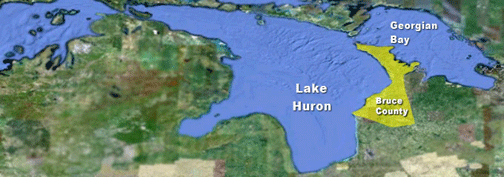


 Image source ;





 nuclear-news