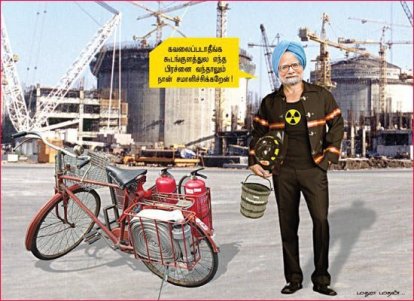
When India’s Prime Minister Manmohan Singh arrived in the U.S. last week, he reportedly carried a generous gift: an unlimited number of free lives. To be precise, Singh was ready to promise President Obama that should any of the nuclear reactors that India is planning to buy from U.S. companies ever suffer an accident, they will not have to pay anything in damages. Whether or not he made this offer is unclear — but the meeting evidently went well. Afterward the two leaders announced a deal between Westinghouse and India’s nuclear operator for building six reactors in Mithi Virdi, Gujarat.
The White House has long demanded such a pledge, and more: that it be written into India’s body of law. In 2008, Singh and President George Bush had finalized a deal enabling India to import reactors and uranium fuel without signing the Non-Proliferation Treaty. “The people of India deeply love you,” a grateful prime minister had gushed to Bush. Indians soon discovered, however, that earning a superpower’s affection takes deep pockets: in lieu of US support Singh had secretly promised to buy at least 10,000 megawatts of nuclear power from Westinghouse and General Electric, at an ballpark cost of about $40 billion. The deal also implied that India would ratify the Convention on Supplementary Compensation for Nuclear Damage.
“….In the film his character tells his enemies: “Pay for your transgression!” Given the ruthlessness with which he dealt with his political opponents, it was a line that probably required no rehearsal….”
“The Japanese are masters at turning a pinch into a new chance.”
TOKYO — Japan’s flagging antinuclear movement received an unexpected new recruit this week when one of the nation’s most popular figures, former Prime Minister Junichiro Koizumi, made a very public about-face from his previous embrace of atomic power.
In a speech to business executives in Nagoya on Tuesday, Mr. Koizumi surprised many in the solidly pro-nuclear audience by saying that Japan should rid itself of its atomic plants and switch to renewable energy sources like solar power. His remarks were reported in the Tokyo Shimbun newspaper on Wednesday.
As a pro-growth prime minister from 2001 to 2006, Mr. Koizumi had backed the business lobby by calling for Japan to become “a nation built on nuclear power,” calling it cheap and clean, and sided with the Tokyo Electric Power Company in deciding to end tax-supported subsidies for solar panels. But he said in Tuesday’s speech that he had reversed his stance after the nuclear accident at Tepco’s Fukushima complex two and a half years ago, which left at least 83,000 people homeless and forced a multibillion-dollar cleanup that has been riddled with mistakes and accidents.
“There is nothing more costly than nuclear power,” Mr. Koizumi, 71, was quoted as saying. “Japan should achieve zero nuclear plants and aim for a more sustainable society.”
Mr. Koizumi spoke on the same day that his son and political successor, Shinjiro Koizumi, 32, was named to a top cabinet post overseeing the recovery of northeastern Japan from the triple disaster that struck in March 2011, when a devastating earthquake and tsunami set off meltdowns at three Fukushima reactors.
Tuesday’s appeal was a rare return to public view by the retired prime minister, who rose to power with his uncanny ability to read the public zeitgeist and inspire voters with calls for radical change. Since retiring from politics four years ago, Mr. Koizumi has remained largely out of sight, refusing interviews or most requests to appear on television.
In the last month, local media reported that Mr. Koizumi had begun saying in private that he now opposed nuclear power, but Tuesday’s speech, before a crowd of 2,500, was one of his first public statements.
“…There is no incentive for politicians to do anything about the evacuees in an abandoned high school building in Saitama. The evacuees don’t complain, and no one complains for them.
They are going to squander a ton of money (maybe literally) on maglev trains and 2020 Olympic, but they can’t even convert this high school building into a more comfortable, habitable living space….”
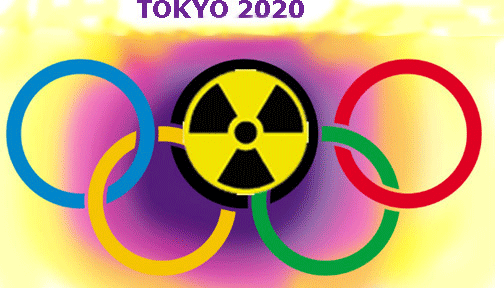
As Japan celebrates “recovery” (at least in the stock market), 2020 Tokyo Olympic, maglev bullet train that will run under Japan Alps, there are still 100 people from Futaba-machi, Fukushima still living in the abandoned high school building in Saitama Prefecture, more than two and a half years after the earthquake and tsunami and the nuclear accident struck Tohoku and Kanto.
In my August 16, 2012 post, I wrote there were more than 200 Futaba-machi residents living in shelter in the Kisai High School building in Kazo City in Saitama Prefecture, in partitioned classrooms and gyms, getting boxed meals.
Since September 1, 2012, the residents who live in the high school building have had to pay for the boxed meals, 30,000 to 40,000 yen (US$300 to 400) per month, out of their own pockets.
According to a volunteer group who’s been providing the residents, mostly elderly, with hot meals every one to two months since September 2012,
One year since [we started serving hot meals], the number of people living in the shelter have been gradually decreasing. However, there are still about 100 people living here [at the high school], eating three boxed (bento) meals every day.
The plan to close this shelter is rapidly gaining momentum, but there are still many issues to be resolved. Where will the current 100 residents at the shelter go? What about compensations?
It is not a good thing that a shelter continues to exist. But we don’t think it is a good thing if this shelter is closed without consensus from the residents.
The residents at the shelter also tell us that despite bad living conditions they find emotional support through human relationship – that they live together with their friends and acquaintances from the same town [Futaba-machi]. If the shelter is closed, they will have to live apart. They have already lost so much and are forced to live in a harsh condition. It would increase the sense of loneliness in the elderly residents and deprive them of their daily joy and happiness.
Katsutaka Idogawa is no longer the mayor of Futaba-machi; he decided not to fight the recall motion by the town assembly. He was a candidate of the Green Party for the Upper Election in July this year, but his campaign didn’t get any attention and he lost.
There is no incentive for politicians to do anything about the evacuees in an abandoned high school building in Saitama. The evacuees don’t complain, and no one complains for them.
They are going to squander a ton of money (maybe literally) on maglev trains and 2020 Olympic, but they can’t even convert this high school building into a more comfortable, habitable living space.
“….The distribution of irradiated food is also a problem. Food from near Fukushima will be sent to another prefecture, and then sent on, relabeled as produced in the second prefecture. In particular, food distributed by the major food companies, and food served in expensive restaurants, is almost never tested for radiation….”
“…This is because the level established by the Japanese Government for permissible radiation in food – which if exceeded the food must not be sold – is the same as the permissible level of radiation in low-level radioactive wastes….”
The fish near the fukushima coast coast used to contain only 0.086Bq/kg (of cesium 137) before the Fukushima disaster.
Now up its up to 100Bq/kg (for cesium), that is 1000 times more radioactive than before. It is allowed to sell this produce.
急いで、みなさまの外国人の知人・友人に広めてください。
Please share this letter with your friends and acquaintance as many as possible.
September 26, 2013
Tokyo Olympic 2020: A Letter to All Young Athletes Who Dream of Coming to Tokyo in 2020 BY Takashi Hirose
Some Facts You Should Know About Fukushima
by TAKASHI HIROSE, an author of Fukushima Meltdown: The World’s First Earthquake-Tsunami-Nuclear Disaster (2011)
On September 7, 2013 Japan’s Prime Minister Shinzo Abe said to the 125th session of the International Olympic Committee, the following:
“Some may have concerns about Fukushima. Let me assure you, the situation is under control. It has never done and will never do any damage to Tokyo.”
This will surely be remembered as one of the great lies of modern times. In Japan some people call it the “Absolute Lie”. Believing it, the IOC decided to bring the 2020 Olympics to Tokyo.
Japanese government spokespersons defend Abe’s statement by saying that radiation levels in the Pacific Ocean have not yet exceeded safety standards.
This recalls the old story of the man who jumped off a ten-storey building and, as he passed each storey, could be heard saying, “So far, so good”.
We are talking, remember, about the Pacific Ocean – the greatest body of water on earth, and for all we know, in the universe. Tokyo Electric Power Company – TEPCO – has been pouring water through its melted-down reactor at Fukushima and into the ocean for two and a half years, and so far the Pacific Ocean has been able to dilute that down to below the safety standard. So far so good. But there is no prospect in sight of turning off the water.
1. In a residential area park in Tokyo, 230 km from Fukushima, the soil was found to have a radiation level of 92,335 Becquerels per square meter. This is a dangerous level, comparable to what is found around Chernobyl exclusion zone (the site of a nuclear catastrophe in 1986). One reason this level of pollution is found in the capital is that between Tokyo and Fukushima there are no mountains high enough to block radioactive clouds. In the capital people who understand the danger absolutely avoid eating food produced in eastern Japan.
2. Inside Fukushima Daiichi Nuclear Reactors #1 – #3 the pipes (which had circulated cooling water) are broken, which caused a meltdown. This means the nuclear fuel overheated, melted, and continued to melt anything it touched. Thus it melted through the bottom of the reactor, and then through the concrete floor of the building, and sank into the ground. As mentioned above, for two and a half years TEPCO workers have been desperately pouring water into the reactor, but it is not known whether the water is actually reaching the melted fuel.
If a middle-strength earthquake comes, it is likely to destroy totally the already damaged building. And as a matter of fact, in the last two and a half years earthquakes have continued to hit Fukushima. (And as an additional matter of fact, just as this letter was being written Fukushima was hit by another middle-strength earthquake, but it seems that the building held up one more time. So far so good.) Especially dangerous is Reactor #4, where a large amount of nuclear fuel is being held in a pool, like another disaster waiting for its moment
3. The cooling water being poured into the reactor is now considered the big problem in Japan. Newspapers and TV stations that previously strove to conceal the danger of nuclear power, are now reporting on this danger every day, and criticizing Shinzo Abe for the lie he told the IOC. The issue is that the highly irradiated water is entering and mixing with the ground water, and this leakage can’t be stopped, so it is spilling into the outer ocean. It is a situation impossible to control. In August, 2013 (the month prior to Abe’s IOC speech) within the site of Fukushima Daiichi Reactor, radiation was measured at 8500 micro Sieverts per hour. That is enough to kill anyone who stayed there for a month. This makes it a very hard place for the workers to get anything done. In Ohkuma-machi, the town where the Daiichi Nuclear Reactor is located, the radiation was measured in July, 2013 (two months before Abe’s talk) at 320 micro Sieverts per hour. This level of radiation would kill a person in two and a half years. Thus, over an area many kilometers wide, ghost towns are increasing.
4. For the sake of the 2020 Tokyo Olympics, an important fact has been left out from reports that go abroad. Only the fact that irradiated water is leaking onto the surface of the ground around the reactor is reported. But deep under the surface the ground water is also being irradiated, and the ground water flows out to sea and mixes with the seawater through sea-bottom springs. It is too late to do anything about this.
SLO, May 27 (Reuters) - Sweden's 1,400 MW Oskarshamn-3
nuclear reactor, the biggest in the Nordic countries,
is expected to be back in operation on Tuesday, ramping
up to full power by June 7, its operator said in a
market message.
    The other reactor at the same plant, 473-MW
Oskarshamn-1, is scheduled to restart on Monday, b
ut its output will be kept at approximately 100 MW
during a testing period lasting two weeks.
    Output from 638 MW Oskarshamn-2 reactor
has been reduced to 350 MW due to high vibrations
on turbine valves, and the reduction is to last until
 the start of annual maintenance on June 1.
    Nordic countries have almost half of total installed
nuclear power capacity offline due to maintenance as of
early Monday.
    The following table lists Nordic nuclear units,
 installed and available net capacity in megawatt,
dates for the end of the outages and planned maintenance
duration.
    PLANT      INSTALLED  AVAILABLE  RETURN TO    MAINTENANCE
               CAPACITY   CAPACITY    NORMAL        PLANNED
 SWEDEN
 Forsmark-1       984        984         -       Jul 7-Jul 30
 Forsmark-2      1,120     1,120         -       Aug 11-Aug 24
 Forsmark-3      1,170        0       Jun 15           -
 Oskarshamn-1     473         0       May 27
 Oskarshamn-2     638        350         -          Jun 1-
                                                April 21, 2013*
 Oskarshamn-3    1,400        0       May 28
 Ringhals-1       878         0        Jun 1
 Ringhals-2       865        865         -       Sept 7-Oct 8
 Ringhals-3      1,063      1,063        -      June 20-Aug 10
                                                 Aug 10-Oct 31
 Ringhals-4       939         0       Jun 15           -
 FINLAND                                               -
 Olkiluoto-1      880        880         -             -
 Olkiluoto-2      880         0       Jun 13           -
 Loviisa-1        496        496         -       Aug 18-Sep 4
 Loviisa-2        496        496         -       Sep 7-Sep 25
 TOTAL          12,282      6,254
    * - Oskarshamn-2's permission to operate is valid until June
30, 2013. Sweden's nuclear power regulator said its extension
will depend on the reactor's modernisation.
    Sources: Nord Pool Spot, Vattenfall AB, E.ON AG, Fortum Oyj,
Teollisuuden Voima Oyj (TVO)
http://uk.reuters.com/article/2013/05/27/nordic-nuclear-idUKL5N0E80SX20130527
TEPCO resumes water decontamination at Fukushima
The operator of the Fukushima Daiichi nuclear plant resumed decontamination of waste water early Monday.
On Friday, Tokyo Electric Power Company resumed a test run of its Advanced Liquid Processing System, or ALPS system, designed to remove radioactive materials from the contaminated water.
12,000 plus 2,000 new items checked in Monju
The operator of a trouble-hit prototype reactor has completed safety checks on about 14,000 pieces of equipment that should have been inspected earlier.
The checks included about 2,000 items the operator recently discovered hadn’t been inspected.
Tainted rainwater overflows at Fukushima Daiichi
Workers at the Fukushima Daiichi nuclear plant face another challenge.
Tokyo Electric Power Company says 4 tons of radioactive rainwater has seeped into the ground after overflowing from a storage container.
The spill occurred on Tuesday when workers were pumping into the container rainwater that had collected around wastewater storage tanks. Officials of the firm say the overflow occurred because the workers transferred the water to the wrong container.
Decontamination tests start in high-radiation zone
Japan’s Environment Ministry has started trial decontamination in high-radiation zones near the troubled Fukushima Daiichi nuclear power plant.
Parts of 7 municipalities near the plant have been designated as unsuitable for living due to radiation levels over 50 millisieverts per year.
Complaints focused on the World at One programme on Radio 4 on Friday, which featured the Australian sceptic Bob Carter. A retired geologist, he leads a group called the Nongovernmental International Panel on Climate Change, and is funded by US libertarians. His words also dominated several subsequent news bulletins.
Earlier in the day, the Today programme had said it could not find any British climate scientists who disagreed with the IPCC’s core findings.
The biologist Steve Jones, who reviewed the BBC’s science output in 2011, told the Guardian he was concerned that the BBC was still wedded to an idea of “false balance” in presenting climate sceptics alongside reputable scientists.
“Science turns on evidence. Balance in science is not the same as balance in politics where politicians can have a voice however barmy their ideas are.
a stunning display of false balance when it devoted less airtime to IPCC scientists than it did to Bob Carter, a sceptic who is funded by a free-market lobby group in the US, the Heartland Institute. Carter was allowed to make a number of inaccurate and misleading statements unchallenged.”
BBC coverage of IPCC climate report criticised for sceptics’ airtime http://www.theguardian.com/media/2013/oct/01/bbc-coverage-climate-report-ipcc-scepticsSteve Jones among experts querying BBC ‘false balance’ in giving climate sceptics ‘undue’ voice on global warming study Fiona Harvey, environment correspondent The Guardian, Wednesday 2 October 2013 Steve Jones said he previously advised the BBC not to present climate-change sceptics as having equal scientific weight with mainstream researchers. The BBC has been criticised for its coverage of the most comprehensive scientific study on global warming yet published. Prominent climate experts have accused the corporation of bias towards “climate sceptics” at the expense of mainstream scientists. Continue reading →
[…] This week the Weekly Asahi (週刊朝日)published a report that in urine samples from children living in Kanto, 70% of those tested, contained cesium, a radioactive element that results in internal exposure […]
Hiroshima to Fukushima,a, Science Policy Reports (2014): Incidences of adverse health effects seem to be increasing rapidly at the time of writing (March 2013), 2 years after the accident. Thyroid anomalies among children are now widespread and observed all over Japan. Sudden heart failure seems to be increasing among the young, too. Chronic fatigue syndrome is also becoming prevalent. All kinds of infectious diseases are increasing, very likely due to weakening of the immune systems in many people […] No official data are yet available, but a large number of cases of adverse health effects have been reported, such as severe nose bleeding, hair loss, severe fatigue syndrome, acute heart failure, acute lymphatic leukemia, systemic collagenosis, spontaneous abortion, and congenital malformation.
Associated Press, Sept. 26, 2013: […] the March 2011 Fukushima disaster unleashed radiation that will affect the region’s health for decades. […] it is impossible to know what the health toll will ultimately be. Only recently has the government acknowledged that much more radioactive water is leaking into the sea than it had previously believed. […] Some medical experts are worried about sickness that may emerge in coming years […] Shuntaro Hida, 96, was among the doctors who treated the people of Hiroshima […] He said Hiroshima never fully faced up to the effects of internal radiation, and that same mistake is being repeated in Fukushima.
Jellyfish Invasion Forces EON to Shut Down Swedish Nuclear PlantBloomberg, By Julia Mengewein – Sep 30, 2013 EON SE shut down Sweden’s biggest nuclear power plant after a swarm of jellyfish made its way into a cooling water inlet at the reactor on the Baltic coast.
The 1,400 megawatt Oskarshamn-3 unit, located about 340 kilometers (211 miles) south ofStockholm, accounts for 5 percent of Sweden’s power supply, Anders Oesterberg, a spokesman for EON, said by e-mail today.
There’s much screaming and shouting from the usual suspects about the new radiation leak discovered at Fukushima, the stricken nuclear power plants in Japan. What they’re not telling you is that the radiation leakage is around the same as 76 million bananas.
A fact which should help to put it all into some perspective.
Most of us haven’t a clue what that means of course. We don’t instinctively understand what a becquerel is in the same way that we do pound, pint or gallons, and certainly trillions of anything sounds hideous. But don’t forget that trillions of picogrammes of dihydrogen monoxide is also the major ingredient in a glass of beer. So what we really want to know is whether 20 trillion becquerels of radiation is actually an important number.
To which the answer is no, it isn’t.
This is actually around and about (perhaps a little over) the amount of radiation the plant was allowed to dump into the environment before the disaster. Now there are indeed those who insist that any amount of radiation kills us all stone dead while we sleep in our beds but I’m afraid that this is incorrect. We’re all exposed to radiation all the time and we all seem to survive long enough to be killed by something else so radiation isn’t as dangerous as all that.
At which point we can offer a comparison. Something to try and give us a sense of perspective about whether 20 trillion nasties of radiation is something to get all concerned about or not. That comparison being that the radiation leakage from Fukushima appears to be about the same as that from 76 million bananas. Which is a lot of bananas I agree, but again we can put that into some sort of perspective.
Let’s start from the beginning with the banana equivalent dose, the BED. Bananas contain potassium, some portion of potassium is always radioactive, thus bananas contain some radioactivity. This gets into the human body as we digest the lovely fruit (OK, bananas are an herb but still…):
Since a typical banana contains about half a gram of potassium, it will have an activity of roughly 15 Bq.
there is widespread distrust of Japanese officials, belonging to the nuclear establishment or the government, in that country. A recent poll by the Asahi Shimbun showed that 94% of Japanese believe that the Fukushima accident has not been brought under control. Prime Minister Abe’s strong claims about there being no problems at Fukushima, and his emphatic reassurances that there are no health effects only increase the levels of distrust. Regaining that trust is going to take both full transparency and openness as well as a complete overhaul of Japan’s “nuclear village”. There is little evidence of either of these happening anytime soon.
M V Ramana (ramana@princeton.edu) is at the Nuclear Futures Laboratory & Program on Science and Global Security, Woodrow Wilson School of Public and International Affairs, Princeton University, the US.
When the announcement about Tokyo being selected for the 2020 Olympics came – after the Japanese Prime Minister Shinzo Abe made a strong pitch to the International Olympic Committee (IOC) – one of my acquaintances on Facebook reacted with a three-letter acronym that is not used in polite language (Hint: the third letter corresponds to a four-letter word that starts as “Fukushima” does!) What else can one say to the kind of assurances that Prime Minister Abe had offered to the IOC. Witness, for example, his answers to questions by Norwegian IOC member Gerhard Heiberg about the recent leaks in Fukushima as well as the 2011 accident. According to Yahoo News, Prime Minister Abe said (in Japanese, of course): “It poses no problem whatsoever…There are no health-related problems until now, nor will there be in the future…I make the statement to you in the most emphatic and unequivocal way.” Continue reading →
IMAGINE the fury of a category five cyclone bearing down on north Queensland. The storm is still a couple of hundred kilometres offshore and tracking slowly west, although meteorologists are unsure where and when exactly it will cross the coast and what sort of a punch it will be packing when it does make landfall. Forecasting the precise movements of such a powerful and destructive weather system is not, after all, an exact science.
On the logic of climate change deniers, who argue the world needs to take no action to combat global warming yet because “the science isn’t settled”, in this scenario the good burghers of coastal towns should take no precautions against the looming tempest because there is no absolute guarantee they’ll experience anything more inclement than a spot of rain.
Indeed, perhaps those people in the possible path of the cyclone should turn off their televisions lest they inadvertently catch a weather bulletin – after all, what you don’t know can’t hurt you, right? All together now, put your hands over your ears and start chanting “na-na-na-na-naaah” and watch on quietly while we abolish the Climate Commission.
The deniers contend that “only” about 97 per cent of the world’s scientific community accept the human influence on possibly catastrophic global warming, thus the jury is out. On this basis then the science on evolution is not yet settled either and news media and indeed our schools should be giving equal weight to the views of intelligent design theorists. Actually, while we are being biblical for a moment, one could view Noah’s ark as the first recorded attempt at Direct Action in the face of climate change, although attempts at a similar solution today may run foul of the Stop the Boats humbuggery.
Kyodo,, June 5, 2013: Researchers at Fukushima Medical University […] said they do not believe that the most recent cases are related to the nuclear crisis. They point out that thyroid cancer cases were not found among children hit by the 1986 Chernobyl nuclear accident until four to five years later. […]
Asahi Shimbun, August 21, 2013: A Fukushima prefectural government official said, “It is likely (the 44 children) developed tumors or lumps before the nuclear accident.” […] In the case of the Chernobyl disaster in 1986, thyroid cancer cases started to soar four to five years later […] A number of residents have expressed strong dissatisfaction with the Fukushima prefectural government over its interpretation of the effects of radiation exposure, the accuracy of its thyroid testing and the way it discloses information.
Wikipedia:: As of August 2013, there have been more than 40 children newly diagnosed with thyroid cancer and other cancers in Fukushima prefecture as a whole, but these cancers are not attributed to radiation from Fukushima […] if Chernobyl is anything to go by the increase in thyroid cancer rates won’t begin until approximately 4–5 years after the accident.
Thyroid cancer found in 18 Fukushima children NHK WORLD English
Hiroshima to Fukushima – Data on Fukushima,, Eiichiro Ochiai (2014): “12 out of 174.000 children” […] is much higher than that seen in the Chernobyl incident […] If 15 more likely cases were taken account of, the thyroid cancer incident rate among Fukushima children would be about 7.8/100.000/year, extraordinarily a high rate. (Note: this number is still an underestimate. This number would he 21/100,0110/y if the data is more properly analyzed). The authority denies that they were caused by the radiation released from the TEPCo NPP on the basis that thyroid cancer would emerge only 4-5 years after such an incident. However, the data on the Chernobyl incident show that thyroid cancer did show up even just one year later (see Fig. 14.4) […]









 nuclear-news