U.S. Dept. of Energy Supports New Renewable Energy Storage System Oil Price, By John Daly | Sat, 28 September 2013 The two bottlenecks inhibiting further use of renewable energy systems are cost and the fact that the sun doesn’t always shine or the wind blow-in one word, storage. While mass production of components such as solar photovoltaic cells means that their price has been dropping, the issue of storing and releasing electricity generated by renewable sources during their down times has led engineers worldwide to tackle the problem.
Large-scale, low-cost energy storage is needed to improve the reliability, resiliency, and efficiency of next-generation power grids. Energy storage can reduce power fluctuations, enhance system flexibility, and enable the storage and dispatch of electricity generated by variable renewable energy sources such as wind, solar, and water power.
Now one technology seems sufficiently promising that it is receiving funding from the U.S. Department of Energy’s Office of Electricity Delivery and Energy Reliability Energy Storage Program.
What is this promising new technology?
Isothermal compressed air energy storage (ICAES) refers to storage of compressed air at a constant temperature, which is a key element in the improved energy efficiency of the system.
SustainX has completed construction of its first utility scale ICAES system. It was hooked up to the grid earlier this month and it’s now in the process of revving up to speed. The DOE’s Office of Electricity Delivery and Energy Reliability’s Energy Storage Program underwrote $5,396,023 of the system’s cost……..
The DOE is certainly impressed, noting on its “Isothermal Compressed Air Energy Storage” webpage; “SustainX’s ICAES technology offers several advantages: it can be sited anywhere, and it is not dependent on advantageous geological formations. It allows power and energy to scale independently. It consumes no fuel and produces no emissions. It utilizes proven mechanical systems and is composed almost entirely of steel, water, and air. It offers 20 years of performance at full power and capacity and 100% depth of discharge.” Governmental endorsements don’t come much stronger than that.
And how big is the compressed air energy storage industry going to become? According to Navigant Research director Kerry-Ann Adamson, the market will grow dramatically over the next decade. Adamson remarked, “Rapidly changing energy mixes and increasing renewable energy penetration will continue to introduce instability onto electricity grids worldwide in the coming years, while the volatility of load profiles will challenge grid operators to deliver reliable and secure electricity. These macro conditions will drive demand for CAES, helping to rejuvenate a sector that has been largely dormant for the last two decades.” http://oilprice.com/Alternative-Energy/Renewable-Energy/Bill-Gates-Backs-New-Renewable-Energy-Storage-System.html
Cameco, Sierra Club face off over uranium licences for Saskatchewan mines THE STAR PHOENIX THE CANADIAN PRESS SEPTEMBER 30, 2013 SASKATOON – An environmental group is raising pollution concerns about Cameco’s uranium mining in northern Saskatchewan to the Canadian Nuclear Safety Commission.
But Cameco says the Sierra Club’s allegations that it massively exceeded regulatory limits are false.
The commission will hear from both sides as public hearings start Tuesday on Cameco’s application to renew its mine and mill licences for its Key Lake, McArthur River and Rabbit Lake facilities.
“The most disturbing thing we discovered in the process of preparing the submission were huge, very huge numbers, in terms of pollution that’s coming from the plant and getting into the environment,” John Bennett, executive director of Sierra Club Canada, said Monday.
“Every kind of pollutant that comes out of them, their numbers are way over the limits and no one’s been enforcing it.”
The Sierra Club says that as of 2010, water releases from the Deilmann tailings facility in cadmium exceed the Saskatchewan standard by 5,782 per cent.
It says the Saskatchewan Ministry of Environment allows Cameco to release water from tailings ponds directly into the environment at Horsefly Lake.
The organization also says at the McArthur River site, concentrations of arsenic, selenium, and uranium in water effluent have exceeded the standards by 54 per cent for arsenic, 700 per cent for selenium and 1,230 per cent for uranium. It says blueberries and fish are contaminated with uranium.
The Sierra Club says the pollution is increasing the risk to human health and local eco-systems.
“We think that before any kind of change, any kind of renewal of the licence, there needs to be an environmental impact study — which there hasn’t been yet,” Bennett said in an interview from Ottawa……..
Obama tries to reassure Israel over Iranian nuclear negotiations Erin Delmore, @erindelmore 09/30/2013 President Obama today sought to reassure Israeli Prime Minister Benjamin Netanyahu that the United States still has Israel’s back.
On Monday, Obama and Netanyahu met at the White House, just three days afterObama’s historic phone callwith the leader of Iran.
Newly-elected Iranian President Hassan Rouhani and Obama spoke on the phone on Friday, marking the highest-level direct contact between the two countries in more than 30 years.
Obama vowed to proceed with caution toward a potential diplomatic resolution to the Iranian nuclear standoff, and reaffirmed an “unshakable bond” with the Israeli people.
“Because of the extraordinary sanctions… the Iranians are now prepared, it appears, to negotiate,” Obama said, adding that negotiations “will not be easy” and that lifting sanctions would require “the highest standards of verification.”
Obama promised to consult Israel and other allies closely and pledged to “take no actions off the table, including military options.”……..
Breast cancer patients are given unnecessary doses of radiation therapy Information Daily , October 1, 2013 For the first time, researchers have admitted that shorter radiotherapy treatments may be as effective as longer treatments, with fewer side effects.
Scientists have found that longer bouts of radiotherapy are overcompensating for cancer cell growth that occurs overnight and during weekends, causing unnecessary and uncomfortable side effects……..
overall they found that an even shorter one-week radiotherapy schedule could replace the contemporary five to seven week schedules – and could even trump the newly popular three week schedule.
Overall, it is clear that clinicans support this move, arguing that shorter treatment schedules would be more convenient for patients, with benefits including fewer trips to the hospital, and also highly cost-effective for health services.
President of ECCO, Professor Cornelis van de Velde, explained that “this is important research that suggests that the overall treatment time with radiotherapy could make a difference to outcomes for women with early breast cancer”.
“If further investigations confirm that a shorter radiotherapy schedule is as effective as the current standard of care, it will be another step towards making treatments easier and more bearable for patients, and possibly cheaper for healthcare services”.
Lead author, Prof Yarnold, added that, “if confirmed, it means that current trends to deliver shorter radiotherapy schedules are likely to bear fruit in the future”.
Russia offers first ever subsidies for renewable energy PV MAGAZINE, 01. OCTOBER 2013 BY: IAN CLOVER The world’s largest oil producer plans to develop its renewable energy sector – which currently produces just 0.8% of the country’s power – and has hosted its first clean power auction, with 39 ventures securing subsidies. Russia has offered its first ever state-backed support for renewable energy, offering subsidies for 39 clean power ventures with a combined capacity of 504 MW.
Solar power won the day, with 399 MW secured, while the wind power sector won just one-tenth of the 1,100 MW of wind capacity offered in the auction. By contrast, solar developers bid for nearly 1,000 MW, winning 32 projects to be built between 2014 and 2017.
“The tender has been quite successful for solar energy, showing that the Russian market can attract developers,” the head of the Russian Solar Industry Association, Anton Usachev, told Bloomberg. Because developers are required to use at least 50% of materials sourced from local contractors, the wind power sector may have been reluctant to invest, he believes.
Solar bidders, on the other hand, were evidently confident in their ability to satisfy local content requirements.
American nuclear chief investigated over casino cheating Navy Vice Admiral Timothy Giardina is accused of using counterfeit poker chips at an Iowa casino The Independent TIM WALKER SUNDAY 29 SEPTEMBER 2013 Apparently, the US military would prefer the officers in charge of its nukes not be the gambling sort. Over the weekend it emerged that Navy Vice Admiral Timothy Giardina, the second-in-command of the US nuclear arsenal, is the subject of an illegal gambling investigation into the use of counterfeit poker chips at an Iowa casino. Admiral Giardina, who has not been arrested or charged, was suspended from his duties on 3 September, officials said on Saturday…….
The US nuclear establishment had already been having an off year. In May, 17 launch control officers assigned to the maintenance of nuclear missiles at Minot Air Force Base in North Dakota were sidelined following a safety inspection. The officer in charge of their training was later relieved of duty. Last month, a missile unit at Montana’s Malmstrom Air Force Base also failed a nuclear safety and security inspection; the commanding officer there was also relieved of duty. http://www.independent.co.uk/news/world/americas/american-nuclear-chief-investigated-over-casino-cheating-8847658.html
The recently published World Health Organization report on its study of congenital birth anomalies in Iraq is nothing short of a disgrace.
There have been an increasing number of reports about childhood cancers, adult cancers and birth defects in Iraq. Public pressure and media attention to this catastrophic situation prompted a joint study by the World Health Organization (WHO) and the Iraqi Health Ministry to determine the prevalence of birth defects in the country. The study began in May-June 2012 and was completed in early October 2012. But it was not made public until recently. And I have to say that those who designed and carried out the study were well aware that the method they chose could not possible give correct answers to the question of congenital anomaly rates, since they had consulted with me before they started, and I had pointed out why their method was unsafe, even sending them a report suggesting a method that would work.
In May 2011, I was asked to travel to Geneva by the Union of Arab Jurists to make my first presentation at the UN Human Rights Council, reporting our preliminary findings of extraordinarily high rates of cancer, infant mortality and sex ratio perturbations in the population of Fallujah, which we published in the International Journal of Environment and Public Health in 2010. I met with the director of the Human Rights Council, and also with the director of the International Red Cross, and made the case for intervention.
There was massive anecdotal evidence of these genetic damage effects of the US uranium weapons since the mid-1990s and in Fallujah after the 2004 war, but no one had carried out any study. We collected some money from individuals (about £4,000) and marched in. What we found made headlines in The Daily Telegraph, Le Monde and all over the world. In that study, we examined infant mortality rather than congenital birth defects, for reasons we gave in the paper and I will review here.
Later we also published two other follow-up studies based on hospital data, one analyzing 52 elements in the hair of the parents of children with congenital anomalies, the other giving the congenital anomaly rates and types. Both were based on prospective collection of data by the pediatricians from Fallujah General Hospital, and so we could be sure of the types of anomaly and the numbers.
Reuters
I have to say that the fear generated by these discoveries made it extremely difficult to get the results published. The Lancet threw the papers out without sending them for review. The International Journal of Environment and Public Health was attacked after the first one, by various individuals they refused to name – and they wouldn’t publish the second one, which was published by Conflict and Health. The third one was also rejected by The Lancet and various other frightened journals and eventually was published by the Journal of the Islamic Medical Association, and then only after I asked them what Allah would think of their pusillanimous behavior. So much for scientific truth.
I pointed out to the WHO representative who contacted me in January 2011, Syed Jaffar Hussein, asking if I would join the WHO project, that the kind of questionnaire study that WHO were proposing would fail for two reasons. The first and most critical is that parents will not have sufficient knowledge to diagnose a congenital anomaly in their baby. For example, in the absence of hospital involvement at a high technical level (e.g. Fallujah Hospital) the baby will just die of what seems to the parents to be pneumonia, or failure to thrive, or the child will die for no apparent reason. In terms of congenital heart defects, or kidney defects, or many neurological defects there is no observable sign. And the type of monstrous defect, the Cyclops eye, the lack of arms, all the pictures on the Internet, these are a minor fraction of all the congenital defects that are fatal at birth. Generally the mother is not allowed to see such a baby and she is told it has died. It is the heart defects that make up the majority, and these are only diagnosable in a hospital pediatric unit.
The second problem I know about, since I have designed and carried out several questionnaire epidemiology studies since the pilot one in Carlingford, Ireland in 2000: it is that people can’t remember back even five years, let alone 15 years. And in a situation like Iraq, where having a child with a congenital defect means that you yourself are contaminated and damaged, the likelihood is that you will shortly be dead from cancer and a whole range of illnesses generated by the causes that killed your baby. So the questionnaire study loses cases as you go back in time. The WHO results clearly show this, since the rates they report are actually lower than expected, suggesting that living in Iraq is good for birth outcomes. They seem surprised by this.
So a hospital-based prospective study is the only way. And since this is such a political issue, I said I would only be involved if I could have a hands-on role so that the numbers could be checked, and that was the end of our communication.
The result is very shoddy procedure which would not make it into peer-review. The WHO says that its work and the report was peer-reviewed by senior epidemiologists at the London School of Hygiene and Tropical Medicine, but if this is true these reviewers should be sent packing. The WHO report fails to refer to any of the studies, like our follow-up papers on uranium in Conflict and Health and the IMANA congenital anomaly rates one. There, for example, we looked at the uranium content along long strands of hair in mothers of birth-defect children and showed that the concentrations increased back to the time of the US attacks.
It is fairly easy to show that the WHO results are ridiculous. There was a previous similar study under Saddam’s regime for the period 1994-1999 which is of interest. This study also was not cited in the WHO report but was discussed in our paper which they must have read. The Iraqi child and maternal mortality survey covered 46,956 births in Iraq from 1994-1999.
Areva SA has promised to remove up to 99.99 percent of the radioactive contaminants in 67,500 tons of water flooding the crippled Fukushima-Dai-ichi nuclear plant. It will use a co-precipitation method employed at its La Hague nuclear fuel reprocessing facility in Normandy.
That process has been documented in detail by a French nuclear expert and by the U.S. government, which has shunned France’s fuel reprocessing method because of “a non-proliferation concern and environmental concerns,” in the words of Nuclear Regulatory Commission Chairman Gregory Jaczko.
The water treatment process has been deplored by environmental groups including Greenpeace and Physicians for Social Responsibility in part because of the quality of cleaned water it produces:
France reprocesses reactor fuel at the vast La Hague facility on the Normandy coast. The so-called low-level liquid wastes from reprocessing are discharged into the English Channel and into the air. However, these “low-level” wastes still contain highly radioactive and often long-lived isotopes. Dumping these same wastes into the sea in containers would violate the 1970 London Dumping Convention.”
Areva has not revealed which chemicals it will use at Fukushima, but a 1995 report commissioned by the U.S. Department of Energy (pdf) details the process it uses at La Hague. According to DOE, Areva uses:
nickel and potassium ferrocyanide to capture cesium
ニッケルとフェロシアン化カリウム:セシウム捕捉用
•barium sulfate to capture strontium
硫酸化バリウム:ストロンチウム捕捉用
•cobalt sulfide for ruthenium
硫化コバルト:ルテニウム捕捉用
•titanium sulfate for antimony and other emitters of alpha radiation
硫酸化ティタニウム:アンティモニイほかアルファ線放射物質捕捉用
Areva also uses hydroxides of sodium, manganese, titanium, and iron, according to other sources. The chemicals and radionuclides are removed from the water in a highly radioactive chemical sludge.
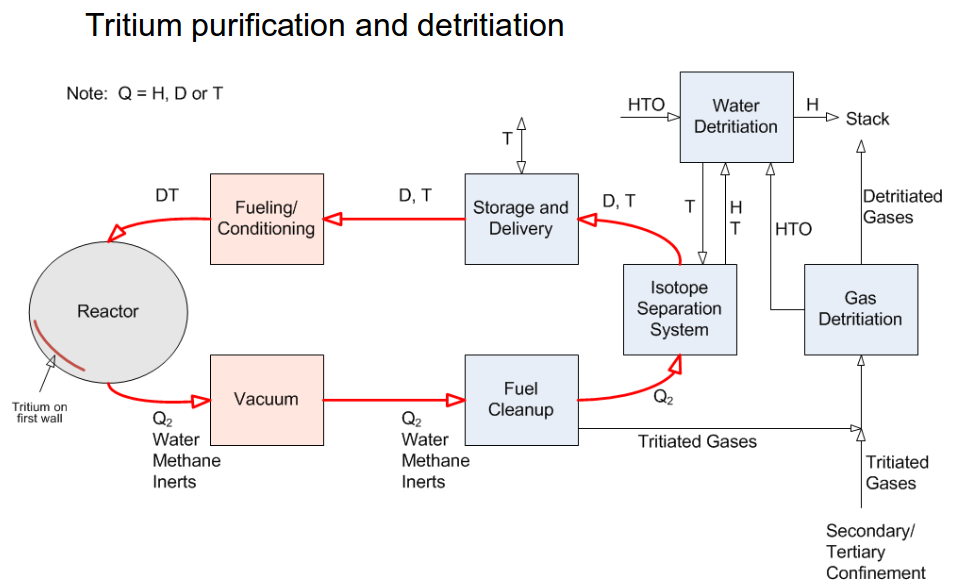
IRVINE, Calif.–(EON: Enhanced Online News)–Kurion, Inc., an innovator in nuclear and hazardous waste management, announced a breakthrough in the treatment of the historically difficult to capture isotope with the introduction of its patent-pending Modular Detritiation System™ (MDS™) to decontaminate tritiated water.
The ability to perform light water detritiation (i.e., the removal of tritium from water) enables the safe release of purified water into the environment or recycling of reactor cooling water. The technology has applications for light water reactors, which are the dominant nuclear plant designs worldwide.
“The key value of Kurion’s patent-pending detritiation technology is that it offers an economical alternative to releasing tritium into the environment and bolsters the appeal of nuclear power as a clean, safe energy source.”
The decontamination of tritium (T) is particularly problematic: it is a special form of hydrogen that forms tritiated water (HTO vs. H2O), which does not lend itself to removal by conventional technologies. This is because instead of the contaminant being carried along in water in suspended or dissolved form, the water molecule itself is modified. As a result, tritiated water is particularly difficult to treat and can spread easily if it escapes into the environment.
BBC correspondent Rupert Wingfield-Hayes moved to Japan with his family in 2012 and has spent a lot of time reporting on the aftermath of the tsunami in 2011 which led to the closure of the Fukushima nuclear power station.
He recently made a second trip inside the crippled plant at Fukushima, and has spent many days in the contamination zone, and talking to nuclear experts.
He asks if it is possible to fully recover from a disaster on the scale of Fukushima and if it is possible to guarantee that it will never happen again.







 nuclear-news