22.97 microSv/h, Koriyama city, Sakabuta Park- residential housing area
Published on 8 Sep 2013
On 7th of Sept 2013 , I measured radiation around Sakabuta Park, Koriyama city, Fukushima pref. Japan
I monitored 0.47 to 0.65 micro Sv/h at my chest height in air.
22.97 on road side sand, on gurter cover on a foot of a slope road.
The monitorinig place is 55 or 60 km from Fukushima Daiichi Nuclear power plant.
Housing area of Koriyama city. Koriyama city: popolation approx 330,000.
Measuring instrument ECOTEST MKS-05, Ukraine made and Air counter of ST Corp., Japan.
Kids have been endangered with external & internal radiation exposure risk
———————-
A map shown in the video is “Radiation counter map of the FUKUSHIMA Daiich nuclear accident” by frofessor Yukio HAYAKAWA of GUNMA university.
群馬大学の早川由紀夫教授による『福島第一原発事故の放射能汚染地図・7訂版』をビデオの中で使用しました。
22.97μSv/h 郡山市酒蓋公園近く 側溝の蓋の上に溜まった砂 2013年9月
Published 2nd February 2013
WorldNetworkChildren
The Fukushima Collective Evacuation Trial Team
http://fukushima-evacuation-e.blogspo/…
World Network for Saving Children from Radiation
http://www.save-children-from-radiati/…
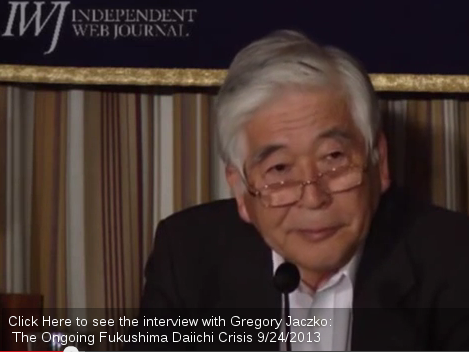
Gregory Jaczko: The Ongoing Fukushima Daiichi Crisis

Published on 23 Sep 2013
Gregory Jaczko: The Ongoing Fukushima Daiichi Crisis; Ongoing Radioactive Discharges and Other Current Issues
The radioactive discharge problem at Tepco’s Fukushima Daiichi nuclear power plant is bringing worldwide attention to Japan’s ability to deal with the continuing crisis at Fukushima.
PRESS CONFERENCE 9/24 Foreign Correspondents Club of Japan
Gregory Jaczko, Former Chairman,US Nuclear Regulatory Commission
Torgen Johnson,Citizens’ Representative, San Diego Forum
Tetsuro Tsutsui,Member, Nuclear Regulation Sub-committee,
Citizens’ Commission on Nuclear Energy (CCNE) /
Nuclear Power Plant Technical Experts’ Group
http://www.ustream.tv/channel/iwj6
外国特派員協会FCCJ記者会見
グレゴリー・ヤツコGregory Jaczko:元米国合衆国原子力規制委員会NRC委員長
米サンオノフレ原子力発電所を廃炉にしたトーガン・ジョンソン (カルフォルニア在住)
筒井哲郎:(推進派と紙一重の実態も)原子力市民委員会 以下参照
良い原発ならOKの意見も ビックリの原子力市民委員会9/12
http://www.youtube.com/watch?v=vzSab6…
モンゴルなど論外と思っていたが モンゴル議論 9/12第五回 原子力市民委員会
http://www.youtube.com/watch?v=afaaif…
参考 9/23 グレゴリー・ヤツコ元米原子力規制委員長が講演
「福島第一原発事故はスリーマイル島事故の重要な教訓を学ばなかった結果」 | IWJ
http://iwj.co.jp/wj/open/archives/102941 掲載期間終了後は、会員限定記事
Fukushima: Nuclear Safety Myth~Anti-Nuclear Mayor Tatsuya Murakami Q&A (English Only)
Published on 24 Sep 2013
This was a really good interview, in my opinion.
I edited the following 52 minute video to include Only English Translation. View the full length video here:
Tatsuya Murakami,anti-nuclear Mayor of Tokai-mura Q&A Includes Japanese Translation.
http://youtu.be/TxPkxdCUzFY
What was discussed in the video posted here?
Ground water is a Big Problem with Fukushima.
Shelf life on the tanks outside Fukushima Daiichi are only designed for three years!
Tokai Daini #2 must be decomissioned ASAP, however, there must be a storage place underground to house the fuel rods, and NO PLACE is safe enough to put the fuel rods, so they will just sit where they are for now.
Should TEPCO be held Criminally Responsible?
Security at Nuclear power plants is IMPOSSIBLE, even with armed guards.
approx: 9:20 Nuclear Plants are Dangerous and we must get rid of ALL NUCLEAR POWER PLANTS.
approx 10:00 Abe Promoting exportation of Nuclear power plants overseas is seen as Japan being immoral and unethical.
approx 12:30 The national government Must step in to take over TEPCO and dissolve Tepco. A new electric supply system must be installed. Lies and mistrust from around the world at Japan, as it promotes nuclear power across the world.
approx 16:00 Status of Tokai Daini is a PROBLEM for a variety of reasons mentioned above
approx 18:30 the Pacific Ocean contamination of Ibaraki prefecture is discussed
approx 19:00 Fukushima fish now not caught but specific species have been more effected than others… but that is a bunch of bullshit. More fish are being caught in Ibaraki, but remember fish know no “exclusion zone” boundaries…
approx 20:00 The LDP grants money to the economy of a region based on nuclear power generation. The JAEA (Japan Atomic Energy Assoc) income comprises one Third of the Budget.
Regulator Authorities is what is wrong and itnernational aid is needed
Fundamental problems with nuclear energy and remember that Japan IMPORTED the nuclear energy technology form the United States. Not enough attention was given to safety and regulation. Remember these people who regulate nuclear energy are ALSO the ones who Promote it.
There is a Myth of Safety that “Nuclear Energy Can Be Controlled”, and it is Clear it CANNOT be controlled, especially in a “promote nuclear” environment without safety measures.
PRESS CONFERENCE Tatsuya Murakami, Mayor of Tokai-mura (Tokai Village, Ibaraki Prefecture)
http://tinyurl.com/m6ub6ve
PRESS CONFERENCE
Tatsuya Murakami
Mayor of Tokai-mura (Tokai Village, Ibaraki Prefecture)
September 5, 2013
(The speech and Q & A will be in Japanese with English interpretation)
Had the tsunami been one meter higher, Japan would have had one more Fukushima catastrophe at a site much nearer to the Tokyo metropolitan area in Tokai Village, Ibaragi prefecture.
The 6.1 meter high breakwater almost completed just shortly before March 11, 2011, barely protected the Tokai Daini Nuclear Plant from becoming fully flooded. Just by a razor thin margin, the plant escaped the doom of total blackout and thus a resulting reactor core meltdown.
Tokai Village is known as the birth place of Japan’s nuclear business. Japan’s first nuclear reactor started operation here in Tokai in 1957. The village also has experienced numerous accidents, including the worst civilian radiation accident in Japan prior to the Fukushima disaster. The accident took place in 1999 and resulted in two deaths.
Tatsuya Murakami was elected mayor of Tokai Village in 1997. He took a bold initiative in the crisis management of the 1999 accident. In the wake of Fukushima catastrophe, he has made his anti-nuclear stance clear. He has been opposing the resumption of the Tokai Plant operation, saying “Japan is not qualified to have nuclear plants.”
Amid the trend for nuclear resumption, Murakami decided not to run during the next mayoral election scheduled for September. Let’s listen to the message he will deliver at the FCCJ press conference on September 5th.
Murakami was born in 1943. He is a graduate of Hitotsubashi University and worked as a banker for 31 years before he was elected Mayor.
here’s a BONUS LINK FOR YOU!
Gregory Jaczko: The Ongoing Fukushima Daiichi Crisis 9/24/2013
http://youtu.be/6TxqAGZOX7s
-
Category
-
Licence
Creative Commons Attribution licence (reuse allowed)
Concrete cover is a safer option for crippled Fukushima nuclear power plant
Japan Expert: Cancel plans for trying to remove Fukushima melted fuel — Cover buildings with concrete instead(VIDEO) http://enenews.com/japan-expert-cancel-plans-trying-remove-fukushima-melted-fuel-cover-buildings-concrete-instead-video
Title: Jaczko, Johnson & Tsutsui, The Ongoing Fukushima Daiichi Crisis
Source: Foreign Correspondents’ Club of Japan
Date: September 24, 2013
Tetsuro Tsutsui, Member of Nuclear Regulation Subcommittee, Citizens’ Commission on Nuclear Energy (CCNE) Nuclear Power Plant Technical Experts’ Group:
Plans for removal of debris should be cancelled. The current METI and Tepco road map says that the removal of the [melted fuel] debris will begin 8.5 years after the accident and be completed 20 to 25 years after the accident.
We propose the following alternative: The contaminated water problem should be resolved. Spent fuel in the spent fuel pools should be removed as planned. Then we propose that the water cooling of the damaged reactor cores should be continued until the decay heat is reduced sufficiently for natural air circulation. Subsequently, the equipment and building areas [slated?] for isolation should be covered with concrete.
Gregory Jaczko: The Ongoing Fukushima Daiichi Crisis 9/24/2013
This proposed method could avoid many uncertain difficulties which would arise in the METI/Tepco plan, including: Plugging an uncertain number of cracks in the pressure and containment vessels; The need to develop missiles to break up the blocks of debris and remove the pieces of debris; The extensive radioactive dose to workers; The huge financial expenses.
Watch the FCCJ event here
See also: Bloomberg: Tepco now in talks to cover Fukushima reactors with concrete for next 75 years — Officials reviewing plan in U.S.
The world must help in unprecedented crisis of Fukushima
 Japan Professors: “Problem of such unprecedented magnitude” at Fukushima — International consequences — Fuel rods melted through reactor floors? http://enenews.com/japan-professors-problem-of-such-unprecedented-magnitude-at-fukushima-international-consequences-fuel-rods-melted-through-reactor-floors
Thomas Snitch, Senior Professor of Science at Institute for Advanced Studies (United Nations University, Tokyo), ), Japan Times, Sept. 23, 2013: Let the world help at Fukushima No. 1 […] It would be useful if the government of Japan would avail themselves of the assistance and technology that could be provided by foreign corporations with experience in the decommissioning of nuclear plants. […] The consequences of the continued delay in addressing the real challenges at Fukushima have international consequences. So, why not allow the international nuclear community the opportunity to help?
Colin P. A. Jones is a professor at Doshisha Law School in Kyoto Japan Times, Sept. 17, 2013: : […] If anything called for a nation’s government to quickly intervene actively on a massive scale and assume direct responsibility for a situation, it would be the crisis that continues to unfold 200 km from Tokyo. […] here we are 2½ years later, learning highly radioactive water has been leaking into the groundwater and the ocean and that storage tanks full of even more radioactive water are starting to fail. Surely it is a basic fact of life in nuclear power that fuel rods need to be kept cool whether sitting in a containment pool or melted through the reactor floor? The accumulation of radioactive water at the Fukushima plant was an utterly predictable problem almost from the day things first started to explode. Tepco gets a failing grade here for sure, but what about the people expecting a single company to deal with a problem of such unprecedented magnitude in the first place? […]
See also: BBC: Fukushima plant in “unprecedented crisis” and it’s getting worse, says Japan nuclear official
Small political lobbies wield huge influence through Internet trolls and apambots
 (Ed Note: “trolls” – comments, put out in large numbers by a political lobby – can be by people paid to send them “Spambots” are computer generated messages – can be put out in thousands to swamp articles with supposedly genuine opinion comments by individual people)
Even a fractious minority wields enough power to skew a reader’s perception of a story.
A politically motivated, decades-long war on expertise has eroded the popular consensus on a wide variety of scientifically validated topics. Everything, from evolution to the origins of climate change, is mistakenly up for grabs again.
Why We’re Shutting Off Our Comments http://www.popsci.com/science/article/2013-09/why-were-shutting-our-comment
Starting today, PopularScience.com will no longer accept comments on new articles. Here’s why. By Suzanne LaBarre 09.24.2013
Comments can be bad for science. That’s why, here at PopularScience.com, we’re shutting them off.
It wasn’t a decision we made lightly. As the news arm of a 141-year-old science and technology magazine, we are as committed to fostering lively, intellectual debate as we are to spreading the word of science far and wide. The problem is when trolls and spambots overwhelm the former,diminishing our ability to do the latter.
That is not to suggest that we are the only website in the world that attracts vexing commenters.Far from it. Nor is it to suggest that all, or even close to all, of our commenters are shrill, boorish specimens of the lower internet phyla. We have many delightful, thought-provoking commenters.
But even a fractious minority wields enough power to skew a reader’s perception of a story, recent research suggests. Continue reading
Fukushima’s nuclear reactor No 4 poses an apocalyptic danger
We’re in very apocalyptic territory, with a wide and unknown range of outcomes. Take that for what it’s worth — little could go wrong, or much
Risky repair of Fukushima could spill 15,000x radiation of Hiroshima, create 85 Chernobyls, America Blog 9/23/2013 by Gaius Publius Does the planned November 2013 removal of the spent fuel rods stored at Fukushima’s heavily damaged Reactor 4 need a global intervention, or should TEPCO (Tokyo Electric Power Co., a for-profit company) be allowed to go it alone?
So far, the Japanese government is allowing TEPCO to handle it. Why should you care? Read on………
Reactor No 4 today. Notice that it has no roof. The spent fuel rods (and about 200 “fully loaded” unspent rods — remember that “reactor 4 had been de-fueled” prior to the accident) are stored in a water-containing chamber high off the ground in a crumbling room and building without a roof. Below – Unit 4 today

How will “they” get the damaged fuel rods out of that crumbling room?
This is the problem today. There are about 1300 fuel rods stored in that room, packed together vertically in racks. Think of a pack of cigarettes standing upright with the top of the pack removed. Normally, the movement of fuel rods is done by a computer-driven machine that reaches into the room from above and removes or replaces a fuel rod by drawing it upward or lowering it downward.
The machine knows to the millimeter where each fuel rod is located. Also, the rods are undamaged — perfectly straight.
The problem is that this pack of cigarettes is crumpled, and the process must done manually. Therefore, the likelihood that some of the fuel rods will break is high. If that happens and fuel rods are exposed to the air — BOOM. What does “boom” look like?
Fukushima’s owner, Tokyo Electric (Tepco), says that within as few as 60 days it may begin trying to remove more than 1300 spent fuel rods from a badly damaged pool perched 100 feet in the air. The pool rests on a badly damaged building that is tilting, sinking and could easily come down in the next earthquake, if not on its own.
Some 400 tons of fuel in that pool could spew out more than 15,000 times as much radiation as was released at Hiroshima.
Meanwhile, at the rest of the site: Continue reading
Treating 56 million gallons of radioactive trash the fist step to clean up Hanford
At the height of World War II, the federal government created Hanford to build the atomic bomb. Today, it is the nation’s most contaminated nuclear site, with cleanup expected to last decades. The effort — at a price tag of about $2 billion annually — has cost taxpayers $40 billion to date and is estimated to cost $115 billion more.
The most challenging task so far has been the removal of highly radioactive waste from the 177 aging, underground tanks and construction of a plant to treat that waste
Phased start to Hanford nuclear cleanup recommended http://www.usatoday.com/story/news/nation/2013/09/24/doe-government-hanford-radioactive-waste-phased-start/2866155/AP September 24, 2013
Dep’t. of Energy urges starting to treat plant’s 56M gallons of waste as soon as possible. KENNEWICK, Wash. (AP) — The federal government is recommending a phased start to treatment of radioactive waste now held in underground tanks at the Hanford Nuclear Reservation in Washington state.
The Department of Energy, in a report released Tuesday, proposes starting to treat some of Hanford’s 56 million gallons of waste for disposal as soon as possible, while work continues to resolve technical issues at the vitrification plant’s Pretreatment and High Level Waste Facilities, the Tri-City Herald reported.
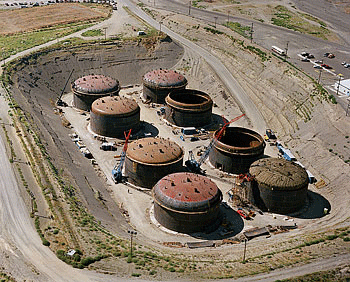
Treatment would include sending some low activity radioactive waste directly to the plant’s Low Activity Waste Facility to be prepared for disposal. That would require bypassing the Pretreatment Facility, which originally was planned to separate all the tank waste into low activity and high level waste streams for separate treatment. Continue reading
A litany of bad news for the US nuclear industry
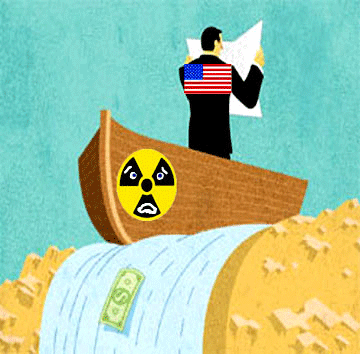 Wall Street firm Credit Suisse set the tone in February with a report that described the aging U.S. fleet of nuclear power plants as “facing declining performance, higher costs and inevitable mortality.
by Elizabeth Douglas, theguardian.com, Wednesday 25 September 2013 As the economics of building plants and maintaining old ones erode, some experts see little hope for an industry being touted by some as a climate savior.
A string of plant closures, project cancellations and other setbacks has raised new doubts about the future of nuclear power in the United States, but there’s disagreement about whether the retrenchment will be limited and temporary or the beginning of a broad and permanent decline.Renewed safety concerns and reinvigorated local opposition have played a role in the industry’s recent troubles. But the most potent foe—and the primary force behind the spate of closures and abandoned projects—is economic.The industry’s run of bad news includes: Continue reading
South Dakota medical association unanimously opposes uranium mining in Black Hills
The acceptance by the U.S. Nuclear Regulatory Commission that “the restoration of an ISL-mined aquifer to pre-mining water quality is … an impossibility.”
“the loss of large volumes of water in such mining operations is not in the public interest” when “considering the projected future scarcity of uncontaminated fresh water in our semi-arid region.”
SD medical association unanimously against uranium mining in Hills http://www.bhpioneer.com/local_news/article_833ccd96-2536-11e3-b6be-0019bb2963f4.html 24 Sept 13,
Group hopes to work with Colorado Medical Society, bring petition to AMA By Adam Hurlburt Black Hills Pioneer
CHAMBERLAIN — The South Dakota State Medical Association has come out in opposition of uranium mining in the Black Hills in direct response to Powertech USA’s proposed in situ leach (ISL) uranium mining project in Fall River County, making it the second statewide medical association to publicly oppose uranium mining in response to a Powertech ISL uranium mining proposal in the past six years.

At a recent meeting held in Chamberlain, the SDSMA’s 78-member Council of Physicians unanimously voted to support a petition opposing not only Powertech’s proposed Dewey-Burdock ISL uranium mining project in the Southern Hills, but uranium mining of any type in the Black Hills Area.
“The vote was held after a careful and thoughtful discussion,” SDSMA President Dr. Daniel Heinemann said in a prepared statement Monday afternoon. “The health and safety of the public is of paramount concern to the SDSMA when considering issues such as this.” Continue reading
Huge project to make Fukushima area habitable again may be doomed
 Fukushima clean-up may be doomed http://www.irishtimes.com/news/world/asia-pacific/fukushima-clean-up-may-be-doomed-1.1537702 24 Sept 13
Critics say Japan’s government is engaged in a vast, duplicitious and fruitless campaign Across much of Fukushima’s rolling green countryside they descend on homes like antibodies around a virus, men wielding low-tech tools against a very modern enemy: radiation. Power hoses, shovels and mechanical diggers are used to scour toxins that rained down from the sky 30 months ago. The job is exhausting, expensive and, say some, doomed to failure. Continue reading
Renewable energy: costs are in $millions, but savings are in $billions
 Cost of renewable energy’s variability is dwarfed by the savings http://arstechnica.com/science/2013/09/cost-of-the-variability-of-renewable-energy-is-dwarfed-by-the-savings/
Wear and tear on equipment costs millions, but fuel savings are worth billions.
by John Timmer – Sept 24 2013, The variability of renewable energy sources like solar and wind have raised concerns about how well the US electrical grid could tolerate high levels of them. Some of the early estimates suggested that the grid couldn’t handle having more than 20 percent of its electricity coming from intermittent sources without needing a major overhaul. But thanks to improved practices and a bit of experience, several states are already pushing that 20 percent limit well in advance of having a smart grid in place.
Adjusting for intermittent power sources primarily comes from cycling traditional fossil fuel plants on and off to match supply with demand. And that cycling has a cost in terms of wear and tear to equipment and fuel burned without producing electricity. So the National Renewable Energy Laboratory (NREL) produced a series of studies to look at these costs and how they compared to the savings in fuel that doesn’t get burned. The answer: the cost is a tiny fraction of the ultimate savings. Continue reading
No place for nuclear weapons in Iran – Rouhani
 Hassan Rouhani tells UN there is no place for nuclear weapons in Iran ABC News 25 Sept 13 Iran’s president Hassan Rouhani says nuclear weapons have no place in Iran’s security and that he is prepared to reach a “framework” for managing his country’s differences with the US.
In his address to the UN General Assembly in New York, Mr Rouhani blasted “violent” international sanctions against Iran and called on US president Barack Obama to avoid the influence of “warmongering pressure groups”……..
Earlier, Mr Obama used his speech at the UN General Assembly to respond to recent friendly overtures from Iran over its nuclear program.
Mr Obama cautiously lauded signs Iran’s new moderate president wants to pursue an agreement…….http://www.abc.net.au/news/2013-09-25/iran-us-un-rouhani-barack-obama-nuclear-weapons/4979158
Ice wall around Fukushima nuclear plant might increase the risk
 Video: Recriticality Concerns at Fukushima — BBC: Professor warns underground ice walls could become ‘neutron reflectors’ and cause nuclear chain reaction Title: Jaczko, Johnson & Tsutsui, The Ongoing Fukushima Daiichi Crisis
Title: Jaczko, Johnson & Tsutsui, The Ongoing Fukushima Daiichi Crisis
Source: Foreign Correspondents’ Club of Japan
Date: September 24, 2013
Martin Kölling, reporter at Handelsblatt (German financial newpaper): Regarding this frozen wall […] some are concerned that this ice wall could work as a neutron reflector and increase the risk of recriticality in the reactor cores. Have you heard about this concern and what do you think about it?
Gregory Jaczko, Former Chairman of the U.S. Nuclear Regulatory Commission: I have not heard of the issue of neutron reflection. My gut reaction is that that would not necessarily be an issue. You have water at the site. So I would be skeptical that that would be an issue to be concerned about. But certainly I’m sure it’s something that should be looked at if there is a possibility of that, but I would not initially think that that’s something that would be of concern.
BBC, Sept. 4, 2013: Dr. Komei Hosokawa from Kyoto Seika University, Japan, warns that in some respects, the ice wall idea could make matters worse: “Underground ice walls surrounding the reactor basement may work as neutron reflectors, which might make an easier condition for the melted fuel debris to go back to criticality (i.e. chain reaction).” Watch the FCCJ event here
1 This Month
Chernobyl: The Lost Tapes – A good documentary on Chernobyl on SBS available On Demand for the next 3 weeks– https://www.sbs.com.au/ondemand/tv-program/chernobyl-the-lost-tapes/2352741955560

of the week–London Campaign for Nuclear Disarmament

Tell the Ukrainian Government to Drop Prosecution of Peace Activist Yurii Sheliazhenko
To see nuclear-related stories in greater depth and intensity – go to https://nuclearinformation.wordpress.com
-
Archives
- April 2026 (114)
- March 2026 (251)
- February 2026 (268)
- January 2026 (308)
- December 2025 (358)
- November 2025 (359)
- October 2025 (376)
- September 2025 (257)
- August 2025 (319)
- July 2025 (230)
- June 2025 (348)
- May 2025 (261)
-
Categories
- 1
- 1 NUCLEAR ISSUES
- business and costs
- climate change
- culture and arts
- ENERGY
- environment
- health
- history
- indigenous issues
- Legal
- marketing of nuclear
- media
- opposition to nuclear
- PERSONAL STORIES
- politics
- politics international
- Religion and ethics
- safety
- secrets,lies and civil liberties
- spinbuster
- technology
- Uranium
- wastes
- weapons and war
- Women
- 2 WORLD
- ACTION
- AFRICA
- Atrocities
- AUSTRALIA
- Christina's notes
- Christina's themes
- culture and arts
- Events
- Fuk 2022
- Fuk 2023
- Fukushima 2017
- Fukushima 2018
- fukushima 2019
- Fukushima 2020
- Fukushima 2021
- general
- global warming
- Humour (God we need it)
- Nuclear
- RARE EARTHS
- Reference
- resources – print
- Resources -audiovicual
- Weekly Newsletter
- World
- World Nuclear
- YouTube
-
RSS
Entries RSS
Comments RSS
 nuclear-news