Fat Geezer, Iain Dale beats up elderly and puny anti-nuclear protester and scares the crap out of a dog live and recommends it to others!!
Former Conservative Party election candidate and blogger Iain Dale grabbed an anti-nuclear protester and wrestled him to the ground after he tried to interrupt a live television interview with one of his authors.
Mr Dale grabbed the man on the seafront at Brighton as Damian McBride was talking to ITV’s Daybreak programme about his memoir Power Trip, which details his dirty tricks while working as a Labour spin doctor.
The radio presenter and political commentator said he was waiting in his car waiting to drive Mr McBride to his next interview when he noticed protester Stuart Holmes.
The pair wrestled during the interview off-camera with the sound of Mr Holmes’s dog heard barking as Mr McBride talked to host Lorraine Kelly.
More discussion from this dog in a demonstration earlier this year.. notice the elderly gentleman’s extremely violent behaviour/sarc
from this event
So, the elderly gentleman was at the demo in March 2013 to support the children of Fukushima and later gets beaten up by a Conservative party dude pontificating about his years of lies.. Who is the thug here?
Common assault at least, an arrestable offence..
UPDATE FROM IAIN DALES BLOG
It Shouldn’t Happen to a Publisher: Protecting An Author During a Live Interview
24 Sep 2013 at 09:40
I knew I shouldn’t have had three weetabix this morning…
OK, so here’s what happened. Damian McBride was doing a live interview on Daybreak on the Brighton seafront. I was waiting in my car to drive him to do his next interview with Nick Ferrari on LBC when I noticed that a protester was holding a placard behind Damian which was filling a lot of the screen and totally distracting from the interview. I assumed someone from Daybreak would intervene to stop him, but no one did. So I did what any self respecting publisher would do, got out of the car, ran across and pulled him out of the shot. He started resisting and we ended up in an unseemly tumble on the ground. I was conscious of the photographers and other cameramen who were present filming the whole thing, but I was determined this idiot shouldn’t disrupt what was an important interview for my author.
I am someone who runs a mile from any form of physical confrontation normally, but I never understand why broadcasters seem to accept without question that someone with a placard or a loud voice should disrupt this sort of interview. Anyone who has seen the pictures and video can see that there was no real violence. I certainly didn’t hurt the guy. He threw a punch at me but missed, and the only injury was when the man’s dog bit him on the bum.
Anyway, now you can see why my publishing company is called Biteback.
In some ways I have committed the cardinal sin of becoming the story myself, rather than my author, and I regret that. But do I regret that I stepped in to protect my author? No I do not. One of the snappers afterwards said to me that I did what they had all been dying to do for years, as he regularly interferes with their professional work. Everyone has an inalienable right to protest, but no one has a right to make a continual nuisance of themselves and interrupt interviews like that.
Rural India’s growing opposition to nuclear power
“We have not forgotten the criminal record of ‘Union Carbide’s now Dow Chemical’ in theBhopal gas tragedy and the shameless episode of Indian politicians letting the culprits goes Scott-free: both physically and in terms of adequate liability for the horrendous disaster,” the activists stated.
Communities near the existing nuclear facilities in Tarapur, Rawatbhata, Kalpakkam, Kaiga, Kakrapar and Hyderabad have also been raising voices against radiation leaks and their harmful effects. Existing and proposed new uranium mines in Jharkhand, Andhra Pradesh and Meghalaya have also met with massive protests.

Mith Virdi Nuclear Power Project faces opposition from villagers http://economictimes.indiatimes.com/news/news-by-industry/energy/power/mith-virdi-nuclear-power-project-faces-opposition-from-villagers/articleshow/22929250.cms By Mitul Thakkar, ET Bureau | 23 Sep, 2013 NEW DELHI: Activists against proposed nuclear power project at Mith Virdi in Bhavnagar district of Gujarat are planning a 40 km rally with participation from over 50 villages to mark their protest. Bhavnagar Jilla Gram Bachao Samiti, Gujarat Anu-urja Mukti Andolan and Paryavaran Suraksha Samiti are taking the lead in the protests against 6,000 mw nuclear fired power project. They decided to register their opposition through rally after they learnt that the government of India is moving to further dilute the Nuclear Liability Act to seal the nuclear deal with the US government during Prime Minister’s visit to Washington soon.
America’s financially crippling addiction to nuclear weapons
 America’s Nuclear Bomb Problem: Outdated B61s Need Expensive Upgrades If U.S. Wants To Keep Them Around International Science Times By Philip Ross on September 23, 2013 U.S. has a nuclear bomb problem. Mainly, the country’s stockpile of B61 nuclear bombs, which have collected dust ever since they were shoved into storage following the Cold War, are in need of some serious – and expensive – upgrades should the U.S. government want to keep them around. According to The World Herald, some of the components of the aging B61s are so old, they can’t be replaced at all.
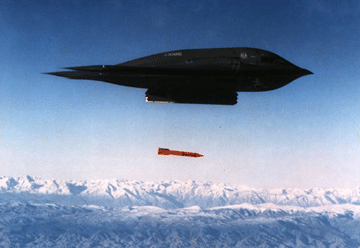
The slender, gray cylinder bombs, which weigh 700 pounds each and measure 11 feet long and 13 inches in diameter, were designed and built in the 1960s by the Los Alamos National Laboratory, a nuclear weapon facility located in New Mexico. The B61s were deployed at NATO air bases in Europe and were meant to dissuade Soviet aggression on the continent during the Cold War. There were about 3,155 of the bombs built during that time.
According to a 2005 report from the Natural Resources Defense Council, the U.S. still has about 480 nuclear weapons in Europe, stored at eight bases in six countries. The U.S. has about 250 of the B61s left lying around air bases in Missouri and North Dakota, with additional bombs stored in Nevada and New Mexico.
The B61s are the most versatile weapon in the U.S. stockpile. They were built to withstand supersonic speeds and can be carried long distances. The nuclear devices also contain about 6,500 parts, and decades of storage have degraded the bombs to a point where some of the electronic pieces are obsolete and unreliable.
“The B61 life-extension program is absolutely necessary,” Gen. C. Robert Kehler, a Commander of the U.S. Department of Defense, told The World-Herald. “Much has been deferred. Now we don’t have the luxury of waiting.” But it’s not a matter of simply dusting the bombs off and tightening a few screws here and there. The nuclear bombs need expensive upgrades – refurbishments that are estimated to cost about $28 million per bomb, according to The World Herald. That’s not to mention the estimated $65 billion price tag to retool America’s missiles, submarines and aircrafts, something politicians on both the left and the right are reluctant to do during a time of congressional belt tightening.
In August, the National Nuclear Security Administration, which maintains the U.S.’s nuclear stash, pitched a solution to America’s B61 nuclear bomb problem. They want to not only refurbish the bombs, but also upgrade them……. http://www.isciencetimes.com/articles/6107/20130923/nuclear-bomb-b61-cold-war-weapons-upgrades.htm
Kazakhstan’s idea to grow food on plutonium contaminated land
 “Opening the land for grazing and other land use will be an unforgiveable mistake,” said Leonid Rikhvanov, a professor at Russia’s Tomsk Polytechnic University, in a 2010 interview with the Telegraph. “If the plutonium gets into the biological chain it could cause a cytogenetic catastrophe that will backfire on the health of our children and grandchildren.” Many people living near Semipalatinsk feel similarly
But in this poisoned place, on a small patch of land near a few downtrodden trailers, there’s an unexpected hint of vitality: bright yellow sunflowers, clustered together near rows of corn, and a barn full of plump sheep. Here, scientists from Kazakhstan’s Institute of Radiation Safety and Ecology, a governmental organization that studies the medical and biological interaction between radioactivity and the environment, have developed an experimental farm. Their goal is to measure the transference of radioactivity from contaminated soil into edible crops, and from those crops into the meat, milk, and eggs of the animals that eat them. Continue reading
Farmers’ movement aims to stop India’s Mithivirdi nuclear plant
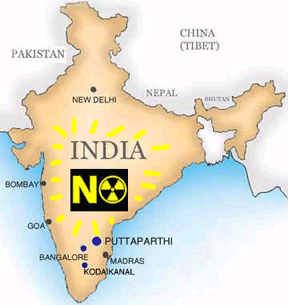 Farmers protest against Mithivirdi nuclear plant http://timesofindia.indiatimes.com/city/rajkot/Farmers-protest-against-Mithivirdi-nuclear-plant/articleshow/22951094.cms TNN | Sep 23, 2013, RAJKOT: Farmers from 30 villages located around the proposed site of 6,000 MW nuclear power plant in Mithivirdi, about 40 km from Bhavnagar, took out the protest rally fromJaspara village to Bhavnagar against the move to set up the power plant.
Throughout their 40km yatra, farmers shouted slogans like ‘Amne pani apo, anu-vijali nahi’ (we want water, not nuclear power) and ‘Jan daisu, zamin nahi’ (we will give our lives, but not land).
Among those who participated in the rally were former BJP MLA from Mahuva Dr Kanubhai Kalsaria and former minister of state for home Gordhan Zadaphia.
“If you want to give us anything, give us irrigation water and we will be happy practicing agriculture,” an agitating farmer from Jaspara village Sonal Gohil said.The farmers have been claiming that the major chunk of 777.8 hectares of land that is proposed to be acquired for the nuclear plant is fertile.
Activists, including veteran Gandhian Chunibhai Vaidya, Dr Kalsaria, former finance ministerSanat Mehta and Rohit Prajapati have been leading the agitation against the project since 2010. They have been raising concerns on threat of radiation.
Over 290 farmers submitted their affidavits saying they don’t want a power plant at the cost of their fertile land to district collector Pravin Solanki.
The plant is proposed to be built by acquiring land in Jaspara, Mandva, Khadpar and Mithivirdi villages. The project is to be implemented in three phases.
Sept 26 High-Level Meeting of the General Assembly on Nuclear Disarmament
 High Opportunity for Nuclear Disarmament at High-Level Meeting, HUFFINGTON POST, Jonathan Granoff President, Global Security Institute, 09/23/2013 Every nation in the world has been invited to participate at the highest political level in the High-Level Meeting of the General Assembly on Nuclear Disarmament scheduled for Sep. 26. This has never happened before. We have never been at such a moment of crisis and opportunity.
The crisis arises because the rational route forward which has been identified by the vast majority of the world’s countries in support of advancing a convention banning nuclear weapons or, as the secretary general has also suggested, a framework of legal agreements achieving elimination, has not been supported by the U.S. or Russia, two states with more than 95 percent of the world’s nuclear weapons.
Thus, progress toward disarmament lacks the galvanizing focus preliminary negotiations on a treaty would provide. It is also a moment of opportunity since except for India and Pakistan, no states with nuclear weapons are actually hostile to one another…….
Renewable energy is thriving, despite natural gas investment
Natural Gas Is Not Destroying Renewable Energy http://blogs.wsj.com/experts/2013/09/23/natural-gas-is-not-destroying-renewable-energy/ What is the single biggest misconception people have about renewable energy in the U.S.? And why do you think they have this misconception? IVAN MARTEN: 23 Sept 13 Very simply, the biggest misconception about renewable energy in the U.S. today is that it is failing.
Many people believe that cheap natural gas is crowding out the prospects investment in renewable energy investment; that U.S. companies are largely destined for bankruptcy as Chinese players expand to dominate the market; and that the Department of Energy has lost an immense amount of money on its federal loan guarantee program. In reality, however, the outlook is much brighter. The market for renewable energy in the U.S. continues to grow rapidly alongside natural gas as a quickly increasing source for power generation. Solar-power installations in 2013 are expected to be up 33% over last year and reach their highest level ever. Consumption of wind-powered energy was 21% higher in the first six months of 2013 than during the same period of 2012.
While there has been a shakeout of weak U.S. renewable-energy companies, others are thriving. U.S. solar manufacturer SunPower gained market share versus Chinese competitors in 2012. Innovative services businesses, such as solar installers, also are enjoying dramatic growth: share prices of SolarCity, for example, have tripled since the company’s initial public offering in early 2013. Project developers such as NRG have built strong pipelines of activity. And new players are popping up frequently. More than $500 million in venture capital was invested in clean-technology companies, including those in renewable energy, during the summer of 2013. Nearly all are based in the U.S.
What about those federal loans? Despite a few high-profile failures –including the infamous Solyndra debacle– the DoE currently is on track to recover 98% of the loans it made since 2009 to help renewable-energy startups commercialize their technologies.
In summary, the U.S. remains a healthy, competitive, and growing renewable-energy market. This growth will continue, driven by the need to meet existing mandates and falling costs that will make the energy more competitive with fossil fuels in the future. The creative destruction brought by market forces will continue, and some existing companies will fail. But new, innovative business models will continue to emerge.
Renewable energy is here to stay as part of the U.S.’s total energy mix.
The BBC and EDF corrupts nuclear science with the help of the USA
“….In 2011, as their share value continued to plummet[Because of fukushima Arclight2011], EDF formed a stakeholder advisory panel, employing Chris Patten, chair of the BBC Trust, as chair of the panel and Diane Coyle, vice chair of the BBC Trust, as a member the panel. She is married to BBC News Technology Correspondent, Rory Cellan-Jones. Other members of the panel include Will Hutton, former editor of the Observer and a leading commentator on social and political affairs, and Sir Richard Lambert, former director of the CBI and former editor of the Financial Times. Chris Patten is linked to David Cameron through Patten’s former chief of staff, who is now chief of staff to Cameron….[Also, The UK SMC and the USA senseaboutscience began its promotion of the “right” science. Arclight2011]”
18 Sep 2013
The Nuclear Industry, Government and the Media
http://ruscombegreen.blogspot.co.uk/2013/09/the-nuclear-industry-government-and.html

Have you ever wondered why we receive so little information about the ill-fated nuclear reactors at Fukushima? Or the massive, year-long protests against proposed new nuclear reactors on the East and West coasts of India? Or even about Scotland’s decision to be nuclear-free? Why do we hear so little about the ill-effects of nuclear power, its enormous cost and legacy of dangerous radioactive waste?
Both talks will take place in the Old Town Hall in Stroud, from 7.30 till 9.30pm.
Risk Perceptions about Nuclear Power and the UK’s Energy Infrastructure
30 Jan 2013
Ms. Fox added that focus shifted away from panels of science experts set up by the Science Media Center to brief government officials and the media on the real risks associated with the crisis. The pressure to sensationalize headlines is real, according to Ms. Fox. “Never let the facts get in the way of a good story.” She described instances where journalists she knew were taken off stories for presenting a more “measured, balanced, accurate narrative” instead of the “scare stories” that their editors wanted.
[…]
A second source of risk misperception at Fukushima, according to Ms. Brown, is overly conservative national safety regulations. As an example, she cited Japanese officials who reported that tap water in the areas around Fukushima showed 210 becquerels per liter of iodine-131 – more than twice the Japanese recommended limit of 100 becquerels per liter for infants. Media picked up this statement, headlining that the water was not safe to drink. (Becquerels is a measure of radioactivity). However, the recommended limit for adults in Japan is 300 becquerels per liter. Further, IAEA international guidelines set the safety limit ten times higher, at 3,000 becquerels per liter, for major events like Fukushima. “What was set out to be a precautionary measure to protect the public,” stressed Ms. Brown, “actually became a source of concern and a source of alarming stories.”
USA Science Media centre
http://www.senseaboutscience.org/pages/about-us.html
UK Science media centre (Formed in 2001 and running by 2002)
1 This Month

Petition to revoke the licensing of the Near Surface Nuclear Disposal Facility (NSDF) at Chalk River. https://www.ourcommons.ca/petitions/en/Petition/Details?Petition=e-7247


of the week – STOP SMALL MODULAR REACTORS IN CANADA
To see nuclear-related stories in greater depth and intensity – go to https://nuclearinformation.wordpress.com
-
Archives
- March 2026 (153)
- February 2026 (268)
- January 2026 (308)
- December 2025 (358)
- November 2025 (359)
- October 2025 (376)
- September 2025 (258)
- August 2025 (319)
- July 2025 (230)
- June 2025 (348)
- May 2025 (261)
- April 2025 (305)
-
Categories
- 1
- 1 NUCLEAR ISSUES
- business and costs
- climate change
- culture and arts
- ENERGY
- environment
- health
- history
- indigenous issues
- Legal
- marketing of nuclear
- media
- opposition to nuclear
- PERSONAL STORIES
- politics
- politics international
- Religion and ethics
- safety
- secrets,lies and civil liberties
- spinbuster
- technology
- Uranium
- wastes
- weapons and war
- Women
- 2 WORLD
- ACTION
- AFRICA
- Atrocities
- AUSTRALIA
- Christina's notes
- Christina's themes
- culture and arts
- Events
- Fuk 2022
- Fuk 2023
- Fukushima 2017
- Fukushima 2018
- fukushima 2019
- Fukushima 2020
- Fukushima 2021
- general
- global warming
- Humour (God we need it)
- Nuclear
- RARE EARTHS
- Reference
- resources – print
- Resources -audiovicual
- Weekly Newsletter
- World
- World Nuclear
- YouTube
-
RSS
Entries RSS
Comments RSS
 nuclear-news