Major NGOs speak out about the Fukushima disaster! Unanswered questions!
Repost..

Below is a list of the organisations that spoke out in defence of the children of Fukushima.No individual countries made any statement concerning the Fukushima disaster and the plight of local residence at the UN meeting.
Save the Children International appreciated the acceptance by Japan of recommendations relating to the ratification of the third Optional Protocol to the Convention on the Rights of the Child and to the adoption of measures to protect the right to health of Fukushima residents. Japan should facilitate and encourage democratic deliberations to implement the act on the protection and support for the children and other victims of the TEPCO disaster.
Reporters Without Borders International said that Japan, which could be proud about the freedom of press, had experienced a free fall in the ranking compiled by Reporters Without Borders, due to lack of information available about the accident at Fukushima. It was hoped that Japan would respect the right of its citizens to information.
Human Rights Now urged Japan to implement the recommendation concerning the protection of the right to life and health of the people affected by the nuclear accident in Fukushima. The response of the Government was not sufficient and Japan should provide sufficient compensation and support for the relocation of people living in contaminated areas.
Japanese Association for the Right to Freedom of Speech said that during the consideration of its Universal Periodic Review report in October 2012, Japan had made a deceptive reply regarding the issue of political tract distribution. This type of detention violated the provisions of the Universal Declaration of Human Rights and the International Covenant on Economic, Social and Cultural Rights.
TAKASHI OKADA, Deputy Permanent Representative of Japan to the United Nations Office at Geneva, said
With regard to the Fukushima disaster, the Government had provided financial and medical support to Fukushima residents. Japan would spare no effort in making further improvements in its situation of human rights.
The Council then adopted the outcome of the Universal Periodic Review of Japan.
http://www.ohchr.org/CH/NewsEvents/Pages/DisplayNews.aspx?NewsID=13142&LangID=E
[Editors note] The Japanese delegation had made this statement on the 14 March 2013. This document of the summary of that meeting was placed on a Chinese speaking part of the UN website.
In this document we find this statement;
[…]Takashi Okada, Deputy Permanent Representative of Japan to the United Nations Office at Geneva, said that out of the 174 recommendations it had received, Japan had agreed to follow up or partially follow up on 125 of them, including those promoting the protection of the rights of women, children, and persons with disabilities, but was unable to accept 26 of the recommendations. Regarding the remaining 23 recommendations, Japan already had sufficient measures in place to address the issues raised by those.
[…]
http://www.ohchr.org/CH/NewsEvents/Pages/DisplayNews.aspx?NewsID=13142&LangID=E
Japan imprisons professor who opposes radiation management
Radioactive contamination has not been properly dealt with at all, and the contamination is being spread through the circulation of food and other goods. In the midst of this situation, the government lies about “insufficient electricity” to try to continue using nuclear power plants. This is nothing but insanity.
Every day I look at my students and wonder what sort of world they will live in when these 20-year-olds turn forty like me
https://nuclear-news.net/2012/12/17/japan-imprisons-professor-who-opposes-radiation-management/
Letter From Hiroshi Hoshi the Japanese man arrested for helping animals from radiation!
(Source)
https://www.facebook.com/notes/the-hachiko-coalition-page/letter-from-hiroshi-hoshi/542703292441060
Friday, 29 March 2013

http://www.change.org/petitions/free-hiroshi-hoshi-and-leo-hoshi-fukushima-animal-rescuers
This letter is from Hiroshi Hoshi who wanted to share it on Facebook.

Image source ; http://www.thetimes.co.uk/tto/news/world/asia/article2946282.ece
“….We were transferred from Nihonmatsu police station to the Fukushima prison custody section on March 21, 2013. Our trial will start on March 27th.
It is involuntary for us but we will admit what we have done but we will also defend the legitimacy of our activities.
We heard that there was somebody, who had worked with Hoshi family before, who said that “the Hoshi’s were arrested because of their own fault”.
I am shocked by this person’s comment who had worked with the Hoshi family. It is something comparable to abandoning a comrade. It is not only about Fukushima, but I feel many Japanese people are in a fog about many issues.
Eric Schlosser: ‘The people who are most anti-nuclear are the ones who know most about it’
 The American author tells Ed Pilkington about his six-year all-out immersion in the terrifying and surreal world of nuclear weapons for his latest book, Command and Contro
21 September 2013
http://www.theguardian.com/books/2013/sep/21/eric-schlosser-books-interview
In the autumn of 1999 Eric Schlosser was invited to Vandenberg Air Force base in California to witness the launch of a Titan II missile, the largest intercontinental ballistic missile America has ever built. At the time, he was a moderately well-known magazine writer, and Fast Food Nation, the book that would act as his personal rocket launcher propelling him into the literary stratosphere, was still two years away from publication.
“They let me go up into the tower and I found myself standing next to the missile. It was right there,” he says, stretching out his hand as though to touch the missile’s cool metal shell. “It was a deeply impressive thing.”
Schlosser was a child of the 70s and grew up with dire warnings of nuclear Armageddon ringing in his ears, largely dismissing them in his mind as fear-mongering and make-believe. “But my God! Watching that missile take off, seeing it soar over the coast of Mexico – it was visceral. These are real! They work! That ICBM was more powerful than any cold war story I’d heard.”
That shattering experience set Schlosser on a journey that has resulted, 14 years later, in Command and Control, his take on the terrifying and surreal world of nuclear weapons. The past six of those years have been spent in what he describes as “all-out immersion” in the subject. The writer is notoriously meticulous about his research, wearing out more shoe leather per book than most journalists do in a lifetime.
For Fast Food Nation, his expose of what he called the “dark side of the all-American meal”, he interviewed scores of labourers, meatpackers and ranchers, and visited countless abattoirs and factory farms. In a similar vein, he spent time with more than 100 bomber pilots, nuclear scientists and weapons designers for Command and Control, as well as reviewing thousands of pages of newly released official documents. “I really went down the rabbit hole into the nuclear madness,” he says when we meet in a coffee bar in Soho, New York. He speaks languidly, elongating his vowels like a West Coast hippie, even though he was born in Manhattan and spent part of his youth here.
Shoe-leather aside, there’s no instantly apparent theme that connects Schlosser’s disparate subjects. From fast food he turned to the war on drugs in Reefer Madness (2003). His next book after Command and Control will be on America’s prison system. Food-dope-nukes-slammers: where’s the logic?
“Powerful systems of control that aren’t being discussed and that work very hard to disguise how they operate,” he answers. “It’s not like I have a megalomaniacal ‘I’m going to save the world’ mentality, but what my work is designed to do is to provoke discussion. I want to produce not a diatribe or a rant but writing that is factually based and footnoted.” (Command and Control certainly is footnoted – the notes and bibliography run to more than 100 pages.)
N-deal: Violation of liability Act will amount to corruption: BJP

22 September 2013
Leader of Opposition in Rajya Sabha Arun Jaitley Sunday said the violation of the provisions of the Civil Liability for Nuclear Damages Act in any contract between Indian nuclear power operator — Nuclear Power Corporation of India Ltd (NPCIL) — and a US firm would amount to corruption under the Prevention of Corruption Act.
“Any attempt now to permit the NPCIL to abdicate the right given to an operator — a government company — would be compromising with state revenue. It would be a contract contrary to the provisions of section 17(b) of the Act. If a public sector company wilfully enters into an agreement with a foreign vendor and abdicates its right to recourse which section 17(b) otherwise provides for its benefit, it would not only be violating the provisions of the Civil Liability for Nuclear Damages Act but also section 13(1)(d) of the Prevention of Corruption Act wherein a wrongful loss would be caused to the revenue of a public sector company,” Jaitley wrote in a signed article.
The Leader of Opposition, in this backdrop, reminded that he was privy to the discussions between the government and the Opposition on the Civil Liability for Nuclear Damages Act in 2010 to stress Parliament ensured that the nuclear plant operator’s right of recourse with the supplier was made independent of an agreement in writing if there was a patent or latent defect in equipment because section 17(b) of the Act “operates independent of the agreement in writing” under section 17(a) of the same Act.
Jaitley alleged that the Congress-led UPA government has the “intention to dilute the right of recourse” provision through the Rules under the Act and claimed that the government has tried to achieve this through Rule 24 of the Act.
“But a leopard never changes its spots. The government’s intention to dilute the right of recourse and make it dependent on an agreement continued. When the Rules under the Act were notified such an intention as apparent in the language of Rule 24… creating an ambiguity that clauses 17(a) and 17(b) would be read in conjunction with each other and not dis-conjunctively,” Jaitley said in his article pointing out that Rule 24, which deals with section 17(a) of the Act and permits the contract to specify the duration of initial licence, has defined the ‘product liability period’.
‘Rest’ in one piece for the coming Armageddon
By Donald Bradley
http://www.gulf-times.com/culture/238/details/366513/%E2%80%98rest%E2%80%99-in-one-piece
22 September 2013

Through the darkness and past massive pillars in this old limestone mine, you come upon lights shining down on several brand-new recreational vehicles.
Sort of a Flintstones-like RV showroom, more than 130 feet deep below thousands of tonnes of solid rock.
Welcome to the doomsday world of Robert Vicino.
Give the man credit. He’s come up with selling points to get someone to pay thousands of dollars to spend a year in a travel trailer in a Kansas mine sealed shut by 2-foot-thick steel and concrete doors.
For a reason that may never occur.
We should all hope it’s blown money.
Vicino’s plan is to turn the mines on the bluffs of this old river town into what he calls the world’s biggest private survival shelter. His vision is that 5,000 paying members will make a beeline for the shelter in their recreational vehicles when nuclear war, a killer asteroid or global pandemic appear imminent.
Beyond the doomsday event itself, he strongly pitches the resulting anarchy’s roving packs of predators.
“The lights go out and there is no food,” Vicino, 59, said last week. “It will happen quickly. You have to decide which side of the door you want to be on.”
That door, he says, will withstand a nuclear blast as close as five miles.
Inside his shelter, where work is just beginning, are more than 2 million square feet of RV park. Vicino promises enough food, water and generator fuel to last a year. Plans also call for a fitness centre, a clinic, a theater, a school and, of course, a place to get a cold drink. The average family can secure space for $25,000 or so.
After a year, according to Vicino’s business model, the survivors will climb to the top as the next Genesis generation to repopulate the Earth.
Sound good so far? Not to Ken Rose, a history professor at California State University-Chico. He told The Associated Press recently that although interest in underground shelters is on the rise, the Atchison project is a “colossal waste of time and money.” The Cold War, which ended with the Soviet Union more than 20 years ago, presented the threat. “At least then, anxiety was based on a realistic scenario,” Rose said.
But look around, Vicino says. Syria, Iran, North Korea. Satellites passing over carrying who knows what. Rogue nukes. Chemical war gases. Biological terrorism.
Don’t think him a gloomy Gus. This is a guy who got his start in large inflatables. In 1983, he mounted a 90-foot King Kon Through the darkness and past massive pillars in this old limestone mine, you come upon lights shining down on several brand-new recreational vehicles.
Sort of a Flintstones-like RV showroom, more than 130 feet deep below thousands of tonnes of solid rock.
Welcome to the doomsday world of Robert Vicino.
Give the man credit. He’s come up with selling points to get someone to pay thousands of dollars to spend a year in a travel trailer in a Kansas mine sealed shut by 2-foot-thick steel and concrete doors.
For a reason that may never occur.
We should all hope it’s blown money.
Vicino’s plan is to turn the mines on the bluffs of this old river town into what he calls the world’s biggest private survival shelter. His vision is that 5,000 paying members will make a beeline for the shelter in their recreational vehicles when nuclear war, a killer asteroid or global pandemic appear imminent.
Beyond the doomsday event itself, he strongly pitches the resulting anarchy’s roving packs of predators.
“The lights go out and there is no food,” Vicino, 59, said last week. “It will happen quickly. You have to decide which side of the door you want to be on.”
WHO Lies Refuted: Physicians’ Group Predicts 100,000+ Fukushima Cancer Incidences/Deaths
Posted on September 22, 2013
References on link
http://thehealthcoach1.com/?p=3307
By Richard Wilcox, PhD
3-14-13
“All governments lie, but disaster lies in wait for countries whose officials smoke the same hashish they give out.” – I. F. Stone
In this new age of instant information, navigating the pitfalls of overload (too much); uncertainty (lack of); misinformation (poor quality); disinformation (intentional distortion, lies); is key in determining the scope of the Fukushima nuclear disaster and assessing immediate and long-term impacts on the international and Japanese public health. Fortunately we have one of the first attempts from researchers to set the record straight and calculate the death toll from the Fukushima nuclear disaster. The report comes from the courageous men and women of International Physicians for Preventing Nuclear War (IPPNW) who expose the Big Lie being perpetrated by the World Health Organization (WHO) that few ill health effects will occur.
Consider that it is standard operating procedure for governments and industry to obfuscate, cover-up and lie about a nuclear disaster as soon as it occurs. The chaos that unfolds during a nuclear disaster such as Fukushima is used in a carefully orchestrated Big Lie process whereby damage control and perception management allow the perpetrators of the Big Crime – Tokyo Electric Power Company, the Japanese government and the international nuclear apologists and nuclear industry – to eventually get off scot free (1).
Even though the Japanese government was fully aware that three reactors had melted down and another one severely damaged, and that people should have been evacuated in a much more bold and expedient manner, the phrase that will live in infamy, “there is no immediate danger,” was repeated during the worst days of the nuclear crisis by the government. In Orwellian fashion they might as well have announced over loudspeakers across the entire country that “The Moon Is Made Of Green Cheese, The Moon Is Made Of Green Cheese,” in order to prove that whatever the government says is true and no one should question it.
The extent and quantity of radiation released from the accident has intentionally been suppressed, and unless the public can gain access to the highest echelons of governmental secrets, we will never know the full truth of how much radiation was released, where it was deposited and whose health was or will be affected.
WHO Do You Trust?
The WHO published their Fukushima report just before the two-year anniversary of the March 11, 2011 nuclear disaster, and – incredibly – announced that there will be practically no ill health effects to the public despite documented evidence to the contrary. A typical “mainstream media” headline reads that thyroid radiation doses in Fukushima infants are well within safe limits (2). Imagine that, the world’s “premiere” health organization and supposedly top medical “watchdog” stating for the record that the most vulnerable population within the most radiated zone is somehow magically “within safe limits.”
The continuing and endlessly repeated message from the media based on WHO’s report is that health damage from the Fukushima nuclear disaster is more psychological than actual (3). If you are worried about radiation you are probably paranoid, and that victims “should smile often” to reduce the negative health impacts of radiation. These depraved assertions are indicative of the specious and insidious lengths WHO and their media lackeys are prepared to go in order to obfuscate and cover-up what is one of the most severe threats to human health in modern history.
Even though the global media is controlled by just a handful of mega-corporations (4; 5), some people (perhaps too few of them) – to their credit – do not instantly accept the WHO’s findings and are now becoming more vocal in their demands for accurate information.
The results of an investigation are only as good as the effort put into it. Many observers have criticized the WHO for ignoring relevant data and basing their conclusions on theoretical assumptions, a biased selection process and insufficient empirical data. According to Simply Info:
The methodology used for the WHO cancer projection risk report fails in a number of ways. Instead of attempting to build a few sample detailed profiles of exposure, they used highly generalized on paper estimates then applied them to entire populations. The WHO study is not based off of real world recorded exposure data in humans. It is instead very rough on paper estimates based off of government environmental radiation readings and food testing. The WHO study also threw out all data from the evacuation zone, where most people were actually exposed. Their study completely lacks this important data in their calculations (6).
The WHO threw out or otherwise selectively omitted data from the very areas where people were most affected. This is fraudulent science at best if not flatly criminal in intent. As nuclear critic Paul Zimmerman has found in his lengthy investigation of the radiation industry, “a clever campaign of misinformation has succeeded in making malignant deeds appear benign.” It is typical of governments that “[f]ollowing a radiation release, [they] avoid adequate radiation monitoring” because it is costly and might alarm the public (p. 23; pp. 209 – 211) (7). There is little concern for the number of people contaminated as the Japanese government’s mishandling of the Fukushima tragedy has clearly shown (8).
Physicians Who Do No Harm
In contrast to WHO disinformation and what may only be described as pro-nuclear propaganda, a report from the International Physicians for the Prevention of Nuclear War (IPPNW) has analyzed some of the available data from Japan and found “[t]he initial health consequences of the nuclear catastrophe are now, two years after the incident, scientifically verifiable” (9).
Depending on which demographic group is included in the survey and the radiation level that is considered a risk, the IPPNW estimated that upwards to 136,872 cancer cases or serious illnesses, apparently not including precancerous tumors on children, could occur. Bear in mind that the IPPNW findings are conservative compared to some general estimates that put potential cancer incidences as high as a million (10; 11; 12).
Differences in risk models tells the story. The IPPNW derive their estimate model from the European Committee on Radiation Risk (ECRR). The WHO derives their estimates from such agencies as the International Commission on Radiological Protection (ICRP) and the United Nations Scientific Committee on the Effects of Atomic Radiation (UNSCEAR). One of the ECRR’s founding members, Dr. Chris Busby, has offered an extensive and convincing critique as to why the WHO and their establishment methodology for radiation risk is outdated and inaccurate (13).
Doctors For The People And Planet
The IPPNW was awarded the Nobel Peace Prize in 1985 and “is a non-partisan federation of national medical groups in 63 countries, representing tens of thousands of doctors, medical students, other health workers, and concerned citizens who share the common goal of creating a more peaceful and secure world freed from the threat of nuclear annihilation…” (14).
Obviously, this group consists of highly professional, courageous and conscientious individuals, most of whom have medical backgrounds and all of whom uphold the Hippocratic Oath admonition “first, do no harm.” IPPNW are opposed to the “nuclear annihilation” of life on planet Earth, which is being threatened on a daily basis by the psychopaths in criminal-controlled governments and militaries around the world.
With a cool 100 trillion dollars in their pocket, we know that it is not only the powers-that-be that are behind our perpetual wars for perpetual peace, but a particular group of supremely evil individuals who employ the threat of the ultimate form of violence in order to maintain their wealth, power, enslavement of humanity and ongoing destruction of the biosphere (15; 16; 17).
The Cult of Nuclearists is comprised of people of a common mentality. They embrace nuclear and radiological weapons as a reasonable element of warfare and statecraft and are responsible for maintaining these weapons in our midst. They have never made a serious effort to forge an international consensus to banish nuclear weapons. They venerate the power they wield, the threat they project, the advantage they possess over the less powerful. They have created a world that 99.999% of humanity abhor…. Our well-being is at the mercy of those with a genocidal mentality. In violation of our sensibilities and sense of decency, we have been forced to live our lives inextricably entangled in the intrigues of petty potentates who derive their right to dictate affairs from the brutality of the weapons they wield. The people of the earth have unfinished business with the Cult of Nuclearists (Op. cit., “Paul Zimmerman,” pp. 29 – 30).
As laudable as the IPPNW’s work is, unfortunately their report, “Health consequences from Fukushima,” which relies considerably on Japanese Ministry of Health data, is very technical, translated from German, not very well written and disappointing in some respects. It is a very short report (four pages) and some important information is not clearly explained (Op. cit.).
For example, why did they not consider the number of people who were doused with radiation from the initial accident but may have moved out of the Fukushima region? Also, they present figures for radiation in food that do not seem logical given food in Western Japan, where almost no radioactive fallout occurred is listed as radioactive.
Call to store nuclear waste in Australia, to sustain uranium industry
“Storage is the Achilles heel . . . it highlights the political, social and technical difficulty of doing this.”
Claire Stewart
Australia will need to start enriching uranium and storing the nuclear waste if it is going to sustain a competitive uranium industry in the future, says senior finance and resources figure Mark Johnson.
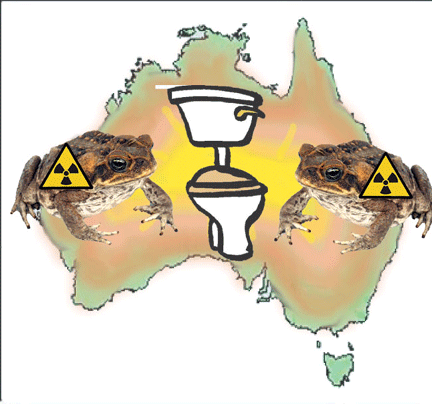
Mr Johnson, a former deputy chair of Macquarie Bank and former chairman of AGL, said Australia had a “great opportunity” to become a participant in a “free world nuclear fuel cycle”, if it produces uranium.
“But the consequence of that is we would also have to store spent uranium,” he told Financial Review Sunday.
Federal government laws explicitly prohibit the building of nuclear fabrication, enrichment or power plants and the return of nuclear waste to Australia for storage.
“Nobody wants spent nuclear fuel in their backyard, even if it would be right in the centre of the outback of Australia, [with] very stable geological conditions,” Mr Johnson said.
The price of uranium has halved since governments around the world promised to cut their reliance on nuclear power following the Fukushima nuclear disaster.
Energy Resources Australia chief executive Rob Atkinson said the market will turn, particularly given expected demand from China.
For other democracies, nuclear power is “off the table for generations”, Mr Johnson said, prompting suggestions that enrichment and storage of waste will be a key part of expanding the industry.
Australia currently processes uranium to the “yellow cake” stage, which is then exported for further processing and concentration, and in some cases turned into fuel rods.
Uranium as a fuel source can only be used for about three years before it becomes too unstable, said Australian Conservation Foundation nuclear campaigner Dave Sweeny.
He said making Australia part of the global fuel cycle was about opening the country up for return of that spent material. “Industry returns are meagre and the risks are significant and continuing,” he said.
“Storage is the Achilles heel . . . it highlights the political, social and technical difficulty of doing this.”
The Australian Financial Review
France to tax nuclear to fund clean energy – is the UK nuclear program going to pay the french too?

France is to tax its huge nuclear fuel programme to help pay for the transition to clean energy. Fossil fuels will also be taxed in an effort to cut down on carbon emissions and reduce global warming.
Closing a two-day conference on the environment in Paris on Saturday, Prime Minister Jean-Marc Ayrault gave details of proposed timeframes to reach previous pledges to cut France’s emissions of greenhouse gases.
The tax on fossil fuels will be replace existing taxes and is expected to bring in four billion euros in 2016.
But Ayrault said the government will not rush the transition.
“Part of the tax on the consumption of fossil fuels will be calculated according to the carbon emissions arising from their use, and that applies to gasoline, diesel fuel, coal and natural gases,” he told the conference.
“I hope this reform is very gradual. It will respect our commitment to stable taxation. In 2014, the first year of implementation, the impact of the carbon component on fuel and heating oil will be zero. Afterwards this measure will amount to 2.5 billion euros in 2015 and four billion in 2016.”
There has been growing tensions between Ayrault’s Socialists and their coalition partners in the Green party (EELV) in the run-up to the conference.
But Housing Minister Cécile Duflot made it clear that her party will not quit the government.
“Now there are targets that the whole government must work for,” she said. “Ecological transition is useful for the whole country – it’s as simple as that.”
But MEP Noël Mamère was less enthusiastic.
“The only concrete measure is the decision to reduce VAT on insulation to 5.0 per cent,” he said. “As for the rest, all that’s being offered is nice speeches whose only purpose is to allow some of my ecologist friends to say ‘We’ll stay in the government’.”
What the proposals will mean in practice should become clearer when the government unveils its 2014 budget on Wednesday.
1 This Month

of the week – Shut Down Drone Warfare!


Tell the Ukrainian Government to Drop Prosecution of Peace Activist Yurii Sheliazhenko

Petition to revoke the licensing of the Near Surface Nuclear Disposal Facility (NSDF) at Chalk River. https://www.ourcommons.ca/petitions/en/Petition/Details?Petition=e-7247
To see nuclear-related stories in greater depth and intensity – go to https://nuclearinformation.wordpress.com
-
Archives
- April 2026 (7)
- March 2026 (251)
- February 2026 (268)
- January 2026 (308)
- December 2025 (358)
- November 2025 (359)
- October 2025 (376)
- September 2025 (257)
- August 2025 (319)
- July 2025 (230)
- June 2025 (348)
- May 2025 (261)
-
Categories
- 1
- 1 NUCLEAR ISSUES
- business and costs
- climate change
- culture and arts
- ENERGY
- environment
- health
- history
- indigenous issues
- Legal
- marketing of nuclear
- media
- opposition to nuclear
- PERSONAL STORIES
- politics
- politics international
- Religion and ethics
- safety
- secrets,lies and civil liberties
- spinbuster
- technology
- Uranium
- wastes
- weapons and war
- Women
- 2 WORLD
- ACTION
- AFRICA
- Atrocities
- AUSTRALIA
- Christina's notes
- Christina's themes
- culture and arts
- Events
- Fuk 2022
- Fuk 2023
- Fukushima 2017
- Fukushima 2018
- fukushima 2019
- Fukushima 2020
- Fukushima 2021
- general
- global warming
- Humour (God we need it)
- Nuclear
- RARE EARTHS
- Reference
- resources – print
- Resources -audiovicual
- Weekly Newsletter
- World
- World Nuclear
- YouTube
-
RSS
Entries RSS
Comments RSS
 nuclear-news