This week’s nuclear news

Christina Macpherson’s websites & blogs
Japan is always the top news. This week, it would be funny if it were not so serious. With the Fukushima wrecked nuclear plant in a calamitous state, The Japanese government, aided by the known to be dodgy Olympic Committee, has won the right to host the 2020 Olympic Games in Tokyo. What a great way to renew confidence in Japan, and in its ability to fix the Fukushima nuclear catastrophe! Unfortunately it is far from fixed, The vast expense of setting up the Olympic Games would be better spent in fixing it. And the world should help.
USA’s Syria dilemma. An attack on Syria is likely to bring about nuclear disaster – in several ways – striking Syria’s nuclear reactor, use of depleted uranium weapons, nuclear retaliation from Russia, or even from other nations that hold nuclear devices.
Iran has reduced its nuclear stockpile – but will the West be ready to truly negotiate?
Nuclear weapons industry – a huge bloated and out of control industry, in USA, Russia – and beyond. It’s in their interest to have A war – with Syria, Iran, anybody, really.
California – a ray of common sense – as electricty utilities join in a project for community renewable energy.
The Science Denial Industry exposed. A new book Dealing in Doubt: The Climate Denial Machine Vs Climate Science In the tradition of asbestos denialism, tobacco denialism, now climate denialism is exposed – (radiation denialism is the next)
America’s nuclear weapons spending – bloated and out of control

The post-Cold War nuclear warhead complex has become a gigantic self-licking ice cream cone for contractors,”
Nation’s bloated nuclear spending comes under fire Journal Review, 13 Sept 13, Matthew Daly reported from Washington, D.C. Associated Press At Los Alamos National Laboratory, a seven-year, $213 million upgrade to the security system that protects the lab’s most sensitive nuclear bomb-making facilities doesn’t work. Those same facilities, which sit atop a fault line, remain susceptible to collapse and dangerous radiation releases, despite millions more spent on improvement plans.
In Tennessee, the price tag for a new uranium processing facility has grown nearly sevenfold in eight years to upward of $6 billion because of problems that include a redesign to raise the roof. And the estimated cost of an ongoing effort to refurbish 400 of the country’s B61 bombs has grown from $1.5 billion to $10 billion.
Virtually every major project under the National Nuclear Security Administration’s oversight is behind schedule and over budget _ the result, watchdogs and government auditors say, of years of lax accountability and nearly automatic annual budget increases for the agency responsible for maintaining the nation’s nuclear stockpile.
The NNSA has racked up $16 billion in cost overruns on 10 major projects that are a combined 38 years behind schedule, the U.S. Government Accountability Office reports. Other projects have been cancelled or suspended, despite hundreds of millions of dollars already spent, because they grew too bloated. Continue reading
American military intervention in Syria could go nuclear
 Five Ways a Wider Syrian War Could Go Nuclear Truth Dig, By Harvey Wasserman, 13 Sept 13, In the wake of an apparent break in the march to a wider war, the reality of a nuclear dimension in Syria remains largely unspoken.
There are at least five key reasons why American military intervention in Syria’s civil war could go nuclear:
(1) There’s a reactor near Damascus.
It is relatively small, by most accounts containing about a kilogram (2.2 pounds) of weapons-grade uranium. That’s not much in the scheme of things when it comes to building an atomic bomb. But as Alexsandr Lukashevich of the Russian Foreign Ministryputs it, “If a warhead, by design or by chance, were to hit the Miniature Neutron Source Reactor (MSNR) near Damascus, the consequences could be catastrophic.”……
(2) Despite Secretary of State John Kerry’s promise of an “unbelievably limited” attack, once the U.S. military commits to action in Syria, it is unlikely to hold back any of its tactical arsenal. That would almost certainly include depleted uranium (DU).
When shells made of this super-hard material penetrate armored vehicles, hardened bunkers and other structures, the DU disperses into fine radioactive particulates that are easily inhaled. Wherever deployed—as in Yugoslavia, Iraq and Afghanistan—DU inflicts horrifying health consequences, including cancer among people of all ages and birth defects among children born well after its use. Uranium-238 has a half-life of 4.5 billion years, imposing virtually permanent contamination.
Should DU weaponry be used yet again, this time in Syria, the contamination would be widespread and irreversible. Many thousands of innocent people—including the countless unborn—would suffer greatly. As with all radioactive fallout, the lethal effects will stretch through the generations.
(3) When the world’s superpowers collide, nuclear war is always a possibility.
At this point, the U.S. and Russia appear to be coming together. But in this too-often irrational global tinderbox, the stakes could not be higher.
In such situations, we hope for the best, but can’t lose sight of the potential worst………
(4) In the bottomless turbulence that defines today’s Middle East, the Americans and Russians so far seem to retain some shreds of rationality. But given the Peaceful Atom’s half century of weapons-grade proliferation, we cannot know which nations or marginal groups might now have atomic devices and what random impulses might prompt their use.
In a profoundly unpredictable world, each of the more than 400 commercial-sized reactors still operating continues to produce radioactive materials that could fuel a nuclear weapon.
Each of those reactors is itself a profoundly vulnerable target. Should the situation in Syria devolve to a wider war, the likelihood of a freelance atomic “situation” becomes all too probable.
(5) While the world’s attention is focused on Syria, the global-scale disaster at Fukushima spirals out of control.
The more serious the crisis in Syria, the more it will divert attention from an existing nuclear disaster. http://www.truthdig.com/report/item/five_ways_a_wider_syrian_war_could_go_nuclear_20130913/
Documentary film about Fukushima’s children
Award-winning Filmmaker on Fukushima: “People have low white blood cell counts… children and adults experiencing more nosebleeds and rashes” -Japan Times http://enenews.com/award-winning-filmmaker-on-fukushima-people-have-low-white-blood-cell-counts-children-and-adults-experiencing-more-nosebleeds-and-rashes-japan-times
Title: Filmmaker revisits the children of Fukushima’s ‘Grey Zone’
Source: Japan Times
Author: Louise George Kittaka
Date: Sept. 9, 2013
For independent filmmaker Ian Thomas Ash, making documentaries is an organic process. “I’m not a journalist, and I don’t try to make judgments,” he says. “My reaction is to film what is going on around me and see where it leads.”
In Ash’s case, it has led to recognition and awards at film festivals around the world for “A2-B-C,” the second of a pair of documentaries about children living in towns a stone’s throw from the site of the nuclear reactor meltdowns in Fukushima Prefecture.
Ash, an American who has called Japan home for the past 10 years, was in Tokyo when the massive earthquake struck on March 11, 2011. […]
When he began hearing about an apparent increase in throat nodules and cysts among children in Fukushima, he knew this was a story that had to be told. There is an added urgency this time, since “A2-B-C” depicts the grassroots efforts of mothers in Fukushima to give a voice to their children and their worries for their future. […]
The film’s title comes from the medical classifications for the size and number of throat nodules and cysts, but the film deals with more than just worries about the risk of thyroid cancer among families in the region. “The film covers other health and environmental issues, such as our inability to decontaminate the area. People have low white blood cell counts, and both children and adults are experiencing more nosebleeds and rashes. Not to mention the constant stress they live with.” […]
Power companies join in California’s Community Renewable Energy project
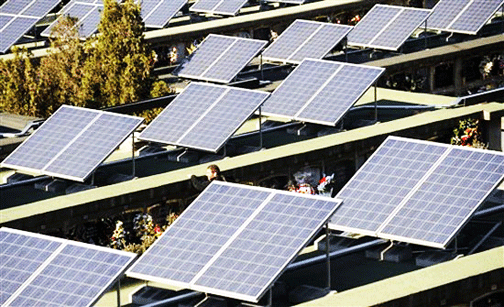 The group estimates that more than 20,000 residential ratepayers throughout California, each purchasing an average 5 KW share, will be able to participate in the program, as well as local schools, businesses, the military and the government.
California approves shared renewable energy program http://www.pv-magazine.com/news/details/beitrag/california-approves-shared-renewable-energy-program_100012727/#axzz2etkybguT 13. SEPTEMBER 2013 BY: IAN CLOVER
 Approval of the largest program for shared renewable power in the U.S. passes in California, enabling schools, rental tenants and owners of homes in the shade to invest in solar energy projects. California’s Legislature has given the green light for the state’s “Green Tariff Shared Renewables Program”, which is the largest of its kind in the U.S. and will allow rental tenants, schools, cities and many other interested parties to invest in California’s renewable energy projects.
The program allows businesses and individuals to purchase shares in the renewable developments of three investor-owned utilities– Pacific Gas and Electric Co. (PG&E), San Diego Gas & Electric Co. (SDG&E), and Southern California Edison Co. (SCE) – in return for a greener electricity supply and, in the future at least, lower bills. Continue reading
Costly clean-up not likely to make Fukushima area habitable again
 Return to the radiation zone: Fukushima clean-up operation mired in fear and misinformation Two years after Japan’s nuclear power plant disaster nobody knows for certain how dangerous the contamination
  is THE INDEPENDENT DAVID MCNEILL
  , MIGUEL QUINTANA FUKUSHIMA WEDNESDAY 11 SEPTEMBER 2013″……..Nobody knows for certain how dangerous the radiation is. Japan’s central government refined its policy in December 2011, defining evacuation zones as “areas where cumulative dose levels might reach 20 millisieverts per year [20 mSv/yr],” the typical worldwide limit for nuclear power plant engineers and other radiation workers.
The worst radiation is supposed to be confined to the 20km exclusion zone, but it spread unevenly: less than 5km north of the Daiichi plant, our Geiger counter shows less than 5 millisieverts a year; 40km north west, in parts of Iitate village, it is well over 120 millisieverts. Those 160,000 refugees have not returned and are scattered throughout Japan. The nuclear diaspora is swelled by thousands of voluntary refugees who, unlike the Saitos, have not returned. Local governments are spending millions of dollars to persuade them back. Continue reading
Iran reduces enriched uranium stockpile
 the West should speak to Iran not with a language of threats or sanctions but with a language of respect.”
 Iran says it has reduced its 20 percent-enriched uranium stockpile by producing reactor fuel, Newser.13 Sept 13 By NASSER KARIMI | ASSOCIATED PRESS Iran significantly reduced its stock of 20 percent-enriched uranium by converting it to reactor fuel, a senior official said, an announcement that appears to be a bid to ease international concerns over its nuclear program. The West remains concerned over Iran’s continuing production of 20 percent uranium, which is enriched to a higher level than that used to fuel most energy reactors and is closer to the 90 percent needed for a warhead. The U.S. and its allies demand Iran halt all enrichment, which Tehran rejects.
The late Thursday announcement, from the government of moderate President Hasan Rouhani, appeared to be a signal to ease Western worries. Speaking to state television, Iran’s nuclear chief Ali Akbar Salehi said the country’s stocks of 20 percent-enriched uranium has fallen from 240 kilograms to around 140 kilograms as it is converted into fuel for a medical research reactor. Salehi said the remainder is also being converted.
“We have converted a remarkable part to fuel rod,” Salehi said. “The amount of 20 percent-enriched uranium is small.”…..
Salehi’s remarks came ahead of a new round of talks planned for later this month between Iran and the U.N. nuclear agency. Talks over the past years failed to reach any breakthrough.
It also came a few days after Rouhani showed a willingness to use his coming visit to the U.N. General Assembly as a point for resuming nuclear talks with world powers.
Earlier Thursday, the new Iranian envoy to the U.N. agency said in Vienna that Tehran was ready for more engagement to clarify its disputed nuclear program. However, Reza Najafi stressed Iran would never give up its “inalienable right to develop a nuclear program,” the official IRNA news agency reported Friday. “Iran is ready to engage and remove any ambiguity,” Najafi said, according to the report. He added: “If other sides want a proper response, the West should speak to Iran not with a language of threats or sanctions but with a language of respect.”
A disarmament expert, Najafi, 51, replaced former envoy Ali Asghar Soltanieh after Rouhani came to power in August.http://www.newser.com/article/da8pic783/iran-says-it-has-reduced-its-20-percent-enriched-uranium-stockpile-by-producing-reactor-fuel.html
USA desperate to save its nuclear industry from being accountable for any accidents in India
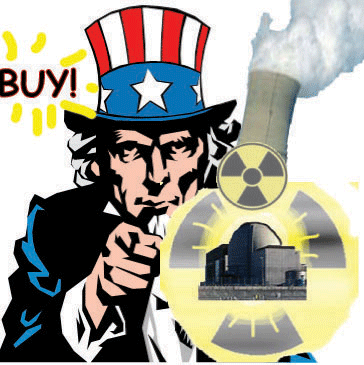
 ‘Nuclear liability law poses challenge to Indo-US nuke deal’ Zee News, September 13, 2013, Washington: India’s nuclear liability law posed a tough challenge for implementing the “transformational” Indo-US nuclear deal though there is a very strong desire to move forward, Nisha Desai Biswal, President Barack Obama’s Indian-American nominee for a key post in South Asia, said. “I think that the 123 agreement was a transformational agreement between the relationship between the United States and India, she said at her confirmation hearing for the post of Assistant Secretary of State for South and Central Asia.
“But since that deal was enacted, I think that there has been very slow and halting progress because of the nuclear liability law in India and the hindrances that that has posed to advancing civil nuke cooperation,” she said yesterday.
…..India’s Civil Liability for Nuclear Damage Law allows the operator of a nuclear plant to seek damages from the supplier in case of a nuclear incident due to supply of equipment with latent and patent defects or sub-standard services. The US says the Indian law is not consistent with the Convention on Supplemental Compensation (CSC). http://zeenews.india.com/news/nation/nuclear-liability-law-poses-challenge-to-indo-us-nuke-deal_876374.html
Ionising radiation causes a particularly aggressive form of breast cancer
 Exposing young girls to ionizing radiation can raise risk of breast cancer later in life http://www.news-medical.net/news/20130912/Exposing-young-girls-to-ionizing-radiation-can-raise-risk-of-breast-cancer-later-in-life.aspx 12 Sept 13, Exposing young women and girls under the age of 20 to ionizing radiation can substantially raise the risk of their developing breast cancer later in life. Scientists may now know why. A collaborative study, in which Berkeley Lab researchers played a pivotal role, points to increased stem cell self-renewal and subsequent mammary stem cell enrichment as the culprits. Breasts enriched with mammary stem cells as a result of ionizing irradiation during puberty show a later-in-life propensity for developing ER negative tumors – cells that do not have the estrogen receptor. Estrogen receptors – proteins activated by the estrogen hormone – are critical to the normal development of the breast and other female sexual characteristics during puberty.
“Our results are in agreement with epidemiology studies showing that radiation-induced human breast cancers are more likely to be ER negative than are spontaneous breast cancers,” says Sylvain Costes, a biophysicist with Lawrence Berkeley National Laboratory (Berkeley Lab). “This is important because ER negative breast cancers are less differentiated, more aggressive, and often have a poor prognosis compared to the other breast cancer subtypes.” Continue reading
Legal fight Sept 23-30 to save Utah water from Green River Nuclear Project

Our case “HEAL Utah et al v. Blue Castle Holdings et al,” will be tried in the 7th District Court in Price, from Sept. 23-30. This is more than just a nuclear power case. It is also a public airing of whether Western officials should endorse virtually any speculative use of our precious water. It’s a chance to ask a judge to seriously consider the growing impacts of climate change, as study after study suggests the Colorado River basin will lose anywhere from 8 to 35 percent of its water as snowpack recedes and drought intensifies.
And, yes, in the wake of Fukushima, it’s a chance to ask whether siting nuclear reactors upstream from the rivers that supply water to 30 million Americans is a wise choice.
Fight the Green River nuclear reactors project in Utah, High Country News, Matt Pacenza | Sep 12, 2013 Drive south from Price, Utah for about an hour until Route 6 intersects with I-70. On your right, toward the west, the stunning San Rafael Reef rises. And on the left, the eastern Book Cliffs rise.
And, just there, to the east of Route 6, if the energy development company, Blue Castle Holdings, and Utah state water officials have their way, you’ll soon see an industrial park dominated by the Mountain West’s first commercial nuclear reactors: the so-called “Green River nuclear” project.
Later this month, at a courthouse in Price, a Utah state judge will hear a bid from more than a dozen environmental groups, businesses and citizens to overturn a decision approving the transfer of Green River water to cool the proposed reactors. This trial is likely the last and best chance to stop the project before it moves to the industry-friendly Nuclear Regulatory Commission. Continue reading
Japanese fishermen not reassured about “expert” confidence on Fukushima radiation
Nuclear expert not worried about Fukushima ABC Radio PM, Mark Willacy reported this story on Friday, September 13, 2013 SCOTT BEVAN: Stung by criticism that its handling of the ongoing crisis at Fukushima has been shoddy, the nuclear plant’s operator TEPCO has brought in a US expert to advise it……..
Now that is despite revelations that about 300,000 litres of contaminated groundwater is flowing into the sea every day and of course it is despite a serious leak of highly radioactive water from one of the hundreds of storage tanks at the site and that was a product of what some say was rushed and shoddy workmanship.
LAKE BARRETT: This is not finished. But I don’t believe there’s anything of major concern and they do have an adequate leak control system there but it needs to be better and addressed, it needs to be explained much better than it’s been explained…….
So that opinion as you’d imagine Scott hasn’t gone down too well with many Japanese, particularly fishermen who used to make their livelihoods from the waters off Fukushima. http://www.abc.net.au/pm/content/2013/s3848510.htm
Fish migrate: therefore all fish from Japan is suspect
Microbiology Professor: “Gov’t needs to ban all fish imports from all regions of Japan” — Nuclear Professor: “No one can block fish migration along with sea currents” http://enenews.com/microbiology-professor-govt-needs-to-ban-all-fish-imports-from-all-regions-of-japan-nuclear-professor-no-one-can-block-fish-migration-along-with-sea-currents
Title: Government says seawater passes safety test-INSIDE Korea
Source: JoongAng Daily
Date: Sept. 12, 2013
[…] Fear of radiation has grown so bad that Korean consumers have stopped buying even locally caught fish. Sales have plunged at discount and department stores, according to the nation’s largest discount chains […]
[Oceans Minister Yoon Jin-sook] dismissed concerns that contaminated fisheries from the eight blocked Japanese prefectures were being disguised as products from other parts of the country. […]
Meanwhile, some experts’ views contrast with the minister’s.
“No one can block fish migration along with sea currents,” said Chang Jung-ouk, a nuclear energy policy professor at Matsuyama University. “When fishermen catch fish in Aomori Prefecture and trade them in Hokkaido, that means Korea could import fish from Aomori through Hokkaido.”
Kim Ik-joong, a microbiology professor at Dongguk University, said current measures are not enough.
“The government needs to ban all fish imports from all regions of Japan,” Kim said.
See also: Expert: “Ban all fish from Japan”
Fukushima: entire core of nuclear reactor 4 remains perched in a damaged fuel pool 100 feet in the air,
Five Ways a Wider Syrian War Could Go Nuclear Truth Dig, By Harvey Wasserman, 13 Sept 13,
“……….Millions of tons of heavily contaminated water continuously flow through the site in central Japan and into the Pacific Ocean. Millions more accumulate in flimsy tanks already breaking apart, all within the specter of the next earthquake.
The three melted cores at Fukushima Daiichi have yet to be found. The common radioactive waste pool near Unit Four is surrounded by buildings whose foundations are being undermined by the continuous flow of radioactive water.
Most terrifying, the entire core of Unit Four remains perched in a damaged fuel pool 100 feet in the air, atop a structure that’s sinking. Should it crash to the ground, that core could potentially spew into the ocean and atmosphere more than 20,000 times the radiation released at Hiroshima.
A sane species would be pouring all its resources into somehow healing the open apocalyptic wound that still festers at Fukushima.
Yet we are tied up in Syria. We can be deeply grateful that the situation there today seems at least slightly less dangerous than it did yesterday.
But atomic danger lurks without warning in every facet of this crisis.
Harvey Wasserman edits Nukefree.org. He is the author of “Solartopia! Our Green-Powered Earth” and hosts the “Green Power & Wellness” radio show. http://www.truthdig.com/report/item/five_ways_a_wider_syrian_war_could_go_nuclear_20130913/
1 This Month

of the week – Shut Down Drone Warfare!


Tell the Ukrainian Government to Drop Prosecution of Peace Activist Yurii Sheliazhenko

Petition to revoke the licensing of the Near Surface Nuclear Disposal Facility (NSDF) at Chalk River. https://www.ourcommons.ca/petitions/en/Petition/Details?Petition=e-7247
To see nuclear-related stories in greater depth and intensity – go to https://nuclearinformation.wordpress.com
-
Archives
- April 2026 (68)
- March 2026 (251)
- February 2026 (268)
- January 2026 (308)
- December 2025 (358)
- November 2025 (359)
- October 2025 (376)
- September 2025 (257)
- August 2025 (319)
- July 2025 (230)
- June 2025 (348)
- May 2025 (261)
-
Categories
- 1
- 1 NUCLEAR ISSUES
- business and costs
- climate change
- culture and arts
- ENERGY
- environment
- health
- history
- indigenous issues
- Legal
- marketing of nuclear
- media
- opposition to nuclear
- PERSONAL STORIES
- politics
- politics international
- Religion and ethics
- safety
- secrets,lies and civil liberties
- spinbuster
- technology
- Uranium
- wastes
- weapons and war
- Women
- 2 WORLD
- ACTION
- AFRICA
- Atrocities
- AUSTRALIA
- Christina's notes
- Christina's themes
- culture and arts
- Events
- Fuk 2022
- Fuk 2023
- Fukushima 2017
- Fukushima 2018
- fukushima 2019
- Fukushima 2020
- Fukushima 2021
- general
- global warming
- Humour (God we need it)
- Nuclear
- RARE EARTHS
- Reference
- resources – print
- Resources -audiovicual
- Weekly Newsletter
- World
- World Nuclear
- YouTube
-
RSS
Entries RSS
Comments RSS
 nuclear-news