Proof found that governments have let the nuclear industry make up the rules on liability
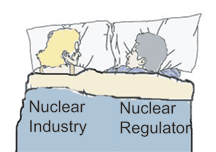 The nuclear industry has been allowed to write its own rules for more than 50 years, as the documents we’ve made public show. It’s time those rules were scrapped and the nuclear industry disqualified from the game it’s been playing with all our lives.
Proof that the nuclear industry has been dodging its responsibilities for over 50 years http://www.greenpeace.org/international/en/news/Blogs/nuclear-reaction/proof-that-the-nuclear-industry-has-been-dodg/blog/46544/ Justin McKeating – September 10, 2013 Information released today by Greenpeace Japan shows that the builders and suppliers of nuclear reactors were afraid of being held financially responsible for any accidents they might cause from the outset of the nuclear energy era in Japan.
A freedom of information request made by us has turned up documents from 1960 that show nuclear companies pressured the Japan Atomic Energy Commission to make sure they were exempted from all responsibility for a nuclear accident, except in the case of a deliberate act. The Commission was only too happy to agree.
But what if a nuclear company is grossly negligent? It needn’t worry. The Commission’s documents say:
“…we decided to delete ‘gross negligence’ to not make suppliers feel uneasy” Continue reading
Formal complaint from Japan, over French cartoons about Tokyo Olympic Games
 Japan voices anger over French cartoons that use Fukushima disaster to mock Olympics decision ABC News, By North Asia correspondent Mark Willacy, wires 12 Sep 2013 ,Japan says it will lodge a formal complaint with France over newspaper cartoons that poked fun at the decision to award the 2020 Olympics to Tokyo despite the ongoing Fukushima nuclear crisis.
Satirical weekly Le Canard Enchaine has published a cartoon depicting two sumo wrestlers, each with an extra leg or arm, facing off with the crippled Fukushima nuclear plant in the background.
In the foreground an announcer says: “Thanks to Fukushima, sumo is now an Olympic sport.”
Another cartoon shows two people standing in front of a pool of water while wearing nuclear protection suits and holding a Geiger counter, saying water sport facilities had already been built at Fukushima………
“This kind of journalism gives the wrong impression about the waste water problem.” [ -Japanese government spokesman Yoshihide Suga]
The government has repeatedly claimed the accident and its waste water problem are under control and should not affect the Olympics.
Mr Suga says Japan will formally complain to the French embassy in Tokyo……….. http://www.abc.net.au/news/2013-09-12/japan-protests-french-fukushima-cartoons/4954462
Japan at risk of losing Olympic Games if Fukushima radiation crisis persists
 Japan Times: Talk of Olympics being taken away from Tokyo if problems at Fukushima worsen over next couple of years http://enenews.com/japan-times-talk-of-olympics-being-taken-away-from-tokyo-if-problems-at-fukushima-worsen-over-next-couple-of-years
Title: Kansai not overly enthusiastic about Tokyo landing Olympics
Source: The Japan Times
Author: Eric Johnston
Date: Sept. 11, 2013
While pleased the Olympics are returning to Japan, the level of public and media enthusiasm in Osaka and the rest of Kansai is far less than what has been seen in Tokyo.
Like critics elsewhere, there is much concern in Kansai over the water leaks plaguing the Fukushima No. 1 nuclear plant. There has even been local speculation that the International Olympic Committee might be forced to consider taking the games away from Tokyo if the problems at Fukushima worsen over the next couple of years. […]
See also: Tepco plan claims Fukushima molten fuel to be removed at same time as 2020 Olympics in Tokyo
“Dealing in Doubt” – new book exposes the climate scepticism industry
Report offers field guide to the climate change denial industry, Guardian, Graham Readfearn, 13 Sept 13, Greenpeace report documents the who, what, when and how of a long-running campaign to block action on climate change It writes boilerplate legislation, runs extensive PR campaigns, puffs CVs with fake credibility, facilitates or promotes the intimidation of climate scientists and advocates, publishes books, organises speaking tours and conferences, gets on the telly and radio a lot, uses Freedom of Information laws as a surveillance tool, pays scientists to speak and – crucially – it manufactures doubt and confusion among policy makers, politicians and the public about climate change.
To get this work done, it has accepted many millions of dollars from fossil fuel interests or ideologically-driven conservative donors who funnel their cash through anonymous trust funds because they are too cowardly to put their mouths and their money in the same place.
We’re talking about the international climate science denial industry. Now it has a field guide, of sorts, courtesy of researchers at environment group Greenpeace.
 Published this week, Dealing in Doubt: The Climate Denial Machine Vs Climate Science recounts the history of efforts to underplay the risks of human-caused climate change, to deny the scientific evidence and to misrepresent the state of the collective knowledge of genuine scientists on the issue.
Oh, and it comes with fun little caricatures of some of the key characters in the denial industry.

The title of the report “Dealing in Doubt” comes from a tactic employed and articulated by tobacco industry executives in a 1969 memo, which read: Continue reading
Russia worried about he state of North Korea’s aged nuclear reactor
 Russia warns over North Korea work at ‘nightmarish’ nuclear reactor Russia has warned that North Korea is apparently conducting work on a nuclear reactor, saying the ageing facility is in such a “nightmarish state” it could cause a disaster. ABC News 13 Oct 13
 US analysts say satellite imagery suggests Pyongyang has restarted a research reactor capable of producing plutonium for weapons at its Yongbyon nuclear complex.
The Interfax news agency has quoted a diplomatic source as saying Russia does not have definite information the work has restarted, but warning of dire consequences should that happen.
“It is obvious that some works are being conducted, and for a long time at that. According to some signs, steps were indeed being taken to relaunch it,” the source said. “Our main concern is linked to a very likely man-made disaster as a consequence. The reactor is in a nightmarish state. It is a design dating back to the 1950s.
“For the Korean peninsula this could entail terrible consequences, if not a man-made catastrophe.”
The US-Korea Institute at the Johns Hopkins School of Advanced International Studies says a satellite image from August 31 shows white steam rising from a building near the hall that houses the plutonium production reactor’s steam turbines and electric generators.
“The white coloration and volume are consistent with steam being vented because the electrical generating system is about to come online, indicating that the reactor is in or nearing operation,” the Washington-based institute said. It says the reactor can produce six kilograms of plutonium a year.
The Russian source has cautioned the steam could “simply be testing of the generator”……. http://www.abc.net.au/news/2013-09-12/russia-warns-n-korea-over-work-at-nuclear-reactor/4954698
UK government by-passing County Councils on nuclear waste dump decisions

 County councils sidelined from nuclear waste dump site decisions http://www.theguardian.com/environment/2013/sep/12/county-councils-nuclear-waste-dump-sites Energy department policy makes district councils lead authority on locating waste dumps, which Cumbria county council says abandons big society Terry Macalister theguardian.com, Friday 13 September 2013 The government has been accused of “astonishingly undemocratic” behaviour after it moved to cut out county councils from deciding the site of a national nuclear waste dump.
The stinging criticism came from the leaders of Cumbria county council, who have been sidelined months after scuppering ministers’ plans by voting against a £12bn high-level waste repository near the Sellafield nuclear complex. Continue reading
Florida: costly high risk nuclear power should not be funded by the tax-payer
 Americans may be divided on the use of nuclear power, but few people will defend the notion that massive utilities should be relying on taxpayers to build nuclear reactors. The bottom line is clear: Putting the full faith and credit of the U.S. government behind this costly, high-risk Vogtle reactor project is fiscally irresponsible
Policy wrongly puts risk of nuclear plants on public http://www.orlandosentinel.com/news/opinion/os-ed-front-burner-nuclear-loans-con-20130912,0,1513077.story By Ryan Alexander, September 12, 2013
Think what you want about nuclear power. Maybe it’s the best way to generate electricity or maybe it’s the worst. For Florida taxpayers, that debate may be less relevant than the one aimed right at your pocketbook.
At issue is the use of taxpayer-backed federal loan guarantees to finance nuclear-reactor projects — such as the Vogtle reactors in Georgia now awaiting a deadline for final agreement on loan-guarantee terms. If these terms are finalized, taxpayers will be left holding the bag in the event of a Vogtle default.
In February 2010, the U.S. Department of Energy conditionally offered Southern Company and its partners $8.33 billion in taxpayer-backed loan guarantees to build two nuclear reactors in Georgia. The subsidy would be provided through the same DOE program that awarded more than $500 million to the now defunct solar-power company, Solyndra. The Vogtle project is roughly 16 times bigger than Solyndra in loan-guarantee terms and perhaps every bit as troubled.
The project is already experiencing construction delays that could increase costs substantially, and its design, the AP1000, has never been built in the United States before or been successfully completed or operated anywhere in the world. Initial cost estimates of $14.1 billion are already being pushed up to $15.3 billion. With lawsuits being pursued by contractors designing the reactor, the cost could jump again to $16.2 billion.
All of this is unfolding against a backdrop of grim news for the nuclear industry in the U.S. Continue reading
Is America’s Environmental Protection Agency (EPA) weakening standards for nuclear safety?
 EPA Documents Raise Doubts Over Intent of New Nuclear-Response Guide
National Journal By Douglas P. Guarino, Global Security Newswire September 11, 2013 WASHINGTON —Newly obtained government documents are prompting concern among critics that Environmental Protection Agency officials are seeking to use the organization’s new guide for nuclear-incident response to relax public health standards, but the agency is denying the claim.
The Freedom of Information Act release comes as the agency has yet to finish collecting public comments on the so-called protective-action guide, which it issued in April after years of internal infighting and public controversy. The document is meant to give federal, state and local officials advice on responding to a wide range of radiological incidents, such as “dirty bomb” attacks, nuclear power plant meltdowns and industrial accidents.
The documents obtained by Global Security Newswire show EPA officials have suggested at meetings around the world that the new guide could allow for the use of long-term cleanup standards dramatically less stringent than those the agency has enforced for decades at hundreds of sites throughout the United States, critics say.
In some cases, EPA officials have not only suggested that a drastic event akin to the Fukushima nuclear power plant meltdown in Japan would necessitate more flexible guidelines, but also have made statements that critics say challenge the very science behind the agency’s everyday radiation rules. Continue reading
Public meeting about decommissioning process for san Onofre Nuclear Power PLant
 NRC sets first public meeting on decommissioning San Onofre nuclear plant http://www.scpr.org/news/2013/09/12/39216/nrc-sets-san-onofre-nuclear-plant-meeting-in-carls/
Ed Joyce | September 12th, 2013 The Nuclear Regulatory Commission announced Thursday it will hold a public meeting September 26 in Carlsbad to talk about the decommissioning process for the San Onofre Nuclear Generating Station in northern San Diego County.
It will be the agency’s first public meeting on closing the plant operated by Southern California Edison.
The meeting is scheduled for 6 p.m. at the Omni LaCosta Hotel, 2100 Costa del Mar Road. Doors will open at 5 p.m. to accommodate security screening.
An NRC press release says technical staff will give a presentation describing the process and regulations covering the decommissioning with a Q&A session to follow.
“We think this meeting is very important for the community,” said Gene Stone with San Clemente-based Residents Organized for a Safe Environment. It’s one of several groups in Orange and San Diego counties that pushed for the plant’s closure.
Stone says a coalition of environmental groups “will create a committee focusing on safety of nuclear waste storage, the timeliness of the process and the costs associated with decommissioning.”
The nuclear plant, which is located on the coast near the border of San Diego and Orange counties, has been shut down since January 2012 after radioactive steam escaped from damaged tubes inside one of the reactors. In June of this year, Southern California Edison announced it would seek the permanent closure of the plant.
Edison International Chairman Ted Craver told reporters in June that closing the plant would take decades and result in spent nuclear fuel being stored “for a very long time” at the plant.
According to Craver, the company has a $2.7 billion decommissioning fund that can be used to close San Onofre. But the money to make up for the loss of the San Onofre plant will come from ratepayers, insurance claims, shareholders and Mitsubishi Heavy Industries, which made the equipment that led to the problems at San Onofre.
The California Public Utilities Commission has set an October 1 hearing to determine just how much ratepayers will pay.
Earlier this month, Southern California Edison opened the San Onofre Digital Document Library. The utility said the library provides the public with documents related to the design of the steam generators that were cited as a reason for the plant’s problems.
Along with Edison, San Diego Gas & Electric owns 20 percent of the plant and the City of Riverside owns nearly 2 percent.
The plant is located about two miles south of San Clemente.
Cuba’s abandoned unfinished nuclear power plant
Concrete Crypt for Communist Dreams: Cuba’s Unfinished Nuclear Power Plant http://www.slate.com/blogs/atlas_obscura/2013/09/11/the_unfinished_cuban_nuclear_power_plant_abandoned_when_the_ussr_collapsed.html By Atlas Obscura, Sept. 11, 2013 In 1976, Communist companions Cuba and the Soviet Union signed a deal to build a nuclear power plant in Juraqua. Construction on the first of two nuclear reactors began in 1983 with a target operational date of 1993. But a few years before the reactor’s scheduled completion, the USSR collapsed. The flow of crucial Soviet funds ceased, 300 Russian technicians went home, and Cuba was forced to suspend construction on its badly needed power plant.
Lacking nuclear fuel and without the primary components installed, the plant sat in limbo until December 2000, when Russian President Vladimir Putin paid a visit to Cuba. Putin offered Fidel Castro a belated $800 million to finish the first reactor. Despite Cuba’s reliance on imported oil for power, Castro declined. Project status: officially abandoned.
The unfinished plant, a huge, domed concrete structure, sits on the Caribbean coast, across the bay from the city of Cienfuegos.
Thank you for the Olympics but what about the children? – Japanese parents protest!
10 September 2013

National Parents Network to Protect Children from Radiation
https://www.facebook.com/kodomo.zenkokunet?ref=hl
Government: Since we won Olympics, protect our children : apply 1msv/h threshold
Since we won the Olympic bid , thank you now to be responsible and to adjust the radiation exposure limits to international standards. Japanese government agreed the limits set by the ICRP (INTERNATIONAL COMMISSION ON RADIOLOGICAL PROTECTION ) at ” 1 mSv ” / year Set up after Chernobyl accident this standard was considered as the limit for people evacuation . But today , many children and their families go on living above 1msv/year areas, even after decontamination , without anything being done. This limit was even raised. (up to 20 mSv with recommendations of half an hour per day outside for small children last year)
If Japan , claims to host the Olympics , he must not forget that there are people who are suffering and hopeless about their future and their health problems due to radiation Do not enjoy this festival atmosphère and stifle their voices . You must comply with this limit of 1msv/year and let immigrate population, provide them medical care, make measurements of radioactivity in food and give all necessary support to live decently . ( Cardiac , respiratory hematologic diseases emerged last year among children. This is denied by the government, which only recognizes the eventuality of thyroid problems which are currently the only recognized examinations )
To protect these children, we continue to ask through legal means ( as we did last year ) the promise to apply the threshold of 1 mSv / year . And we are more determined than ever since Japan won the Olympic Games. The country must take its responsibilities towards the Japanese people who live above an exposition of 1msv/year .
Olympic Insanity + If Gundersen were in Charge at Fukushima

Fairewinds Energy Education’s Arnie Gunderson with Nuclear Hotseat Producer/Host, Libbe HaLevy –
NUCLEAR HOTSEAT PROGRAMME NUMBER 117
September 10, 2013
DOWNLOAD HERE:
http://lhalevy.audioacrobat.com/download/7342ed07-115e-fa78-3b6c-ef92adacbac1.mp3
INTERVIEW: Former nuclear industry insider Arnie Gundersen of Fairewinds Energy Education (www.Fairewinds.com) paints a clear picture of the current state of problems at Fukushima Daiichi… and then explains what he would do if he were in charge of the disaster site. His first five minutes on the job would be awesome – and that’s a word I almost never use! – See more at:
1 This Month

Chernobyl: The Lost Tapes – A good documentary on Chernobyl on SBS available On Demand for the next 3 weeks– https://www.sbs.com.au/ondemand/tv-program/chernobyl-the-lost-tapes/2352741955560

of the week–London Campaign for Nuclear Disarmament

Tell the Ukrainian Government to Drop Prosecution of Peace Activist Yurii Sheliazhenko
To see nuclear-related stories in greater depth and intensity – go to https://nuclearinformation.wordpress.com
-
Archives
- April 2026 (181)
- March 2026 (251)
- February 2026 (268)
- January 2026 (308)
- December 2025 (358)
- November 2025 (359)
- October 2025 (376)
- September 2025 (257)
- August 2025 (319)
- July 2025 (230)
- June 2025 (348)
- May 2025 (261)
-
Categories
- 1
- 1 NUCLEAR ISSUES
- business and costs
- climate change
- culture and arts
- ENERGY
- environment
- health
- history
- indigenous issues
- Legal
- marketing of nuclear
- media
- opposition to nuclear
- PERSONAL STORIES
- politics
- politics international
- Religion and ethics
- safety
- secrets,lies and civil liberties
- spinbuster
- technology
- Uranium
- wastes
- weapons and war
- Women
- 2 WORLD
- ACTION
- AFRICA
- Atrocities
- AUSTRALIA
- Christina's notes
- Christina's themes
- culture and arts
- Events
- Fuk 2022
- Fuk 2023
- Fukushima 2017
- Fukushima 2018
- fukushima 2019
- Fukushima 2020
- Fukushima 2021
- general
- global warming
- Humour (God we need it)
- Nuclear
- RARE EARTHS
- Reference
- resources – print
- Resources -audiovicual
- Weekly Newsletter
- World
- World Nuclear
- YouTube
-
RSS
Entries RSS
Comments RSS
 nuclear-news