Japan Defends Standards in Wake of Korean Ban on Fish Imports
…South Korea, which had previously imposed a ban on 50 fish products from a swath of Japan’s coast near the nuclear facility, also criticized Tokyo for not providing information “sufficient to predict the future evolution” of the situation…
September 6,2013
http://www.laht.com/article.asp?ArticleId=992064&CategoryId=12396

TOKYO – Japan’s government issued a statement Friday defending the country’s food safety standards after South Korea banned all fish imports from the Fukushima region, where a crippled nuclear plant has spilled radioactive water into the Pacific.
Chief government spokesman Yoshihide Suga said Japanese food products were subject to tight international controls and called on Seoul to “adopt measures based on scientific facts.”
“We have provided the South Korean government relevant information since the leaking of contaminated water into the sea was discovered,” Suga said.
He was referring to the acknowledgment in July by the Fukushima nuclear plant’s operator, Tokyo Electric Power Company, or TEPCO, that hundreds of tons of contaminated groundwater were making their way to the Pacific every day.
South Korea on Friday announced a ban on imports of all fish products from eight Japanese regions, including Fukushima, amid heightened concerns at home over the leaks.
Citizens “are increasingly concerned about the fact that hundreds of tons of irradiated water are leaking every day from the site of the Fukushima nuclear accident,” Seoul said.
The plant was battered by a devastating March 2011 earthquake and tsunami.
South Korea, which had previously imposed a ban on 50 fish products from a swath of Japan’s coast near the nuclear facility, also criticized Tokyo for not providing information “sufficient to predict the future evolution” of the situation. EFE
Concrete burial a better option for Fukushima- but not good for PR?
 Japan Expert: Covering Fukushima reactors in concrete like at Chernobyl should be considered — Nuclear Official: If we just buried them, no one would want to look at another nuke plant http://enenews.com/japan-expert-covering-fukushima-reactors-concrete-like-chernobyl-be-considered-nuclear-official-buried-one-look-another-nuke-plant-years
Title: Errors Cast Doubt on Japan’s Cleanup of Nuclear Accident Site
Source: New York Times
Author: Martin Fackler
Date: Sept. 3, 2013
[…] some experts dismiss the current cleanup plans as just a way of defending the status quo by convincing the public that the damage can be undone […]
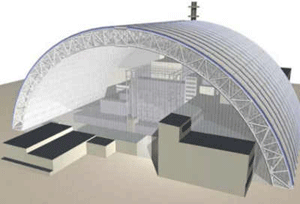 Harutoshi Funabashi, a sociologist at Hosei University who led a critical examination of the recovery efforts by the Science Council of Japan […] and other critics say Japan should consider other options, including the tactic adopted by the former Soviet Union at Chernobyl of essentially capping the shattered reactors in concrete and declaring the most contaminated towns off limits for a generation.
Japanese officials said the large amounts of groundwater under the plant mean that just covering the reactors with concrete would fail to contain the spread of radiation. They also said giving up on a large portion of Fukushima was not an option in a densely populated country where land remains a scarce commodity.
But they also suggested that the reason for eschewing a Soviet-style option may be the fear that failure could turn a wary public even more decisively against Japan’s nuclear industry.
“If we just buried the reactors, no one would want to see the face of another nuclear power plant for years,” said Shunsuke Kondo, chairman of the Atomic Energy Commission, an advisory body in the Cabinet Office. […]
See also: Bloomberg: Tepco now in talks to cover Fukushima reactors with concrete for next 75 years — Officials reviewing plan in U.S.
Could the Fukushima Ice Wall melt?
Nuke Fatigue & the 2020 Tokyo Olympics EE Times, Junko Yoshida, Chief International Correspondent, 6 Sept 13, “…………So far, I’ve heard no skeptics in Japan questioning the science and long-term viability of the technology behind the proposed ice wall — especially on NHK, Japan’s public broadcaster.
To hear the argument against it, I had to turn to Tuesday’s edition of the PBS Newshour, whose link my former colleague and science writer George Leopold sent via e-mail.
‘Risky experiment’
In the program, Arjun Makhijani, an engineer specializing in nuclear fusion and president of the Institute for Energy and Environmental Research, called the proposed ice wall scheme “a risky experiment.”
Looking at Risks if the Fukushima Ice Wall Defrosts
Makhijani explained that the Japanese “hope to freeze the soil, basically, with a giant freezing machine, just like your freezer at home, [to] put cooling coils in the soil, lots and lots of them.” He pointed out that this scheme “takes an enormous amount of electricity.” That is just what the Fujushima nuclear plant can’t do.
The biggest worry is potential power failures. Makhijani said:
…if the power fails, you know, just like if your — when the power goes out with your refrigerator, everything will de-freeze in — defrost in the freezer. Even though ice wall technology had been used frequently to stabilize the ground in big construction projects, like the Big Dig highway project in Boston, The New York Times pointed out that some critics are dubious.
They argue that it’s a costly technology “that would be vulnerable at the blackout-prone plant because it relies on electricity the way a freezer does, and even more so because it has never been tried on the vast scale that Japan is envisioning and was always considered a temporary measure, while at Fukushima it would have to endure possibly for decades.” http://www.eetimes.com/author.asp?section_id=36&_mc=SM_EET&itc=eetimes_sitedefault&doc_id=1319412&page_number=2
Iran’s Foreign Minister to now be nuclear negotiator
Iran Foreign Ministry to lead nuclear  talks http://www.aljazeera.com/news/middleeast/2013/09/20139515176846972.htm President
  tasks ministry with handling negotiations, in shift away from security officials setting Tehran’s strategies. 05 Sep 2013 Iranian President Hassan Rouhani has tasked the Foreign Ministry with handling the country’s nuclear negotiations with world powers, in a shift away from security officials setting Tehran’s strategies for the talks.
The announcement on Thursday came three weeks before Iran and the UN atomic watchdog are to resume talks in Vienna over Tehran’s controversial nuclear programme.
Since 2007, negotiations have been conducted by Saeed Jalili, head of the country’s Supreme National Security Council, who was seen by Western diplomats as an uncompromising ideologue.
Last month, the president named ex-foreign minister Ali Akbar Salehi to head the country’s Atomic Energy Organisation and career diplomat Reza Najafi as envoy to the UN nuclear watchdog, the International Atomic Energy Agency.
Iran’s most powerful authority, Ayatollah Ali Khamenei, retains the final say on any proposed deals.The last round of negotiations in April with the United States, Russia, China, Britain, France and Germany again fell short of any breakthrough.
But some believe more progress can be achieved under Rouhani, a relative moderate who was elected in June and has pledged a more conciliatory and transparent approach to foreign policy than his predecessor, Mahmoud Ahmadinejad. The six world powers have demanded Tehran cease enrichment of uranium to a fissile purity of 20 percent to reduce concerns that it could be used for nuclear weapons, allegations Tehran has repeatedly denied.
During his role as Iran’s chief nuclear negotiator, from 2003-2005, Rouhani accepted the suspension of the enrichment programme. Rouhani said last month that Iran was ready for serious talks, but he said there could be no surrender of the right to the peaceful use of nuclear energy and that Iran would not give up uranium enrichment.
West taking a gentler approach to Iran at nuclear meeting
West to hold back from targeting Iran at U.N. nuclear meeting By Fredrik Dahl VIENNA | Thu Sep 5, 2013 (Reuters) – World powers will refrain from raising pressure on Iran at a U.N. nuclear meeting next week to give its new moderate president time to show he is serious about moves to reduce tensions over its atomic activity, Western diplomats say…….. “There has definitely been a change in tone from the Iranian government which we recognize and welcome,” a Western envoy said, speaking ahead of next week’s governing board meeting.
“We have to give them at least the time to translate their words into action,” the envoy added, noting there were no plans – unlike previous board meetings – to push for a resolution to chide Iran over its refusal to curb sensitive atomic activity…….. http://www.reuters.com/article/2013/09/05/us-iran-nuclear-iaea-idUSBRE9840IL20130905
TEPCO continues to put out unreliable data on Fukushima radiation
Regulator Raps Fukushima Operator Over ‘Unreliable’ Data VOA, Reuters September 05, 2013 TOKYO — Tokyo Electric Power Co. [Tepco], the operator of the stricken Fukushima nuclear plant, is still putting out questionable data on radiation leaks, causing confusion and a heightened sense of crisis, according to Japan’s nuclear regulator.
 The stakes have been raised as Japan makes a final pitch for Tokyo to host the 2020 Olympic Games, while a steady stream of bad news from Fukushima, the site of the worst atomic disaster in a quarter of a century, leaves officials frustrated by Tepco’s missteps and miscalculations.
“As I’ve said before, Tokyo Electric has not been properly disclosing the situation about the contamination and the levels of contamination,” said Shunichi Tanaka, chairman of the Nuclear Regulation Authority [NRA]. “This has caused confusion domestically and internationally. Because of that, the Japanese government has a sense of crisis and I, personally, feel a little angry about it.”
“I wouldn’t go as far as to say Japan’s reputation has been made worse, but releasing incorrect information about the radiated water problem has created trouble around the world,” said Tanaka…… Officials have been keen to assure the world that Tokyo will be safe during the Olympics in seven years, if chosen. Prime Minister Shinzo Abe flies to Buenos Aires later on Thursday from a Group of 20 meeting in St. Petersburg to lead Tokyo’s final pitch before the Olympic committee. Madrid and Istanbul are the other contenders.
“We would like to host the 2020 Olympic and Paralympic Games here in Tokyo and welcome athletes, people affiliated with the events and visitors from all over the world,” said Chief Cabinet Secretary Yoshihide Suga, adding that food and water in Japan is safe….. http://www.voanews.com/content/reu-japan-regulator-raps-fukushima-operator-over-unreliable-data/1743815.html
Nuclear Academic Capture in Canadian University
 The university administration is complicit, the faculty and staff are largely acquiescent, and the vast majority of students appear to be oblivious to the dangers of encroaching corporate influence. It has been left to a few faculty and students and a minority of university senators to raise the alarm about the murky undercurrents.
In light of these alarming trends, it is essential that opposition to the university’s role in nuclear development extend to the wider community.
 “……….A gentle wooing The readiness with which the university administration and faculty accepted the establishment of the CCNI comes as no surprise. One might conclude, after reading to this point, that there is an aura of inevitability about it. But in fact, the foundations for university support have been carefully built over several years.
The uranium industry, and particularly Cameco – its chief manifestation here in Saskatchewan – have assiduously wooed the University of Saskatchewan and given millions of dollars in endowments to chairs, scholarships, and infrastructure over the past two decades. Cameco Plaza, next to the Administration Building, and Cameco Skywalk at Royal University Hospital, are among the most visible physical signs of this corporate impact.
Several of the faculty, directors, and department heads who wrote glowing letters of support for the establishment of CCNI have at one time or another seen their programs benefit from Cameco’s largesse. Continue reading
New nuclear bomb tally – 125,000 more nuclear warheads since 1945
“Approximately 4,400 warheads—nearly half of all stockpiled warheads—are deployed on missiles or at bases with operational launchers,” BAS says, “we estimate that roughly 1,800 US and Russian warheads are on high alert atop long-range ballistic missiles that are ready to launch 5 to 15 minutes after receiving an order.” (below – a pilotless nuclear missile)

Since Hiroshima, We’ve Built 125,000 More Nuclear Bombs http://motherboard.vice.com/blog/since-hiroshima-weve-built-125000-nuclear-bombs By Brian Merchant, 5 Sept 13, “…….A new report from the Bulletin of the Atomic Scientists, “Global nuclear weapons inventories, 1945–2013,“ says that since that fiery event at the tail end of World War II, human beings have built 125,000 more nuclear warheads. And 97 percent of them were built by the US and Russia. The report offers a fascinating synopsis of how many warheads are out there, who built what, and how far we have to go before we approach true nuclear disarmament.
There are nine nations with confirmed nuclear stockpiles, and those with smaller arsenals—or those, like Israel, that haven’t really fessed up to having any at all—are harder to count. Continue reading
Fire in turbine building at Palo Verde Nuclear Plant

 Emergency declared at U.S. nuclear plant due to fire in turbine building — Two ‘reflash events’ occurred — Fire emergency lasted over four hours #PaloVerde http://enenews.com/emergency-declared-at-u-s-nuclear-plant-due-to-fire-in-turbine-building-two-reflash-events-occurred-fire-emergency-lasted-over-four-hours-paloverde
Associated Press, Sept. 3, 2013: The Palo Verde Nuclear Generating Station declared an unusual event when oil-soaked insulation behind a water pump caught fire, officials said Tuesday. […] An unusual event is the lowest of four emergency levels for nuclear power plants. […] APS spokesman said the cause of the fire is under investigation, but NRC spokesman Victor Dricks said it appeared that insulation that covers very hot metal surfaces had become soaked by bearing lubrication over time. […] The unusual event was the second at Palo Verde in two months […] The last unusual event was on July 2 when Unit 1 reactor temporarily reduced its power production after there was a minor explosion in a cabinet that holds electrical switching gear.
NRC: Event Notification Report for September 4, 2013 – – UNUSUAL EVENT DECLARED DUE TO FIRE IN THE TURBINE BUILDING […] An Event Classification of Unusual Event (HU2.1) was declared at 1926 [MST] for the Palo Verde Nuclear Generating Station. At 1912, smoke was detected by a security officer by the ‘A’ train Main Feed pump. An Auxiliary Nuclear Operator investigated and identified a fire on lagging, with one foot flames behind the main standard ‘A’ train Main Feed pump. The fire team responded to the fire and is currently on scene. Fire was declared out at 1957. […] The ‘A’ Main Feed pump high vibration alarm was received, but the continued operation of the main feed pump is currently not in jeopardy.” While removing lagging, during the recovery process, the licensee had 2 reflash events. The flame was extinguished and the licensee continues to remove the oil soaked lagging for the ‘A’ Main Feed pump. […] Vapor extraction differential pressure was increased to eliminate the oil vapor leak. At 2134 MST, received a report of two reflash events while the Fire Department was removing additional lagging with no sustained flame or fire. All the affected lagging has been removed and the fire emergency was terminated at 2345 MST on 9/2/13. See also: Explosion reported at U.S. nuclear plant, emergency declared
Japanese people ‘in denial’ about Fukushima radiation – suffering ‘nuclear fatigue’?
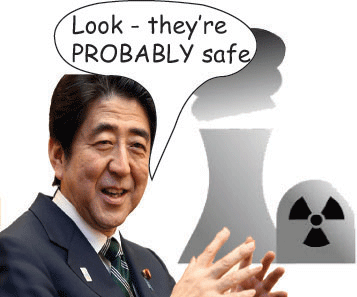 Nuke Fatigue & the 2020 Tokyo Olympics, EE Times, Junko Yoshida, Chief International Correspondent 9/5/2013“………..What’s unacceptable to me, though, when I come back here, is to witness firsthand how Japan is handling the persistent radioactive leakage problem at the nuclear power plant in Fukushima. The people, the government, and the entire nation seem to be living in total denial.
Hitomi Nakayama, a lawyer and a long-time friend of mine since college days, calls it “nuclear fatigue.” She laments the fundamentally stoic nature of people in the stricken region of Tohoku. Some who lived in villages in Fukushima, heavily nuked as a result of the meltdown at the power plant, still harbor dreams of returning to their homes. Many have never even considered suing the plant’s operator, Tokyo Electric Power Company (Tepco). Instead, with a shrug, they say they’re thankful for Tepco’s contribution to economic growth in the region, Nakayama explained.
People and the media in Japan would rather talk about something else, like the 2020 Tokyo Olympics, as they look past the still unfolding nuclear crisis in Fukushima.
I’m sure I’m not alone in feeling troubled by the supine media here — who are insanely obsessed with the pending vote by the chronically corrupt International Olympic Committee. Japanese newspapers and TV are clearly dancing to the tune of those who badly want Tokyo to host the 2020 Summer Olympic Games.
In contrast, there is little public debate about the worst atomic horror in Japan since Nagasaki……
Cataracts in the eyes of birds in Chernobyl and Fukushima
the key factor determining the presence of the disease was the intensity of local radiation, with cataract scores of over one proving to be far more common in areas that were above ten microseiverts per hour
Birds live with cataracts in Chernobyl The Economist, Sep 7th 2013 CATARACTS are relatively common in people who live to a ripe old age. They are sometimes seen in animals that live in zoos as well, but in the wild they are almost unheard of. The reason is simple. Losing eyesight is in effect a death sentence for a wild animal that must find its own food and, should that animal live long enough to develop the disease, starvation or predation would quickly follow|cataracts unrelated to age are surprisingly common in birds living near the site of the Chernobyl nuclear disaster in 1986.
This is revealed in a new study by a pair of ornithologists, Timothy Mousseau of the University of South Carolina and Anders Moller of the University of Paris-Sud, which is published in the Public Library of Science. That cataracts and ionising radiation are related is well known. As high energy ions, usually produced by the sun’s rays, slam into the water found next to the lenses of the eyes, free radicals are created that damage DNA and cause errors to develop in the formation of proteins that make up the lenses, resulting in cataracts.
This led the researchers to suspect that cataracts in birds might be common in areas where there are high levels of ionising radiation, and they turned to Chernobyl as a study area. Continue reading
Films “Crying Earth Rise Up!” and “Black Waters” help tribes win Rapid City Coucil support against uranium mining
 Rapid City backs tribes in uranium mine fight Climate Connections, By Talli Naumann, September 2, 2013. Source: Native Sun News Folks who want to learn more about the Rapid City Council’s vote to oppose Powertech Uranium Corp.’s Black Hills uranium mining plans got an opportunity with the scheduling of a double feature film showing at the Dahl Arts Center on Aug. 28.
Voices of the Heartland Independent Film Society booked filmmakers to lead a discussion on the issue following the 6:30 p.m. screenings of “Crying Earth Rise Up!” by Oglala Lakota producer Debra White Plume and “Black Waters” by Black Hills native Talli Nauman.
The Council voted 9-1 against the Canadian company’s proposal for the mining 50 miles west of the Pine Ridge Indian Reservation, after hearing testimony about treaty rights and children’s health downstream on the Cheyenne River Indian Reservation. Continue reading
Japan Olympic Committee desperately spinning Tokyo’s safety from Fukushima radiation
Japan Olympic Committee delegates in radiation spin control Media trip up team while it tried to put best foot forward Japan Times, BY DAVE HUESTON, 5 Sept 13 KYODO, AP BUENOS AIRES – What should have been a resounding kickoff for the Tokyo 2020 bid with the International Olympic Committee’s vote coming Saturday turned into a fencing match as bid chief Tsunekazu Takeda tried to parry questions from the media about the Fukushima nuclear crisis.
Takeda, who is president of the Japanese Olympic Committee, and Fujio Cho, president of the Japan Sports Association and honorary chairman of Toyota Motor Corp., held a media event Wednesday in Buenos Aires to pitch Tokyo’s proposed marketing program and emphasize the capital’s certainty to deliver the games in first-class style……..
UK an ‘attractive opportunity’ for Russia to sell its nukes
 Russian ambitions to build nuclear reactors in Britain are ‘realistic’, say ministers By Emily Gosdenhttp://www.telegraph.co.uk/finance/newsbysector/energy/10289525/Russian-ambitions-to-build-nuclear-reactors-in-Britain-are-realistic-say-ministers.html 05 Sep 2013
Ministers have opened the door to Russia building nuclear reactors on British soil, signing an agreement describing it as a “realistic longer-term ambition”.
The memorandum of understanding, signed in Moscow by energy minister Michael Fallon, said that “mutually profitable commercial relationships between Russian and British companies in third markets could form the basis in the longer term of commercial cooperation in the UK”.
This would be achieved through an “incremental, step-by-step approach”. Mr Fallon said: “Inward investment into our energy sector will depend upon all reactor technologies meeting the stringent and independent regulatory standards required in the UK and EU.”
The agreement came as Rosatom, the Russian state nuclear corporation, commissioned Rolls-Royce to prepare the ground for its reactor to seek UK safety approval. Rolls-Royce, which already has a partnership with Rosatom, will “undertake engineering and safety assessment work” ahead of Rosatom’s reactor “potentially entering the first step of the UK’s formal regulatory approval process”.
Reactors have to pass a ‘generic design assessment’ from the Office for Nuclear Regulation before they can be built in the UK. EDF-Areva’s reactor design for proposed use at Hinkley Point in Somerset took five years to approve.
Rosatom said it viewed the UK as “an attractive opportunity” because most of the UK’s existing reactors are due to close in coming years.
Russia has made no secret of its desire to expand in the UK but has to convince politicians it can overcome security fears as well as safety concerns stemming from its role in the Chernobyl disaster. In June ministers agreed to create a joint working group on “cooperation in the peaceful use of atomic energy between Rosatom and DECC”.
Uranium price is tied to what’s going on in Japan, says UEC
Uranium Energy Cuts Output as Nuclear Fuel Prices Lie Low Bloomberg, By Gerrit De Vynck – Sep 5, 2013Uranium Energy Corp which mines and processes the nuclear fuel in Texas, is cutting production as prices trade at a seven-year low…..Uranium spot prices have fallen 22 percent this year amid delays in the restart of nuclear plants in Japan following the March 2011 earthquake and tsunami. Last month, Cameco Corp. (CCO), the world’s third-largest uranium producer, dropped its projected sales volume from its German trading unit Nukem Energy GmbH to 8 million to 10 million from 9 million to 11 million pounds.
“This uranium price is tied to what’s going on in Japan,” said David Talbot, an analyst for Dundee Securities Corp. in Toronto. Once Japanese regulators approve more plant restarts, it will signal to the world to begin buying uranium again and the price will rebound, he said….. http://www.bloomberg.com/news/2013-09-05/uranium-energy-cuts-output-as-nuclear-fuel-prices-lie-low.html
1 This Month

of the week – Shut Down Drone Warfare!


Tell the Ukrainian Government to Drop Prosecution of Peace Activist Yurii Sheliazhenko

Petition to revoke the licensing of the Near Surface Nuclear Disposal Facility (NSDF) at Chalk River. https://www.ourcommons.ca/petitions/en/Petition/Details?Petition=e-7247
To see nuclear-related stories in greater depth and intensity – go to https://nuclearinformation.wordpress.com
-
Archives
- April 2026 (114)
- March 2026 (251)
- February 2026 (268)
- January 2026 (308)
- December 2025 (358)
- November 2025 (359)
- October 2025 (376)
- September 2025 (257)
- August 2025 (319)
- July 2025 (230)
- June 2025 (348)
- May 2025 (261)
-
Categories
- 1
- 1 NUCLEAR ISSUES
- business and costs
- climate change
- culture and arts
- ENERGY
- environment
- health
- history
- indigenous issues
- Legal
- marketing of nuclear
- media
- opposition to nuclear
- PERSONAL STORIES
- politics
- politics international
- Religion and ethics
- safety
- secrets,lies and civil liberties
- spinbuster
- technology
- Uranium
- wastes
- weapons and war
- Women
- 2 WORLD
- ACTION
- AFRICA
- Atrocities
- AUSTRALIA
- Christina's notes
- Christina's themes
- culture and arts
- Events
- Fuk 2022
- Fuk 2023
- Fukushima 2017
- Fukushima 2018
- fukushima 2019
- Fukushima 2020
- Fukushima 2021
- general
- global warming
- Humour (God we need it)
- Nuclear
- RARE EARTHS
- Reference
- resources – print
- Resources -audiovicual
- Weekly Newsletter
- World
- World Nuclear
- YouTube
-
RSS
Entries RSS
Comments RSS
 nuclear-news