nuclear-news

The News That Matters about the Nuclear Industry Fukushima Chernobyl Mayak Three Mile Island Atomic Testing Radiation Isotope

Leak opening detected at crippled Japanese nuclear plant

“…The ongoing difficulties in dismantling Fukushima represent a blow to Tokyo’s 2020 Summer Olympics candidacy. The latest reports about the leaks come just days before the International Olympic Committee selects the host city for those Games…”

A photo provided by Japan's Nuclear Regulation Authority that shows technicians inspecting Japan's crippled Fukushima nuclear power plant. Tokyo Electric Power Company, the operator of Fukushima, for the first time has detected an opening through which groundwater is penetrating the basements of the reactor buildings. EFE/File

Sept. 5, 2013

http://www.vidalatinasd.com/news/2013/sep/05/leak-opening-detected-at-crippled-japanese/

— The operator of Japan’s disabled Fukushima nuclear power plant for the first time has detected an opening through which groundwater is penetrating the basements of the reactor buildings.

After drilling a hole in the soil around the bottom floor of the Unit 1 reactor and inserting a camera, Tokyo Electric Power Company obtained video footage released Thursday of the spot where water is leaking into the building.

TEPCO now will evaluate how much groundwater is flowing into the building through that opening.

Water must be pumped in to cool the reactors after the plant’s refrigeration systems were knocked out by a devastating 2011 earthquake and tsunami.

But, as a result, an estimated 70,000 tons of radioactive water have seeped through cracks and accumulated in the basements of the Unit 1 and Unit 4 reactors and their adjacent turbine buildings.

An additional 400 tons of groundwater also is believed to flow into the basements of the reactor buildings, mixing with water that has already been contaminated.

Continue reading

September 5, 2013 Posted by | Uncategorized | Leave a comment

Russia Questions IAEA on Syrian Nuclear Risks

http://en.ria.ru/russia/20130905/183192716/Russia-Questions-IAEA-on-Syrian-Nuclear-Risks.html

Russia Questions IAEA on Syrian Nuclear Risks

MOSCOW, September 5 (RIA Novosti) –

Russia has handed over an official request to the International Atomic Energy Agency (IAEA) to analyze potential nuclear risks of a US airstrike on Syria, a Russian diplomat said Thursday.

Earlier in the day, the Russian Foreign Ministry said Moscow would raise the issue at a meeting of the International Atomic Energy Agency’s board of governors on Monday.

Russia’s permanent envoy to international bodies in Vienna, Vladimir Voronkov, said he had handed over an official letter to IAEA director general Yukia Amano.

“We request the agency to immediately react to the current situation and provide member states with an analysis of risks, related to potential US strikes on a neutron reactor and other objects in Syria,” he said, adding that similar letters were sent to Vienna envoys of other IAEA member states.

A day before, the Russian Foreign Ministry urged the IAEA secretariat to urgently evaluate nuclear risks of a US strike on the Miniature Neutron Source Reactor (MNSR) near Damascus and other nuclear objects in Syria.

Western intervention in Syria could jeopardize the region’s nuclear security, the ministry said in a statement, adding that any damage caused to a neutron reactor near Damascus would have disastrous consequences.

Continue reading

September 5, 2013 Posted by | Uncategorized | Leave a comment

Economics – nuclear industry’s fatal flaw

The answer from the nuclear industry to all these criticisms is always the same: it will be different next time. But the rolling farce in Fukushima proves yet again the opposite. The only reliability the industry can offer is consistently breaking promises and busting budgets.

As the false nuclear dawn fades, a new brighter horizon may be revealed, where the intrinsically safe and therefore ultimately cheaper technologies of energy efficiency and renewable energy can used to build a power system fit for the 21st century, not one harking back to the 20th.

Fukushima farce reveals nuclear industry’s fatal flaw http://www.theguardian.com/environment/damian-carrington-blog/2013/sep/04/fukushima-farce-nuclear-industry-flaw, 4 Sept 13, text-Carrington,-Damian
Keeping the lid on costs when the task is to keep the lid on a slow motion atomic explosion is an impossible challenge Once upon a time, when the nuclear industry was shiny and new, it simply burned uranium. Now, old and tarnished, it burns money. From the promise of nuclear electricity being too cheap to meter, we now have costs that are too great to count.

At the site of the Fukushima meltdown in Japan, the government is being forced to spend over £200m on a fanciful-sounding underground ice wallin the latest desperate attempt to halt the radiation-contaminated waterthat is leaking into the sea.

When mere stopgaps cost this much, it is clear any real solution will cost the earth. Japanese taxpayers have already had to bail out the operator Tepco to the tune of £6.5bn. The final clean up will cost tens of billions and take 40 years.

Yet supporters maintain that nuclear power offers affordable low-carbon electricity and is a vital tool in the fight to curb climate change. The UK government, already spending most of its energy budget on nuclear clean up, has crashed through deadline after deadline in a fruitless search to find anybody willing to build new nuclear power stations at reasonable cost.

The only serious players left in the game are those backed by the French, Chinese and Russian states, whose interest in power is as much political as electrical. Commercial companies have fled the scene. Continue reading

September 5, 2013 Posted by | general | Leave a comment

Fukushima fishermen losing hope as trial operations postponed

THE ASAHI SHIMBUN (JAPAN)

September 04, 2013

http://ajw.asahi.com/article/0311disaster/fukushima/AJ201309040053

SOMA, Fukushima Prefecture–With a series of leaks of radioactive water at the crippled Fukushima No. 1 nuclear power plant, fishermen such as Yoshinori Yamazaki are feeling frustrated after being forced to postpone trial operations scheduled to start in September.

Yamazaki, 45, who lives in Soma, about 40 kilometers north of the plant, said time is being wasted as he cannot go to sea with his father Matsuo, 71, and his 23-year-old eldest son.

Before the Great East Japan Earthquake struck in March 2011, the three generations of his family went fishing together.

Matsuo had been excited about his grandson joining in the family tradition.

“We (the family) were doing as well as anyone else,” Yamazaki said. “How many valuable years do we have to lose?”

The city’s Matsukawaura Port had boasted one of the largest fisheries hauls in the Tohoku region before the disaster. For many working at the port, fishing is a family business, with a number of teenagers and those in their 20s deciding to take up the trade each year.

Throughout the season, more than 100 species are caught in the waters off the port. In the morning, the fish market was crowded with the wives of fishermen helping sort the day’s catch.

But the port was devastated by the tsunami, which followed the earthquake on March 11, 2011, and killed 101 members of the Soma-Futaba fishing cooperative association.

In an effort to bounce back from the earthquake and the Fukushima nuclear plant accident, the association started test operations in June 2012 for “mizudako” (North Pacific giant octopus) and two other species.

Conducting monitoring inspections, the association repeatedly checked samples to confirm safety of the catches.

Association members originally planned to triple the fishing grounds and increase the catch to 16 varieties when the trial operation resumed in September.

Yamazaki was well prepared for fishing for whitebait, a new species that was scheduled to be added in September. The fish, which brings high prices, is a lucrative catch for fishermen.

Fish detectors were showing large schools of whitebait, which have increased in number during the past years of suspension of fishing operations.

Yamazaki bought new fishing equipment, costing about 2 million yen ($20,000), to replace the gear that had been washed away in the tsunami.

The announcement by Tokyo Electric Power Co., the operator of the Fukushima nuclear power plant, that highly radioactive water has been leaking at the Fukushima No. 1 plant came during such preparation.

Following the March 2011 earthquake, his son obtained a license as a heavy truck driver and a heavy machinery operator. Yamazaki has told him to wait “until things get better.”

“I cannot keep him from leaving home forever,” Yamazaki said. “This coast will be no more if young people are gone.”

His mother, then 65, who supported the family’s fishing operations, was killed in the tsunami while Matsuo piloted his boat to safety in waters off Soma immediately after the earthquake.

“Even three years after the disaster, I cannot operate the boat I had protected in exchange for my wife’s life,” Matsuo lamented. “It doesn’t seem right that I saved the boat.”

Nobuo Shishido, president of the Soma-based supermarket Super Shishido, has also been discouraged by lagging sales apparently due to media coverage about the contaminated water leaking into the ocean.

“Last summer, 10 times more octopus, caught during the trial fishing period, were sold than this year,” Shishido said. “Even if I want to sell, consumers do not respond.”

Of about 200 kilograms of octopus caught in Fukushima waters and stocked in early August, half have been left unsold.

According to the Soma-Futaba fishing cooperative association, octopus caught during the trial fishing period had been shipped to Tokyo and Nagoya. But wholesalers in Nagoya stopped accepting the octopus in late July, a week after TEPCO announced a leak of radioactive water.

Hiroyuki Sato, who heads the association, has also felt frustrated.

“Products we monitored and found to be safe have been given the cold shoulder (by our customers),” Sato, 57, said. “We have done many things until now, but we are right back where we started.”

Fukushima Prefecture has been monitoring radiation levels of fish since April 2011. The levels have shown recovery from the measurements taken immediately after the accident.

The prefecture measures weekly radiation levels of about 150 fish samples at about 40 locations in the waters off Fukushima Prefecture, except the area within a 5-km radius of the wrecked Fukushima nuclear power plant.

In recent months, radiation levels have been at less than the detection limit of around 16 becquerels per kilogram for most species, such as flatfish, marbled flounder and whitebait.

According to the prefecture’s marine products division, the fisheries haul in coastal waters totaled only 122 tons in 2012, when Soma-Futaba started the trial operation, compared with about 26,000 tons, worth about 9 billion yen, each year before the 2011 disaster.

This year saw improvement, with a total of 386 tons of fish caught during trial operations while the concentration of cesium did not exceed the safety limit at many locations off the prefecture.

Aside from the Soma-Futaba fisheries cooperative association, the Iwaki fisheries cooperative, based in Iwaki, Fukushima Prefecture, south of the Fukushima No. 1 plant, planned to launch a test operation in September for the first time since the 2011 earthquake and tsunami.


(This article was compiled from reports by Takayuki Kihara, Takemichi Nishibori and Shinichi Fujiwara.)


THE ASAHI SHIMBUN

September 5, 2013 Posted by | Uncategorized | Leave a comment

Fukushima Farmers negotiate with Japanese Government/Tepco 福島農家の若者、政府と東電に対して勇気ある発言

http://fukushimaappeal.blogspot.co.uk/2013/09/fukushima-farmers-negotiate-with.html


WorldNetworkChildren
Chiyoko Kaizuka, 83-year old farmer, weeds a spinach field Sunday, March 20, 2011 in Moriya, Ibaragi Prefecture, Japan. Japan announced the first signs that contamination from its tsunami-crippled nuclear complex has seeped into the food chain, saying that radiation levels in spinach and milk from farms near the facility exceeded government safety limits. (AP Photo/Eugene Hoshiko)
“…“You can’t even sell a small quantity without tests,” she said. “Even for your own consumption, you have to get your crops checked. It’s mandatory. After the crops have been declared safe, we eat them. We hope they are safe.”…”
Image and quote source ; http://www.dw.de/fukushima-farmers-return-to-the-land/a-16446642
The 38th National Action day of Environmental pollution victims  negotiation with TEPCO/Japanese government 6th of June, 2013
(Editor’s note: He did a brave speech in front of the Government and Tepco.  I am so glad to hear the voice of very sincere Fukushima farmer and he is not the only one. The video doesn’t run smoothly.)
(Typescript by Mia) 
I am still engaged in agriculture full time in Fukushima.  I live in Sukagawa in Fukushima prefecture.  Last year, cesium exceeding 100Bq was detected in the brown rice produced there.  First case nationwide.  As a result decontamination of the rice fields started.  In my district, farmers were also mobilized to do the decontamination work in the rice fields.  I hope you heard me, I am not talking about the radiation reading in the air. 
We are just tilling deeply and spreading the radiation thinly.
We are not removing the contamination.  No wonder that radiation level has gone down.

We decontaminated the rice field.
We have not removed the contaminated soil.  Of course not!
The environment has not changed at all two years after the explosions.
The guidelines say we cannot use farm materials such as coverings that are contaminated.
But we have no way of measuring the radiation level for those.
Are you going to do something about this?  Please don’t take lightly what we farmers are going through.
We grow food.
We eat safe and clean food ourselves.
And we supply them to our consumers.  But there is no longer the joy in harvesting our produce.

The farm produce from Fukushima is cheaper than that from other areas.
Do you think we can keep our motivation going, knowing that in advance, and expecting the compensation payment for the loss?
(Editor’s note: For farmers to be able to claim the compensation to the government to maintain their livelyhood, they need to produce and sell their food accordingly depending on the level of radiation in their food, and see how much loss they had.)
The current government limit is 100Bq/kg. 
The farmers know how many Bq of cesium their produce contains.
We can ship them if the reading is lower than 100.  

(Editor’s comment: Prof. Koide at Kyoto Research Reactor Institute commented that it was 0.1Bq/kg for cesium in rice before the Fukushima disaster.  So 100Bq/kg means 1000 times more radioactively contaminated than before.)

But I would not dare eat them myself.
The consumers assume there is no radiation in the food they buy. 
What do you say about this?
We Farmers know better.
We feel guilty about growing it and selling it.

We won’t eat it ourselves, but we sell it. I want to hear what you think about this.  I would like you to respond to my question.
(Editor’s note: I may type up the other farmer’s voice as well  if I have some time.)

September 5, 2013 Posted by | Uncategorized | 1 Comment

Radioactive Warning! Tokyo Olympics 2020 Don’t say we didn’t Warn you!

Published on 4 Sep 2013

MsMilkytheclown1

Original upload here: (Thank you RumorECurioso) http://youtu.be/5ghHlnwyNhQ
http://tinyurl.com/lwhhfzx
http://www3.nhk.or.jp/nhkworld/
Arnie Gundersen/Fairewinds Energy Education:
http://www.fairewinds.com/
http://fairewinds.org/
http://tinyurl.com/n462ue9
in Japanese: http://www.fairewinds.com/ja
Maggie Gundersen http://tinyurl.com/ms8ufgp
AGENDA 21 DEPOPULATION WARNING: http://tinyurl.com/yz76b9o

TOKYO OLYMPIC BID FACES FUKUSHIMA CONCERN

Members of Tokyo’s Olympic bid committee have been questioned by journalists about contaminated water leaking from the stricken Fukushima nuclear power plant.

The host city for the 2020 games will be chosen on Saturday in the Argentine capital, Buenos Aires.

The Japanese committee members held a news conference in the city on Wednesday that was attended by about 100 journalists from more than 20 media outlets.

Bid committee president Tsunekazu Takeda said at the beginning that he hopes to spread the value of sports among young people by hosting an Olympics in Asia, home to more than 1 billion people.

4 out of the 6 questions asked were about the safety of Tokyo, in light of the radioactive water leak at the Fukushima plant.

Takeda responded saying Tokyo is safe in terms of radiation levels.

A British journalist said Tokyo officials only emphasize the city’s safety but had still not answered the question. The reporter called it a grave problem that should be taken more seriously.

An American journalist expressed dissatisfaction with the answer and said the question will be asked repeatedly.

A reporter from an Argentine TV station said the Tokyo officials had answered the question sufficiently by saying the city is safe.

Sep. 5, 2013 – Updated 00:50 UTC

September 5, 2013 Posted by | Uncategorized | 1 Comment

National Report or National Disgrace? Expert comments

After a seeing the National Report article it became apparent that it was a badly crafted article aimed at PARODY.. Whilst I enjoy a Joke myself, I could not bring myself to laugh at other peoples suffering as the writer and commenter’s on the article on their web-site.

It was in very poor taste and likely, is a nasty attack on the struggling fishermen and locals who live on the coast. It was not funny for that reason alone.

It also minimises the health impacts whist insulting the effected population living with the effects of the disaster Fukushima Daichi

I am posting this video from kevin Blanch who spotted it straight away and alerted the blogging community.. Thank you Kevin..

I will not waste time but to say to the readers and subs that this is a spurious attempt at humour in the very worst taste.. And i will let Kevin let you know how he feels (a victim of the USA nuclear testing, and a long time activist against the excesses of nuclear madness).. Some swearing advisory(with some common sense ) below this point…..

“…do not get fooled he knows exactly what he is doing’; it IS NOT Innocent satire,
http://nationalreport.net/breaking-fu…
IT IS NOT, SO CALLED SATIRE, THIS IS NO FUCKING GAME, HE KNOWS WHAT HE IS DOING, DON’T LET THEM DO THIS,,, his so called satire I AM TELLING YOU ALL now I saw it before with Chernobyl,….”

Kevin D Blanch 2013

September 5, 2013 Posted by | Uncategorized | Leave a comment

Nuclear Expert ‘Tepco Not In Control’ of Fukushima nuclear plant

September 5, 2013 Posted by | Resources -audiovicual | Leave a comment

Death within hours – if you get close to Fukushima reactor’s radioactive areas

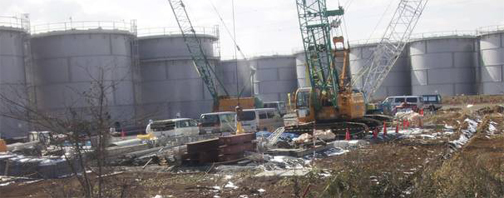
exclamation-water tanks FukushmaNuclear disaster: Radiation levels at Fukushima would now be fatal within hours Raw Story, By Justin McCurry, The Guardian, September 4, 2013 The crippled Fukushima Daiichi nuclear power plant has radiation leaks strong enough to deliver a fatal dose within hours, Japanese authorities have revealed, as the government prepares to step in to help contain leaks of highly toxic water at the site.

On Wednesday the country’s nuclear regulation authority said radiation readings near water storage tanks at the Fukushima Daiichi nuclear power plant have increased to a new high, with emissions above the ground near one group of tanks were as high as 2,200 millisieverts [mSv] per hour – a rise of 20% from the previous high.

Earlier this week the plant’s operator, Tepco, said workers had measured radiation at 1,800 mSv an hour near a storage tank. That was the previous highest reading since Tepco began installing tanks to store huge quantities of contaminated water that have built up at the plant.

An unprotected person standing close to the contaminated areas would, within hours, receive a deadly radiation dose. The nuclear regulation authority said the radiation comprised mostly beta rays that could be blocked by aluminium foil, unlike more penetrative gamma rays…… http://www.rawstory.com/rs/2013/09/04/nuclear-disaster-radiation-levels-at-fukushima-would-now-be-fatal-within-hours/

September 5, 2013 Posted by | Fukushima 2013 | Leave a comment

Fukushima radiation exposure will later bring cancer death toll

radiation-warningNuclear Engineer on Radio: Unfortunately, the truth is there will be a large death toll from Fukushima — Damages to be seen “over the next century” — Disaster at plant is unprecedented in magnitude (AUDIO) http://enenews.com/radio-interview-nuclear-engineer-truth-death-toll-fukushima-will-be-large-hazard-will-remain-many-decades-disaster-plant-site-unprecedented-magnitude-audio
Title: Interview with Dave Lochbaum
Source: Linda Moulton Howe
Date: Aug. 29, 2013
Dave Lochbaum, Nuclear engineer, former Nuclear Regulatory Commission water-tanks-Fukushimainstructor, current director of Union of Concerned Scientists’ Nuclear Safety Project: The Fukushima site is unprecedented in the magnitude — 3 reactor cores have melted down, 4 spent fuel pools that are in jeopardy, 3 buildings that exploded — so, they have a lot of problems. […]

Linda Moulton Howe Emmy-nominated journalist: And Fukushima, the reality, without any sugar-coating is, that in the next 18 to 19 years, there will be a death toll from radiation exposure in Japan that will be large.

Lochbaum: Yes, that is unfortunately the truth. Plant operated for 40 years and will remain a hazard to people living around it for decades longer. Politicians and society will have to determine whether the benefits derived from those 40 years offset the damages done over the next century.

More from this interview on Linda Moulton Howe’s website here

Full broadcast here (subscribers only) — Interview currently available on YouTube here

September 5, 2013 Posted by | Fukushima 2013 | Leave a comment

Fukushima radiation spreads under pacific Ocean seabed

Pacific-Ocean-drainJapan Expert: Contamination from Fukushima is traveling “under the seabed” and spreading further out in Pacific Ocean — Measures needed to stop flow http://enenews.com/japan-expert-contamination-fukushima-traveling-seabed-spreading-further-pacific-ocean-measures-needed-stop-flow

Title: Japan to fund ice wall to stop reactor leaks
Source: Associated Press
Author: MARI YAMAGUCHI
Date: Sept. 3, 2013
Atsunao Marui, an underground water expert at the National Institute of Advanced Industrial Science and Technology, said a frozen wall could be water-tight but is normally intended for use for a couple of years and is not proven for long-term use as planned in the outline. The decommissioning process is expected to take about 40 years.

“We still need a few layers of safety backups in case it fails,” Marui told the Associated Press. “Plus the frozen wall won’t be ready for another two years, which means contaminated water would continue to leak out.”

Marui said additional measures should be taken to stop contaminated water from keep traveling under the seabed during that time and leak further out in the sea.
See also: Japan Expert: Contamination from Fukushima flowing beneath seafloor? “Could spring up outside the port”

September 5, 2013 Posted by | Fukushima 2013 | Leave a comment

If UN proved Syria’s chemical crime, and took action, Russia would join

Putin: Russia doesn’t defend Assad, we defend international law

September 5, 2013 Posted by | Resources -audiovicual | Leave a comment

Depleted Uranium spreads its dangerous radiation around the world

depleted-uraniumDangers and Health Effects of Depleted Uranium, Disabled World 4 Sept 13  Thomas C. Weiss

Summary: Information relating to Depleted Uranium (DU) a chemically toxic and radioactive heavy metal potentially hazardous to human health.
“Children in particular are susceptible to DU poisoning. They have a much higher absorption rate as their blood is being used to build and nourish their bones and they have a lot of soft tissues.”

Document Detail: Depleted Uranium (DU) is a waste product, one that is left over when uranium is enriched to create fissionable material for nuclear weapons and reactors. DU consists of uranium from which most of the fissionable isotopes, uranium 235 and 234, have been removed. DU contains 99.5% Uranium 238.

The term, ‘depleted,’ carries with it the implication that it is not particularly dangerous; however, DU is a chemically toxic and radioactive heavy metal and because of this it is potentially hazardous to a person’s health. It is believed by many that exposure to depleted uranium (DU), especially when a person inhales or ingests it as a particulate, causes severe and long-term health effects. The size and effect, as well as the political significance of it, remain in dispute at this time. DU is an extremely dense material, 1.7 times as dense as lead, and is also, ‘pyrophoric,’ and is combustible when it comes in contact with air.

DU is being used by the defense industry in the creation of armor piercing munitions and anti-tank projectiles, as well as in the manufacture of tank armor.

Around 17 nations are thought to have weapon systems containing DU in their arsenals to include: Continue reading

September 5, 2013 Posted by | 2 WORLD, depleted uranium, Reference, Uranium | 1 Comment

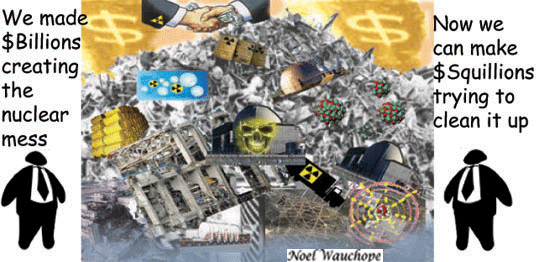
Build ’em up, pull ’em down – always money for the nuclear industry

Flag-USANuclear Trashmen Gain From Record U.S. Reactor Shutdowns Bloomberg By Brian Wingfield – Sep 4, 2013 More than 50 years into the age of nuclear energy, one of the biggest growth opportunities may be junking old reactors. Entergy Corp. (ETR) said Aug. 27 it will close its 41-year-old Vermont Yankee nuclear plant in 2014, making the reactor the fifth unit in the U.S. marked for decommissioning within the past 12 months, a record annual total. Companies that specialize in razing nuclear plants and hauling away radioactive waste are poised to benefit.

Disposal work is “where companies are going to make their fortune,” Margaret Harding, an independent nuclear-industry consultant based in Wilmington, North Carolina, said in an phone interview. Contractors that are usually involved in building reactors, including Bechtel Group Inc. and URS Corp. (URS), “are going to be looking very hard at the decommissioning side of it.”

money-in-wastes-2

With Dominion Resources Inc. (D)Duke Energy Corp. (DUK)and Edison International (EIX) shuttering reactors this year — and Exelon Corp. (EXC) planning to close its Oyster Creek plant in 2019 — the U.S. nuclear fleet of 104 units is shrinking, even as Southern Co. (SO) and Scana Corp. (SCG) build two units each. The reasons vary: Edison and Duke are permanently removing damaged plants from service. Entergy and Dominion are retiring the units because of factors including a glut of natural gas, a competing fuel……….

The length of time to decommission a reactor creates uncertainty surrounding plant oversight, according to Shaun Burnie, an independent nuclear consultant who previously led environmental group Friends of the Earth’s campaign to close Edison’s San Onofre plant in California.

“Is Entergy going to be around in 50 years time? In 10 years time?” he said in a phone interview.

Ralph Andersen, senior director of radiation safety and environmental protection for the Nuclear Energy Institute, said the industry is entering a new era for the companies that handle reactor decommissioning.

“It really does open the door to the marketplace rethinking ways to handle decommissioning,” he said………. http://www.bloomberg.com/news/2013-09-04/nuclear-trashmen-gain-from-record-u-s-reactor-shutdowns.html

September 5, 2013 Posted by | decommission reactor, USA | Leave a comment

Most dangerous new nuclear power plant at Taishan, Guangdong

safety-symbol1flag-ChinaNuclear threat on our doorstep, South China Morning Post, Green groups say flawed and untested technology puts city at risk from ‘world’s most dangerous nuclear power plant’, South China Morning Post,05 September, 2013 Ernest Kao ernest.kao@scmp   A nuclear power plant being built just 130 kilometres away from Hong Kong was yesterday labelled by green groups the “most dangerous nuclear power plant in the world” The plant in Taishan, Guangdong, is using technology that has never been used before and would put the city and another 30 million people at risk in the Pearl River Delta in the event of a Fukushima-style meltdown, say nine groups, including Greenpeace, Green Sense and the Professional Commons lobby group. They are calling on Hong Kong authorities and the provincial and national governments to look again at the risks involved.

The Taishan Nuclear Power Plant, due to start operating in December, will run on two European pressurised reactors, or EPRs – a new Franco-German pressurised-water reactor which the groups say is immature.

areva-medusa1French nuclear power giant Areva sealed an €8 billion (HK$92.53 billion) deal to build the two reactors for China’s state-owned Guangdong Nuclear Power Group in 2007. Construction began in 2009.”It is very risky to import a European nuclear reactor technology that has not even met the proper nuclear safety standards and regulations in Europe,” said Albert Lai Kwong-tak, an engineer and a policy expert at independent lobby group the Professional Commons.

Two EPR projects, one in France and another in Finland, have been plagued by delays after safety-related flaws were found. Both projects are not expected to be completed now until 2015 at the earliest, despite construction commencing years earlier than in Taishan.Lai said that upon completion, Taishan would be the “most dangerous nuclear power plant in the world” given its potential radiation level was three times higher than Japan’s crippled Fukushima Daiichi plant.

“Design flaws such as how to power cooling systems for its external spent nuclear fuel pool in the event of an emergency have not been addressed,” he said.

“A digitised and automated emergency control unit also lacks a manual override … these are all lessons which should have been learnt after Fukushima.

“One must ask if Chinese authorities have taken any of these into account.”……. http://www.scmp.com/news/hong-kong/article/1303433/nuclear-threat-our-doorstep

September 5, 2013 Posted by | China, safety | 1 Comment